
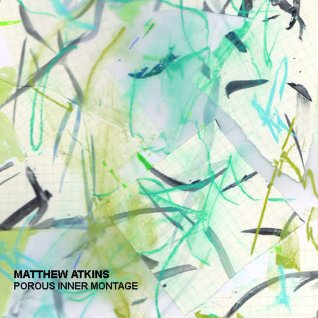
 Matthew Atkins’ newest effort is much larger in scope and ambition than the last tape of his that I heard, The Subtle Silence. On Porous Inner Montage, he makes use of a wider palette of sounds, sculpting everything from electrical crackles and pops and electronic drones to recordings of shuffles and the creaking of wood into bewildering sonic constructions. The tracks’ developments are pleasingly unpredictable, and each is completely unique in the way it progresses and unfurls. Atkins avoids a restrictive linear format, instead allowing the elements to combine and harmonize in a way that feels uninhibited, even organic. But once again, his greatest strengths arise when he contrasts abstract, timbral elements with melodic ones; track 5, the first on side B, opens with Tilbury-esque, spacious piano plinks that slowly organize themselves over a bed of fascinating textures, and ends up being one of the tape’s strongest and most emotionally resonant moments. As a whole, Porous Inner Montage is a magnificent step forward for Atkins’ work. It feels cohesive and well-crafted but doesn’t play anything too safe. I’m excited to see him explore these more difficult, nonrepresentational compositions, and I also hope he retains those brief moments of conventionality that create such an amazing contrast.
Month: July 2018
Review: The OO-Ray – Tiny Fugues (Audiobulb, Jul 3)
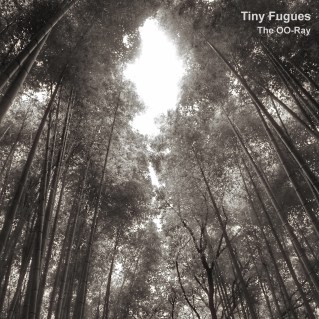 According to Ted Laderas, who records and performs under the alias The OO-Ray, Tiny Fugues is about “searching and finding the unexpected in the everyday.” While I’m not sure if I’d call this scintillating and celestial music “everyday,” Laderas certainly succeeds in finding, and reveling in, the unexpected. With the help of new software called the fuguelooper that transforms his cello and electronic improvisations into newly rhythmic material in real time, Laderas approaches new realms and possibilities within his sound both actively and passively. These chromatic, ambient pieces loop, cascade, and coalesce, forming beautiful clouds of dreamy sound. Much of the majesty of Tiny Fugues originates in its transparent construction; the listener hears every step of the sonic journey, from the reverent bowing of the cello strings to the effects laden electronics and their gaudy, fuzzy counterparts swirling above and around them. It’s truly expressive and emotional music, conveying so much in a wordless, abstract way; and while I’m not sure it lends itself to being as conceptually complex as Laderas states, Tiny Fugues is certainly an inciter of “curiosity and compassion.”
 Noise Not Music