
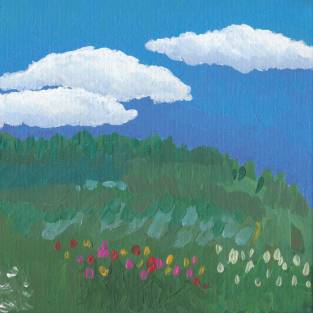
 In contrast to Face Always Towards the Sun, Blithe Field’s previous album, Days Drift By sees Spencer Radcliffe leading a diverse ensemble of featured musicians. This is a much lusher and more ambitious record, but it still feels just as personal. Field recordings of bubbling brooks and chirping birds share space with beautiful piano melodies, glitchy electronic augmentations, and the rich drones produced by Ben Austin’s cello. Despite the expanded lineup and larger range of sounds, the music on Days Drift By is welcoming and intimate. Its loose, organic climaxes and distinct colorfulness beckon you to join in, and doing so is the auditory equivalent of rolling around in soft grass on a warm summer day. Luckily, the album also avoids tedium, which can happen with even the sunniest music. The contrast found between the first two tracks provides a great example of the variety that’s present here; the soft effervescence of “Prelude” dissolves into the much more abstract contortions of “Bubbling Cauldron,” yet the underlying atmosphere is always constant. Days Drift By is making even me wish for summer, especially since the weather outside right now belongs more to January rather than early April.
Author: Jack Davidson
I like to listen to, read and write about, and play music.
Review: Kemialliset Ystävät - Siipi Empii (Leaving, Apr 6)
 As any fan of strange, adventurous, or unique folk music will know, Kemialliset Ystävät (Finnish for “chemical friends”) is a hard name to miss. The loose collective, led by Jan Anderzén, has spawned an inordinate amount of projects whose reach extends far past the borders of Finland, including Lau Nau, Kiila, Avarus, Islaja, Es, and Anderzén’s own solo moniker Tomutonttu. The vast pool of artists who intermittently come together as Kemialliset Ystävät bring a dizzying range of styles and influences to the table, giving the group a formidable eclecticism that is rivaled by few. Siipi Empii, their newest album, may be their most accessible effort yet. Though the music is still as uncompromising as ever, there are woozy but defined rhythms that tie everything together. A phrase I often use to describe Kemialliset Ystävät’s sound is “density without weight;” that is, there is so much going on at any one time, but it’s all carefully layered in such a way that it still sounds light and whimsical. It also helps that Siipi Empii’s production is incredibly well-handled and clear, giving each element room to breathe as they endlessly tumble over each other, spinning and shooting between your ears. As with all of their records, I find myself disoriented but in an enjoyable way; and unique to Siipi Empii is its airy pulse that keeps me grounded.
Review: Marco Colonna – FORAMINIFERA (Plus Timbre, Apr 1)
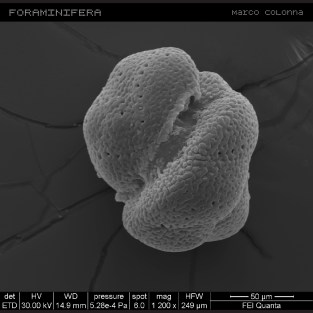 On FORAMINIFERA, Marco Colonna’s breaths reign supreme. There are hardly any conventional notes produced by his clarinet throughout the entire album; instead, the focus is placed on other sounds. We hear the clicks of the keys, guttural inhales, and bass-filled drones, a truly bizarre range of noises that makes it seem like Colonna is more doing battle with his instrument than playing it. Even when notes are present, they’re not really the center of attention. Instead, the listener is drawn to the mechanical clanks and percussive blows that produce the notes. Sometimes, the almost futile-sounding exhales that produce no tones strike me as similar to Anthony Braxton’s playing on the legendary For Alto; but where the latter’s attacks eventually claimed victory and broke into atonal flurries, Colonna’s often fail completely, providing us with an entirely unique set of textures to explore. While FORAMINIFERA is the first thing I’ve heard from the young musician, it cements him in my mind as a capable and captivating improviser, which will no doubt be supported by the rest of his impressive body of work.
Review: Timber Rattle – Timber Rattle (Stoned to Death, Feb 21)
 The Ithaca-based doom folk collective Timber Rattle’s self titled cassette is dark, hypnotic, and apocalyptic. Constructed upon the simple combination of acoustic guitar, synth drones, and pastoral vocal layers, it’s an album that reaches something far beyond its humble beginnings. Timber Rattle is definitely repetitive, but not to a fault; instead, the focus on atmosphere rather than significant progression induces an almost trance-like state. The lyrics are unintelligible for the most part, but according to the band they are written about “land and bodies and life and death and magic and language and ritual and myth and space and cycles and animals and plants and food and poison,” a range of subjects that mirrors the music’s raw, primal nature (interview w/ Potlista). And even if the lyrics are hard to make out, the vocals possess incredible power just from their deep, primordial sonority. Yes, there is a clear oppressiveness in this music, but it’s somehow soothing, and seems to celebrate the unspoken energy contained in the things we cannot control.
Join me in seeing the band live, along with DREKKA and Dr. Zapata, at the Fuse Factory this Saturday (link to event).
Review: Simon Whetham – Open and Closed Circles (Mappa, Mar 28)
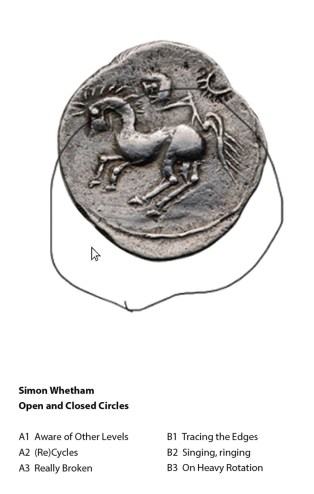 Despite Simon Whetham’s initial plan to take a break from composing in order to focus more on installation and performance work, the idea of a “format-specific piece” intrigued him. According to Whetham himself, “mechanism, magnetism, friction, rotation, failure, repetition, fragility, ephemerality…” were all key words that inspired the compositions found on Open and Closed Circles, his newest tape out on Mappa Editions. Clearly, many of those key words can also be applied to the cassette format, and help to draw comparisons between the similarities of the physical tape and the music it contains. Open and Closed Circles is full of scraping, grinding, churning, creaking sounds that are sequenced and layered in bizarre ways. Whetham’s compositions haphazardly but purposefully bind the timbres of unrelated objects together, creating brashly physical soundscapes that are unpredictable and erratic. But there is also a clear rhythm to the album, a subtle rotary pulse that mirrors the turning of cogs, the repetitive motion of a mechanical loop; and even though I wasn’t able to actually listen to Open and Closed Circles on cassette, it’s impossible to deny how crucial the format is to its identity.
Review: Gianluca Favaron – Variations (Fragments of Evanescent Memories) (13, Feb 28)
 Experimental artist Gianluca Favaron’s Variations is a masterclass in sound sculpting. Using a variety of sources including nature recordings, portable tape recorders, hydrophones, contact microphones, and physical instruments, he creates dense, abstract collages that are expertly manipulated and shifted throughout. The presence of both active and passive recording techniques is intriguing, and is the basis for a multitude of contrasts upon which the album is built: natural vs. mechanical, beautiful vs. abrasive, harmony vs. dissonance. Though Favaron’s thought process and purpose behind Variations is not made readily available, he does include this Arnold Schönberg quote in the album description: “Even variation is a form of repetition.” It seems that the music sets out to either support or challenge this claim, or possibly even both. Each fragment is presumably constructed with the same tools, and definitely bear unmistakable similarity to each other. But the unpredictability of said tools introduces an irreplicability, and guarantees a certain uniqueness to each piece.
Buy the CD here.
Review: Borgne – [∞] (Avantgarde Music, Mar 30)
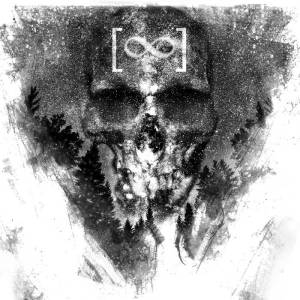 Though at this point Borgne has technically been around for over two decades, the project has only been operating consistently since 2007. Originally solely consisting of multi-instrumentalist Bornyhake, the new record welcomes Lady Kaos on keyboards. I would never guess that the band is a duo, however; [∞] is an astonishingly detailed and lush record even without considering the fact that it was made by only two people. Each track is uniquely oppressive, piling countless icy layers atop pummeling blast beats and Kaos’s grandiose synths. The compositions are contorted and disorienting, but the atmosphere is never sacrificed; Bornyhake’s tortured vocals intertwine with harmonizing tremolo riffs and sludgey, dense chords that maintain an overwhelming darkness that presides over the progression. Unsettling electronic textures are also frequently added, almost throwing everything off balance; yet it only adds to the anger and uneasiness already present. [∞] is quite an ambitious album, but most of the risks it takes pay off ten times over. Insane moments like the noisy industrial beat that kicks in at the end of “Comme si ça s’arrêtera / Stone” giving way to the majestic symphonics of “I Tear Apart My Blackened Wings Pt. 1” shouldn’t work, but man, they really do. I am excited to listen to [∞] many more times, and to see where this creative project goes next.
Pick up the LP here (ships April 8th).
Dual Review: Jiang XiaMeng – Pieces / Myra Siewert – Dream Journal (self-released, Feb 19)
 Reviewing two albums at once is obviously not something I usually do. But the mysterious Bandcamp page listed under “Louis Schumacher” on which I found these releases instructs listeners to experience the two in tandem. Both albums are roughly 22 minutes in length and make heavy use of field recordings, but that’s about where the similarities end. Pieces, composed of four parts mostly containing very short songs, is described as a “commentary.” The miniature tracks are isolated portraits of various environments, ranging from conversation excerpts to recordings of zippers to occasional electronic overlays. They pass by at breakneck speed, blocking any opportunity to analyze the mysterious sonic snapshots in any significant depth; that is, until the final track “IV.” It’s a long form electroacoustic piece, barely making use of any field recordings at all; certainly a significant contrast to what came before.
 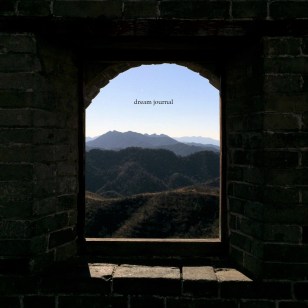 It’s an interesting choice to induce such immersion within this track, while the previous three parts allowed none; the explanation behind which I am still trying to figure out. Dream Journal, in contrast, is a “purge.” Almost instantly, it’s clear that it’s quite different from Pieces; the recordings are layered and sculpted rather than fragmented and sequenced, the songs taking on a (fittingly) dream-like quality. The sounds are always shifting in and out and around each other, forming a fluid collage that is a perfect foil to the tension-filled conclusion of Pieces. For the most part, these albums and their connection to each other are still uncertain, but it sure is fun to speculate. And at the end of the day, both releases are great in their own right, and I’d highly recommend trying them out.
Review: Ljudvägg – Varande (Purlieu Recordings, Mar 1)
 Ljudvägg is a new alias of Swedish sound artist Filip Forsström, who has also released music as Tegelbruk. My efforts to learn more about Forsström were largely unsuccessful; unfortunately, my dizzyingly vast repertoire of talents does not include being able to read Swedish. As far as I can tell, however, he works with both found sound and piano, both of which were used to create his newest tape Varande. From the first track it was already clear that I wouldn’t make it through with dry eyes. The lilting arpeggios of “Hem” sigh like a weary spirit, slowly revealing subtle environmental sounds buried beneath the rich notes. This duality in composition is explored throughout the rest of the album, as Forsström’s expressive playing engages in beautiful battles with various field recordings and textures. An incredible climax is reached on “Textur” when percussive electronic processing gives way to the tinkle of chimes and soft drones, eventually rising to breathtaking heights with the help of jittery hand clapped rhythms and harmonica. None of the facets that make up Varande are particularly unfamiliar, yet together they create a unique musical language that defies description – and makes my eyes quite watery.
Review: Ungfell – Mythen, Mären, Pestilenz (Eisenwald Tonschmiede, Mar 23)
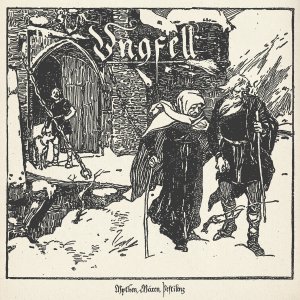 Ungfell, primarily Zürich-based musician Menetekel with help from occasional other members, won my heart last year with Tôtbringære. It blended many of my favorite aspects of black metal, including aggressive vocals and rawness, with others I don’t usually enjoy very much. such as melodic elements and folk instrumentation. It wasn’t a combination that sounded appealing to me at first, but the record quickly became one of my favorite metal releases of the year. Here, on Mythen, Mären, Pestilenz, Menetekel works with the same toolkit, but manages to create a final product that is distinct from its predecessor. The folk passages are more isolated and fleshed out, and this time around would be better described as actual songs rather than just interludes. Ungfell’s distinct lo-fi charisma is still present with the fuzzy guitars and full-bodied shrieks, but the songwriting is much more refined and the melodies better integrated. On my first listen, this seemed to be a drawback, but after revisiting I’ve once again changed my tune. Despite initially seeming to disrupt the album’s flow, the folk songs are a welcome ingredient, mixing well with both the atmospheric passages and the catchy tremolo melodies. The stylistic melting pot found on Mythen, Mären, Pestilenz is undeniably magnetic, and is sure to draw in fans of all sorts of music.
Buy the LP here.
 Noise Not Music