
Review: E L U C I D – Shit Don’t Rhyme No More (self-released, Feb 24)

I have a strange relationship with hip-hop. I certainly listen to a decent amount of it, and many of my all-time favorite albums could be classified as hip-hop, but it differs from many of the other genres I enjoy in that, aside from a few exceptions, I am much pickier about what I consider to be “good.” This was made painfully apparent throughout most of last year, during which I only really enjoyed one release (lojii & Swarvy’s excellent collaboration Due Rent). 2018 has unfortunately been the same; that is, until I discovered Shit Don’t Rhyme No More.

It’s usually a good sign when an interesting/odd sample is used right off the bat. In this case, the woozy collage of leading track “Swazi” is built on Björk’s “Pleasure Is All Mine,” also the first song from its respective album. On my first listen, the inclusion felt bizarre and forced, but it’s since grown on me substantially. “Swazi” is one of all but two of the ten tracks that were produced by E L U C I D himself, and is far from the only one constructed around a strange sample/homage; the beat “Rick Ross Moonwalk” bears a strong similarity to “Machine Gun” by Portishead, and on “All of a Sudden We Were in a Vampire Bar,” the EP’s closing track, the iconic vocoder of Laurie Anderson’s “O Superman” emerges. Normally, I’d be annoyed by so much transparent sampling, but each one actually feels at home amidst the other production choices, forming abstract instrumentals that shift and contort under E L U C I D’s cryptic verses and surprisingly catchy hooks. I’m so excited to once again fall in love with a new hip-hop album, and I’m hoping we get a full-length from this promising new artist soon.


Review: Dirch Blewn – Care Work (Soft Error, Feb 21)

“In January 2016, artist David Bloor spent 5 days in Flat Time House, London with a self built robot called Leonard. These are excerpts of recordings made during that time. ”

This is the brief yet very intriguing description of Care Work on Soft Error’s Bandcamp page. Even though, in my opinion, music can never be supported entirely by its concept, this one really piqued my interest. Thankfully, the album is every bit as engaging as its premise would imply, the odd sonic palette creating a truly unique atmosphere. Leonard the robot’s presence is always identifiable, the sounds of its movement and other unknown activities emerging from lethargic clouds of circuit drones and effects. Everything sounds very soft, almost organic; a surprise considering almost every element is electronic. Bloor also plays the Cocoquantus, a bizarre custom instrument that I’ve only ever seen used by Toshiji Mikawa in an incredibly loud noise set, so I have no idea what sound it’s making here. All this uncertainty, however, only adds to the experience. Care Work is mysterious, haunting, and oddly lonely; like I’m alone in a house, but it’s not mine, and there are things moving around just out of my line of sight that are neither malicious nor benevolent. A fascinating release to be sure, and if you’re skeptical because of my vague abstract descriptions, don’t take my word for it.

Side note: I accidentally discovered that this works well as a soundtrack to Brakhage’s Dog Star Man.

Review: Hampshire & Foat – The Honeybear (Athens of the North, Feb 28)

It’s a special thing when an album makes you feel like a little kid again. This profound effect could arise from nostalgia or something even less tangible, a beautiful sense of innocence and carefree wonder that most (including me) sadly seem to have lost. With The Honeybear, Warren Hampshire and Greg Foat seem to have uncovered a relic of childhood daydreams, of imaginative adventures in a sun-drenched forest; it’s a record that perfectly captures a freedom that we may never again experience. Described as a musical representation of a nonexistent children’s book, The Honeybear is comprised of exquisite chamber folk arrangements, neo-medieval melodies, and gorgeous ambient sections. Interspersed throughout the “chapters” are subtle inclusions of field recordings collected around the Isle of Wight, introducing a pleasingly natural atmosphere. Though the record is entirely instrumental, even the least melodic elements seem to be more expressive than words ever could be. Whether you follow along with the story or are content to simply lose yourself amidst the undeniable warmth, The Honeybear is something very special.

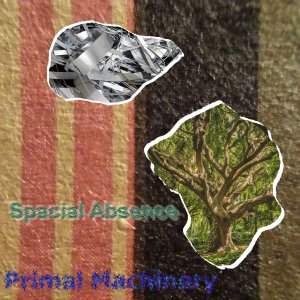
Review: Spacial Absence – Primal Machinery (Deadleg Incident, 2017)

Even though this one came out quite a bit ago, I only recently discovered it and really think it deserves more attention. Primal Machinery is the debut release of Pennsylvania artist Spacial Absence, who also operates under the aliases Cador, Aether, and others. It’s undoubtedly an album that would best be placed under the umbrella of harsh noise wall, but it also approaches the genre in unique ways. Each track is based on field recordings from various sources; according to the artist, “Air Fatigue” uses noises recorded on an international flight to China, “Nighttime Panic 100°C” consists of sounds made by insects, and the two-part “Shower,” unsurprisingly, is formed by a recording of a shower. The odd one out is “Forest Fire Fishing Trip,” which was produced using manipulated microphone feedback, but it’s just as lush and diverse as the others and doesn’t feel out of place in the slightest. The whole album feels just as organic as the source material; the dense walls are static, yet build and contract. Despite the dynamics and structure still being incredibly subtle, the focus is not only placed on the noise itself, but also on how it moves, unfurls, and decays; a concept that makes Primal Machinery one of the most interesting and engaging harsh noise wall albums I’ve ever heard.

Event: Frequency Friday at the Fuse Factory (Mar 2)

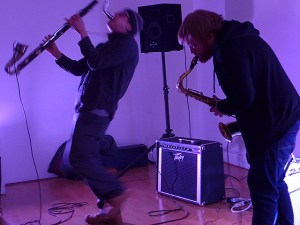
On the first Friday of each month, the Columbus based Fuse Factory Electronic and Digital Arts Lab puts together performances from a variety of experimental musicians and artists, both local and worldwide. I was so happy to discover that such a place existed so close by, and I’ve been to one show so far and am planning to attend some of the workshops they offer. On the bill for tomorrow is Ava Mendoza, a solo guitarist and singer who is also a member of Unnatural Ways; Ann B Clorox, a performance artist; Istvan Medgyesi, an experimental electronic musician; and local Columbus artist Mike Shiflet, who will perform excerpts from his new composition Tetracosa. The latter I am most excited for, because Tetracosa, Volume One was fascinating and I just preordered the next two installments, but every act sounds worth the modest admission price. Stop by and hang out! (Adjacent image is of Wasteland Jazz Unit performing at the February Frequency Friday event, courtesy of FF’s gallery.)

Review: The Skull Defekts – The Skull Defekts (Thrill Jockey, Feb 23)

This self-titled album is the Swedish band The Skull Defekts’ final release, a swan song to close out nearly fifteen years of continuous activity. According to founding member Joachim Nordwall, the group’s initial goal was to make “circular, ritualistic, monotonous rock music.” It’s pretty poetic, then, that their final album is their most fully realized success at this task yet. It’s a work of intense passion, but in an entirely singular way; every second is full of barely restrained aggression and emotion, struggling to escape but never succeeding. The grooves are nocturnal and hypnotic, Henrik Rylander’s percussive drumming almost never leaving the toms as he builds to imperceptible climaxes amidst cutting feedback, guitar interplay, and the dual vocal powerhouse of Nordwall and Mariam Wallentin. The Skull Defekts is equal parts frightening, awesome, sultry, abrasive, and ecstatic in its defiance. It’s an incredibly fitting end to the band, a monument to the members’ chemistry despite mounting tension, and a touching thank-you note to everyone that has been involved along the way.

Review: Rafael Anton Irisarri – Midnight Colours (Geographic North, Feb 27)

Yes, this album literally just came out today, but I’m so excited about it that I’m already writing a review. Midnight Colours is the newest tape by ambient/drone musician and composer Rafael Anton Irisarri, one of two officially announced for 2018 so far (Sirimiri will be released by Umor Rex on March 16). It elicited one of the most positive initial reactions of anything I’ve listened to so far this year, which was surprising considering I was not a fan of last year’s The Shameless Years. From the first seconds of leading track “The Clock” it is breathtakingly beautiful, as ethereal drones and warm vinyl-esque crackles pervade the lush soundscapes. Despite the consistent prettiness, Midnight Colours does not suffer from the mindless simplicity of “laptop ambient.” Instead, it is well constructed, detailed, and possesses a unique identity among music that is so often plagued by homogeneity; the same music, coincidentally, that is making 2018 a great year so far.

Review: Asher White – Transfigure Eighteen (self-released, Feb 2)

Transfigure Eighteen is an album of beautiful angst. Asher White‘s lyrics are troubling and cryptic and everything in between, their raw vulnerability matched by her frail, androgynous vocals, which often take center stage. The instrumental arrangements are wispy and fragile, every element within the pleasingly messy stitching possessing its own unique texture. It’s an album that’s difficult to read. It all seems so melancholy, with the brushed drums and weakly plucked guitars and ghostly voices; but it’s also gorgeous, even hopeful. From the organic climax of “Seasons Change” to the soft head-bobbing groove of “Reasons I Freaked Out in My Room” to the wrenching catharsis of “Nudes,” Transfigure Eighteen resides in a middle ground between many emotions, and it is wondrous to behold. Maybe the record is White’s declaration of optimism amidst hardship, or something else entirely, but for now I’m happy to be uncertain. One thing’s for sure, though: this is an astonishingly realized work from a young artist, and all but assures that the rest of her career will shine brightly.

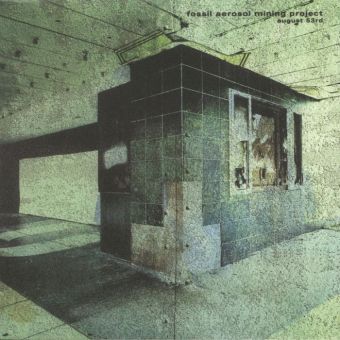
Review: Fossil Aerosol Mining Project – August 53rd (Helen Scarsdale Agency, Feb 23)

With origins dating as far back to the mid-80’s, Fossil Aerosol Mining Project seems to be a name I should have heard much earlier than now. Though the group was on hiatus for most of the 90’s, they have been working and releasing recordings since 2004, mainly utilizing found sounds, field recordings, and signal processing to create imaginative soundscapes. August 53rd is their most recent record, a seven track LP that represents one of the most detailed sonic constructions I’ve heard this year. The stuffy, lethargic atmosphere projects a pronounced solitude, the wistful tape loops and airy sound bits fleshing out a hauntingly beautiful environment that never stops closing in. Every element used is so enigmatic; no one sound is immediately identifiable or obvious, but everything seems to fall into place perfectly. The photograph featured on the cover could not have done a better job of representing the music contained within.

Review: Thomas Tilly – Codex Amphibia (Glistening Examples, Feb 22)

On Codex Amphibia, Thomas Tilly lets the field recordings take the reins. Collected in Guiana in late 2016 as part of a field research project with the French National Center for Scientific Research, the mostly unprocessed selections paint vivid pictures of a lush natural environment. Leaves rustle, water bubbles, and the ribbits of the titular amphibians are just a few of the sonic elements that comprise the organically dense collages, and the masterful production ensures that everything is heard clearly. The digital version comes with a few photos that I assume were taken during the recording process, and it’s a testament to the album’s clarity that they’re almost exactly like what I was picturing in my mind while I was listening. It’s one of the most intensely immersive albums I’ve ever heard, with Tilly’s subtle additions in the form of sine waves and quiet drones keep anything from seeming too stagnant. Codex Amphibia is a truly awe-inspiring work, one that I’m sure will reveal more layers as time goes on.