 I bought Couesnon in a three tape bundle from Katuktu Collective’s Bandcamp for $12, which is probably among the best decisions I’ve ever made (free domestic shipping too! Only three left, get them while you can). Haven’t gotten a chance to listen to the other two tapes yet, but Couesnon honestly made the purchase worth it all on its own. Ambient musician Erik Levander creates achingly beautiful, noisy soundscapes that expand and contract effortlessly. Textural and melodic elements exist in perfect harmony, as equal a balance as the abrasive elements have with the gorgeous drones and ethereal ambiance. There’s more than enough diversity across the five tracks to warrant multiple listens, which I have definitely been taking to heart; I can’t seem to get enough of it.
Author: Jack Davidson
I like to listen to, read and write about, and play music.
Review: Vanessa Rossetto – Fashion Tape (No Rent Records, Feb 6)
 Despite the apparent transparency and directness of spoken word samples, music that makes use of them is usually anything but. It is often true that the combination of a multitude of snippets – that on their own would hardly be significant – results in creations that are cryptic, mysterious, and even disorienting. I hope I’m getting my point across, but if not, you need not look farther than Vanessa Rossetto’s Fashion Tape for an example. In contrast to last year’s Rocinante, an hour long piece completely absent of field recordings, the new tape largely consists of a wide variety of collected vocal samples; anywhere from whispered numerical calculations to the description of a certain color. The resulting diversity makes Fashion Tape‘s collages as colorful and fascinating as its bold cover art. When coupled with Rossetto’s well-tuned sense of dynamics, as well as an almost playful atmosphere, it makes the album something really unique. I feel like I will have to listen many more times to make sense of it all, so it’s a good thing that the package No Rent has put together is one of the best-looking tapes I’ve ever bought.
Review: Manja Ristić – Fairy & The River Teeth (Sonospace, Jan 31)
 Fairy & The River Teeth is Madrid label Sonospace‘s sixth release this year. It joins a multitude of other projects in various areas of electroacoustics, field recording, phonography, and soundscaping. Probably the most notable example of these is the nearly four-hour, multi-artist collection Soundmaps for the Dreamer II, which I will reviewing as well (once I finish listening to it, of course). But despite the wide variety of sounds and even instruments Ristić uses, Fairy & The River Teeth is an incredibly intimate album. It quickly sucks you into an unfamiliar world, one that I’m still not really sure is comforting or frightening. Many of the recordings, i.e. a teakettle squealing, a pencil scratching on paper, or the twittering of birds, seem to magnify everyday noises to the point where you become completely immersed. In this way, the record exerts a lot of control over the listener, but not in a malignant way. For example, on the title track, I found myself so lost in the collages of sound that I was almost moved to tears when hints of conventional melody began to break through; not because of the beauty of the melodies themselves, but because it actually felt like these notes were coming from within me – a very profound experience to be sure. What I’m getting at is that Fairy & The River Teeth is amazingly unique, and ultimately you’ll have to listen for yourself to determine its true nature (which is a course of action I highly recommend).
Review: Make a Change… Kill Yourself – IV (Cursed Records, Jan 15)
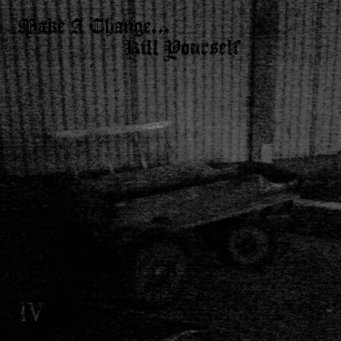 It’s not exactly a revolutionary idea that longer songs are better suited to certain contexts. An 8-minute long grindcore track would, in most cases, be exhausting and overextended, while a 30-second drone piece would probably feel stunted and unfulfilling. While long songs are not out of place in atmospheric black metal, when a band releases an album consisting only of two side-long tracks it’s usually pretty hit or miss whether or not their duration will be justified. And Make a Change… Kill Yourself’s new tape, IV, is definitely a “hit.” The movement and progression of both songs feel natural and organic, yet just composed enough to not come across as aimless. As the (in my opinion, overly melodramatic) band name would suggest, the atmosphere created on IV is depressive and dark. The guitar tones are simultaneously airy and claustrophobic, and the tortured vocals, despite being mostly unintelligible, communicate anger, hatred, and sadness. Surprisingly, these long form tracks are mostly carried by the drums, whose subtle changes retain interest without drawing too much attention to themselves. As you can probably tell, I went into my first listen of IV not really expecting to like it. But the band overcomes any pigeonholing as a meandering, whiny depressive suicidal black metal act, and reaches impressive heights.
Review: Junko Hiroshige & Pandu – A Collaboration (Gerpfast Kolektif, Feb 8)
In an effort to boost the relevance of my blog and give me more writing material (only one of those reasons is true, I’ll let you guess which), I’ve decided to start reviewing recently released albums. If you have any suggestions for records I should review, please comment on posts or send me an email!
 The aptly titled A Collaboration is a dual effort by vocalist Junko Hiroshige of legendary noise band Hijokaidan and Pandu of the more recent project Bergegas Mati. Having loved 2004’s Pinknoise, a collaboration between Junko and noisician/improviser Mattin, I was excited to find this album had a similar format: Junko’s shrill, yipping vocals set against waves of piercing noise. Despite consisting only of a 21-minute track, it’s easily the best harsh noise release I’ve encountered this year, and possibly one of the best I’ve ever heard. Pandu’s contributions are dense and infernal, with chunks of distortion and ear-splitting frequencies roiling and shifting like a demented sonic river. Surprisingly, the piece is anything but static; the dynamics are actually very pronounced, making the track seem even shorter than it actually is – a good thing in this case, because once I’m finished I just want to listen again. It’s always refreshing to hear really great stuff in this genre, especially when it offers the pairing of a personal favorite and a new face.
Thoughts: Jürg Frey’s Weites Land, Tiefe Zeit: Räume 1-8, or, The Difficulties of Listening to Lowercase Music on a College Campus
 In contrast to many traditional figures of classical music, Swiss composer Jürg Frey is not exactly known for loudness or grandiosity. And while many works by well-known composers aren’t exactly short, Frey’s pieces often dwarf them in scope – take, for example, last year’s archival release of L’âme est sans retenue I by Erstwhile Records; this composition stretches past the six hour mark. Weites Land, Tiefe Zeit: Räume 1-8 is shorter, but by no means brief. Originally created to accompany installations by the late artist Mauser from 2001 to 2002 (Olewnick), the album was released on 8xCD by b-boim in 2010. It consists of eight segments, each titled simply “Raum” plus the disc number, that were produced through heavily processed field recordings gathered by Frey himself. The processing results in the original sound sources becoming mostly unintelligible, instead blurring into ethereal, layered drones. If you haven’t heard the album, at this point it probably sounds like a pretty typical ambient construction. However, as is Frey’s tradition, the music is so quiet it is almost imperceptible at normal volume.
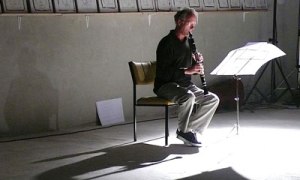 This use of low volume and occasionally complete silence to emphasize sound is a cornerstone of the philosophy of the Wandelweiser Group, of which Frey is a key member. The compositions created by Antoine Beuger, Radu Malfatti, Michael Pisaro, and others are often categorized as “lowercase,” a moniker that references their scaled down palette. Though I am no expert in many of these artists’ work, what I have heard has been both fascinating and gorgeous. However, the quiet and sparse nature of these recordings necessitates a very quiet listening environment, something not easily found on a bustling college campus. So Weites Land… has been, for lack of a better phrase, my “guinea pig album” for prospective listening environments, as I investigate various libraries and secluded areas around town to find the optimal space. And today I think I’ve found it; I was able to listen to “Raum 3” in the geology library’s almost complete silence, a favorable setting that allowed me to truly appreciate the subtle beauty that Frey has constructed. Music at such a quiet volume level requires a lot of focus, which causes a significantly increased perception of even the most minuscule dynamics and elements. In the future, if no one who works here objects to me spending hours upon hours at a time just sitting with headphones on, I’ll be able to experience a lot of cool stuff.
Top 50 Albums of 2017
Hey. It’s been a while. I would say I was really busy over winter break, but that would be a lie. I was just lazy. Anyway, here are my fifty favorite albums for 2017. The top ten were previously published on the AROUSE site, and the top 31 on my Cymbal account (@jckmd), but the others have never before been seen! I hope you guys enjoy.
1. Jun Konagaya – Memento Mori (Steinklang, Jun 9)
Experimental musician Jun Konagaya has been steadily releasing music for nearly 35 years, and yet compared to many other beloved figures of the Japanese underground he remains largely unknown and unappreciated in the United States. This is a tragedy, considering Konagaya’s endless devotion to his craft and the amazing amount of emotion he presents with his music; two elements that are incredibly evident on his newest release, Memento Mori. The record sees Konagaya further exploring the ambient post-industrialism of 2014’s Travel and the wistful organ-driven folk of its predecessor Organ, and is an amazingly cohesive work that serves as both an acknowledgement of past styles and a step in a new direction. While Konagaya’s albums are always incredibly personal, Memento Mori is a different beast: we hear him at his most aggressive and his most vulnerable, his vocals ranging from ragged animalistic rapping to desperate croons. This album filled a very special place for me this year, and is without a doubt the best thing I heard in all of 2017.
2. Endon – Through the Mirror (Daymare/Hydra Head, Mar 8)
Upon first listen, Through the Mirror elicited one of the most immediate reactions of any of the albums on this list. It’s a cruel trick they play on you: the trance inducing pound of “Nerve Rain” gives way without warning to the unbridled insanity of “Your Ghost is Dead.” The whole record is absolutely teeming with similar surprises, all of them equally as awesome. From the invigorating primal shrieks and growls on “Born in Limbo” to the abrasively cathartic beauty of “Torch Your House,” Through the Mirror doesn’t let you catch your breath for a second. I wouldn’t have it any other way.
3. Oxbow – Thin Black Duke (Hydra Head, May 5)
It’s rare, at least in my experience that a band comes back after ten years with a great record. It’s even rarer that a band returns after all that time with their best album yet, but this wouldn’t be the first time Oxbow has surpassed expectations. Thin Black Duke is probably the experimental rock quartet’s most conventional effort yet, moving away from the sludge and noise of their early releases in favor of sultry, bluesy chamber rock. The string arrangements oddly sound right at home amidst the distorted guitars and Eugene Robinson’s trademark wails, pushing the band toward a completely new sound – for which I couldn’t be more excited.
4. Faust – Fresh Air (Bureau B, May 5)
It’s no secret that Faust is one of my favorite bands ever, so I just want to iterate that there’s no bias here; Fresh Air is just a really fantastic record. I wasn’t exactly optimistic, considering how underwhelming both jUSt and Something Dirty were, but I was very happy to be proven wrong. Fresh Air represents so much of what I love about Faust, offering surreal arrangements, quirky spoken word, and ear-shattering climaxes, while still presenting new elements I didn’t even know I wanted in their sound.
5. The Ruins of Beverast – Exuvia (Ván, May 5)
There’s something special about records that are enjoyable even though they conjure up images of things you never want to see or experience. Exuvia is one of those to a T, its dark tribal atmosphere always pushing feelings of unease and fear through you. It’s the soundtrack to a demented ritual of horrific implications, and it’s so incredibly vivid that it’s hard to believe it all came from one man. Von Meilenwald is a stellar musician, and will hopefully continue to add to his incredibly consistent catalog.
6. Lorde – Melodrama (Lava, Jun 16)
Lorde returns with the pop album I never asked for but that I couldn’t be happier I got. It’s an improvement upon her debut in virtually every way. The incredibly lush production is such a step up from the infuriating minimalism of Pure Heroine, the songwriting is more mature, and I felt like it’s much more cohesive overall. It couldn’t have come out at a better time, too; Lorde’s ironic depictions of the titular melodrama that dominates modern romance are poignant and fascinating. Plus it’s catchy as all hell.
7. Ikue Mori – Obelisk (Tzadik, Jul 28)
Despite the undeniable strangeness of Ikue Mori’s music, she somehow sounds just as good while playing with other musicians as she does on her own (if you don’t believe me, just listen to Electric Masada’s At the Mountains of Madness). On Obelisk, with three talented improvisers supplementing her usual electronics, the effect is otherworldly. Drummer Jim Black, pianist Sylvie Courvoisier, and Okkyung Lee form an amazing quartet, and the unspoken improvisational conversations are wonderfully apparent. This is a new favorite of mine from Mori, and while I adore her solo works I am in love with this sound.
8. Dao De Noize & Hiroshi Hasegawa – Saturnus Cursus (Bludhoney, Oct 6)
Best known as a founding member of legendary noise act C.C.C.C., Hiroshi Hasegawa is one of my favorite figures of the Japanese noise scene. His visceral approach to his music is on full display on this collaborative cassette with Ukrainian artist Dao De Noize. The two twenty minute pieces are harsh but psychedelic, constantly assaulting your ears with lush collages of atmospheric noise. They’re somehow stagnant and dynamic at the same time, building and contracting but never letting up. Amazing project from these two musicians.
9. lojii & Swarvy – Due Rent (Fresh Selects, Mar 31)
Unfortunately, this wasn’t the best year for my personal hip-hop listening. I pretty much just stuck to my usual favorites and didn’t really like anything new that came out. Except Due Rent, which I would honestly say is one of the most refreshingly great records I have heard in a long time. Both artists show immense talent, with Swarvy’s jazzy lo-fi beats perfectly complementing lojii’s deadpan delivery and earnest lyrics. I haven’t been able to put this one down, and I’m glad for a glimmer of hope amidst a bleak period for the genre (for me at least).
10. Will Guthrie – People Pleaser (Black Truffle, Mar 10)
On People Pleaser we get the best aspects of Guthrie’s style all in one album, his spastic drumming providing a frenetic backbone for obscure samples, frequency manipulation, and crackling electronics. In contrast to many of the other records on which he’s played, the tracks are short and immediate, yet still incredibly well developed. It’s consistently intense, disorienting, overwhelming, colorful, and utterly amazing. Definitely looking forward to where he goes next.
11. Vanessa Rosetto – Rocinante (self-released, May 4)
12. Sunn Trio – Sunn Trio (self-released, Jun 23)
13. Stefan Christensen – Shake Off the Village (C/Site, Sep 1)
14. Jon Irabagon, John Hegre & Nils Are Drønen – Axis (Rune Grammofon)
15. Ulver – The Assassination of Julius Caesar (House of Mythology, Apr 7)
16. Snapped Ankles – Come Play the Trees (Leaf, Sep 29)
17. Converge – The Dusk in Us (Deathwish, Nov 3)
18. The Doomed Bird of Providence – Burrowed Into the Soft Sky (Front & Follow, Sep 1)
19. White Suns – Psychic Drift (The Flenser, Jun 16)
20. Jason Lescalleet – Almost Is Almost Good Enough (Glistening Examples, Jul 20)
21. James Holden & The Animal Spirits – The Animal Spirits (Border Community, Nov 3)
22. Raising Holy Sparks – Search for the Vanished Heaven (Eiderdown, Jul 27)
23. Sutcliffe Jügend – Shame (Hagshadow, Feb 3)
24. Ostraca – Last (Skeletal Lightning, May 24)
25. Sissy Spacek – Slow Move (Troniks, Jun 23)
26. Alex Cameron – Forced Witness (Secretly Canadian, Sep 8)
27. Taiwan Housing Project – Veblen Death Mask (Kill Rock Stars, May 5)
28. Tchornobog – Tchornobog (self-released, Jul 21)
29. The Inward Circles – And Right Lines Limit and Close All Bodies (self-released, Mar 12)
30. Avec le Soleil Sortant de sa Bouche – Pas Pire Pop [I ♡ You So Much] (Constellation, Jan 20)
31. Bain Wolfkind – Hand of Death (Tesco Germany, Jan 24)
32. Razen – The Xvoto Reels (Three:Four, Sep 15)
33. Mary Lattimore – Collected Pieces (Ghostly International, Apr 14)
34. Yadayn – Adem (Navalorama, Jun 26)
35. Arto Lindsay – Cuidado Madame (P-Vine, Jan 6)
36. Black Cilice – Banished from Time (Iron Bonehead, Mar 10)
37. Taku Unami / Graham Lambkin – The Whistler (Erstwhile, May 31)
38. Cheval Rétréci, Junko & Will Guthrie – Cheval Rétréci (IKD, Jun 8)
39. Ninos du Brasil – Vida Eterna (Hospital, Sep 13)
40. Heaven in Her Arms – 白暈 (Daymare, March 22)
41. Keith Rowe / Michael Pisaro – 13 Thirteen (Erstwhile, Jun 14)
42. Sugai Ken – UkabazUmorezU (Rvng, Oct 20)
43. Coutoux – Hellicoprion (Kill All Music, Mar 31)
44. You’ll Never Get to Heaven – Images (Mar 24, Mystic Roses)
45. Mchy i Porosty – Hypnagogic Polish Music for Teenage Mutants (Recognition, Jan 9)
46. Tyshawn Sorey – Verisimilitude (Pi, Aug 4)
47. KYO – I Musik (Posh Isolation, Mar 23)
48. Bordreuil / Rowden – Hollow (No Rent, May 30)
49. Hell – Hell (Sentient Ruin, Aug 11)
50. Širom – I Can Be a Clay Snapper (Glitterbeat, Sep 8)
Note: Jürg Frey’s monolithic tape work L’ame est sans retenue I would most likely have made it onto this list had I had time to listen to it last year; but seeing as how finding six hours to sit alone in complete silence is not the easiest thing in the world…
Graphic Scores & Organized Uncertainty
Legendary avant-garde composer John Cage will forever be known (regrettably) for his infamous “silent” composition 4’33”. Consisting of three movements, the piece can be performed by any amount of performers on any instruments; the only instruction Cage provides is to not actually play. It was originally performed in 1952 by pianist David Tudor, who signaled the start and end of each movement by opening and closing the lid of his piano. Audiences were confused, irritated, and even outraged by what probably seemed like an elaborate joke.
But the thing about 4’33” that is hardly ever understood is that it’s really not about the absence of playing. Instead, Cage was attempting to make sound that would normally be extraneous diegetic to the performance. Hence, the sonic content of Tudor’s original performance was not silence; it was the shuffling and whispered confusions of the audience members, the creaking of the piano stool on the stage, and other ambient noises that would normally be drowned out.
Despite how you may feel about this controversial composition, it represents a popular example of an important concept in modern classical and experimental music: indeterminacy. No two performances of 4’33” are exactly the same, because the environmental sounds heard throughout the duration of the piece will always be different. Though this was not Cage’s central goal with 4’33”, it was something he and many of his peers worked with throughout their careers. Indeterminacy, or incorporating some element of chance into a musical composition, challenged the definition of what a work truly is and offered new opportunities for unconventional composing.
Works that fall under the umbrella of indeterminacy are often completely unrelated stylistically. In general, most versions of Terry Riley’s legendary minimalist composition In C, which is comprised of 53 segments that are played in an order determined by the individual performers, differ greatly from Cornelius Cardew’s The Great Learning, a choral work based on the text of the same name by Confucius. Even more interesting is the possibility for two recordings of the same piece to sound entirely different! Take, for example, the Bang on a Can All-Stars’ recording of In C, a tension filled performance consisting mainly of strings, vs. the Africa Express version, which is much looser and happier due to the use of a greater number of performers and ethnic instruments.
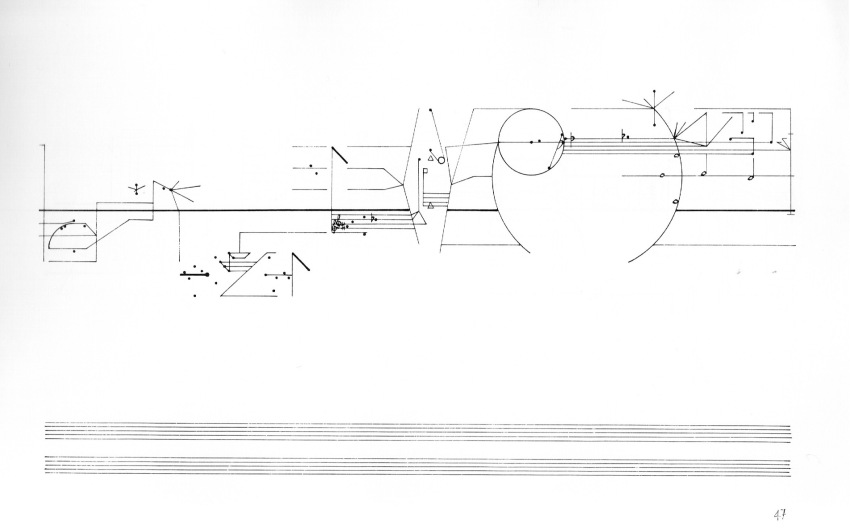
Also related to this idea is the concept of graphic notation. Composers, instead of using conventional notes and staves, represent the movements within a piece with pictures, lines, shapes, or other visual elements. While this can introduce more control into a performance than purely indeterminate notation, there is still an element of uncertainty, as the sounds that are produced are based on how each performer interprets the abstract score. Examples include Cardew’s legendary 173-page work Treatise, John Wiese’s Tet compositions, and this awesome visual accompaniment to Ligeti’s “Artikulation.”
Note: Most of this information was gleaned from Michael Nyman’s book Experimental Music.
Thoughts: Marika Papagika’s Greek Popular and Rebetic Music in New York
Setting aside the music itself, compilations like these are incredibly interesting because they provide a window into a completely different time. In a way similar to Washington Phillips’ The Key to the Kingdom or Robert Johnson’s The Complete Recordings, this collection of Marika Papagika recordings from the 20’s presents a portrait of an artist most likely unknown to many people in modern times. 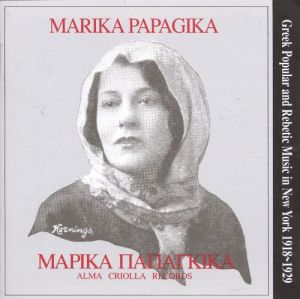
Rebetika isn’t a genre with which I am at all familiar, so going into this album I really had no idea what to expect. I immediately noticed that many of the tracks were much longer and more developed than singles usually were at the time, often utilizing unique song structures. Papagika’s voice is captivatingly beautiful, mysterious and enigmatic in an enjoyable way. Interestingly, many of the scales and intervals used in her melodies were ones I personally associate with Eastern folk music, but they communicated a completely different mood than the spiritual mysticism often found in those compositions. The frequent use of harmonic minor intervals seems to contradict the friendliness of the music.
I’m probably going way too in depth with my descriptions here. Regardless of my analytical observations, the compilation was ultimately very enjoyable, and I’ll definitely be checking out more Greek folk music in the future.
Show: The Big Noise Show @ No Place Gallery (Dec 16 at 7 pm)
Don’t miss out on this killer show, which is headlined by harsh noise/experimental legend John Wiese (also known as Sissy Spacek, the all-time favorite noise project of yours truly) and Cincinnati skronk scoundrels Wasteland Jazz Unit. It’ll be a night of diverse sounds, with the abstract improvisations of Columbus act Wet Hands, the classic harsh noise attacks of Brad Griggs, as well as some other local performers whose work I am unfamiliar with. The cherry on top is that entry is only $10, and, in the organizer’s own words, no one will be turned away. The link to the Facebook event is embedded here. Come hang out with me and hear some extreme sounds.
 Noise Not Music