
 Tom Soloveitzik’s Air 2011 is an ode to human insignificance, a love letter to the cosmic confusions that rock us every day, a deconstructive distortion of time and space. The recordings were precipitated after a strange experience Soloveitzik had upon returning home to London, in which he “was thrown back to the memories of moments and sounds from [his] first stay, as if [his] personal timeline had shrunk and time had folded into itself.” Shrinking and folding are just two ways to describe the forcefully structural actions Soloveitzik performs on his sound materials, which largely consist of an arsenal of saxophones and portable recorders. Brief opener “Two Jets Over Tahrir square” works with a Seth Cooke-like polarity of external exhalation and interior electronics, while “B-Park Blues (for Toshiya Tsunoda)” echoes works by the title-honored artist such as Snared 60 Cuts or Ridge of Undulation as a closely recorded noteless saxophone breath mimics claustrophobic urban wind currents atop the spacious sonic environment of an outdoor park. The disparate and opposite are forcibly affixed to each other, creating stubborn paradoxes while our minds attempt to reconcile yawning gaps in the physicality of the recording: the dark, bottomless, uncrossable chasms between our selves and the universe.
Author: Jack Davidson
I like to listen to, read and write about, and play music.
Review: Kommodus – Kommodus (self-released, May 29)
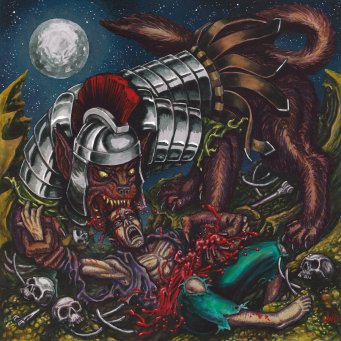 I recently read something in one of Bandcamp Daily’s This Week’s Essential Releases columns that really struck me as inaccurate: the claim (in the context of I and I by A Pregnant Light) that “the vast field of one-person black metal bands isn’t exactly known for experimentation.” In my experience, some of the most subversive and unusual material I’ve encountered in this genre has been generated by solo projects, from the solitary woodland blackgaze of Petrychor or innovative folk-music substitution of Kaatayra to the abrasive nocturnal misery of La Torture Des Ténèbres or power-noise mayhem of Gnaw Their Tongues. One-person acts display a unique trend of reverence to the black metal tradition while allowing for diversity and adventurousness, something exemplified by the recent self-titled release from Lepidus Plague’s Kommodus. With a rich tape recording by “Count Hoggeth Palmeri” and contributions from the “Kommodus horde” (which apparently includes Burier, a Noise Not Music favorite), Kommodus is the first full-length studio album from the project, stuffing its ample 63-minute duration full of incendiary riffs desperate howls, and punishing brutality. Things start off innocuously enough with the short “Black Evangelion” introduction, but Plague soon displays the viciousness in store for listeners on the following “Where Iron and Blood Converge,” a lengthy and punishing track whose heavy-hitting rhythms draw from both hardcore and thrash. The group vocals really add an important angle too, evoking the howling winds that swirl around desolate mountaintops or the echoes of agony from distant hells on “Heir to the Line of Wolves.” An excellent release; nothing shockingly revolutionary, but certainly still more than “turn[ing] the treble way up, turn[ing] the bass way down, press[ing] record and sound[ing] demonic.”
Review: Annina Boogen – Operation Beton (self-released, May 25)
A note from Jack: After four straight days of protesting I am exhausted, badly sunburnt, and still aching for the injustices experienced by my Black neighbors and those who stand in solidarity with them. I am resting today for my own health and I feel a need to return to some semblance of my routine, so for now I’ll be back to publishing reviews. Know that my head, heart, and soul are always with my fellow Americans.
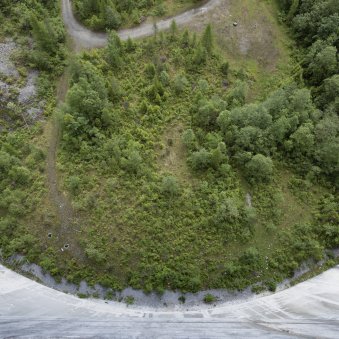 With a world in nigh-unprecedented turmoil, creative works that deal in immersive escapism are more valuable than ever. Water sounds aren’t everyone’s bag when it comes to phonography, but I’m not sure even those listeners will be bothered by the 26-minute recording that comprises a significant portion of Annina Boogen’s “synthesis report” for her Operation Beton project, which “deals with the relation of energy infrastructure and its surroundings, the alpine landscape.” Boogen used a variety of collection approaches to acquiring information and understanding of this relationship, from the use of hydrophones and standard mics to gathering relevant “image and text material.” The latter are presented in a booklet that is not available on the Bandcamp page, but the LP recording offers up more than enough opportunity for thoughtful consideration as it gently moves from trickling water currents to clattering flagpoles and distant conversations. The progression throughout the A side seems to perfectly encapsulate the purpose of the project as the detailed, mechanical interiority of the dam recordings give way to the openness of the countryside.
Request: Action

To all of my beloved readers in and outside of the United States: the people of the broken country I grudgingly call home are under attack. Even aside from the ongoing racially-motivated violence against people of color enabled and perpetrated by countless corrupt police departments, the protests against this injustice have encountered a grotesque response of unnecessary force, abuse, and denial of basic human rights. Children as young as nine years old have been tear-gassed while peacefully demonstrating with their parents. People in several states have been severely injured by rubber bullets and other riot suppression weaponry. A police SUV drove through a crowd of protesters in New York City. Civilians and journalists are being arrested and charged without being read their rights. A cop was filmed flashing the hand gesture of white supremacist gang The Aryan Circle while his fellow officer smiled and laughed. These are just examples; to view a sickeningly long list of other police brutality incidents that have occurred in the last few days alone, click here.
If you’re anything like me, it’s difficult to go about your normal routine with these atrocities happening around you. In lieu of a review today, all I ask is that you join the fight against the boot of fascism that is not-so-slowly descending on all of our heads. If you are in a place where protests are taking place, please join in. If you are unable to protest, consider donating to helpful charities and fundraisers like the Minneapolis Freedom Fund, the George Floyd Memorial Fund, or local funds that go toward bail or legal representation for arrested protesters (in Cincinnati, Beloved Community Church has set up one such fund). This is a crucial time and I hope that all of you can help.
Review: Amine Mesnaoui & Ignaz Schick – Noise of the World (Zarek, May 22)
 I’ve been a fan of Berlin-based improviser Ignaz Schick ever since I first heard Live • 33 • 45 • 78, his superb duo recording with fellow abstract turntable virtuoso Martin Tétreault. Schick is a fascinating contributor because its impossible not to try to visualize the vast array of motorized devices, objects, repurposed instruments, and turntable preparations of which he makes use during his performances, his crowded table setup emitting carefully constructed currents of switch-flips, whirs, and mechanical drones. Noise of the World documents more of an unusual pairing for Schick’s approach: that of Amine Mesnaoui, an African sound artist and traditional music performer who shares Schick’s love of subversive forms and Moroccan traditional music. Both of these predilections are present in ample quantities on the pair’s debut release, which filters Mesnaoui’s Gnawa sensibilities through an “untuned” Fender Rhodes and grand piano while Schick injects a wide range of textural and rhythmic elements, from struck organ pipes and Shruti box to agitated surfaces and tonearm abuse. Though the two musicians’ improvisations wander into various stylistic locales, from the relatively classic improvised approach on “Nat-Nat” (Mesnaoui’s chords remind me a bit of Tilbury) to the meditative polyrhythms and mysticism one associates with African music, they are always incredibly engaging.
Review: Gandum – Rituali Selvatici (El Mondo Niovo, May 20)
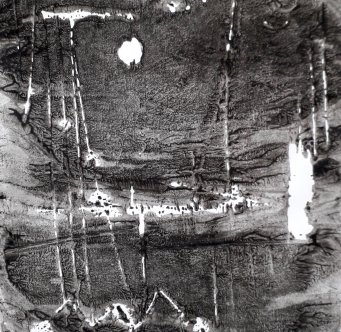 Rituali Selvatici is one of two inaugural releases by newborn Dutch label El Mondo Niovo, which will exclusively release recordings of experimental music that are “focused on a specific sound-space, technique, instrument or praxis.” The nearly half-hour, single-track album is (to my knowledge) the first official release by Gandum, the duo of Hague-residing sound artists Darina Žurková and Riccardo Marogna, and continues the techniques and approaches explored in 2019’s Dingen performance. True to the EMN mission statement, Rituali Selvatici is largely based on the unusual timbres of Žurková’s prepared zither, a wondrously versatile sound-making device used here to conjure crystalline drones comprised of sharp metal edges and almost sonorism-esque atonality. These enrapturing textures get the piece off to a strong start, immersing the listener so thoroughly that the gradual entry of supplementary elements like synthesizer patches and electronics goes almost unnoticed; all the parts are so seamlessly integrated that the entire track flows like the hypnotic flow of molten metal being poured into a vat. Even the most drastic alteration that occurs around the halfway point is executed flawlessly, the gossamer ambient unspoolings naturally giving way to a lush garden of delay-affected clarinet and subtle string clatter that slowly becomes more complex. Rituali Selvatici may start off sounding a bit… difficult, but stick with it and witness the careful unfurling of a beautiful, detailed soundscape.
Review: WELP. – Emergency in Six Movements (self-released, May 17)
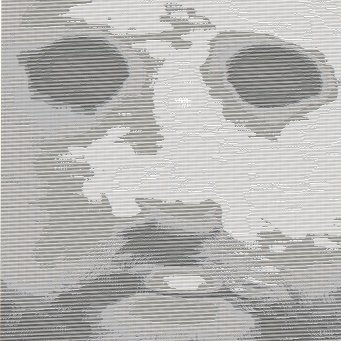
There aren’t many musical releases (good ones, anyway) that can be accurately summed up with a single sentence. Maybe it only takes a few words to communicate a defining feature, a unique approach or lyrical preoccupation or historical context, but inevitably such a succinct description will fall short of truly representing the multitude of things that actually happen within the confines of the release. Sound artist Johnny Beaver’s newest work under the alias WELP., however, doesn’t have this problem; one phrase is enough to convey the entirety of the contents of Emergency in Six Movements, and it is very helpfully provided on the Bandcamp page: “This is a cover of the original US emergency broadcast system tone.” Yes, that is all that this nearly two-hour, six-part odyssey contains: a single, completely homogeneous, stubbornly static tone, and one that has motivated many an American to screw up their face in discomfort and plug their ears to boot. Stuff like this often makes music enthusiasts (purists might be a better word) angry—just look at reactions to some of Sachiko M’s more extreme releases like Sine Wave Solo and Bar さちこ, compared to which this might be seen as even more “difficult”—with phrases like “shouldn’t exist” or “not even music” frequently cropping up in the large volume of, erm, very respectful and thoughtful reviews. But isn’t it so much more fascinating to avoid normative, opinionated assessments and just examine something for what it is? It doesn’t matter if it “shouldn’t exist,” because it does, so what does that mean? In my opinion, Emergency in Six Movements is a piece of music that will most likely tell you more about yourself than the other way around. You’ll question the way you hear and process sound; you’ll find yourself at the mercy of your own mind as it tries to reconcile something completely stagnant, coaxing out overtones and harmonies that couldn’t have been there before (they were); you’ll evaluate your own capacity for patience, maybe even realize that your time isn’t worth nearly as much as you think it is. Check this out and come out the other side with a perfectly uniform hole drilled through your brain. You won’t even feel it.
Or, an alternative opinion, also provided by Beaver: “‘I would rather drink paint than listen to that entire emergency tone album’ – Jonathan Weinmann.”
Review: Costantino Rizzuti – Storie di Terra (self-released, May 19)
 “If you do not live those places; if you do not breathe that air; if you do not listen to that silence: so deafening and sometimes noisy; you cannot perceive the beauty of what has been, of what is no longer, of what is in a continuous transformation and becomes other while remaining unchanged.”
This ambiguous introduction to Italian sound artist Costantino Rizzuti’s newest album does a superb job of capturing the evasive difficulties of capturing the sounds, atmospheres, and other even more intangible aspects of physical places. While Rizzuti is primarily interested in less organic means of experimental sound-making such as algorithmic compositions and digital synthesis, his words display a deep appreciation for the holistic identities of locations: “Opposites exist only for fools, for superficial people. Who knows how to listen to [sic] understands that the two things are not separate, but coexist, like faces of the same coin, in places, landscapes and abandoned villages.” The cover of Storie di Terra shows a dilapidated, possibly fire-charred stone building, which casts some degree of interiority over the proceedings, but for the most part Rizzuti’s two pieces elect to subvert the spacial phonographer’s typical approach. The first “Noisy Silence” shudders and evolves like a stuttering computer printout, the barely-substantial electronic tones that begin it folding into polyrhythmic layers of metallic collisions and glitched-out speech, while the second combines heavily abstracted tribal percussion with fragile feedback that threatens to collapse at any moment, everything residing in a decidedly dark and cavernous sonic milieu. It seems that the more successful one is in capturing the true essence of a place, the less it will sound like a “place” at all.
Review: Time Bomb – Frozen Meat Conspiracy (self-released, May 15)
 Hardcore has always been a genre indebted to the sweat-drenched splendor of the physical live performance. Is a HxC band really a band until they’ve taken the stage (or cordoned-off section of basement) in front of a steaming pile of apathetic audience members who’d rather indiscriminately 2-step their way into an unnecessary and violent confrontation than actually listen to the music? But there has been plenty of material to show us that this is not always an indispensable rite of passage. Killer solo recording projects like Crisis Sigil, The Sound That Ends Creation, Arms, and others showcase the bone-crushing energy that can be achieved in the more sterile environment of solitary home studio recording. Time Bomb, Patrick D. Hogan of PlasticBag FaceMask’s side project, definitely belongs with the other great examples I listed; his new album, Frozen Meat Conspiracy, displays an impressive range of both technicality and heaviness across ten short cuts of deathcore-infused math metal madness. Hogan’s vocals jump from strained emotional screams to sinister low-pitched growls to anxiety-ridden spoken word that sounds straight out of a golden age Disembodied release. As this dizzying mass of abrasive madness lumbers over unexpected speed changes, whiplash-inducing riff switching, and eviscerating breakdowns, do your best to keep your skull intact.
Review: City Medicine – Argentine Dogs (Regional Bears, May 13)
 Christopher Donaldson, whether he’s releasing music under his own name like the wonderful Rhythm Nation or as City Medicine, is an artist I cherish because his work always seems to make use of the cast-offs and unwanted extras of others’ projects, trivial detritus and garbage made beautiful again. With Donaldson, it’s less “one’s trash is another’s treasure” as it is “everyone’s trash is my treasure,” and in this regard he’s in top form on his short new cassette release for Regional Bears. Argentine Dogs is the Miami musician’s first release in nearly half a decade, presenting two eight-minute sides of discordant discharge, tactile gunk, and other bargain bin ephemera. “Without War” finds much of its duration occupied by a whirling tendril of tape noise, stretched and looped to the point of constant near-collapse, a single fuzzed-out tone blaring from a cracked speaker cone as the deck beneath it shakes itself apart. In the latter half of the track, other sounds and textures are pasted in, short snatches of conversation and dripping water and obscure improvisation, a palette that helps unify the two tracks as “Down a Hill” continues with more in this vein. Donaldson never does much processing on his sources other than the low fidelity inherent to his chosen medium, so most of their mystery originates in the way they are layered and sequenced; bee-swarm-drone between clatter segments like a too-taut stitch, abstract percussion loops loom over crowds of people, an erroneous hip-hop radio transmission unexpectedly forces through. Oh, to be an Argentine dog.

