
Feature: Bánh Mì Verlag

Amidst many other exciting archival Bandcamp additions, presumably a result of quarantine boredom (make sure to check out newly available past releases from Bob Desaulniers / Translucent Envelope, Francisco Meirino, Lighten Up Sounds, and others), Jack Callahan’s small batch tape label Bánh Mì Verlag has made its entire back catalog available for digital streaming and purchase. If you’re like me and haven’t been able to hear many of these releases before, this is a goldmine for fans of liminal, subversive music. Here, in no particular order, are some of my favorites so far:

Shots – Up Front (2016)

Even if you haven’t been following this site for very long, you’re probably aware how fond I am of Shots, the enigmatic trio of Matthew Friberg, John Friberg, and Daniel Dimaggio. Up Front is their first standalone document after their initial appearance on Kye’s Nice Weather for War compilation, and already begins to form the purposeful, deliberate creative arc that Shots have followed over the course of their existence. The considered clatter and obvious improvisation remain from “D.C.,” but also involved is an increased sense of location and uncertainty, that elusive void that only expands with ensuing releases.
die Reihe – Toward Agave Expressionism (2019)

An irreverent, parodic, post-internet shtick and an astute ear for the captivatingly unusual are two of the defining features of Bánh Mì Verlag, so it’s unsurprising that these phrases also aptly describe Callahan’s own project die Reihe. Created with fellow artist Alec Sturgis, Toward Agave Expressionism is a programmatic reverse-dissection of an esoteric vision statement that can be found both on the cover of the tape and in undisturbed text-to-speech delivery on the final track. “When do we know that we have rebelled or failed to rebel? And against what?”

Ellen Phan – Ideomotor Response (2018)

Echoing messier releases by another label (with a somewhat similar aesthetic) on which I also did one of these features, fals.ch, Ellen Phan’s only solo cassette is a masterful piece of extreme computer music. Unidentifiable sources are stretched, chopped, and shredded beyond repair into whirling tendrils of raw data. Punchy and percussive at times, delicate and detailed at others, and never afraid to blast the ears with hackle-raising digital destruction. Also, perhaps the most fitting cover design of the bunch.

Skylark Quartet – Skylife (2015)

I’ve previously written about the Skylark Quartet (for last year’s Live in Tokyo CD on Marginal Frequency), but at that time much of my consideration was directed toward the “observers” of the Quartet. On this earlier release the recorded perspective is not nearly as subjective, and the listener is able to retain a reasonably sturdy position over these 11 deconstructed renditions of “Skylark.” The near-constant presence of outdoor noises is an interesting element; the separation between location and music is more defined here.

Lucie Vítková – Music Domestic (2017)

This curious tape embraces a very singular approach to domestic/household improvisation through an “extra step” between observance or performance and presentation: dissection and synthesis. Each track lists the sound objects that were used in its creation, a provision that only makes it easier for their structure to seem reassembled or artificial. Compositions like the queasy “(big fan, preparations, harmonica, voice; coming home, washing dishes)” hover on an impossibly thin tightrope above the border between comfort and malaise.

Review: Hair Clinic – Mirror in a Bag (self-released, Mar 30)

I certainly spend a great deal of my time curating, writing, analyzing, concluding, etc., but as I’m sure is also true for many of you, listening is and always has been my top priority. Thus, my root source for all non-listening activities is listening: why do I enjoy this? What does it make me think about? Recently much of my attention lies with the burgeoning practice of “non-music,” a term that has always existed but now refers to a much more unified tradition of artful mundanity. I personally believe assigning names to genres is perfectly fine in order to simplify discourse, but this particular descriptor comes with concessions that must be made. First, as is this case for the title of this site as well, I don’t view any organized or presented sound, no matter how subversive of convention, as “not music.” Non-music refers to the extreme removal of these auditory results from what is commonly considered to be music, and does not argue against their actual musicality. It’s also important to recognize the back-endedness of assigning genre names. It’s reductive to assume that artists produce their work with these things in mind, so any and all arbitrary classification must refer to the works when they are actually observed; thematic/aesthetic unification instead of individual suppression.

To preface a review of such a short release with such a verbose disclaimer may seem odd, but I hope I’ve made clear that this sort of music is some of the most rich and thought-provoking art being produced today, so to me, no level of analysis seems too excessive. Hair Clinic is a project that like many others I know very little about. Their artist photo on Bandcamp appears to be one of those stroke simulation images, which display an assortment of nonsensical, distorted objects that nonetheless look familiar. The music on Mirror in a Bag, unsurprisingly, can be similarly described: the six diminutive tracks make use of the subdued domestic fanfare with which I’m sure we’ve all become quite well acquainted recently: squeaking chair legs, creaking furniture, old squealing hinges, backyard nature-symphonies, running water. There’s something mysteriously infectious about these recordings; I’m constantly coming back to it like some sort of sonic surveyor, unconsciously trying to identify and place each sound within its environment. Mirror in a Bag is meditative home life fragmented into small but well-formed pieces, each shard enough its own to be recognizable yet jagged enough to always remind us of the glaring absence of the whole. If you’re able to listen more passively, this enigmatic debut is a sublime dose of household improvisation, but if you (like me) are inclined to dig deeper, beneath the surface lurks a deceptively vast depth of ambiguity to excavate.

Review: Ahti & Ahti – Why Do Birds Suddenly Appear? (Ouidah, Mar 27)

“Why do birds suddenly appear?” is less a question regarding phenomena of nature and more of a recognition of humanity’s increasing irrelevance in the environment surrounding us. Birds don’t “appear,” they simply find their way into our field of perception, but it’s a very human thing to place our own senses in the role of objective observer (though here there’s somewhat of a sardonic concession with the inclusion of “suddenly,” seemingly a recognition of the beholder’s inattentiveness/fallibility). The first release from Finnish duo Ahti & Ahti (Marja Ahti and Niko-Matti Ahti) follows an evolving tradition in contemporary experimental music of uncertain or distorted origin as captured field recordings, modular synthesis, and household improvisation are carefully assembled into a fluid composition. Both sides of the LP open with quaint yet slightly mysterious vignettes of breezy garden domesticity in a similar vein to the first track on Daniel Löwenbrück’s cassette 1800m, both of which blur the border between active participation and passive observance. The birds sing of their own accord, but is that just a wind chime swaying lazily in the wind or the intentional sounds of a homemade instrument? Is that some sort of flute-like wind instrument or the sporadic interjections of a distressed gull? Further uncertainties creep into the mix when the separately recorded electronic elements are introduced, creating unexpected and indecipherable textural interactions with irreconcilable spacial implications. Shifting, ambiguous, and deceptively eclectic, Why Do Birds Suddenly Appear is a pleasant and disorienting romp back and forth through a partition that many artists refuse to cross.

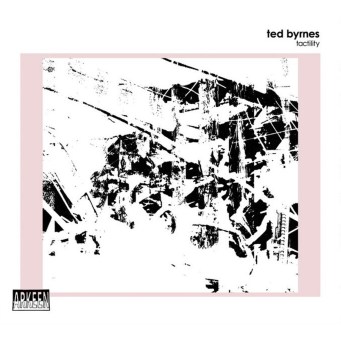
Review: Ted Byrnes – Tactility (Arkeen, Mar 27)

If you don’t already, make sure to follow Ted Byrnes’ Instagram account. One of his greatest strengths as an improviser and performer is his ability to retain the assaulting physicality of his approach in audio recordings, but seeing the techniques, setups, and speed he uses is a wonder to behold. Seriously, it seems like I always need to pause his videos to make sure he doesn’t secretly have more than two arms. Something else gained from witnessing Byrnes play is that, no matter how abstract and alien his work often sounds, much of it is generated using a standard drum kit setup. This element is crucial to Tactility, his most recent full-length on Cincinnati’s very own Arkeen imprint, a new venture from Fantastique Distribution. Not only are these all drum set improvisations, but some of the pieces are even dedicated to much more conventional drummers whose styles and music have influenced Byrnes: Jamie Muir (King Crimson) and John Bonham (Led Zeppelin). Byrnes’ reverence for the latter is especially palpable in the corresponding track (“JH Bonham”) which sees him executing a dexterous hand solo reminiscent of Bonham’s legendary “Moby Dick” performances. The following tracks are less conventional; “Shells” is a brief but detailed array of pleasing clatter ostensibly generated using strings of the titular objects, while “Small and Large” demonstrates some of Byrnes’ most awe-inspiring acrobatic phrasings as he transforms simple metal-on-skins percussion into a lush, enrapturing sonic environment. “Auto Parts” is another illustratively titled track much sparser than the cacophony conjured by Byrnes’ project with Sam McKinlay (a.k.a. The Rita, whose remix of Tactility is included on a 3″ in the deluxe version of the album), Cackle Car. By the end of “Fix It,” the album’s longest and most eclectic piece, you’ll feel as battered and bruised as if you were just another one of Byrnes’ objects—but also exhilarated and astonished.

Guest Review: Paul Ray on Shit Creek’s The Land of the Remember (Crow Versus Crow, Mar 27)

The Land of the Remember opens with a barrage of effervescent noise, spits of sparkling sound fizzing and glitching joyfully around the stereo field. It’s noise music at its giddiest and most escapist, digitally abstracted and fucked musical artifacts collapsing in on themselves and singing radiantly. Although the album doesn’t sustain this sonic intensity throughout its entire sublime 40 minutes, all the songs on Shit Creek’s latest and best record are built around a remarkably generous feeling of bliss. It’s drone as fairytale, noise as vivid escape.

Amid the islands of roaring fuzz lie bucolic, shapeshifting ambient compositions which ripple and shimmer like dust floating in a sunlit room. On the two title tracks, warping organ chords sustain themselves tenuously in the oozing sonic liquid, buoyed by un-selfconsciously uplifting melodies and snatches of garbled voice. “Terry Houndface,” perhaps the album’s most straightforwardly beautiful cut, is a reverie of watery sound, snatches of alienated voice, and guitar and piano fragments which sound like the patter of rainfall. Not boring grey rainfall, rainfall when it’s hot and humid and strange outside. “Pram Racers” is a 3/4 waltz of bitcrushed synths, a deeply calming and nostalgic texture amid the bewildering beauty surrounding it, while “Little Solas” reminds me of Animal Collective at their freak-folk peak, with multitudes of roughly (yet also so softly!) strummed acoustic guitars co-existing alongside a percussive Morse code, which sounds like someone tapping a plate.

And then there are the noise tracks. “This Is the Trap” is nearly seven minutes of metallic playfulness, a pulsing drone foundation underpinning the pirouetting whisps of melodic fizz. “This is Nowhere, and It’s Forever” sets up an undulating drone and then builds on it in 4ths and 5ths, as if loudly playing in a huge resonant chamber. It’s lazy writing to deploy too many comparisons to other artists, but these ebullient noise tracks remind me of Jefre Cantu-Ledesma at his most blissful and distorted. The Land of the Remember is a wonderful, emotional collision of noise, drone and ambient techniques, coalescing into a work of escapism and beautiful technicolour.

Review: Jugendwerkhof – Schandwandlung (Marbre Negre, Mar 22)

Berlin harsh noise duo Jugendwerkhof are a project I’ve been following ever since Low Life High Volume put out their debut release Blutstätte ‎in 2018. Their deafening dual assault of “scrap metal, electronics, broken instruments, feedback, [and] voice” offers up equal amounts of the two qualities I appreciate most in this genre: intensity and immersion. Schandwandlung is their longest album yet, and as the first track wastes no time in revealing, it’s also a different beast. Newly heightened emphasis is placed on the percussiveness of the waves of noise the duo generates, and desperate, incoherent howls and shrieks are often foregrounded, giving the music an undeniably metallic edge (both in the stylistic and the textural sense). And that’s just part one. The next segment evolves from tightly orchestrated clatter to a warped, savage stretch of depraved vocalizing, contact mic abuse, and torrents of distortion that resembles the violent death of some horribly mutated beast. Schandwandlung seethes, spits, slices, and smears itself over the remaining half hour, as Jugendwerkhof’s fiendish industrial emissions manifest in forms ranging from plodding, punishing static walls  to roiling, white-hot, hyperactive blasts. A terrifying new release from this great band in an equally terrifying year.

Review: Alex Cunningham – Echo’s Bones Were Turned to Stone (self-released, Mar 22)

One of the countless reasons that freely improvised music is so exciting is the near-limitless possibilities that extended techniques open up in the hands (or other body parts) of skilled artists. Standard musical instruments once viewed as innocuous, constrained tools become sources for untamed sonic energy. There’s an online review of Derek Bailey’s Aida by Rate Your Music user ac_church that puts it well (I’m pretty sure I’ve quoted it here before): “it’s strange to find yourself in a same room with a guitar after you’ve listened to Derek Bailey… it suddenly becomes an incredible alien artifact of immense power… ‘you really could do all that? how come I didn’t know?’ ” Alex Cunningham is no stranger to escaping the restraints of a conventional approach; his nimble, abrasive violin assaults instantly drew me in when I first heard Fiddle back in 2018. But as the title track on that release—produced using the self-imposed constraint of “improvise a fiddle tune”—makes clear, Cunningham also owes a great deal of reverence and love to the traditional music to which his instrument of choice is essential. His most recent release Echo’s Bones Were Turned to Stone continues in the direction of last year’s Knell on Fort Evil Fruit with a set of extended dynamic pieces. As always, we not only hear the deep, dense drones Cunningham coaxes from the violin but also the resin-shredding strength of the bowing that produces them, the mesmerizing swirl of cascading string slides and ersatz chords, the moments of invigorating Appalachian fiddle stomp (however brief or abstract). The St. Louis String Sawer’s latest is a jagged, harrowing, and triumphant exclamation from the dark depths of isolation.

Mix: Cooped Up

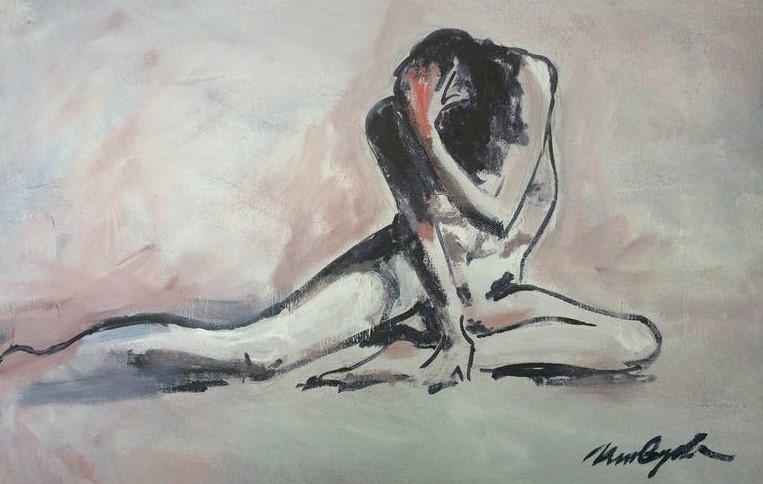
The sound of domestic self-isolation gone horribly wrong. Junk and trash thrashed out of sheer desperation, degradation of language, slow but deliberate descent into panic and madness. Let’s hope it doesn’t happen to any of you. Thots and preyers.

“Isolation” by Kim Beyer-Johnson

00:00. Usurper – 2nd untitled track from Fishing for Tripe (Chocolate Monk, 2013)

04:28. Derek Bailey & Han Bennink – “Who Is That” from Derek Bailey & Han Bennink (Incus, 1972)

08:28. Laurie Tompkins – “War” from Heat, War, Sweat Law (Slip, 2016)

12:14. Territorial Gobbing – “Went” from Stud Mechanism (Cadmus Tape, 2019)

18:00. Textile Orchestra – “The Beginning of the End” [excerpt] from For the Boss (Beta-lactam Ring, 2009)

21:09. The New Blockaders & Putrefier – “Tiras Abrasivas” from Schleifmittelbögen (Birthbiter, 2007)

24:46. Micro_Penis – “Lorsque la lune est pleine je le sens vraiment” from Tolvek (Doubtful Sounds, 2011)

28:53. Animal Collective – “Panic” from Here Comes the Indian (Paw Tracks, 2003)

33:28. Taku Unami – 2nd part of “Whistler Vanished in Wind” from The Whistler (Erstwhile, 2017)

35:02. Boredoms – “Used CD” from Super Roots (WEA, 1993)

Review: Terror Cell – Last Day of Sun (self-released, Mar 20)

I’m pretty glad the title of Terror Cell’s debut release isn’t timely; with everything going so wrong on this planet the last thing we need is for the sun to finally wink out. Luckily, at least here in the Midwest, temperatures are becoming somewhat palatable and our old yellow friend in the sky has been occasionally peeking out from behind the clouds. So, in conclusion, it’s the perfect weather for holing up inside in the dark and thinking about how awful humanity is while blaring Last Day of Sun at full volume. There’s no better way to experience the powerful opening instrumental “[REDACTED]” than with the knob all the way to the right, but the monolithic slab of crushing low end and swirling psychedelic blackness is sure to set the stage for the rest of the album well at any decibel level. The following five tracks present a formidable fusion of modern metallic hardcore, dense sludge/doom, and an overwhelming sense of anger, pain, and uncleanliness that can only come from the darkest corners of extreme metal. The new Richmond quartet’s influences manifest differently on each song: patient, plodding atmosphere-building on “Modern Failures”; malevolent crust and pounding metalcore on “White Phosphorous”; cinematic post-metal crescendos on the title track. The vocals are well done too, varying from unnatural wails to throat-gouging bellows. Solid and much-needed stuff from a promising new band.

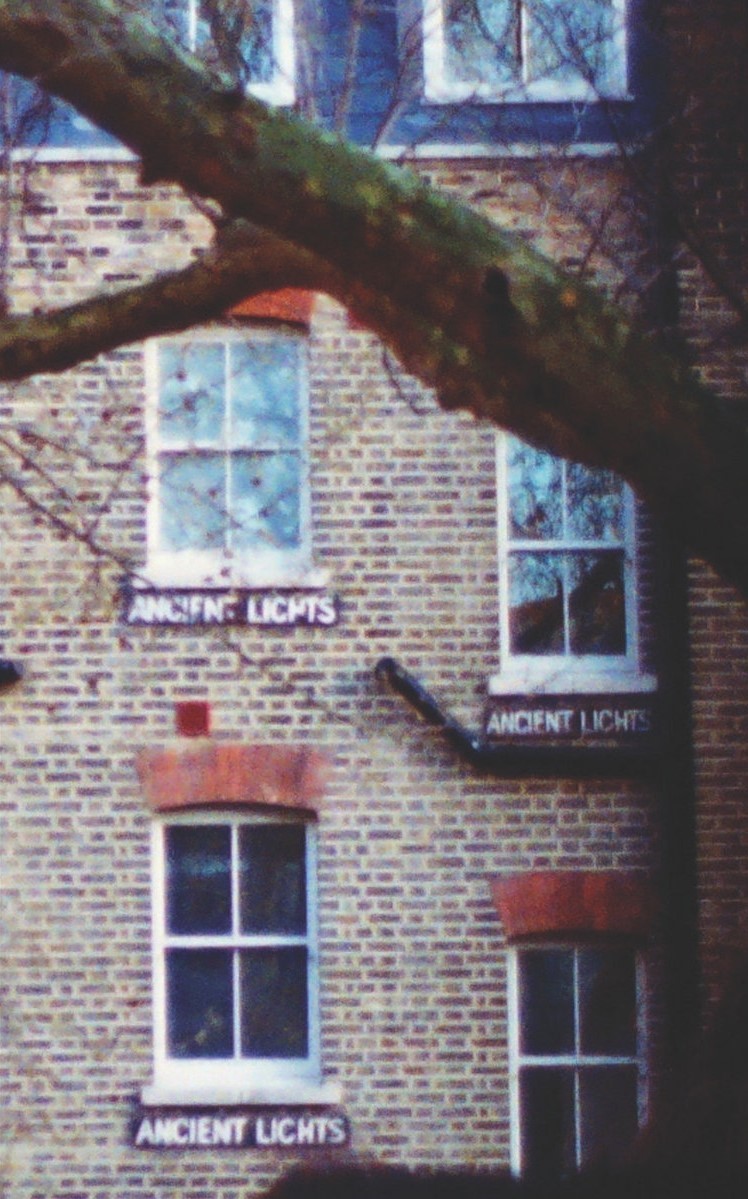
Review: Ingrid Plum, Anton Mobin & Graham Dunning – Ancient Lights (Fort Evil Fruit, Mar 20)

I’ve often discussed the marked difference between directly recorded and reverb-filled, space-utilizing tabletop improvisation, and how artists’ work can fall into either category (or both). Like Dylan Burchett’s bread, the piece which most recently engendered this discussion, Ancient Lights seems to possess elements both internal and external, with a spectacular intensity that could only from these three mad sound-scientists at their eclectically equipped laboratory surfaces. Each participant is a formidable force in their own right: Ingrid Plum, accomplished improviser and performer, lends choice contributions from objects, Walkman, and utterance; Anton Mobin, master of his singular, lushly intimate style of théâtre d’objets, amplifies and broadcasts miniature percussive events from his prepared chamber; and Graham Dunning, dedicated sound artist and educator, bewilders (as usual) with his virtuosic extended turntable techniques. This well-controlled mess of machinery takes a while to emerge from the recording which begins “Frame Makers,” which one might think captures the sound of audience members and the surrounding locale during the music’s recording—but all of Ancient Lights was documented in the controlled studio environment of Sound Savers in Hackney. This is just one of many instances in which field recordings and other disparate intrusions are used to play around with physical space in its communicative form, when a somber, wordless croon or distant clunk greases the already precarious surfaces of churning cogs and rotating plates.