Mix: Sonic Stew

Stew is a good meal to make on a freezing cold evening when you just need some warmth in your body. Stew is also a good meal to make when all you have are some broth and a pile of disparate ingredients you don’t really know what to do with. Apply the two preceding sentences to dense, playful collage music—what I like to refer to as “sonic stew”—and the claims still hold true. Go ahead and help yourself to a sizable spoonful.


00:00. Faust – beginning of “Why Don’t You Eat Carrots?” from Faust (Polydor, 1971)

00:56. Gus Coma – “Meet Our Employees” from Color Him Coma (It’s War Boys, 1983)

03:58. Sugar Pills Bone – “Lumb Airline Crash on Blue Waffle Island” from Lumb (Orb Tapes, 2019)

07:29. Martin Tétreault – “Induction” from La Nuit Où J’Ai Dit Non (Audioview, 1997)

15:59. Guido Gamboa – “Nasal Passage Complication Inducing Variants of Voluntary Breathing, Light Sensitivity Traced to Anticipation of Migraine Aura Onsets” from 2018: Recent Amelioration of Lingering Proprioceptive Issues, Elimination of Winter Coat Improves Muscle Tension (Regional Bears, 2018)

19:30. Gomma Workshop – “Bruitages cubik” from Almanacco Moderno (Madcap, 2004)

24:02. Five Starcle Men – “Ducks Abduct” from Gomba Reject Ward Japan (Lost Frog Productions, 2007)

26:11. Ken Shoticker – “ctch th mnkey” from avatar toolkit (fals.ch, 2001)

27:15. Ground-Zero – “The Glory of Hong Kong – Kabukicho Conference” from Revolutionary Pekinese Opera Ver.1.28 (ReR, 1996)

31:45. Stanol Ester – “Yn, the Monts of the Mystics” from Yn, the Monts of the Mystics (self-released, 2018)

35:01. Ash Charge – “II” from Ash Charge (Garden Magik, 2019)
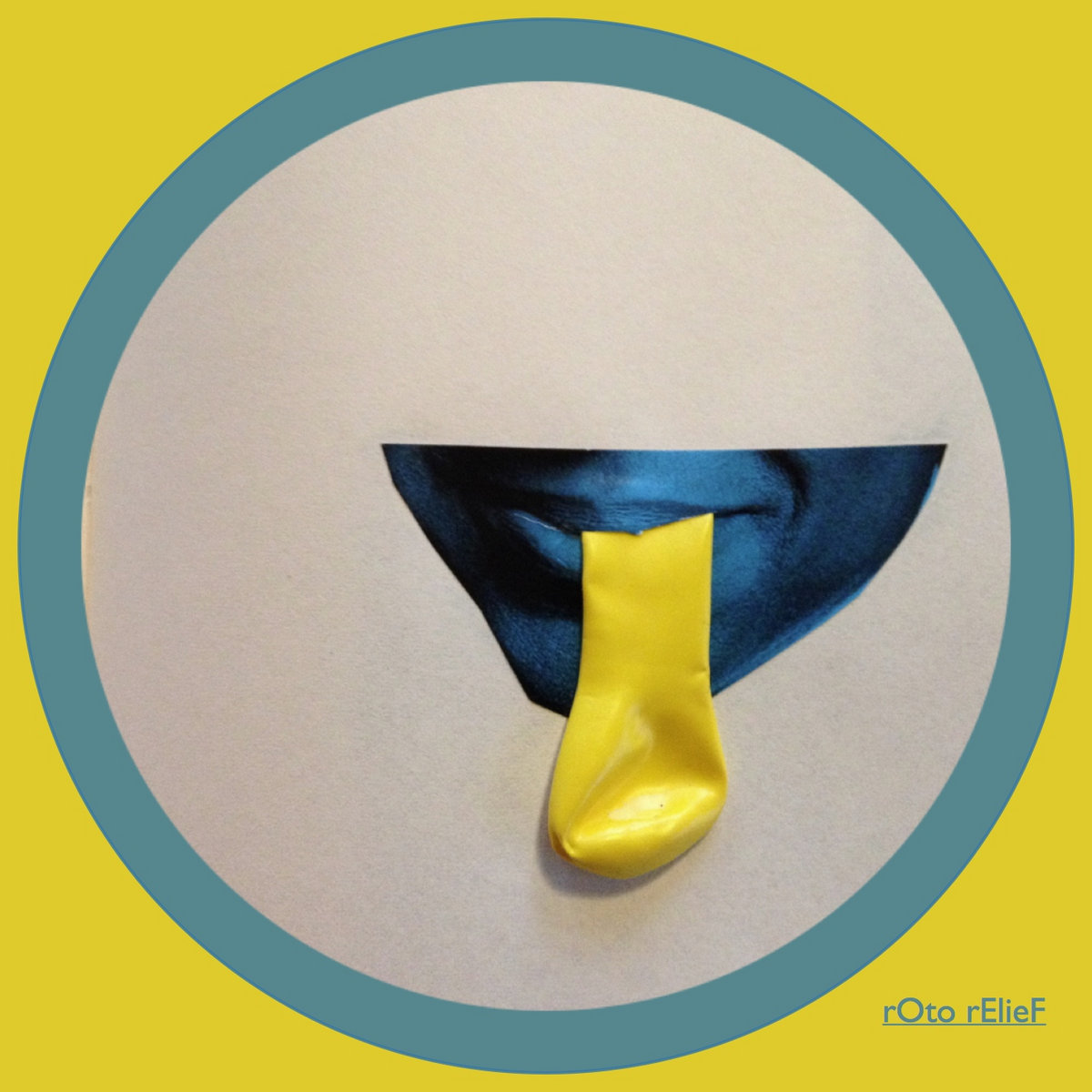
Review: Fissures – rOto rElieF (self-released, Feb 2)

I never seem to run out of great music to review from Belgian sound artist Ludovic Medery (a.k.a. Fissures), nor does he ever seem to run out of inspiration or motivation for making some of the finest contemporary acousmatic music out there. rOto rElieF is simply the latest in an oeuvre that also includes wonderful releases such as RituelsLes voix du matin, and MORPHOSIS (two of which I’ve written about for this site), but like all of Medery’s work it doesn’t at all suffer from his predilection for prolificacy. “Face A” carves out a stuttering, hypnotic form from a series of concrete sound loops; there’s rhythm in the sense of reliable repetition but not nearly enough to grab onto for support as even more shifting components are added to the mix, notably the fragmented speech samples that kick in around the three minute mark. In accordance with the playful, colorful surreality of the album cover, the piece is unstable but nonetheless vibrant and infectious as it maintains its tottering amble, briefly falling into respite before a new mess of kinetic, mangled clink and clatter takes hold. The gap between “A” and “B” is astutely stitched together by a fractured tape recording, which despite presenting a largely familiar and unmanipulated sonic environment is almost as jittery and space-defying as the more abstract sounds that preceded it. It’s also an appropriate lead-in to the latter half of the album, which starts things off with an array of more organic-sounding elements than the former before returning to the unifying palette of squeaking machinery. rOto rElieF is a symphony of moving parts, microscopic mechanisms, organized entropy; if you’ve ever found yourself enraptured by the sound of those gear-system toys at playgrounds (because I certainly have), look no further than this release for a similar fix.

Review: American Cig – Nausea (Commuter Disk, Feb 2)

Apart from just having one of the year’s best album covers so far, American Cig’s new CD Nausea is a superb and fascinating release. I know little about the duo—just that they’ve put out a handful of releases on excellent DIY labels like Barton Street and Male Activity, and I’d previously encountered Nathan Ivanco’s solo noise project Marion through Taping Vol. 1 on A R C H I V E—but their “music” speaks for itself. American Cig practices a form of free improvisation situated somewhere between the erudite reticence of AMM and the industrial clatter of Morphogenesis, using tapes, voice, electronics, and strings to conjure mysterious, metallic soundscapes. Despite its seemingly synthetic origins, opening track “Domestic Incident” seems to consist of just what its title implies as Ivanco and Smith improvise to what sounds like steady rainfall outside of the recording space. As the track moves into its latter part, “The Witch’s Bottle,” the duo ramp up their interactions to produce a restless cacophony of tape loops, stuttering strings, and growling rumble, yet it’s one that still feels tense and restrained. What with the threatening atmosphere and shrieking strings, I can’t help but be reminded of Tobe Hooper and Wayne Bell’s harrowing score for the original Texas Chain Saw Massacre—a compliment which, coming from me, is of the highest order. American Cig continues with both the apt track titles and the compelling amalgam of organic and mechanical sounds as “Boiler Room Persuasion” begins with the unmistakable sounds of splashing water. “Noxious Tide” brings Nausea to a jittery and fitting end as the sonic equivalent of a metal noose tightens around our necks—the machines have invaded our private spaces, and things will never be the same again.

Review: alpha privative – monoclinic (self-released, Feb 1)

Modular synthesis is one of those things that I (personally) can observe, witness, be taught extensively, and still have no idea how any of it works. And I kind of like it that way; I think I’m so partial to music that utilizes the modular synth as an active compositional tool because the method used is simultaneously so transparent and mysterious. Everyone has a unique approach to this incredibly versatile instrument, and we see the true magic that can be conjured by modular wizards on wonderful releases like alpha privative’s debut tape monoclinic. I know nothing about this new project other than the traditional meaning of the phrase “alpha privative” (the a- or an- prefixes in front of words like “asynchronous” or “anesthetic”) and that it originates from Denver, Colorado. monoclinic doesn’t necessitate much more context than that, though; its sheeny, languid currents of heavily processed concrete sounds are directly descended from the classic form of musique concrète practiced by eminent creatives like Beatriz Ferreyra or François Bayle, where not only is composition the final step in the music-making process but the final product is an array of sound whose origin is of no consequence, and all that’s left is an array of completely new materials produced through careful alteration, layering, and sequencing. The tape is also distinctly modern, however, with a subtle but pleasant element of conventional ambience nestled throughout the darkly effervescent cascades of ringing strings and gleaming chimes. At just 22 minutes, alpha privative’s inaugural release is a well-executed and concise exercise in abstract atmospherics.

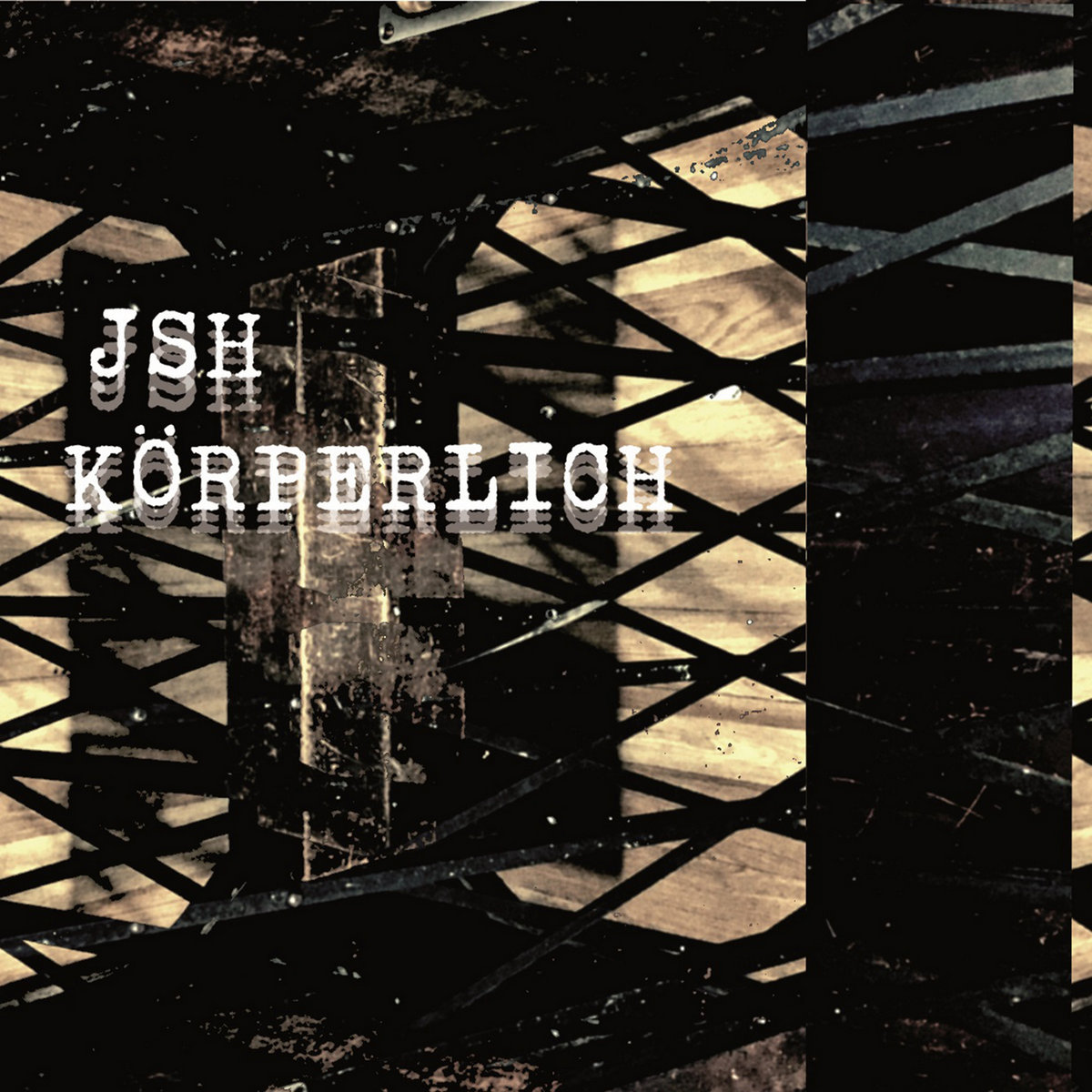
Review: JSH / Körperlich Split (Tribe Tapes, Jan 29)

Slabs of textural harsh noise come in many forms, and as listeners the quality we are most often drawn to first is what we perceive the sound’s origin to be; some artists’ noise seems to fall pitter-patter from the sky like rain, others’ gives the impression that it’s bubbling up from the ground beneath us, and sometimes there’s not really an illusion of direction at all, cases where the noise just simply, well, exists. None of the previous categories describe JSH’s track “Pieces” though, which howls into squalling existence from some indiscernable source point at the back of our heads, an undammed jet of heavy static that occasionally lashes against its mono-imprisonment and flits into stereo. That quality is also what makes the nearly half-hour piece remain engaging throughout its duration; this is no wall, so the artist is constantly constricting and contorting the mass of noise, but that vicious forward velocity is never extricated from the music, even in its most reserved moments. Towards the end of “Pieces” is where its strength truly becomes apparent, as squeals of screeching feedback and mangled vocal additions sew discord in the already collapsing cacophony. If we continue discussing motion, Körperlich’s “Afflicted” acts as a slight counterpoint to the chaotic sonic barreling on the preceding side, the paths of its more classic palette distortion pedal and radio adopting more of a lateral trajectory across the stereo field. The radio grabs are overused and even detrimental throughout the first half of the track, but it regains its footing with a well-executed progression from a stretch of fragmented clatter into the muck that acts as a conclusion.

Review: Daniel J. Gregory – Heard Under Orphan Eyelid (self-released, Jan 29)

Daniel J. Gregory’s modest description of himself as “object botherer” couldn’t be more accurate. Whether he’s assaulting audiences with the amplified sounds of clattering detritus as half of the art-noisecore duo Gregory/McGrory (check out Gateway to Conclusion) or recording an album with the classic singer/songwriter palette of “acoustic guitar, plastic cups, biscuit tins, singing bowl, dry pasta, [and] throat” (Kebab Shop Will Sell Ice Cream), Gregory’s “music” is as skittery and unpredictable as the piles of junk and trash we kick aside every day. Such a direct approach to soundmaking is certainly within the realm of the scruffy, DIY experimentalism I love so dearly, but Gregory always seems to have a point or purpose in mind for his various releases, implicit conceptual facets that reach far beyond the music’s humble essence. Heard Under Orphan Eyelid consists entirely of recordings taken with a mobile phone (of much higher fidelity than any my own phone has ever yielded) and deals with a sense of place in flux. Each piece presents a sonic focus—radio improvisations, malfunctioning electronica, claustrophobic capture of a plastic bag’s innards—that clashes with the environment it occupies. We cling to what we perceive as the primary element of each track but are consistently betrayed as other forces make us aware of Gregory’s surroundings, which despite being dwarfed by their occupants often come across with far greater lucidity: hands make contact with the physical form of the phone, a turn signal clicks on, a sound event ends and nothing is left to do but scramble to end the recording. Heard Under Orphan Eyelid is a rough-edged affair of observation, action, and transmission that reaches for—and, inexplicably, grasps—the sublime.

Review: McClane – SALE CONTRE TOUS (self-released, Jan 26)

One might not think that a stylistic amalgam of black/extreme metal and gabber could be in any way fruitful. There are a lot of ways disparate combinations can fall flat, but somehow McClane’s newest self-released album doesn’t resort to gimmicks or rely on novelty, and truly assimilates these two genres into something entirely singular. There’s not much time to think about any of this once SALE CONTRE TOUS actually starts, though, because after a short introduction “LESS IS MORT” arrives with crushing force. The riffs are often played by plasticky synths, stretched and layered in uncanny facsimiles of tremolo guitar picking, while a metronomic beat pounds away—half four-on-the-floor, half blast beat. On “CRACKHEADBANG,” an interlude of mangled samples and half-formed melodies gives way to a breakdown that actually does the track’s title justice. The rest of the album sees McClane exploring catchy, infectious arrangements with “URO DANCE” or a balance between uplifting trance/rave electronica and destructive metal assaults that doesn’t sacrifice the impact of either on “ZBEUL THEM ALL.” After a strange industrial-strength shuffling hip-hop interlude SALE CONTRE TOUS finds a memorable conclusion in its title track, an ambitious and grandiose anthem complete with complex instrumental arrangements and even a substantial amount of cleverly used claps. This is one of the most singular things I’ve heard in a long time that still incorporates so much of what I know and love already.

Review: TARAB – Material Studies #1 (Hemisphäreの空虚, Jan 24)

I first encountered sound artist Eamon Sprod’s solo project TARAB when I heard 2018’s HOUSEKEEPING, a CD that evolved from a multimedia installation in a unique manner: “rather than a documentation of an installation, this iteration has been arranged from the debris collected during the process of making one.” Sprod is an artist who often seems to adopt a scientific approach in creating his music, playing the role of a curious and active observer in the midst of his surroundings, though the emotional impact of his work never seems to suffer (despite the cold impartiality one may associate with the practice of science). In the case of Material Studies #1, the identities of Sprod’s surroundings are not made nearly as clear; we are told that some of the elements are sourced from old cassettes from the project’s early days, but other than that the “materials” he utilizes are quite wide-ranging—metallic machinery that resembles recordings I myself once captured of children’s playground equipment, small vibrating objects on agitated surfaces, Velcro-like scrapes and scratches. The exhumed tape remnants add a crucial dimension to the music, unseating the clearly and closely recorded tactile events with a cloying layer of ghostly hiss and hum. There’s a particularly strong stretch near the beginning of side B where heavily processed micro-sounds flit and crackle around droning, soupy clatter, the former almost resembling the hyperactive granular textures of pure data synthesis. Material Studies #1 is essential listening for all those who love to turn their ears to immersive, textural sonic landscapes that refuse to abandon their gritty, earthly origins.

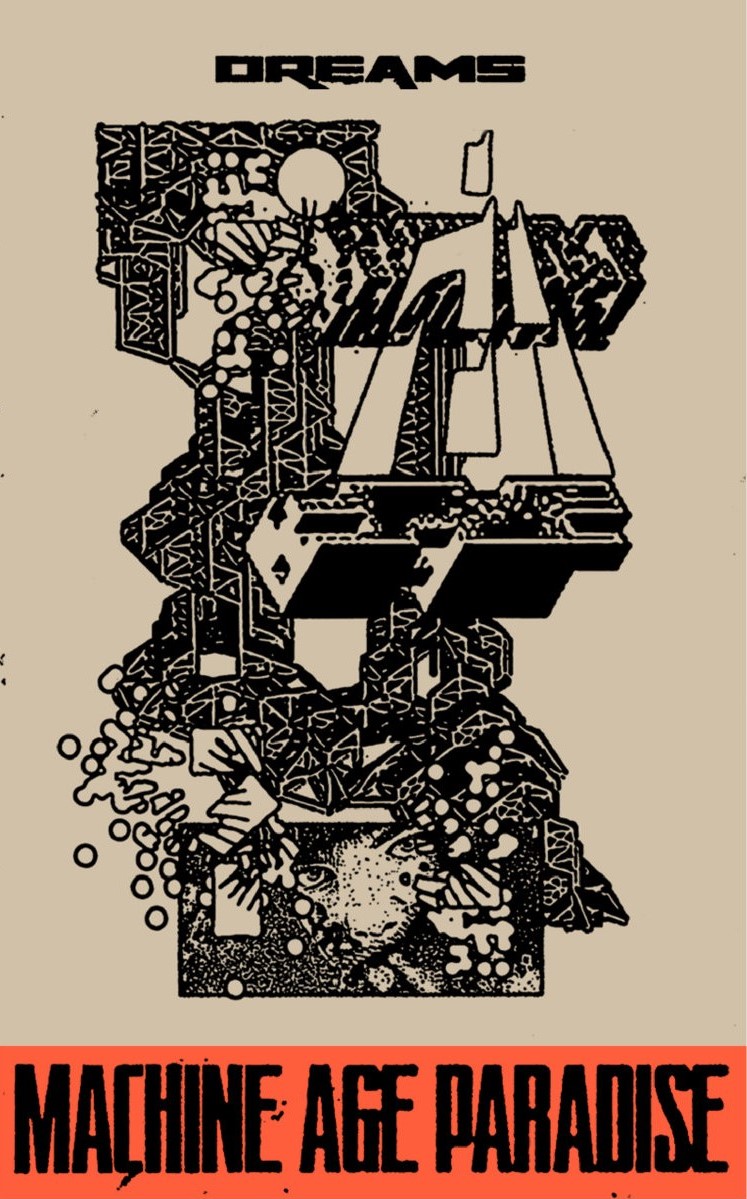
Review: Dreams – Machine Age Paradise (Bank, Jan 24)

Machine Age Paradise might be the most artificial-sounding record I have ever heard. Each track is constructed from brazenly digital elements stripped down to their barest and unsettling roots: when beats do appear, they’re lethargic, detached, barely interacting with the rest of the track as their industrial clanks and pounds echo from a distance; the watery ambience that soaks tracks like “Light Removal Vacuum” and “Born With Scales” is sickly and uneasy; even the occasional human voice samples sound like alien transmissions. This all sounds very negative, but it’s also what makes the second full-length LP from LA producer Jesse Pimenta (a.k.a. Dreams) so remarkably engaging. Machine Age Paradise is electronica deconstructed, but not in the sense of frenetic “deconstructed club” or any other existing dance subgenre I could think of; it’s more like Pimenta has taken conventional stylistic influences like techno, hardcore, and progressive electronic and gutted them, removed their innards, viciously contorted them to a form in which he’s actually interested. The result is an uncanny palette of sounds that feel empty, humid, somber, menacing, frail, and dark (really—at any given time, any to all of those descriptors are applicable). After a subdued and yet subtly anxious finish with the title track, one is left confused, drained, maybe even scared. The only cure is to listen again.

Pictured here is the cassette cover. The LP is available from Bank’s Bandcamp and comes in a plain sleeve.

Review: Dylan Burchett – bread (self-released, Jan 18)

Solo tabletop improvisation usually ends up being quite intimate even with the most maximalist of sonic results; there’s something distinct about the direct relationship between the performer and the actions they take that the listener can always pick up on, a lurking yet palpable personality. Intimacy arises differently from both of the two main recording approaches a solo improviser can take, a dichotomy well-represented by two Keith Rowe releases, The Room (Erstwhile, 2007) and Live at Fairchild Chapel (Idiopathic, 2015); the former evokes claustrophobic and microscopic sound-worlds through line-in capture, while the latter makes the performance space a perceptible presence in the music, shrouding Rowe’s prepared guitar clatter and ghostly radio transmissions in shadow. I provide these examples because Dylan Burchett’s bread, a single 37-minute improvisation, is somewhere in between the two, making use of both direct and overhead recording for a delicate domestic odyssey. A range of sound sources form the basis for the track (“motors, fans, contact mics, objects, hard drives, speakers, computer”); we hear sine waves and digital crackle materialize in the liminal space between action and result as Burchett’s array of devices are arranged and activated by hand. There’s a lot of perceivable movement near the beginning, but starting at around the ten-minute mark everything begins to coalesce into a sublime, crystalline drone, full of light mechanical whir and rattle. Burchett’s presence returns around halfway through, reaching around in preparation for new sonic activity as soft samples continue independently. There’s a tremendous amount of restraint at work here, and despite its undeniable abstractness bread’s subtlety make it an accessible, cozy mid-afternoon listen for anyone with an adventurous ear.