 Even disregarding the music found within Spasm of Light (which is not at all something I intend to do) the context of the relatively known ensemble Imperial Cult reads like a who’s who of the pioneering Dutch atmospheric metal scene: members congregate from projects like Turia, Solar Temple, Cryptae, and Iskandr, all of which have released some truly amazing music—a trend that definitely continues with this release. According to one source, the propulsive blast beats and fretboard-climbing riffs are largely improvised, but it doesn’t come across as an arrhythmic congealment like Spit Forth From Chaos; instead, what sounds like a well-versed trio of musicians simply loosen the strings of a more strictly composed piece to create this fluid mass of meditative darkness. Luckily, the track remains engaging throughout its 34 minutes, relying on hypnotic repetition and subtle changes in dynamics to support itself. The metronomic blasting is nothing short of trance-inducing, barely letting up until about halfway through when a more plodding section enters, acting as a brief reprieve before a driving snare build signifies that the inferno’s return isn’t far behind; and return it does, whipping up scathing sonic winds into a forceful, droning ambience that rockets forth until it breaks apart under its own weight.
Author: Jack Davidson
I like to listen to, read and write about, and play music.
Review: E L U C I D – Every Egg I Cracked Today Was Double Yoked (self-released, Aug 19)
 It’s a testament to Chaz Hall’s skill as a producer—and as an musician in general—that an album made “while floating between various hotels, airport terminals and bedroom closets” and based upon material tracked using laptop mics and iPhone recordings sounds this lush and fleshed-out. The enigmatic hip-hop creative has carved out a name for himself with a large audience via his work with Milo as Nostrum Grocers and with Billy Woods as Armand Hammer, but his most revolutionary releases, including Cult Favorite’s For Madmen Only and his self-released solo endeavors, continue to fly under the radar. Unfortunately, I doubt that Every Egg I Cracked Today Was Double Yoked will enjoy any greater attention, seeing as it’s probably Hall’s most experimental venture yet, but for fans who enjoyed the enrapturing atmosphere of Shit Don’t Rhyme No More this is a godsend. Some incredible variation is present despite the release’s short length: driving, snare-heavy drum grooves cut through a dense haze to bolster the rapper’s commanding flow on opener “Honestly, Aight,” while on “Colony” it’s his complex, interlocking bars holding everything down while atmospheric sample abstractions reach for the sky. With wonderful surprises like the piercing sax skronk on “Careen” or the glitchy stereo agitations of “A Gruv,” Every Egg… is yet another document of a truly inspired artist, who is certainly one of the highlights of the thriving hip-hop underground.
Review: Shots – Private Hate (Careful Catalog, Aug 16)
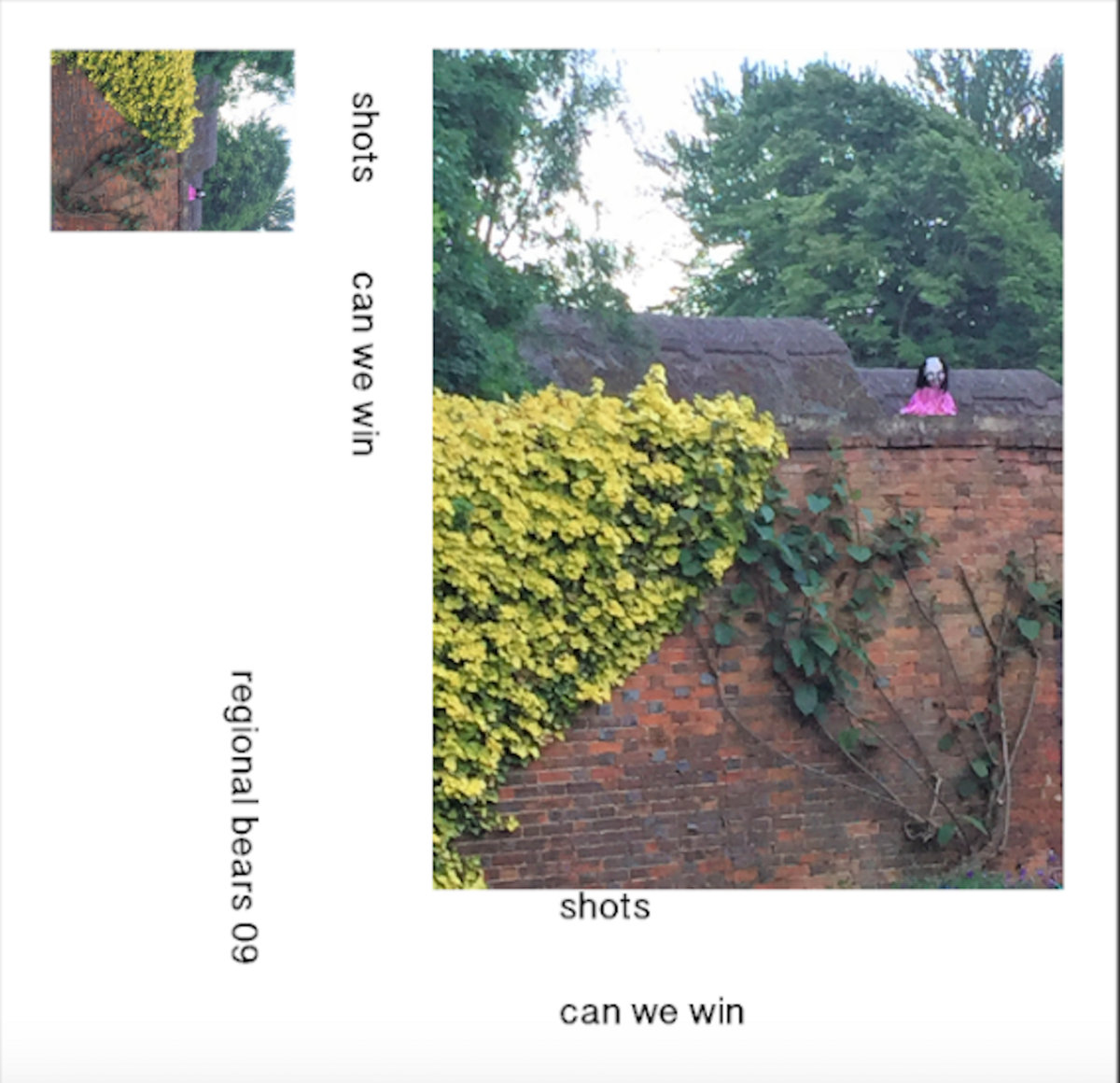
 The music of Shots—though, true, “music” doesn’t always seem to be an entirely accurate descriptor—takes the form of an unapologetic statement, an unanswerable question, an irreconcilable truth. Dan Gilmore puts it perfectly when he places the material on Private Hate in context with the album cover of Can We Win: “that thing was clearly embedded in broad daylight, defiantly real and on display as if to antagonize whoever saw it into coming up with an explanation.” Like that pink-clad, unsettling, uncanny valley-residing thing, Shots’ creations are modest yet unyielding in their impenetrability. As with past releases, the stabbing injections of erratically struck percussion and other trivial objects melds with whatever environment surrounds them, but on Private Hate the sense of place is more important than ever—in that the increased presence of location somehow makes the recordings even more difficult to define. We hear the distant hum of traffic and honking horns, rushing air currents that may be from concentrated wind or manmade vents, but there’s absolutely no sensory physicality to any of it, and we’re left floundering as we try to steady ourselves in a room with no floor. The conclusion of “PH1” is filled with empty space, but the abrasive squeaking and clangs of metal make that irrelevant as the listener is encased in a concentrated claustrophobia; it’s even more disorienting in “K&K,” where a distinctly human setting is challenged by concentrated contact mic scrabbling, any comfort that familiarity might provide vacuumed out by this spacial distortion. As always, the sound itself is truly and purely sublime, but it’s not an easy beauty, and with Private Hate more than ever Shots prove their mettle in an area of abstraction that no one else seems to occupy.
Mix: The Freeing of Folk
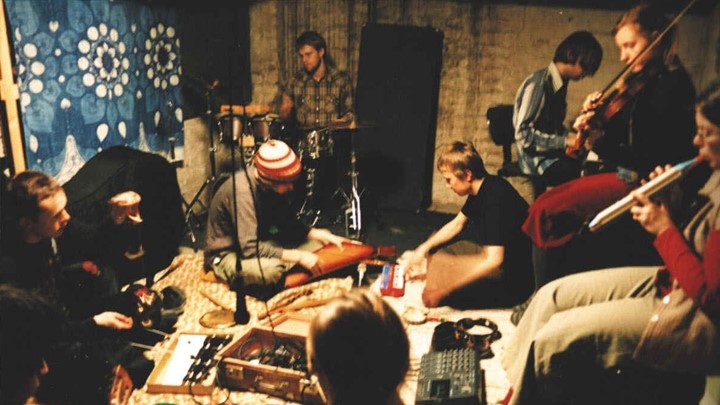
A collection of pieces on the fringes of folk music, where the communal, earthy atmosphere has been lifted from the bounds of rhythm and conventional structure and carried into a realm of unbridled beauty. These tracks are often ecstatic and sublime, but there is also a mysterious energy that lurks beneath.
00:00. Jackie-O Motherfucker – “Amazing Grace” from Fig. 5 (Road Cone, 2000)
10:01. Davenport – “Free Country” from Free Country (Foxglove, 2004)
13:00. Wooden Wand & the Vanishing Voice – “Sun Sets on Clarion” from Gipsy Freedom (5 Rue Christine, 2006)
15:20. Three Forks – “Firewood” from Firewood (Metonymic, 2005)
19:44. The Hands Free – “Needle & Thread” from The Hands Free (New Amsterdam, 2018)
26:24. Scatter – “Orbling” from Surprising Sing, Stupendous Love (Pickled Egg, 2004)
29:07. Mike Cooper & Tasos Stamou – excerpt of first untitled track from London Taximi (Coherent States, 2017)
34:32. Kemialliset Ystävät – “Valojuopot” from Kemialliset Ystävät (Fonal, 2007)
Review: Anton Mobin & Le Syndicat – Le Désordre (Middle Eight Recordings, Aug 1)
 French sound artist Anton Mobin’s primary approach to music-making is a distinct and memorable one; he (at least, most notably) improvises within a given space called a “prepared room,” in which modified instruments, trivial objects, and other materials are amplified by electroacoustic transducers and guitar pickups, providing himself with a freedom not often found in even the most extended uses of traditional instruments. Le Désordre is the latest document on Mobin’s label Middle Eight, which is dedicated to releasing his own various solo and collaborative endeavors, and presents a cacophonous interaction with Jean-Marie Onni, a.k.a. Ruelgo, from the long-running collective Le Syndicat. The recordings are hulking and rust-covered, with both participants using magnetic tape to exert control over a mass of industrial-strength bangs and clangs. The woozy, uneasy presence of the tape manipulations, along with Onni’s contributions via digital interfaces, provides an excellent contrast to the metallic din, sometimes tempering the noise with spectral treatments or high-speed dragging, other times melding in uncanny harmony with the clatter—like on “Bazz,” when Mobin’s rattling of an unknown object is accompanied by moisture-saturated fast forwarding and an array of diminutive glitch textures. The two artists’ creations are fast-paced and never stay in the same place for long, but they never fail to craft an amazingly detailed amalgam of sounds, even in the briefest of vignettes.
Review: SCLD – Feall Beul (self-released, Aug 17)
 I think a lot of people would be interested to know what the hell goes on in the mind of Chris Douglas, the sound artist behind a staggeringly prolific multi-artist discography, collected under the Amhain moniker on Bandcamp. Since I heard k[:\y/b[4.g\, the first of Douglas’s releases I came across, a little over a year ago, he’s put out an overwhelming amount of albums under various aliases, but I finally seem to be catching up. Feall Beul, Douglas’s first material as SCLD, makes further forays into the realm of disorienting digital synthesis he’s explored on Reclats and Bytreqw, whipping serrated chunks of unruly data outputs and bulbous glitch globules into a whirlwind of seething electronics. Purposeful construction of music like this can result in a potently physical presence despite the insubstantiality of the source, something that’s definitely achieved with Feall Beul; almost mimicking the percussiveness of contact mic abuse, the dense electrical hodgepodges slam and crunch on “x8ud3h,” scrape and snag on “d3u9d7,” and slowly boil over throughout “f2q4f4,” in which some undercurrents of melody can be discerned amidst the erratic tendrils.
Review: Telmetale – Telmetale (tmrw❯, Aug 15)
 “Tale,” the opening track from Telmetale’s debut C20 that takes up the entire first side, rises from the darkness like a whirling spectral apparition, composed of skulking drones and hair-raising prepared guitar plinks. The newly formed duo consists of guitarist Jacek Chmiel and multi-instrumentalist Kamil Korolczuk, who here contributes a mixture of moody modular transmissions and live magnetic tape processing, and their chemistry is audible in the music’s consistently evocative milieu of smoke and shadow. When writing about recordings with a similar approach such as qb and Rural Tourniquet, I like to bring up the idea that small-scale collective improvisation can end up being a unified pile of sound rather than a discernible musical conversation; however, in Telmetale, elements of both seem to manifest. “Tale” is a dense and harrowing amalgam of drones and AMM-esque nocturnal clatter, but on “Serotonin” the musician’s additions are separated in the stereo field, with plasticky tape frequencies butting up against tactile scratching. The duality of source is even more apparent in “Part II,” in which Chmiel’s guitar playing becomes much more sporadic. This promising duo’s first release is queasy and unsettling, but ultimately an intoxicating document of atmospheric free music.
Review: Hoan Kiem Chess Team – Paskal’s Dream (Soft Error, Aug 14)
 The only times I’ve encountered the Ciat-Lonbarde Cocoquantus, a very unique custom-built electronic instrument, is during a deafening set by harsh noise legend T. Mikawa and as an element in Dirch Blewn’s Care Work cassette, which came out last year also on Soft Error. Here, on Hoan Kiem Chess Team’s most recent release, the Cocoquantus seems to take on a much more audible role, its “self-reconfiguring spasms” aiding in the restless electronic simmers that bubble up throughout Paskal’s Dream. The tape is an ersatz love letter to nature, a synthetic pastiche of a lush, life-filled swampland, its dense, intricate collages of bubbling growls and scrabbling crackles evoking something robotic yet undeniably organic—not far from the spectral image that adorns the cover. Assisted by the unusual sampling abilities of the Cocoquantus, the artist makes occasional forays into palettes that incorporate more purely natural elements, such as the closely-recorded creaking wood around which “Sleeper” is based, but as a whole Paskal’s Dream presents a dedicated, consistent atmosphere of sublime imitation, and despite its length remains completely engaging for its entire duration.
Review: Maciej Wirmański – Sounds of a Boiler Room and a Laundry Room (Szara Reneta, Aug 9)
 Sounds of a Boiler Room and a Laundry Room (Polish: Odgłosy kotłowni oraz pralni), the newest work from sound artist and phonographer Maciej Wirmański, was entirely recorded in the “kitchen” of his home—the quotes are present because as Wirmański states, the room is not really a kitchen by the contemporary definition at all, and is closer to what would be called a boiler/laundry room or utility room. From just the artist’s description, it’s immediately clear that this place has a special presence: “In this place time accumulate[s]. It is a heart of the house clogged with lodgments of unwanted things.” But as the subtle yet evocative 36-minute piece unfolds, we hear the indescribable energy of a “heart of the house” at work, as the sounds of the makeshift hot-water stove and washing machine simulate the pumping of blood throughout an organic system. The sporadic hum and rushing water of the laundry cycle, the clinks and snaps and pops of the heating stove, the way in which the small room seems to muffle, even embrace, the sounds within—Sounds of a Boiler Room… is an intimate portrait of a home from a uniquely limited perspective (limited in the physical sense, at least).
Review: Dario Di Francesco – Sistema (Sono Space, Aug 6)
 There is a certain frequency that caresses your bones and removes you from suffering. I always try to find it and realise a new journey and work has been made while I was searching.
Dario Di Francesco’s cryptic introduction for his newest release on Sono Space doesn’t shed much light on the actual sounds that are heard, but it does add an interesting element of unintentionality. Are the recordings that make up Sistema an inadvertent result of Di Francesco’s search for this “certain frequency”? Or is that frequency an unattainable end, which he recognizes and simply states it as an abstract purpose to cast what is actually presented in an unusual light? I doubt I’ll ever know for sure, but I will say that the sounds and textures collected to form Sistema do their fair share of “caressing”; the Italian sound artist’s quiet compositions are constructed from the barest of hums, rustles, and taps (with the exception of that jarring saxophone loop in “Cromo”), sketching out a frail and insubstantial yet undeniably physical environment. Interjections of soft clatters and sweeping scrapes act as hooks that prevent the more delicate drones from drifting away completely, which gives rise to interesting contrasts on tracks like “Cerio,” where a pillowy, tonal air current lurks behind a dainty din of clinking metal.