If you can’t tell, I’m just a bit fascinated by the ability of creatively captured environmental recordings to convey profound emotion. With this mix I’ve compiled a collection of my favorite instances where a phonographer or composer has used unadulterated sonic vignettes to explore elements that may not have been present before, where the line between the objective reality of what’s being recorded and the much less identifiable, much more abstract presence of the music becomes blurred.
Seattle Phonographers Union
00:00. Daniel Löwenbrück & Marcellvs L. – second untitled track from Stallgewitter (iDEAL Recordings, 2014)
03:54. Toshiya Tsunoda – “Seashore, Venice Beach_31 July 01” from Ridge of Undulation (Häpna, 2005)
07:13. HDL – “Laying Eggs in the Exhibits” from Whales Have Hind Legs(Sacred Tapes, 2018)
10:28. Yeast Culture – “IYS*” from IYS (Petri Supply, 1989)
15:20. Abby Lee Tee – excerpt of “Simulacrum I-VII” from Imaginary Friends I(Czaszka, 2018)
19:44. Joe Colley – “Icewater.05.02” from Desperate Attempts at Beauty (Auscultare Research, 2003)
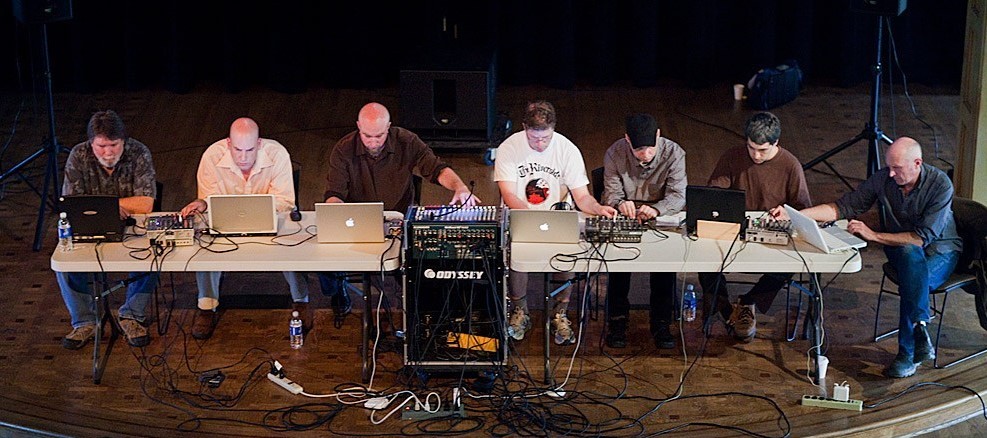
22:35. Seattle Phonographers Union – fourth untitled track from Live on Sonarchy Radio (Accretions, 2003)
26:24. Lucas Norer – “Das Unerreichbare Dort” from Portbou (self-released, 2018)
30:20. Szara Reneta – “Cmentarz żydowski w Czarnym Dunajcu” from Dawne Cmentarze Żydowskie 2 (Szara Reneta, 2018)
37:04. Ola Saad – “Cairo-Rec1” from her Soundcloud page (self-released, 2019)
When AMM brought the subversive practice of freely improvised music to the public eye, it wasn’t exactly accompanied by a championing of accessibility. With their extensive backgrounds in jazz, arcane philosophies, and overall air of impenetrable mystique, they embodied the truly unlimited potential of improvisation on the end of the perceivers, but not so much the other wondrous aspect: the fact that this form of music all but eliminated the need for any formal training or experience whatsoever. This is not to say that the performers of this curious “outsider improv” lack musical talent, but instead that the only thing of importance is the textures, sounds, and the harmonies between them that are created. This mix collects my favorite instances of the amazing results that can come from these elusive, mysterious, singular collectives and artists.
It also acts as an homage to Davey Williams, who died earlier this month. Williams performs on the first track as part of Trans-Idio.
As with the Crackle! mix I posted a bit ago, this one has a record that sort of exemplifies the concept. In this case, it’s Reynols’ 2000 release Blank Tapes, a collection of sublime collages constructed from the amplified sounds of the titular materials. To work with magnetic tape as a sound production source is to also work with insubstantiality, to carefully manipulate a fragile medium to repeat, change the speed, or otherwise alter a variety of sounds, and nothing captures that tenuous atmosphere than the use of tapes with hardly any recorded sound at all. This mix assembles my favorites of these adventures into the barest and most delicate of sonorities.
00:00. Reynols – second untitled track from Blank Tapes (Trente Oiseaux, 2000)
As soon as you attempt to classify (in this case, a more vivid–and fitting–verb might be ‘coagulate’) an artistic movement as fearless and wide-ranging as the mass of eclectic avant-garde rock music that arose in the late 70’s and early 80’s, it begins to break down. While these bands and artists are commonly grouped under the umbrella term “post-punk,” much of it owes little debt to traditional punk, instead drawing from funk, jazz, industrial, surrealist art, krautrock, and many other areas. In addition to looking backward in time for inspiration, many artists arrived at remarkably prescient stylistic cocktails. The often rough, do-it-yourself music foreshadowed things whose full potential wouldn’t be realized until much later, working with anything from collage and primitive musique concrète to tribal rhythms and free improvisation. Here are my picks for the best examples of this awe-inspiring creativity, somewhat skewed towards obscurities that have been lost to time.
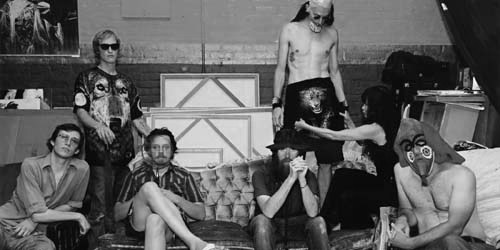
Lemon Kittens, 1981 (photo by Akiko Hada)
00:00. Mars – “Helen Forsdale” from No New York compilation (Antilles, 1978)
02:28. Clock DVA – “White Cell” from Thirst (Fetish, 1981)
07:00. A Certain Ratio – “Choir” from To Each (Factory, 1981)
09:44. L. Voag – “Living Room” from The Way Out (self-released, 1979)
12:11. 23 Skidoo – “IY” from Seven Songs (Fetish, 1982)
17:12. Lemon Kittens – “Nudies” from …The Big Dentist (Illuminated, 1982)
20:30. The Stick Men – “Tail Dragger” from This Is the Master Brew (Red, 1982)
22:32. Stutter – “These Are Small Times (Not Good Enough)” from Broken Snakes (Check, 1989)
25:31. D.A.F. – 8th untitled track from Produkt Der Deutsch-Amerikanischen Freundschaft (Warning, 1979)
28:40. Savage Republic – “Flesh That Walks” from Tragic Figures (Independent Project, 1982)
32:00. Milk From Cheltenham – “Snappy Fingers” from Triptych of Poisoners (It’s War Boys, 1983)
34:31. Alternative TV – “Graves of Deluxe Green” from Vibing Up the Senile Man (Deptford Fun City, 1979)
Michel Waisvisz wasn’t the first to explore primitive electronic textures in improvisational music, but his 1978 album Crackle (whose title track gives this mix its name) signified more than that. The record was produced using Waisvisz’s self-invented cracklebox instrument, a notably personalized version of the plundered circuits used by so many (including myself). In my opinion, it’s just as important to seek out new sounds in everyday things as it is to make them using instruments with which we are already familiar. The piercing squeaks and grainy electric sputters of circuit bending have also become a recognizable and defining texture in modern electroacoustic improvisation.
Voice Crack (Norbert Möslang & Andy Guhl)
00:00. Michel Waisvisz – “Crackle” from Crackle (FMP, 1978)
02:28. Voice Crack – “Red Square” from Taken and Changed (Falsch, 1999)
08:27. English – “Senator Bustamente” from English (Copula, 2005)
14:24. Alexei Borisov & Phil Durrant – “Part 4” from In the Wood(Zeromoon, 2018)
19:37. Jazzkammer – “Bullets for Breakfast” from Timex (Rune Grammofon, 2000)
25:26. Yoshimitsu Ichiraku – “Machine Headz” from The Music of Surround Panner (Zero Gravity, 1998)
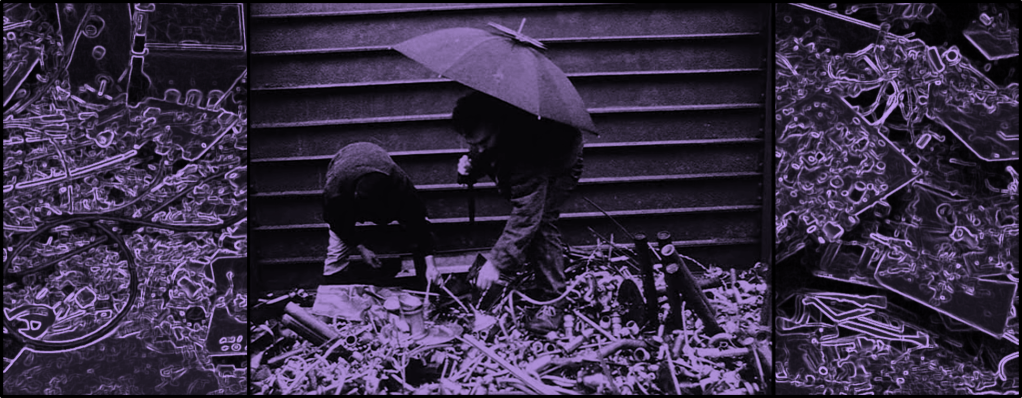
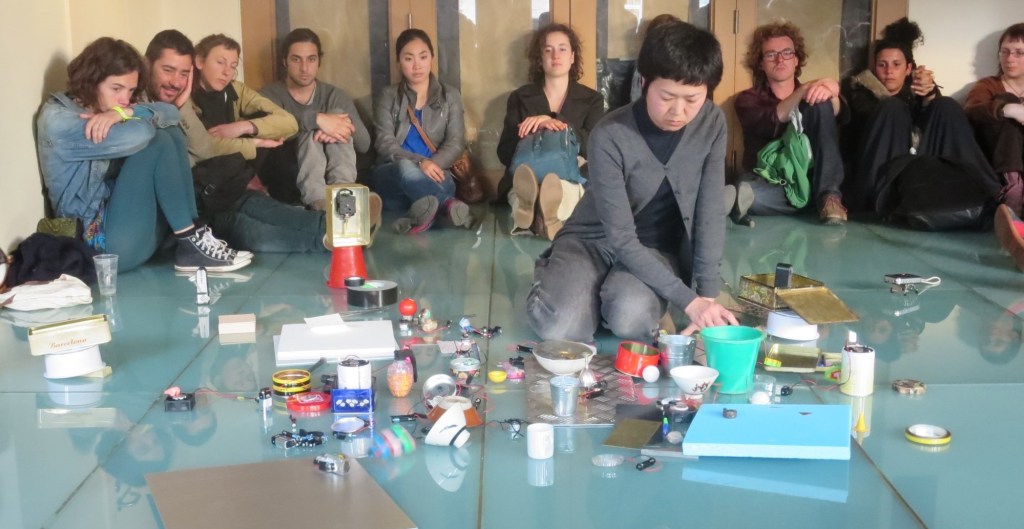
If you’re at all familiar with experimental music or adventurous sounds in general, it’s not an uncommon sight to see a musician credited with playing “objects” in the liner notes of a release. “Object” is clearly not a very specific classification, but here we take it to refer to something whose primary purpose is not music-making yielding sound, whether melodic or textural. The field of sound art is often concerned with exploring the acoustic properties and potentials of such objects, and they are also used in abstract improvisational contexts or as unconventional percussion devices. The tracks selected for this mix range from the primitive junk-painting of early Japanese pioneers Group Ongaku to manipulations of electric circuits and robotics to layered compositions formed from recordings of household appliances. I love this kind of stuff for many reasons: the use of objects requires no formal musical training or knowledge, their unique timbres can be harnessed for such a wide variety of purposes, and, most importantly, unexpected beauty is the best kind of beauty. Enjoy.
Rie Nakajima (photo by Q-02 Gallery)
00:00. Group Ongaku – “Object” from Music of Group Ongaku(Hear Sound Art Library, 1996)
04:57. Akio Suzuki – “Aeolian Harp” from Odds and Ends(Hören, 2002)
08:49. Jean-Luc Guionnet & Thomas Tilly – “Window, contact recording #1” from Stones, Air, Axioms / Delme(Fragment Factory, 2018)
10:56. John Collins McCormick – “7” from One Bone in the Arm(Pan y Rosas, 2018)
14:32. Joe Colley – “Untitled Unstable Stereo Circuit” from Disasters of Self (C.I.P., 2010)


 Noise Not Music