 When FIM kicked off in January 2024, it was the CD by Stalwart (the quartet of label founders Caleb Duval and Luke Rovinsky with Ben Eidson and James Paul Nadien) that felt most like a mission statement. Raucous and irreverent, intentionally dissonant, as interested in being combative as in arriving at some sort of cursed textural harmony, the music was and is emblematic of what I see as an exciting movement away from stylistic stagnancy and calcifying tropes in contemporary improvised music. If Blessed was the manifesto, then Enough Nihilism is the praxis. Duval (double bass) and Rovinsky (electric guitar) are once again joined by skin-shredding partner in crime Michael Larocca for this follow-up to HI-FI LO-IQ and various one-off collaborations, and the single-day, nearly eighty-minute session is their most ambitious release yet. Weasel Walter’s liner notes, though deservedly effusive, adopt an angle I find a tad reductive; while I agree that the material is a breath of fresh air in an overcrowded, “overeducated” tradition, his characterization of it as “relentlessly assaulting form and maintaining a ceaseless, bloody-minded aural intensity” misses the mark. Not only are there actually some almost tender bits here, the trio’s interplay is also less about “deconstructing” or “vandalizing” conventions and more about building their own. Sure, there’s disruption—all signs point to Duval trafficking the pop fragments (radio? sampler?) yet no one takes official credit, probably to avoid legal and/or moral culpability—but there’s also connection, moments where things which cannot or should not coexist do so anyway, and they’re beautiful. Larocca’s spider skitters and predilection for brushes pair well with Duval and Rovinsky’s string tension abuse. They get almost jazzy on “Highland Park”, then meld symbiotically with Chief Keef toward the end of “Green Jacket and Maroon Fleece.” The hard panning starts to wear on the ears a bit, and sometimes the more conventional drum rhythms throw a wrench in the momentum rather than pushing anything forward, but that’s just a natural part of taking real musical risks—not all of them pay off. Hoping to see these guys play this year, I can’t imagine it isn’t a blast to see.
Category: Reviews
Review: Commercial Roof – Internal Electric Fan (Jan. ’95 CD-Rs, Feb 2)

When I asked Bob Pulinski about this release, he simply said, “The fan had to be recorded.”
There are times and places for field recordings captured with the utmost fidelity and the least human presence possible. But as I’ve become a more curmudgeonly listener, I find less value in them as standalone music. Internal Electric Fan is the glorious opposite. It distills the practice to its most basic essence: not only the sharing of a sound, but the process of doing so. There is no editing; we hear the activating of the recorder, the scrabbling as it is moved into place, and the turning on of the fan itself. And what a fan it is. Far too noisy for any appliance that could fit in a “room at the electronics store,” a heavy current of hot air over the unmistakable hum and warble of a cheap noisy motor. It had to be recorded. But other things remind us of the room around it. There’s shuffle as Pulinski (I think) sidles over to sit and listen, creaking doors and more movement in the background (or foreground?), a dog (??) jangles its collar. The fan quiets down a bit eightish minutes into “Fan #1” (or does it?). The overall length tells us something too. It takes exactly this long to truly understand the fan, and perhaps even the room that it’s in. Get to the end, and the payoff is sublime—exactly what you think will happen happens, but you could never have predicted it would happen the way it happens. Intimate and beautifully boring, as it should be. Pulinski has the answers. He is sitting in a room (at the electronics store) different from the one you are in now. He is recording the internal electric fan.
Copies (only $7) are available via email: jan95cdrs@gmail.com.
Review: Pholde – The Central Core (Vacancy, Feb 2)
 The most understated of Canada noise legend Alan Bloor’s projects, Pholde encompasses his experiments with the sonic properties of metal in a more meditative, ambient context than the extreme amplifications of Knurl or full-throttle distortion of Pyrox. Following 2022’s Deprive of Power, The Central Core is his second tape on Vacancy and fits right in on the Niagara label’s roster of homespun sound art. When Bloor performs live, he usually rakes handheld files against either tined sculptures of his own creation or manufactured components like grill grates, looping and layering the resulting sounds to construct hypnotic tactile drones. The visual dimension isn’t here, so while it’s likely that he made these recordings with the same hands-on approach, they are so patient and methodical that they could easily have come from motorized contraptions operating of their own accord. “To Rule Against” especially evokes a forgotten machine still running in the depths of some cavernous industrial sanctum, its lonely revolutions echoing against the walls. The appeal is similar to something like Small Cruel Party—the simple pleasure of materials making contact—but the scale feels much larger, just as intimate but with more space to breathe. After decades of honing his craft, Bloor has exceptional control of pacing and dynamics; “The Lower Level Is Obtained” slowly swells like an open ocean wave, complete with tortured high-pitched scrapes like wistful whale calls.
Review: Jordan Topiel Paul & Bryan Eubanks – Pushovers (Sacred Realism, Jan 23)
 Tracked during a cold Berlin January in 2024, this first meeting of Jordan Topiel Paul (snare drum) and Bryan Eubanks (synth) finally sees life two years later. What seems to be an inauspicious instrumental pairing soon reveals itself to be anything but on Pushovers. The interplay between Paul and Eubanks approaches psychic levels. Their unified interest in certain textural inflections makes it difficult to discern where one’s contributions end and the other’s begin. The close alignment of Paul’s all-acoustic setup and Eubanks’ direct-input electronics is a testament to how well-recorded the session is: careful mic placement ensures the former’s precise hits and jumps across the stereo field are just as clear and agile as the latter’s gain swells and whip-panning. I also can’t tell (thanks to my woeful ignorance of modular workings, no doubt) whether Eubanks is processing the snare live or simply using patches that sound percussive. Either way, it’s an alluring dynamic that more often comprises mutual construction rather than response, with both improvisors embracing a classical ratatat-tat ethos, so to speak. The inclinations toward persistent but elastic repetition reminds me of French duo Phanes, whose self-titled release I reviewed several years ago. I also love the moments when Paul sets down the sticks and instead rides the strainer, setting the wires in flux between their two primary tensile states, a blurring of a boundary that’s crucial to extended snare exploration canonized by Murayama and others. The duo shows signs of running out of steam toward the end of the lengthy “Boletus / En polvo,” but they stick the landing with the more concise “Toffee / Muroidea.”
Review: Moth Drakula – Metal Arcade (Swampland Press, Dec 6)
 Of the many fondly remembered projects that made up the legendary LA harsh scene in the early to mid-aughts, Moth Drakula was one of the most prolific, putting out close to 30 splits, tapes, CDs, and even a 2xLP on iconic labels Callow God, Troniks, and Chondritic as well as Evan Pacewicz’s own small-batch imprint Swampland. Much like the rest, their fire fizzled around 2006, but after nearly two decades they revealed themselves to be not dead, but simply dormant. For whatever reason—the doldrums of the pandemic, perhaps, or the general feeling of a renewed interest in US noise, which may or may not be the same phenomenon—both members have resumed activity in a big way. Pacewicz helped put together a retrospective Roman Torment 2xCD for Phage and has revitalized Swampland, releasing printed matter as well as new solo work, while Josh Stewart, formerly of Genius Females and Bedrooms, is back at it as Ex Jesus. And, of course, together they’re breathing new life into Moth Drakula, which brings us here to Metal Arcade. Though just a brief 20-minute CD-R, it’s the first comeback material that jumps out as just as good, if not better than their original run. MD always had a sloppier, sleazier sound than their contemporaries, and that’s still the case here: the two pedal-slingers prioritize crudely sandwiched effects and brute-force impact over fidelity and precision (the production, muddy in the best way, helps too). Distortion-drenched samples build tension that is subsequently ripped apart by swipes and slashes. Warm melodic extracts bookend “Mirror Rejection,” the midst of which is overrun by writhing feedback screeches; the white-hot abrasions of “Shut Out and Crushed” drop into a loose-slung hypnosis loop. If you were waiting on an excuse to put in a Swampland order, this is it (plus the Roman Torment discog comp is only $10).
Review: Erell Latimier – Stay Still (Kythibong, Nov 18)
 Following 2019’s L’impatience directe des corps CD on Glistening Examples, Stay Still is the newest release from French poet and sound artist Erell Latimier. The LP comprises two extended pieces commissioned and composed within the last few years that continue her exploration of the web of connections between voice and sound. She’s far from the first to embark on this voyage—see last month’s review of Victual Vittle Bottle Cunt—but both “Ils seront silencieux après” and the title track display a more focused and singular trajectory than her previous work. The former is a spellbinding drama of both text and texture, making use of jarring junctures between lulling concrète vignettes and unaccompanied speech to imbue the narrative with a haunting dislocation. The spoken delivery of the tale of a profoundly removed woman (many thanks to the artist herself for providing a translation so I could follow along with the French) is at once forlorn and detached, as if the speaker is grasping onto these memories one last time before letting them go forever. It turns out that this process is audible too: the sentences begin to echo, then fracture as they’re laden with distortion and tape slur, before finally dissolving into a fraught harmonic coda. Latimier spotlights the spaces where distinctions are difficult. “Ils seront” ends with a dry bubbling noise that could be the rattling of undecided vocal cords, while “Stay Still” enlists a cast of guest speakers—Camille Belhoradsky, Eric Cordier, and Will Guthrie—to stitch a rotting lattice of half-formed phrases and abandoned thoughts. The artist’s own words are once again the unifying element, here doomed to be vivisected into jagged glitches. There’s a moment around the 13-minute mark, so fleeting you’ll miss it if you’re not listening closely, when a rare wail of raw emotion cuts through the murk and is immediately, mercilessly silenced. How horrific it is to break… or rather, to be broken, because there is indeed someone else here: “They noticed it and came to watch us. They stocked us in a large room and kept telling us: don’t move, don’t move—and after, louder, stay still.”
Review: Ineffable Slime – Deep and Desperate Fictions (Virtues, Nov 4)
 If you weren’t already aware that Albuquerque’s Ryan O’Connor, the man behind Ineffable Slime, is an avid reader and devoted independent bookseller (dig Alarum), you could probably surmise as much from the numerous literary allusions and arcane homages scattered throughout his modest but steadily metastasizing discography. Through recent releases on Fusty and Tribe he’s homed in on a distinct aesthetic steeped in European/Anglospheric avant-garde and esotericism, sharpened to a fine point with his two full-length CDs on the Milwaukee-based Virtues label (run by Alex Kmet of Climax Denial and Sexkrime fame), Stalking the Sphinx and now Deep and Desperate Fictions. The inscriptions and imagery run right off the yellowed pages of a dusty tome, and yet O’Connor’s sound is more sterile than ever. Had I not seen him play before I might assume a heavily modular rig, or maybe even some laptop, but listening closer it’s clear it’s all about the pedals—despite the crystal-clear surgical sound, the noise is too brash and beefy, its kinesis and dynamics too gestural. It’s less contrast, more amalgam due to the eclectic setup: the samples deploy via microcassettes and tape loops add agility, all while synth boxes and glitch delays work up caustic storms. Conceptually too it feels like a more serious outing than previous ones, which featured track titles such as “Quantum Suicide of the Satanic Guido” and “Liturgical Dunce Conniption”; here, ominous phrases like “Cartesian Errata” and “Casting Leaden Eternity” evoke a cold, clinical pessimism fitting for these deep and desperate times.
Review: Iris Our – Victual Vittle Bottle Cunt (Recital, Oct 31)

Kiera Mulhern and Sydney Spann’s set at the Stone Circle back in March still stands as one of my favorites of the year. Prior to that, I’d seen both artists perform individually, Mulhern in an installment of Tone Glow’s Quarantine Concerts in 2021 and Spann for the opening of her Cow, Cow, Cow, Rabbit, Recalcitrance, Bunny, Dog, Dog, Dog installation at the Center for Performance Research in 2022. Unsurprisingly, their live collaboration was a direct extension of their respective bodies of work, but it also introduced a more grounded dimension. Imperfect instantaneity; the pushing of pedals; the messy, mercurial forms of base utterance. Their duo project is now known as Iris Our and has issued a lovely recorded debut with Victual Vittle Bottle Cunt, which delves deeper into that earthy realm. Structured, as always, around voice, the short five-track suite roams complex caverns, brushing by patches of “raw pink flesh.” The sense of organic space and blurred ontological boundaries are reminiscent of Mulhern’s marvelous De ossibus 20, but where that record was introspective, Victual is universal, the free-associative conduit between the two poets swelling ever outward. Ensconced in echoing piano and murky electronics, their exchange in “The Columns of Echo’s Lymphatic Library” is a thematic invocation for the CD’s focus on “femininity understood through diffusion”: “the mouth of it / wound / wound / mouth / splits open / wound / mother” (I’m paraphrasing; many of the words are spoken simultaneously). Even with the lush sound-collage instrumentals, much of Victual boils down to just great poetry. “Debris Promise” traces rent threads via rhyme—”torn sheet, or something shorn”—while “Splits and Wants” favors textural over literal meaning with its wordless birdsong chorus. In “Erections of Angels Directed at Me,” their singing (and flute-playing) is defiant light in droning mechanical darkness. Iris Our stand in a rich continuum of subversive feminine poetics encompassing everything from Tender Buttons to Dictee, Katalin Ladik to Asha Sheshadri. Abstract as it is, Victual splits the vortex of horror with a fleeting yet concrete mantra: “weather / together.”
Copies are available from Recital and various distros: Forced Exposure, All Night Flight, Soundohm, etc.
Review: Hamid Drake & Pat Thomas – A Mountain Sees a Mountain (Old Heaven Books, Oct 20)
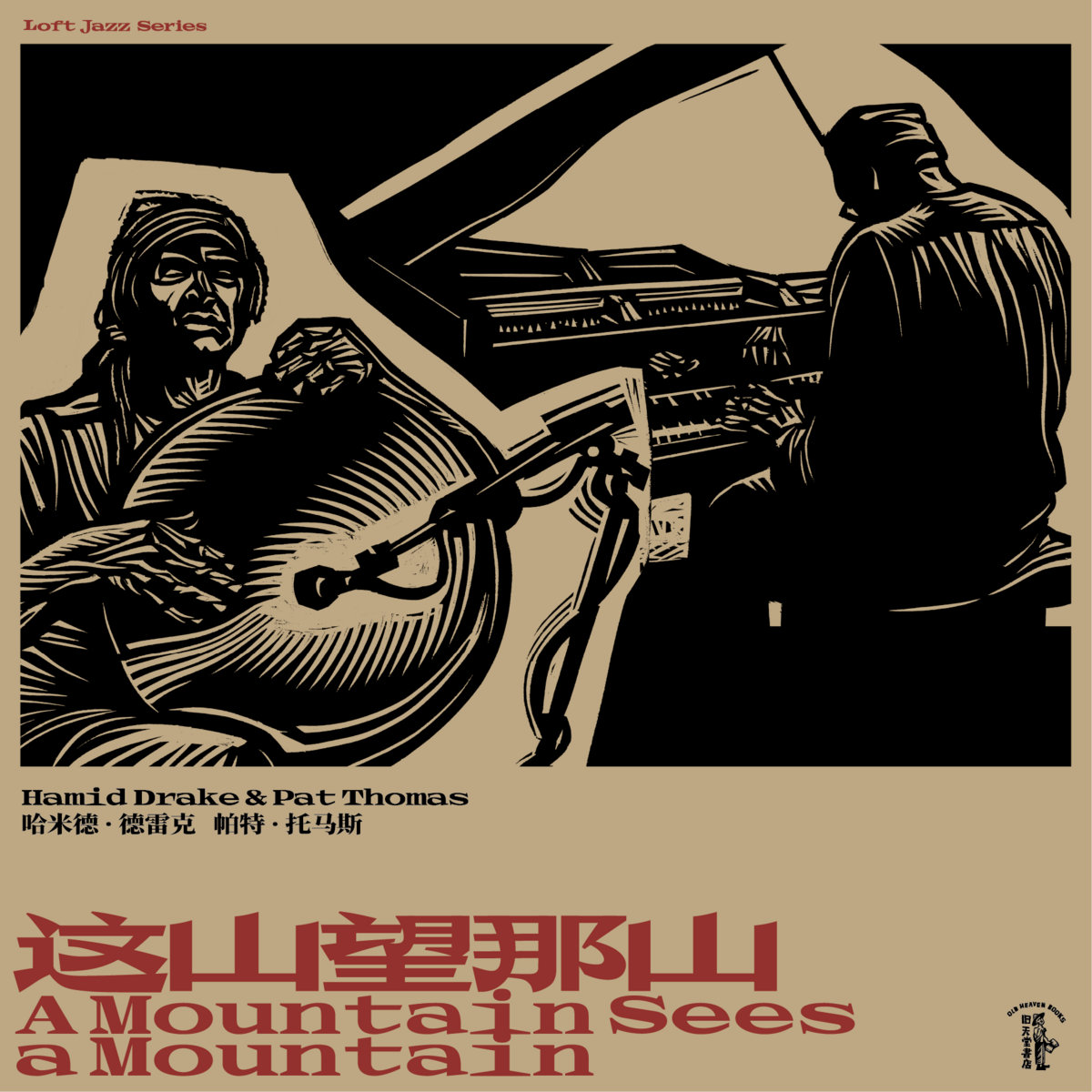 Having not heard of the OCT-Loft Jazz Festival held annually in the Nanshan district of Shenzhen, I assumed the “Loft Jazz Series” label on the cover of A Mountain Sees a Mountain was a reference to the 70s New York loft scene. This assumption quickly fell apart, of course; I remembered that percussionist Hamid Drake, though based in the city, only began performing a decade after rising rents and institutionalization brought that boom to an end, and that pianist Pat Thomas is English. While the series name may or may not be an homage, OCT-Loft references the area surrounding the OCT metro station, where the two free music heavyweights played as a duo for the first time in 2019. Six years later (to the day), their extended live session sees new life as a multi-format release on the record label arm of Old Heaven, the bookstore that curates the festival and serves as the venue for its performances. Drake and Thomas have met before in larger ensembles (twice on record, both at OTO via various configurations of Thomas’s Black Top project with Orphy Robinson) and their chemistry sits in a sweet spot between established rapport and boundless possibility. Thomas fires off a flurry of muscular dissonance to match Drake’s thumping intro to “The Spider’s Web,” but then they drop into a slow textural build that morphs into a lurching swing. Thomas deals in both convention and abstraction interchangeably: there are several electric moments when he’s banging out thick erratic five-finger clash chords or dizzying atonal right-hand runs, and then suddenly a surging groove appears as if out of nowhere. Drake’s hits and rolls are as raw and painterly as ever, but his singing doesn’t work as well here as it has elsewhere. “Friday the 13th,” the first of two brief encores, is a fleeting but thrilling climax that offers a glimpse of the raucous glory the duo could have worked up if they’d wanted to, but their restraint makes it all the more satisfying. Though the circumstances that led to this lovely hour of music may not be directly connected to the historic loft era, its eternal spirit is alive and well—this is the sound of community, of two artists separated by one ocean crossing yet another to meet an eager audience. As Drake himself says in “Time for Learning”: “This is something that we’re all doing together as one spirit, one family, you know, one love, one light, one harmony. One light.”
Review: Stimulant – Sub-Normal (Nerve Altar, Sep 19)
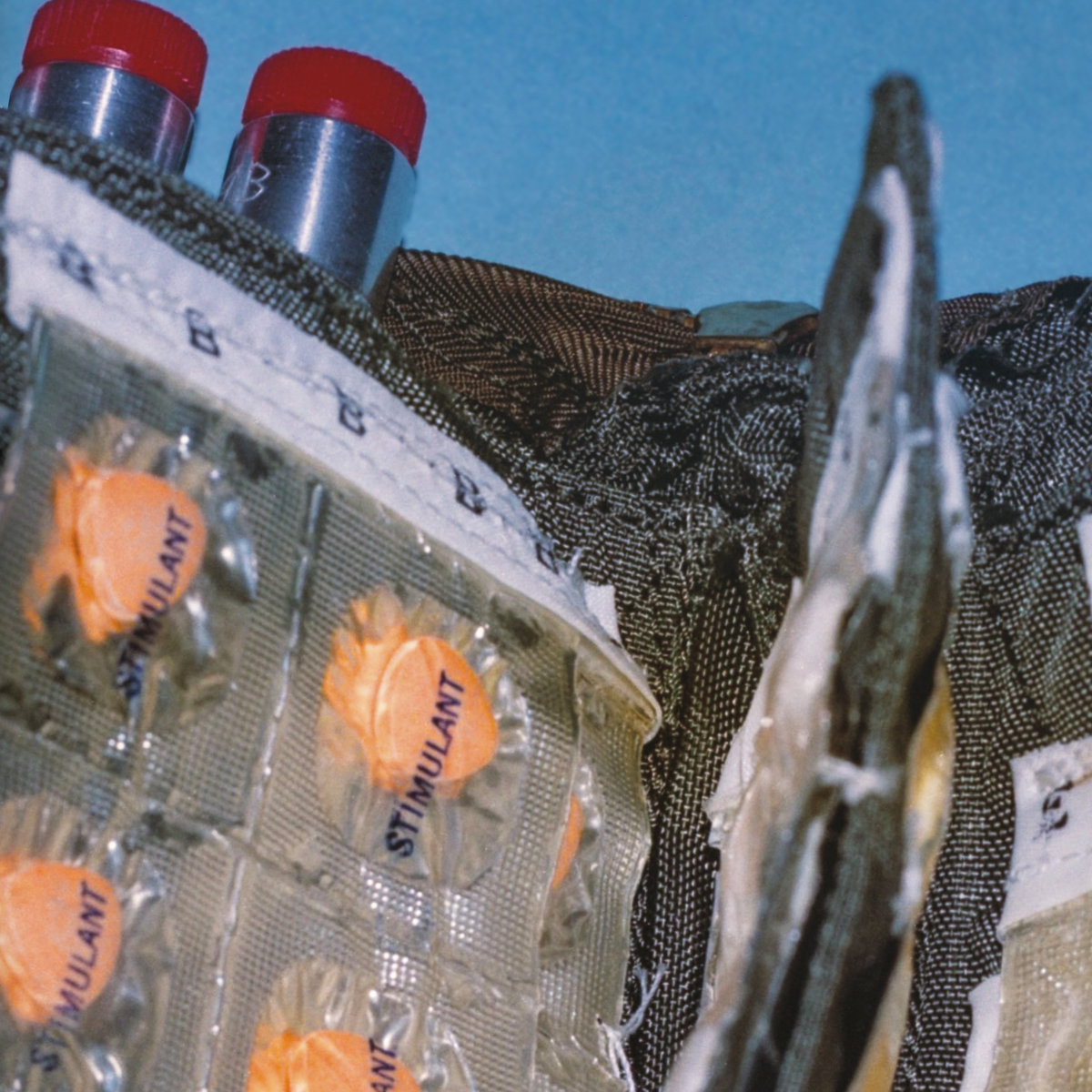 Though only around for a few years in the early ’10s, hardcore trio Water Torture are still remembered and beloved by many. Out of their ashes emerged Stimulant, a new band comprising two thirds of the WT lineup—one of whom, Ian Wiedrick, had the honor of playing with the legendary fellow Buffalo locals Snapcase post-reunion—and three thirds of the creativity and aggression. They’ve been quiet but not completely inactive since their last LP in 2020, notably making a live return last year at the Yacøpsæ/Extortion gig here in New York. Now they’re back in full force with Sub-Normal, a new full-length that offers up their best material yet (and they aren’t the only Nerve Altar alums who have reemerged with a vengeance; don’t miss out on Tempo Severo, the first CD from São Paulo shredders D.E.R. in nearly a decade). As usual the program is chomp-sized assaults of straight-shooting grindviolence. “Internment” is a reminder of what we’ve been missing, a tightly wound track that deploys the duo’s winning formula of catchy interlude riffs, muscular blast gallops, and dual vocal attack to crushing effect. Neither Wiedrick nor Thomas Leyh are strangers to noise, having also recorded a tape of unhinged power electronics together as DNR, and as always they meld it well with the music instead of resorting to undercooked interludes; the six-second “Standing Water,” for example, is almost Spacek-esque. And a Stimulant record wouldn’t be complete without a chugging sludge closer, a box that “Hubris” checks with confidence. I know this year already has you beating your head against the wall—might as well do it to this.
 Noise Not Music