
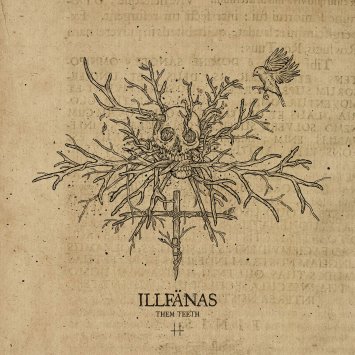
 Them Teeth have been active for more than a decade at this point and still haven’t been given their flowers, let alone the freshly picked deadly nightshade they rightly deserve. The mysterious duo had already ventured into the deepest innards of the shadowy Swedish woodlands by the time they recorded the material presented on Erstwhile and Auditory Witchcraft, they always seem to find new, even more darkness-soaked annals for their obscure sound-summonings: in the case of Sun of Serpent, Moone of Cipher the skins and strings were strung across a misty lagoon veined with slivers of lunar light; Illfänas, on the other claw, is described as “an untamed offshoot from the previously set path” of the past two records, seething and crackling with the heat of a bonfire that threatens to reduce the surrounding foliage to cinders at any moment. Raw, hypnotic rhythms have always featured prominently in the project’s sonic grimoire, but this LP elevates their presence to new heights, building each carefully structured and uniquely memorable track around pounding percussion rituals that channel both the metronomic throb of drone-rock triumphs like Outside the Dream Syndicate: Alive and Deux Lives and the supercharged Auvergnat folk music stylings of Toad. The more abstract elements of Them Teeth’s singular sound also reach new heights here—many of the meditative jams collapse or simply rot into stretches of harrowing electroacoustic dirge, leaves curling and branches blackening as the flames spread over all. It’s almost too easy to get completely lost in the outstretched arms of the forest, even as tracks like the superb closer “Du skola aldrig få hvila” prove that this is a concise and considered full-length (that also happens to be the band’s best yet).
Category: Reviews
Brief summaries intended to describe and express my enjoyment of albums. My opinions are not the focus: I purely seek to facilitate discovery.
Review: Met Glas & THRTDSPLY – Out and Out and in Favour of Anythiing (Bent Window, Jul 28)
 Calgary’s Met Glas is easily one of the most exciting new voices in noise right now, and even though van Reekum later informed me the material for this new tape on Bent Window was recorded a few years ago and differs from the sound he’s been exploring on stellar recent tapes such as Crooked Like a Dogs’ Hind Legs and Moody Brooding), it should come as no surprise to anyone familiar with the project that Out and Out and in Favour of Anythiing is still excellent. Hailing from the other side of the Columbia, Vancouver’s THRTDSPLY brings a slightly more atmospheric presence to the table, even as the almost comically overblown harsh crunches well into the far red; I’m not sure of the exact collaborative process here, whether one artist provided source recordings for the other to manipulate or it was tracked live or a mixture of both, but whatever the case there is a palpable new structural dimension to the rich, crushing analog chaos to which I have quickly become addicted. Throughout “Uselessness on Earth” the immense slabs shift and swell with surprising ease, like ten-ton chunks of bedrock gracefully transported with an elaborate system of pendulums and pulleys, so fluid one barely notices the extent to which the track evolves over its almost-twenty minutes. “Burning Existence” begins with the sound of a quarter-inch cable being plugged directly into your eardrum, your pained request for the proper adapter completely drowned out by yet another surge of righteous distortion, so thick you could cut it with a knife. This one sounds a lot more direct-action/all-hands-on-deck, but again, who knows… can’t think, skull still ringing.
Review: Hazel Cline – Spell Song (Sweet Wreath, Jul 28)
 Whether literal or abstract, the imagery of a farm, or specifically that of a barn/stable/shed, is often a grand and pastoral one in atmospheric music (and film; see also Larry Gottheim’s Barn Rushes), a connotation bolstered by the recent surge of “ambient Americana.” But as anyone who’s been inside a ramshackle wooden structure after the sun has begun to go down knows, its interior is often not as romantic as its exterior, instead becoming a space of soggy straw and shadow that seems to whisper your own thoughts back at you. It is here that Hazel Cline sews the seeds of her humble soundscapes on Spell Song: hands rattle forgotten trinkets and ephemera, breeze and breath blow across the chipped rims of glass bottles, soft voice curls in the musty air as both tongues and textures. Apparently “inspired… [by] industrial music and the sound poetry of Kurt Schwitters,” the Atlanta-based multimedia artist’s sublime debut leaves both of those influences in the dust in terms of intrigue and nuance, a distinct sonic dialect all its own growing organically from the humble minimalism of the musical approach. There is an intoxicatingly cryptic essence to these invocations, but not the sort of cryptic that begs to be deciphered—rather, the sort that, instead of simply concealing concrete meaning, abandons it altogether. A nocturnal ritual to some ears, no doubt… perhaps a dusk-swaddled lullaby to others… but to all, a must-listen foray into rural mystique.
Reviews: Kino – Recent installments in Playing series (self-released, July)
 Field recording is a practice that is both limited and unlimited in its simplicity: observe, record, present. Entirely singular to the genre is the fact that the object(s) and/or event(s) being captured comprise the majority of a recording’s artistic essence, rather than the artist’s own perspective or contributions. But now, especially with the telescoping downward spiral of irony constantly being accelerated by a post-internet culture, many purely documental works released these days do not purport to be either intriguing or informative—they simply exist, near-moot artifacts of something that doesn’t really matter, but occurred nonetheless. Kino is an artist who never seems to stop releasing music (a query of the “Kino” creator field in Internet Archive yields over eight hundred results, and it’s only one of many aliases and side projects), much of which seems to not give two shits whether anyone actually listens to it or not. Strewn between various nature recordings and contact mic examinations are the many entries in the Playing series, in which the artist simply records themselves playing a classic DOSBox shooter (e.g., Catacomb 3-D: The Descent, Strife, Duke Nukem 3D, etc.) for anywhere from two to over fifteen minutes.
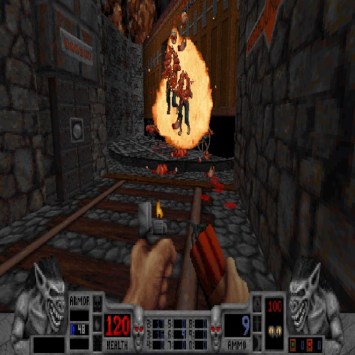 Many of these releases don’t offer much beyond that, but even with such profound conceptual humility there’s an implicit argument being made for the value of virtual sonic ecologies along with “real” ones, something that’s been explored more deeply by Network Glass (Twitch, Exercise of Whatever), Graham Dunning (Panopticon), Kelly Ruth (Simulacra), and others. The most recent installments, Playing Powerslave: Build Engine Version (Level 2: Dendur) and Playing Blood: One Unit Whole Blood (E1M2: Wrong Side of the Tracks) with the Fan on, are some of the best so far and introduce new delights with the help of the longer-form approach, especially the latter, which pulls the sonic lens back to include the sounds of the fan and the controller. There are enough ingredients for a healthy helping of unusual ambience, but the triviality is ever-present; it’s hard to settle into a soundscape when NPCs are screaming in cartoonish agony the whole time. Which of course, if you’ve been paying attention, is the point—if there even is one at all.
Review: Casa di Caccia – Grand Totàl (Absurd Exposition, Jul 21)
Matteo Castro is a name that may not be known to many, but to the few for whom it is familiar, you likely don’t need to read any more of this review to be confident that the latest Casa di Caccia material is absolutely superb. With both the inimitable Second Sleep label and his own diverse projects—Kam Hassah, Endless Sea, Drug Age with Francesco Tignola, Mercury Hall, Primorje with Giovanni Donadini, and of course Lettera 22 with Riccardo Mazza—Castro has always stood tall at the intersection of many different realms of experimental sound, bringing the same level of detail and commitment to quality in any context. That’s definitely true for Grand Totàl, the latest release from the duo with Gianluca Herbertson; it’s one of those tapes that obliterates from the very first seconds, the lush full-stereo intensity blazing throughout both ten-minute sides even as classic pedal-chain kinks like distortion panning and tension-filled brief bouts of silence keep things interesting. Any fellow fans of Negative Tongue or Lack of Attention will feel right at home for the duration of this jam-packed C21 (in almost direct contrast length-wise to the previous CdC release, one of two massive eight-cassette box sets released by Second Sleep earlier this year). At least in terms of my own retrospective thinking, harsh noise more so than most other genres/traditions in the avant-garde sphere grows and evolves regionally, and while the 90s may have belonged to the Japanese and the aughts to the North Americans, projects like this make a convincing case for the Europeans being the ones leading the charge post-2010.
What’s also great is that Grand Totàl is just one of a hefty handful of killer new tapes from Absurd Exposition; don’t miss Wasauksing Sniper, Discordia, or especially Moody Brooding.
Review: Francisco Meirino & Jérôme Noetinger – Drainage, in Six Parts (Klanggalerie, Jul 21)
 Neither of these decorated artists need any introduction, and neither does Drainage, as it turns out; part one immediately kicks things off with a web of supercharged concrète that consistently highlights both Meirino’s trademark intensity and Noetinger’s virtuosic tape technique. This isn’t the first time they’ve worked together—back in 2012, Noetinger commissioned “Techniques of Self-Destruction” for that year’s l’Audible Festival in Paris, and then much more recently the two contributed remixes to the Lingua Corrente Reworks tape compilation and released a 2020 trio live recording with Antoine Chessex as Maiandros—but it is their first duo meeting, and thus the stamp of quality ensured by each is doubled up. Those same stamps guarantee that this won’t sound quite like anything either artist has done so far, because from Additive Manufacturing and The Blind Match to Genève / Paris and La Cave des Etendards, both allow for their approaches and ideas to be shaped by their collaborator in order to generate the most singular results possible. This is absolutely the case here; Drainage operates via a musical language built from scratch, one that mobilizes processed glitches, emf interference, and other razor-sharp microsounds in a sonic sandstorm beset by lengthier samples and field recordings. Though the overall sound is a futuristic one, made possible by the more than sixty years concrete music has existed, plenty of homage is paid to the deepest roots of the tradition: fleeting theatrical audiodramas in part three, the barrage of Henry-esque creaking wood at the end of part five. The level of detail and totality of vision at work here are a wonder to behold.
Review: Farrah Faucet – Pain Body (Cleaner Tapes, Jul 7)
 The Cleaner Tapes roster continues to expand with the best of both old and new names in queer noise and industrial music. Pain Body is only the Pittsburgh-based Rain Matheke’s second tape as Farrah Faucet, the first one being Depression Body on Summer Interlude earlier this year, but the artist already displays a mastery of the power electronics fundamentals that is head and shoulders above most stuff out there, as well as plenty of singular twists that make the material fresh, exciting, and as brutal as possible. Embracing a harsh-indebted palette for the instrumentals along with a wide-ranging assortment of samples and live vocal attack, Matheke also very much takes cues from genre titans like Straight Panic in structure (that full-frontal blast after the muffled, muttered speech intro in “Lungless” is flawlessly executed) and Interracial Sex in texture, how the sounds are immensely heavy and yet seem to always be decomposing (the run of “Venom” through “Receding” makes this tape essential listening for fellow fans). But I can also confidently I’ve never heard a PE album quite like this, nor one that tackles these same topics of bodily pain, discomfort, and trauma with such depth and panache. From its uncanny, saliva-soaked lyrical delirium to the cathartic noise crescendo that swells like irritated gum tissue throughout, “Flinching” encapsulates it all in a succinct nine minutes, slathering an atmosphere that is as enthralling as it is revolting. “…I’m thinking about rot on a microscopic level.”
Review: Bryan Day & Dereck Higgins – Woven Territories (Public Eyesore, Jul 7)
 It is not up for debate that Bryan Day is very good at what he does—nor that he is the only one who even can. Not only does he scratch-build novel sound sculptures that function as both musical and visual artwork, but many of them are also fully usable instruments as well, harnessed by the same hands that cobbled them together in amazing displays of improvisational dexterity (check out this video of him playing with Jay Kreimer as Seeded Plain a few years ago). That dexterity also allows for transposition to a variety of contexts, something explored on other collaborative efforts on eh?, Eyesore, and elsewhere over the years, a recent gem being 2021’s Crooked Doppler with Seymour Glass on Tanzprocesz. Like that tape, Woven Territories dissolves any boundaries between performance, observation, and processing, making it difficult—irrelevant—to tell who’s doing what. Is this a field recording of the same space in which these machines are trundling, or is it cut-and-paste? Is that the sound of a contact mic’d vibrating surface or the growl of an old tractor engine? Any answers I spitball tend toward the imagistic because of how vivid these surreal vignettes are, painstakingly painted in all the right colors. I am a big fan of the unwieldy motifs that show up in the lengthy sketches like accidental inkblots: short synth ditties like train station announcement tones; sweeping, gauzy swirls of loosely spooled tape blur.
Review: Bulk Carrier – Derbyshire (Turgid Vermin, Jun 30)
 As Bulk Carrier tapes pile up on my shelf like shipping containers on a brine-streaked deck, one has to wonder if such an aesthetically laser-focused project dedicated (recently at least) to decommissioned vessels will itself ever run aground. And then you actually turn on the deck and listen to the latest slabs—in this case, the two sides of Derbyshire—and remember what a load of bilge those doubts are. There is not and has not ever been anyone else whose walls sound like this, slow and hulking with a hard-to-define lifelessness to it all, the dirge of a dead ship slogging. This last quality dominates both Derbyshire and May’s Ojibway, each playing like even more of a eulogy than usual. While the latter carrier was only just taken out of service in 2022, the MV Derbyshire was lost to the maw of the northern Pacific more than four decades ago in 1980, and accordingly the two tracks that comprise the tape seem to yawn from the very depths of the ocean itself, the highs minced to shreds by ruthless pressure and the lows groaning at a register that sounds more tectonic than human-made. Stagnance is the clear structural backbone, but there are always very intentional cracks in the hull that keep things interesting and unpredictable. A watery grave has never been more appealing.
Review: Trombe – Déluge (STNT, Jun 21)
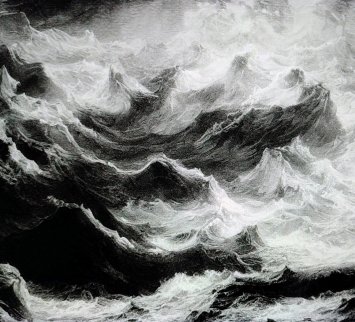 Trombe’s 2019 self-titled debut LP kicked off the Nantes unit’s ongoing two-piece experiment with a short and sweet exercise in minimal brut-jazz, with percussionist Erwan Cornic rattling chains and trinkets just as often as he plays full drum set and Thomas Beaudelin yanking the sax valves like root vegetables. But even though the duo has garnered praise from devout skronk stalwarts like Mats Gustafsson, their particular style has always had a distinct, almost delicate melodicism at its heart, and that’s only become more apparent with this brand new CD Déluge. Take “Flopée” for example, a lengthy track that opens with some of Trombe’s most straightforward free music tumble yet and ends with a serenade so sublime one has to do a double take, with the road between the two points being a relentlessly abstract and unpredictable one. “Foultitude” might be even better, and in spirit approaches the sound of Ayler/Corsano duo I’ve only heard in my dreams. This is the project’s most diverse and best release yet, and I hope its both inspired and singular approach is an indicator of a new direction in improvised music. I disagree with Takeo Suetomi’s statement that Trombe and others have “become more sophisticated and less jazz-like in their energy”; on one hand it just sounds a lot like AMMrogance (aRowegance?), and on the other, to my ears this stuff is jazzy as all hell.
 Noise Not Music