
Review: Devin DiSanto – Waiting and Counting: Domestic Ritual for the Stereo Field (Rope Editions, May 12)

There are a few reasons why I’m catching up on these mid-May releases so late; the most relevant to me at the moment is that I’ve been out sick the past week, but even beyond that a lot of material just takes longer to reach me now. Whether you’re an artist, label, or distro, please send me stuff (can be digital or physical). I want to build and grow a mutually beneficial network now more than ever.


Based in New York since 2013, sound researcher and performer Devin DiSanto has sporadically but deliberately crafted a select body of work focusing on objects, space, timing, and choice. Earlier projects like his duo CDs on Erstwhile with Nick Hoffmann and Taku Unami sketch preliminary formulations of a distinct style, but nothing I’ve heard has been as fully realized as Waiting and Counting: Domestic Ritual for the Stereo Field, DiSanto’s first full-length solo effort in nearly a decade. Released as a handsome CD run by South Korea’s newly minted Rope Editions, Waiting and Counting, in the artist’s own words, “is based around a performance determined by a partial system of cues (max patch) that occur ‘randomly’ and are intended to be listened for and responded to by a performer or small group. This activity is occasionally juxtaposed with brief sections of recordings from different waiting areas I’ve made over the years.”

The allure of DiSanto’s music has always been its algorithmic nature, sound with a core of simple mechanisms that radiates much more complex consequences, and these 15 short pieces are humbly illustrative examples. “A” and the other letter-titled segments are granular exhumations of the original sessions, their plasticine texture-stretch and spatial inversions adding further dimensions to the unmanipulated numbered extracts, which range from supermarket and sine-tone ambience (“1”) to sparse shuffle and clutter (“8”). With the simultaneous preoccupation by what’s happening inside and outside of the performance, I’m reminded of comparably radical documents like Eric Laska’s Presets & Studies or Jean-Luc Guionnet and Thomas Tilly’s Stones, Air, Axioms / Delme: down-to earth, democratic sound art with one ear to the ground and the other to the sky.

Review: Triple Negative – Rodez Island Cyclone (Cost of Living, May 23)

Triple Negative is one of those bands that with each successive release not only reminds one of how fantastic they are, but also present and explore new facets of their sound. Most, if not all of the recordings that comprise the just-arrived Rodez Island Cyclone cassette edition will be brand new to fans, but the age of the music itself varies widely; the tracks that make up the two side-long suites are plucked from unreleased material and live performances captured well before the project’s recorded era, while others were tracked just this year. Even more lo-fi and rough-edged than the already slipshod Precious Waste in Our Wake and God Bless the Death Drive LPs, the near-formless delirium of A-side (‘La La La Haine’) cuts like “Overhead Pane Stane” evoking the best of that elusive early aughts homegrown psychedelia, from the moldy corner–dwelling group improv of NNCK to the woozy, sun-dusted drones of Sunroof! and Burning Star Core. These recognizable elements are still present in Triple Negative’s current output—albeit more thoroughly assimilated—so it’s fascinating to hear such foundational pieces of the band’s singular sound in a raw, unrefined state. Newer listeners like myself will feel right at home amidst the cacophonous tribal percussion and vocal abstractions of the early bits of side B (‘The Hares’), especially “Your Face Is Written Off All Over Your Face,” but the breadth of eclecticism soon grows even more with nods to early post-punk both implicit and explicit—the collection concludes with a breathless cover of “Karen,” one of The Go-Betweens’ first recorded songs. It should already be obvious, but as usual all of the song titles are incredible, their sensical nonsense and idiomatic half-subversion echoing the equally ambiguous yet familiar music.

Reviews: Country Gun, Lapse (Small Mercies, May)

One of those names unknown to most but ubiquitous among few, Small Mercies is a relatively new CD-R label operated by Justin Lakes (Shredded Nerve et. al) that sporadically surveys the best the US noise scene has to offer. Its stylistic focus is specific yet still eclectic, drawing from artists at both ends of the extremity spectrum—e.g., the first of several appearances by Roman Leyva’s Plague Mother was followed up by a comparatively tranquil full-length by black-metal-turned-industrial act Mistletoe. While the still-fledgling imprint has already doled out a sizeable share of quality noise, this newest batch might be my favorite so far.


Country Gun – Drunk & On Drugs

“Images drift on the drugstore window. The wind has blown the smell of cattle into town. Our eyes have been driven in like the eyes of the old men. And there’s no one to have mercy on us.”

—William Gass, In the Heart of the Heart of the Country

The abstract idea of “the country” means something different to everyone, but there’s not too much ambiguity with regard to what approach this new duo of Matt Boettke and Kyle Flanagan takes (hint: less Little House on the Prairie, more Calvaire). Drunk & On Drugs is a moody, smogged-over debut, the dual sludge of electronics and tape is psychedelic in a lethargic, delirious kind of way, like the final throes of exposure. “Angel Poke” is an odd but fitting choice for a centerpiece track; displaced drones and pinched synth pulses simmer in mud-pit stasis, languidly expanding and contracting rather than steadily building toward a climax. But then, unexpectedly, “Boys Gone Wild” is just that, a cathartic howl of junk metal screech that leaves the fields blackened and barren. And it gets better every time. Plus, I mean, just look at that cover.

Lapse – Powerline

The 27th entry in the Small Mercies catalog is also the fourth appearance of Lakes’ own Lapse project, and the first in nearly two years, since 2020’s Weaponization. The alias often delivers some of the label’s most abrasive material, and Powerline is no different, comprising four assaults of crunchy, dense harsh that’s both brutish and textural. Opener “Solvent” is loud in itself (surprising, I know), ripping torrents of crushing analog gunk across a low-end floor that’s so blown out it’s almost rhythmic, but “Glue Trap” is louder. Like, whatever machine this shit was recorded on is scrap now louder. It’s glorious. The entirety of the 18-minute scorcher is actually quite varied, with plenty of new layers and frequencies and volume levels (sort of) to keep things interesting, but it never loses the savagery of its initial blast. There’s no respite or cooldown or any of that nonsense to be had in the last two tracks, and “Veronica” especially is just incredible. I’ve listened to this every day since I got it and don’t plan on stopping… and if preferring routine to change makes me a rat, then I’m a fuckin’ rat.

Review: Sophie Sleigh-Johnson – Nuncio Ref! (Crow Versus Crow, May 6)

Though the works that first exposed me to Halifax’s Crow Versus Crow—Shit Creek’s The Land of the Remember and Cahn Ingold Prelog’s Accelerate—were comparatively less voice-centric, the label’s most recent output has traced a piecemeal but still comprehensive survey of the best of U.K.-based babblers. Sophie Sleigh-Johnson is probably not as familiar of a name to most (at least compared to prolific stalwarts like Posset, Yol, and Brandstifter), but her debut(?) tape Nuncio Ref! is all the introduction you’ll need. From the cryptic Nyoukisy liner notes to the devoutly specific source material and structural logic at work in the actual music, these “first-baked tape works” (Sam and Ella? sorry, never heard of them) are both individually and collectively superb sonic arcana, the overall suite landing somewhere in the mutual outskirts of surreal radio play, hermitic tape collage, and text-sound. I firmly recommend that anyone even remotely interested in any of those art forms check this album out in its entirety, but if you really need a sample, look no further than “Napoleon’s Violet,” an easy standout that offers everything from dictaphone skronk and tactile clutter concrète to elastic speech glitching that would make Mr. LPC proud. In summary, really excited about this one. So gather ’round children, “it’s feeding time at the revised pit.”

Review: Dressing – Dressing (Krim Kram, Apr 29)

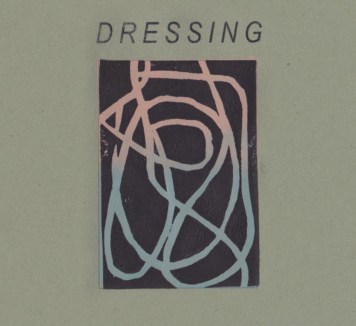
From Cork’s newest noise et al. label Krim Kram comes the first widely available material by Kevin Kirwan’s Dressing project, and even standing shoulder-to-shoulder with two stalwart avant cornerstones (representing the BUFMS and the LAFMS, respectively) in this inaugural batch, the Dublin-based tape- and feedback-wrangler delivers some compelling, memorable, and truly striking music. Culled from two micro-edition C20s Kirwan put out himself last year on Dul Amú (early Barn Sour catchall disc when???), the four tracks that comprise this self-titled offering can all be heard as meditations on/in abandoned, dilapidated dwellings, meticulous orchestrations of all the noises and nightcrawlers that scuttle in the shadowy corners. “Knotted Thought” is titled appropriately, making ample use of the same tensile head-scrubbing that gives the Nevari Butchers their creeping hangman’s horror, while in the following track both more reserved (“Warm Routine”) and more abrasive (“Enduring Mercy”) moments bring to mind a wide range of other analog-based contemporaries, from Urall to Shredded Nerve. But even though Kirwan’s work certainly seems to engage with the still-thriving tape noise tradition and all its innumerable facets, there’s something fundamental about it that sets it well apart, something I can’t quite yet put my finger on. Perhaps because it is likely not something, but many things: the rage buried within even the most anemic of distortion blasts, the spiderweb logic that imbues the disarming cut-ups and jagged layers with some kind of sense, the way the sound seems to deny even as it explores. Long story short, I know for a fact that I am in no way prepared, but very much excited for whatever Kirwan has in store for the upcoming Oxen release.

Review: No Artist – Dear Master, […] (Chained Library, Apr 15)

Like many of the arcane electronic-based sound art projects given a platform by the elusive Chained Library imprint, this anonymous cassette release, based in the nebulous darkness of Emily Dickinson’s infamous “Master” letters, has a conceptual fabric that is perceptible yet obscure, bursting at the seams with palpable meaning that itself is impossible to ever fully pin down. Embarking on diverse textural excursions through seething noise, fractured recitation both artificial and organic, and deconstructed lexical null-scapes along the lines of Porcje Rosołowe and Łukasz Podgórni’s previously peerless Skanowanie balu collaboration, this sonic reimagining of Dickinson’s alluringly cryptic, genre-defying shadow correspondence is literary in its own right, the poet’s trademark em-dash onslaughts and epistolary subversion transposed to stuttering glitches and a total abandonment of the conventionally musical. Of note are the centerpiece track “Oh – did I offend it” (titled after one of the best-known phrases from the letters), a swirling micro-apocalypse of circuit-board industrial and barely intelligible, constantly shifting speech; and closer “If you saw a bullet,” which seems to be composed of a single utterance fed through a complex effects loop. Though it isn’t crucial to be familiar with the “source” material to enjoy Dear Master, […], I highly recommend you check it out regardless.

Buy the tape via Chained Library’s website or stream all seven tracks on their Soundcloud.

Review: Gorgeous Gorgeous – The Expressionless Fear (Brachliegen Tapes, Apr 1)

In a way somewhat similar to Cheerleader, Jun Konagaya’s newest release as Grim, the rhythmic presence of The Expressionless Fear is ephemeral and unreliable despite its abrasive heaviness, as if it were just as likely to have been created as an accidental byproduct of forcing far too much gain through a low-end speaker system as by artistic intention. I would hope, at least, that the truth is somewhere in between, but regardless of what went on behind the scenes, Busan producer Gorgeous Gorgeous has delivered a beautiful heap of still-sputtering industrial wreckage with this new tape on Brachliegen. Bitcrushed almost to oblivion and mastered so loudly that it’ll shake the very plastic of your headphones, opener “Ankle Lock” wastes no time bulldozing a trampled, charred path for the rest of the rusted machines to stumble down, crafting a kind of shellshock hypnosis with the oscillations between piercing screeches of feedback and hydraulic-press bass hits. “Throwing Knife” is even more trance-inducing, whether due to the intoxicating 3/4 plod or the dangerously high volume; “Fetterer” almost approaches psychedelia with its wounded loops; and “Grotto” is essentially a power electronics track that trades vocal elements for—get this—more noise. Whether this thing scares you shitless or reinvigorates your existence, or both, it will invariably get your blood pumping.

Reviews: Grey Windowpane, Roadhouse Duo, Staubitz and Waterhouse (Fruit of the Spirit, March)

Subtitled with the tagline “Free Sound and Vision for the Ages,” newly minted barebones blog/netlabel hybrid Fruit of the Spirit is one of several promising independent music sources stepping up in the wake of recent events, and is probably the one I’m most excited about. Each release is simply hosted on Google Drive in whatever format and metadata the artist(s) sent—farm-to-table freshness! My three favorites of the first wave of titles (all of them duo concoctions, incidentally) are the following. I’m not sure if there’s a way to directly support the label yet, but I hope there is soon.


Grey Windowpane – Catskin (Mar 14)

Cobbled together entirely from long-distance digital exchanges of “samples, cut-ups, voice memos and instrumentation,” Transatlantic duo Grey Windowpane’s debut Catskin is a series of messy yet careful collages, each one offering a casual, almost careless strain of theatricality that gives the hour-long album a deeply narrative feel. The vocal elements are some of the strongest and most memorable, from the Black Dice–esque nonsense psychedelia and unhinged lunacy of “Drillers Don’t Trip” to the evocative layering of “Yards of Valiente” and “Shane,” but contributors Troy Curry and Michael “Ma” Turner also include plenty of more inconsequential sounds as well (the shrieking teapot featured prominently in “Friday’s Needle” is a favorite).

Roadhouse Duo – I Am Stuck Between Two Cars (Mar 15)

I don’t know anything about Equipment Pointed Ankh, the band from which the Roadhouse project(s) apparently arose, but the hazy flume ride that is this tour CD-R is more than enough motivation for a deep dive (it’s unclear when the actual physical edition was first released). Chris Bush and Jim Marlowe pinwheel through several stylistic milieus throughout the single half-hour track, New Zealand earth-drone yawns and airplane-engine guitar roar and finally the most tired, dusty dance music, but its consistent character is that of a free-flowing jam, a.k.a. exactly what I needed this week.

Staubitz and Waterhouse – Live at Mystery Train 10/1/21 (Mar 20)

It shouldn’t be surprising to anyone that Pawtucket collaborators Mary Staubitz and Russ Waterhouse are just as compelling as a live unit as they are a process duo (for most of their releases, Staubitz records and Waterhouse processes/edits), but now this 3″-length document ensures that the evidence is out there, just in case. From their diverse arsenal of turntables, garden implements, electronics, and pre-captured sounds arises a whimsical but weighty atmosphere that gives the same uncanny comfort as a shrine made from yard detritus (or limes and paper). I was initially caught off guard by the somewhat clumsy tambura drone that elbows its way in around the ten-minute mark, but it almost immediately peters out and then bounces back, wracked with the same organic instability as all of the other ingredients.

Review: Barn Sour – One Trick Pony (Staighre, Mar 11)

Is there any act with more of a paradoxical mixture of obscurity and ubiquity than Barn Sour? Not exactly likely your next-door neighbor would have a copy of Conté for Dick ‎in their frequent listening stack, but ask anyone at a niche record shop or sparsely attended basement show and they’ll almost certainly have at least heard some of the buzz, because the snorts, neighs, and whinnies of Winnipeg artist Pat Klassen’s most fascinating project have quickly shaken the underground music community to its core. That was true even before the release of One Trick Pony on Matthew Sullivan’s new-ish imprint Staighre, but now, with what I can already confidently call their best work yet, Barn Sour has branded themselves as an unmatched and truly terrifying sonic force. The first two tracks immediately introduce the diverse palette of the release, a seamless amalgam of elements and emotions previously explored: weighty, fraught tape ambience; impressionistic piano and organ resonance; queasy delirium; incoherence both cathartic and horrifying. “Gouch Call” is an early standout with its strangled sax babble and guttural gargles, conjuring what is perhaps the fullest realization of the project’s consistently indescribable atmosphere—that is, until “Peace, Be Still (Mane Mix),” which is easily both the most frightening music I’ve ever heard and my new pick for favorite Barn Sour track. The unnamed contributor whose manic laughter graced the A side of horses fucked over the head with bricks returns to take part in a hair-raising dual-vocal attack, chilling shrieks and startling pitch-doubled shouts and feverish giggling all trampling over the ersatz slur of a mortally wounded phonograph. Even with such a towering precedent “Foal Dub” closes things out perfectly, hanging up the bridle in a loose, careless, apathetically ambiguous way that makes it clear one, two, ten listens won’t be nearly enough. I’ll check back in at #100; stay saddled.

Review: The Gerogerigegege – >(decrescendo) Final Chapter (いぬん堂, Mar 9)

Even for someone who was not only just then getting into Gero, but noise as a whole, the surprise comeback release of Moenai Hai in 2016 was an exciting event, to say the least. Thinking back, perhaps more so than anything else that experience was the catalyst for the solidifying of my interest in experimental art in general. I’m far from alone in having a deeply personal connection to Juntaro Yamanouchi’s infamous project; awe, curiosity, nostalgia (of varying sorts and sizes), and gratitude are just a few of the many emotions that their music, aesthetic, and philosophy—or lack thereof—evoke for fans all over the world. Though the band has remained active for these past six or so years, the recent concluding installment in the >(decrescendo) series already feels like another significant, poignant milestone in a formidable body of work. This is attributable to the fact that, over its two-disc sprawl, Final Chapter carefully enshrines so much of what defines Gero’s undefinable art in a single, inexplicably unified acoustic experience. “Farewell Dream Treatment (a.k.a. Our Dream Is Over)” is an extended cut of the original >(decrescendo) release: a simple mono recording documents Yamanouchi quietly playing a HAPI drum at a park in the wee hours of morning, the softly malleted metallics humbly blending into the pre-dawn naturescape. The minimal, organic, solitude-steeped approach is of course not far from the hermitic reticence of past releases like Hell Driver (1999) and Gig in Train (recorded in 1993, released in 2019), but gone is the oppressive isolation and bleak despair that saturated that pre-reformation material—instead, Yamanouchi’s extended meditations sound more like a tribute to being alone rather than a desperate decrying of it. “Destructive Crust Treatment (a.k.a. To the End of the World)” elevates the beautiful, beguiling catharsis to new heights with a blanket layer of diaphanous distortion, which both alters and shrouds the sonic profile of the preceding disc like smoke over lightning storm desolation. You can still hear the pensive tones of the HAPI beneath the haze, and when the squawking birds send sharp sound-spires through the crust, the harmonies formed are nothing short of otherworldly… and yet they aren’t, because all in all Final Chapter may be Gero’s most profoundly grounded work yet, and for that reason it may also already be my favorite.

(Image credits to speranza.)