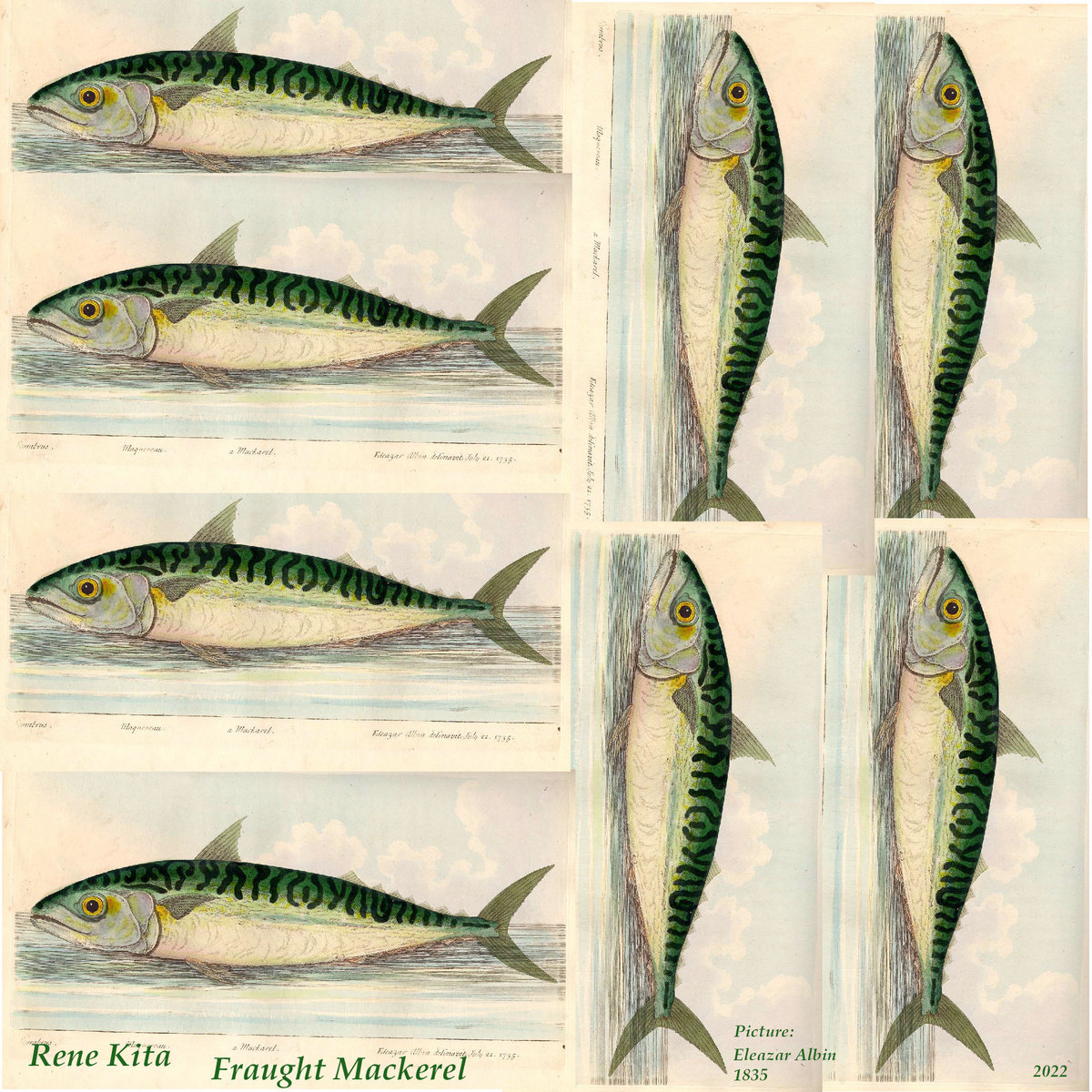
Turku artist Rene Kita, whose “main purpose in life is to draw one million faces before [they] die,” has given me and presumably at least some others a splendid, joyous gift with Fraught Mackerel. Though it barely crosses the 11-minute mark, the release feels dizzyingly expansive, stuffed to bursting with the kind of sonic density that’s just the right sort of exhausting. Many of the bite-sized segments, despite being at their cores coldly digital, have a delirious woodland effervescence that I associate with a lot of the Finnish abstract music I love, and a few are straight up magical (just listen to “Feral Molochs”; I was not being flippant with my use of “joyous”). Both within each track and as a whole, the album is undoubtedly full of nonsensical chaos, and yet—whether from our brains, the actual music, or both—even on a first listen plenty of patterns emerge: bouncing rhythms shattered into sparkling shards that do their best to reform the whole, who-knows-how-many different melodies trying and failing (or succeeding?) to coexist. But for the most part…. “Such a pretty mess, don’t you think?”
Category: Reviews
Review: crcfd – danceableas (The Absorption Directory, Feb 9)
Apart from listing that they’re based in Brooklyn, relatively new netlabel The Absorption Directory has an extremely cryptic web presence: their bio reads “Act III”; each release is tagged with the words “metallic,” “pristine,” and “shiny”; and there are no real names, external links, or context in general of any kind to be found. danceableas was the album that led to my discovery, and it’s also my favorite from the imprint’s catalog that I’ve heard so far. Like many of the other artists on the roster, crcfd owes a certain amount to electronic dance music, but here that influence appears as simply one of countless lenses through which radiant beams of computer music are refracted, the core stylistic elements simply specters on the outskirts of raw abstraction. While strange choices, the aforementioned descriptors certainly apply to this music, which feels smooth and mercurial despite its many tethers to recognizable grounding points (minimal techno bursts, eviscerated bubblegum pop, candied synthbient washes, industrial incessance). Here the sharp, crystalline sonorities of pure data output and digital mastication are a fluid fabric rather than an abrasive torrent, its constant undulations a wonder to behold. For fans of Network Glass, Bánh Mì Verlag, and Soulseek.
Review: Unfucked – Unfucked (self-released, Feb 8)
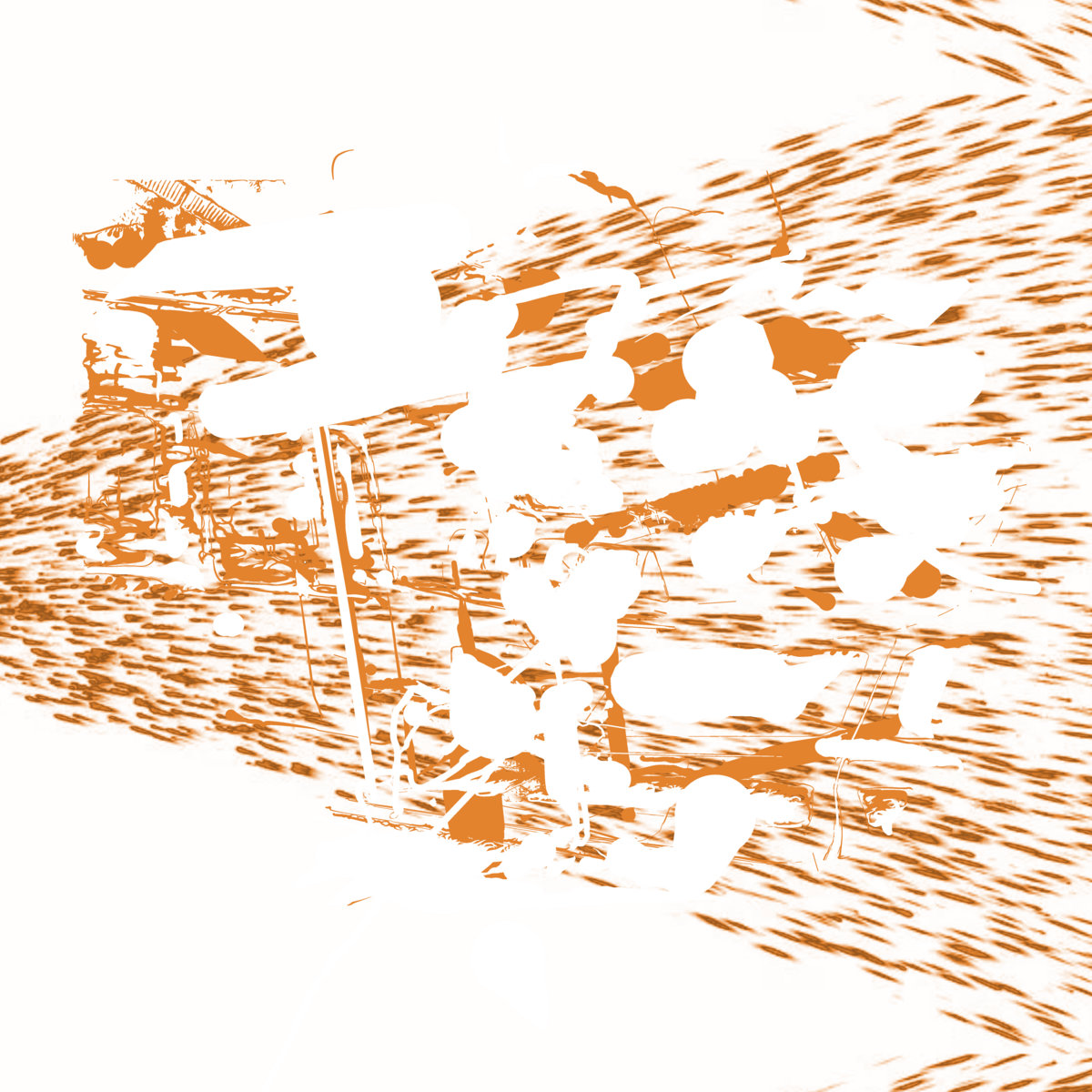
Moscow project Unfucked’s self-titled debut is just about as close to bedrock as one can get in the context of electronic music. Whether these five untitled pieces were generated using modified/cracked circuits, modular synthesis, or some obscure combination of both, the result is a series of mechanical yet intimate meditations with fully exposed innards, at once evoking the sensation of being in the actual room with the artist as they play and the strangely comforting hypnosis of aimless, exploratory tinkering. Any time the tactile processes of creating sound are presented alongside the sound itself there’s a unique but consistently immersive effect introduced (Giovanni Lami is the main example that comes to mind), and Unfucked is no exception; the metallic clutter of pushed buttons, flipped switches, and cables yanked and plugged back in gives the sluggish sci-fi pulses and rumbling drones a quite complementary sharp edge. More environmental artifacts cast their frail shadows on the music as the album progresses: distant voices haunt the pivot between I and II; III juxtaposes soft rustling, whispers, and whistles with dense, throbbing loops; the very walls and floor shake in V. Whether it’s a splitting of seams, a dissolving of delineations, or a blurring of borders, any kind of musical boundary transgression is always welcome, especially if it’s as intoxicating as this.
Review: Psyberlama – 佛笑伽羅 (Karma Detonation Tapes, Feb 5)
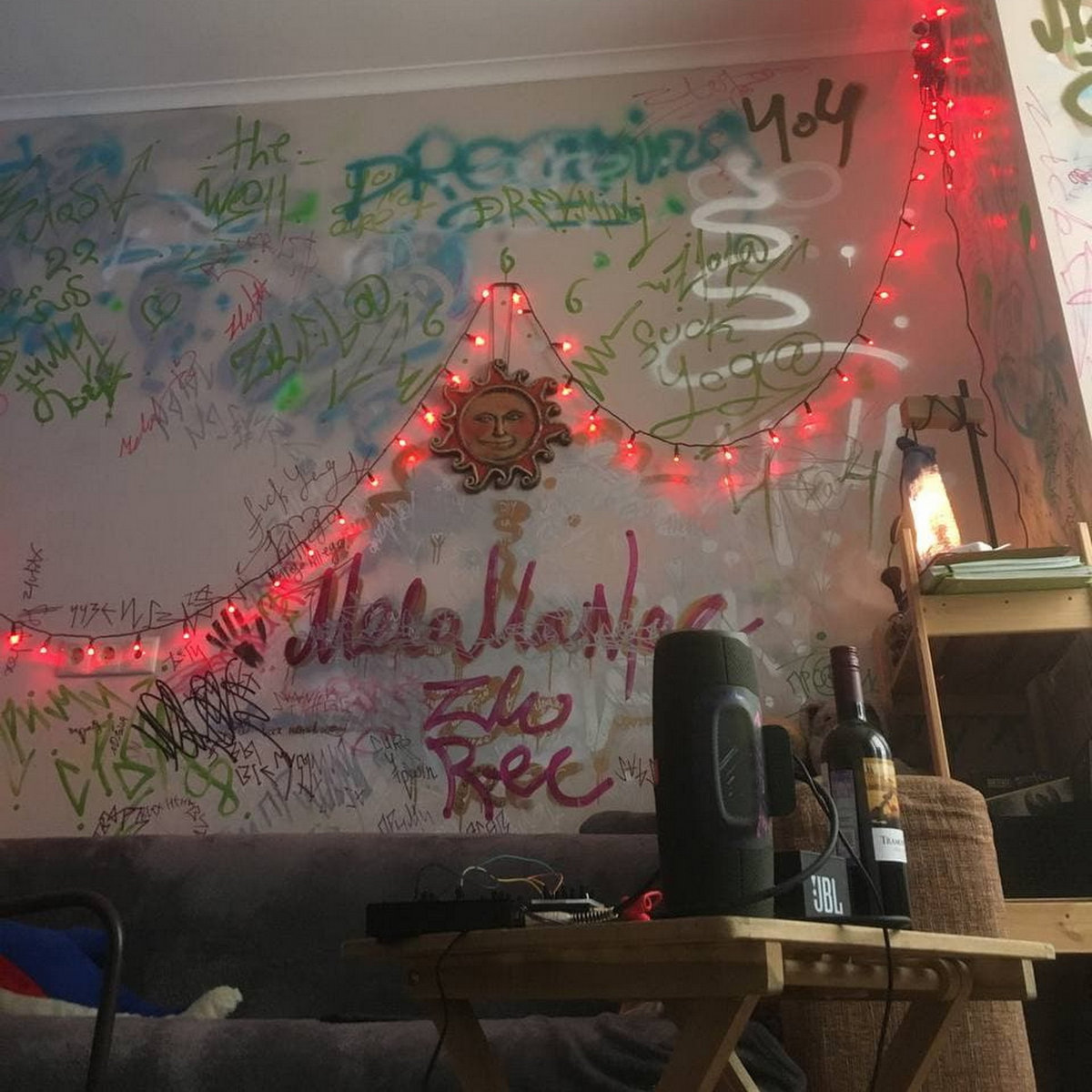
As complex as 佛笑伽羅 certainly is, it not only feels difficult but also somewhat pointless to write about, because it is so thoroughly visceral and immediate, simply music to be experienced and to recover from. Much of this scalding aesthetic intensity originates in the utterly unique improvisational dialect developed by saxophonist Chen Hong-yu and Logic wrangler DJ Wu Hun, joined on the second track of this debut tape by Lu Li-yang (they’re credited with “dub control”; I honestly have no idea what that is). On side A, which comprises a half-hour live performance in March 2021 at Meta Flexing Vol. 7, Chen and Wu sling jets of intricate abstraction toward each other like flung buckets of flaming coals, the former’s writhing ersatz arpeggios and subtly evolving phrases tangling with the latter’s heavyweight digi-percussion hits and caustic pure-electronics screech in a violent but colorful collision. There’s not actually any live processing of Chen’s playing via Wu’s Logic setup—the duo is just tuned-in and enmeshed with each other enough to conjure chaos that is at once unified and dichotomous. At first, it seems like the title track, a studio recording rather than a live one, is a more reserved and pensive affair; the repetitive minimalism Chen hints at on the previous side is now a key structural element, a lone sax swell forming the basis for steady dynamic and textural crescendos. But that steadiness is soon superseded by something more like barely contained explosive expansion, tectonic tremors seething under a clattering kettle lid while sublime steam curls in the air above.
Review: Jesucristo Mentiroso – Ruido Asesino (self-released, Feb 4)
RUIDO ASESINO VIENE ACOMPAÑAR LA IDEA TRANSFORMADA EN TRABAJO Y EL TRABAJO EN ACCION DE INFINIDAD DE PERSONAS QUE DIA CON DIA LUCHAN A FAVOR DE UN MUNDO MAS JUSTO, DE UN MUNDO MEJOR, POR QE ES UN RUIDO ASESINO OF PENDEJOS AND PENDEJADAS.
JESUCRISTO MENTIROSO
RUIDO SIN MANDATO, NI OBEDIENCIA
Being the bonehead monolingual murican I am, I’m barely able to understand any of the lyrics on Salamanca band Jesucristo Mentiroso’s new full-length Ruido Asesino, so it’s a testament to the strength of even just the vocal performances themselves that 1) a great deal of the meaning and sentiment still permeates my thick skull, and 2) there are more than a few parts that are impossible not to sing (or shout) along to. The title cut also opens the album, setting the spike-lined stage for what’s to come: multifarious, complementary assaults of ragged-throat screams, bottom-of-the-gut growls, and emotive straightforward speech; viciously technical meat-and-potatoes grind riffs played with dizzying speed and perfect imperfection; detailed, engaging songwriting that makes each track feel like its own self-contained spectacle of chaos. Classic metal covers are often rough territory for newer extreme bands, so I was a bit nervous for the rendition of Motörhead’s “Iron Fist,” but the raucous quintet handily pulls it off with a generous helping of traditional shred from guitarist Javi. And then the three miniatures following that are sheer lunacy, all of the mayhem spread across the preceding expanse now crammed into 90 seconds. The diaphanous bleakness of mood piece “Importancia” is a fitting closer, giving time to collect oneself after the thrashing just received.
Review: Defektmensch – – (self-released, Feb 3)
While I enjoy my fair share of releases that are pretty much near-silent, Defektmensch’s – seems like a deeper burrow to musical nothingness than any of them. Resolutely minimal and subdued, the short two-track debut from the anonymous new German project was created using only tape, radio, and samples, a limited palette by most standards that still appears busier than what’s actually going on in the recordings themselves. I find myself thinking back to Iniciação, which to date is—lamentably—the only material by São Paulo artist Van Jack under that alias; with that album, too, I knew I had to write about it within the first fifteen-or-so seconds I heard of it. There’s something so sublimely null about the sluggish shuffle of almost-empty tape over corroded heads, the conspicuous presence of the medium itself (in the form of the hiss and low fidelity) impossibly amplifies and emphasizes the next-to-nil it contains. Even the steady if erratic trudge of the tape is subject to imposed emptiness; in “012622” it sputters and seizes as if stumbling to a finish line that keeps retreating, quietly evoking a futility that is ungrounded and abstract yet no less affecting. “020322,” recorded the same day the release was made available, is even more stifled, crumpled by a shifting weight that contracts to allow broken bits of antenna-snatched melody to leak from the sides. Is this the only honest “music” left?
Review: Tossapol – P (self-released, Feb 1)
I have previously written about the many ways digital-age artists are able to both preserve and reimagine the extreme, enthralling obscurity that once seemed exclusive to physical music, tiny homemade cassette editions or made-to-order CD-Rs that pass from ear to ear via record store bargain bins. Bangkok corner-lurker Tossapol first came to my attention with their short EP Plate back in March of last year, which I think I found while scouring the page for the “objects” tag on Bandcamp. P, however, is much, much more than just a novel curiosity (not to imply that any the project’s previous material was “just” that either). It rivals Tossapol’s past releases in its diminutivity, comprising just four short tracks “recorded by small objects with kids at Pichit province, Thailand at the end of the year 2021.” In a manner not unlike the approach Grisha Shakhnes has recently been perfecting, minimal sound cores of simple improvisation with various debris and knickknacks are surrounded by an environment seemingly indifferent to the small spot of participation at its center, and yet the two realms are very much in conversation with one another. There’s a clear partition between the shoreside gravel scrabble of “b” and the cardboard tube spun on the floor of an avian atrium in “b / b,” but the latter track both reconfigures itself and then blurs into the subsequent “s” without missing a beat, a structural fluidity that’s just one piece of P‘s humble, earnest commitment to constant boundary dissolution. For me, it easily joins the ranks of the select few musical works that captivate and comfort in a way that is completely unverbalizable.
Review: Galerie Déplacée – Tendresse (self-released, Jan 30)
Audio recordings of sound installations comprise a significant portion of the material most foundational to my learning to appreciate everything I hear (and don’t hear). Classics like Tinguely’s Sculpture at the Tate and Eastley’s career-spanning 2×CD compilation on Paradigm were and are incalculably influential on me and the way I listen, thanks in most part to their simultaneous radicalization and distillation of the relationship between the physical and the auditory. That quality, however, is somewhat predicated on actually knowing what the installation that was recorded looks like, or better yet having seen it in person; there’s an interesting limbo opened when a document is presented without the thing it documented, as I discussed with regard to Wind Tide’s release of audio from their Focused and Found Routines. But in that case we were at least given a bit of description about what the work involved, and any shred of context can go a long way. Here, with Tendresse, the Polish sound artist operating under the pseudonym Galerie Déplacée gives us what is perhaps the most precisely cut half possible—i.e., the effect without any of the cause—in the form of a digital album ripped from a cassette which in turn was tracked with roughly 33 minutes of the sound of the unknown installation. With two degrees of removal (or three?) it’s hard to tell where one plane of perception ends and another begins, so one might as well focus solely on the audio itself, which is pretty incredible. I love the subversion of clarity in using portable analog as a documentation medium, and the automated homemade-industrial mechanisms that somehow drag across and tap string instruments with bows, strike bells, and maintain swelling cells of feedback that never tip over into chaos are a perfect fit for it. The static minimalism of the overlapping operations easily immerses, and the incessant repetition is comforting, in a way, and it’s as if we don’t actually have to see the physical art at all to “know what it is.” But I bet it looks cool as fuck.
Review: Excusable Negligence – Performance Outrage Enhancement (Skunt Productions, Jan 28)
Being the humble doctor-turned-medical-startup-entrepreneur that I am, I don’t often use this site as a platform to peddle the products I distribute. But I took that damn Hypocratic Oath just like the rest of these quacks, so when I’m in possession of a batch of new pills that just feel like they need to be shared with the world, who am I to withhold the possibility of perfect health from so many? This fresh new shipment in from Kansas City, MO certainly fits the bill, so as soon as I signed off on it and bribed the courier not to log the delivery I knew I had to distribute treatments as quickly as possible. Prospective patients can find relevant details below:
USE FOR: aches, pains, anxiety, diarrhea
of the mouth, straw-grasping, dog whistling, election frauding, government destabilization, and all other ailments.DIRECTIONS: take both sides daily until symptoms disappear.
IF EFFECTS LAST MORE THAN 6 HOURS CONTACT YOUR DOCTOR. [That’s me! Hi!]
Review: Breathe Heavy – Hypothermia (Cruel Symphonies, Jan 28)
From the mysterious, unbroachable wilderness that is upstate roars the relatively new Cruel Symphonies imprint, which since November 2020 has offered a finely curated but still eclectic catalog of noise music. Breathe Heavy’s Hypothermia, one of two in the label’s most recent mini-batch (alongside the long-awaited—by me, at least—physical edition of VIVIAN’s excellent Abduction Plot) is somewhat relevant to reality at the moment, given that many of us are cursing the incessant, bitter cold daily in recent weeks; but the scathing pair of bifurcated walls, each of which covers two of the four stages of the titular condition, are hardly concerned with the everyday bite that dries hands and runs noses. This is music for the precipice of death, an iced-over end. Fatal freezing is said to be far from the most painful way to die—in the final moments, most of your nerves have shut down, and you apparently just blissfully “fall asleep”—but Breathe Heavy chooses to survey all of the time leading up to that: panic and desperation, subzero chill like so many needles in every pore, the horrible sensation of feeling your very thoughts slow to a stop. It’s not exactly a sudden process, but the first slab in “Stages 1 & 2” certainly kicks in with brutal abruptness, a thick current of chunky distortion crunch that’s made all the more punishing by the few seconds of quivering blank tape that precede its entrance. There isn’t much nuance to the sonic progression between stages, but the artist really had an incredible core blast going here, so I don’t mind hearing it in minute variations. Wait, “don’t mind”? No. I love it. Is it just me, or is it kinda cold in here?