
 If you’ve somehow managed to keep your cognitive functions intact while in the throes of her majesty Charybdis, Après Nous, le Déluge is a pretty close approximation of what you’d hear once she’s swallowed you whole. The newest release from UK south coast project Lonely Water joins the recently NNM-reviewed Galeophobia in an elusive tradition of mortally fractured, gutted aquatics, each an abrasive manifestation of both the unfathomable expanse of the ocean and the brutal immediacy of its many horrors. The four parts that comprise Après Nous, le Déluge can be confidently classified as static noise, a distinct element that introduces something new to the dialogue. Part one sears like a seashell frying pan filled with salt water, bursting forth with a forceful but ultimately lifeless current, at once violent and indifferent in much the same way as the giga-tons of pressure folding your paper skeleton in half over and over and over. After that we descend even deeper; part two is even more anemic than the first, and ends with a purposeful bout of silence that serves as a chilling transition to the volatile, haunted fissure-flares of III. There’s even more silence following the relatively short section, and then the looming swarm of grotesque bottom-feeders takes full control as IV tears into existence, its field-filling lushness the sound of kelp corpses absorbing the life force bubbling off your soggy dead flesh. As the artist themselves says, “Volume high for suffocation. Volume low for meditation.” But to be honest, I’m fine with both at once.
Category: Reviews
Review: Tetuzi Akiyama & John Krausbauer – Gift (Erototox Decodings, Jan 15)
 Granted, I haven’t heard too much of Tetuzi Akiyama’s music—in improvisational contexts, the sparse, clear, tonal guitar style he often uses doesn’t appeal to me at all—but what I have heard definitely did not prepare me for the startling radiance of Gift, a new 7″ collaboration with composer/curator John Krausbauer that strips drone music back to its raw acoustic roots. Both “A Prayer” and “An Omen” are five-minute beams of dust-encrusted light, generated via the primordial fusion of electric guitar, effects, and delay (Akiyama) and amplified violin and feedback (Krausbauer). The grandiose yet restrained energy behind the reverential meditations is easily reminiscent of the genre’s founding legends—the Dream Syndicate/ToEM, Flynt, Oliveros—but not to the point that it feels like just a tribute or throwback. Both musicians are playing with purpose here, conjuring their own tapestries of thick, gritty transcendence and then filling in any blanks left by the other’s like collaborative painters, forming a majestic twofold current whose halves ebb, flow, and melt around and into each other. One could say that it’s Krausbauer’s slicing bow and high-octane melodicism that steals the show on “A Prayer,” while Akiyama asserts more of a presence on “An Omen” with some room-shaking amp resonance, but to try to separate that which is so powerfully unified is pointless.
Review: Slowbleed – The Blazing Sun, a Fiery Dawn (self-released, Jan 15)
 The pairing of conventionally technical guitars breezing through thrash chugs and heavy metal–esque melodicism with dark, hard-hitting, mean metalcore is what I loved most about Santa Paula quintet Slowbleed’s debut EP, Never Been Worse. It was also more than enough to make me extremely excited for their first full-length release, excitement that I now know was completely warranted. The Blazing Sun, a Fiery Dawn is a huge step up for the band in every possible way, from the disturbing cover art (and Never Been Worse‘s was already great) to the execution of the exterior metallic influences that put even more weight behind the vicious hardcore assaults. The 48-second “Aurora” is an innocuous enough intro, but the following “Ice Cold Odyssey” makes it clear there is no fucking around to be found here. And from then on, there’s little to no mercy either; each track lashes out with dizzying solos, vocals straight from the depths of hell, and plodding, ridiculously brutal breakdowns that feel like being repeatedly clubbed over the head. Don’t believe me? Listen to “Sangre” through to the end and then we’ll talk. “The Law (Atonement Through Blood)” is another standout that seems to distill everything great about Slowbleed into a single blow (to the head, again). The unrelenting heaviness finally breaks for a brief moment on “Driven by Fire”—a quiet/loud-whiplashing track that, despite only being four minutes and 26 seconds long, feels nothing short of epic—and the subsequent acoustic interlude “Diluculum” before the awe-inspiring culmination that is “Graves (Pours of Earth).” I’m not usually one for the almost cheesy guitar shredding, but my god, it’s just perfect here.
Review: Nameless Mist – II (Fólkvangr, Jan 14)
 The music of Lauren Straily’s Nameless Mist solo project, despite not being too widely circulated (yet), is heavily associated with DSBM; the genre is even explicitly mentioned in the Raleigh multi-instrumentalist’s Bandcamp bio. But make no mistake—this is, at its core, beneath all the dark loathsome layers, profoundly cathartic and sometimes even triumphant music, particularly in the case of II. I don’t mean to imply that tracks like “The Behemoth” and “The Dead Woman” aren’t the abrasive, harrowing expressions of pain and hatred that they are, and there are plenty of familiar DS tropes to go around with all the plodding slowcore breaks, blasts blurred into drones, and vocals that sound like the howling knives of ice cold wind that slice at your ears when you forget your hat. I just want to make it clear that II won’t make you sad (unless you’re already sad, in which case it’ll definitely make you sadder, but you probably planned for that anyway). At least for me, the effect of this sublime opus of perfectly underproduced black metal is the reintroduction of a violent, feral appreciation for life and all of its misery and violence and impossibility, an appreciation for it as a foe rather than a friend. Existing sucks. Let’s not pretend it doesn’t. But we face it together, and that’s something. And, of course, nonexistence necessarily precludes witnessing the majesty that is “The Queen of Shadows.” Life wins again.
Review: Muster – _am_ (Slightly Off Kilter, Jan 10)
 _am_ is Muster’s follow-up to debut tape Find a City to Live in on (fittingly) Invisible Cities, an album I could have sworn I’d at least mentioned on the site before, but it turns out that not only have I never namedropped the duo of James O’Sullivan and Dan Powell, I’ve also never used the word “muster” in any context. (Which is strangely unsettling, given I’m close to a thousand posts and every single one is filled with my thesaura regurgita you all seem to not hate.) That ends today, clearly, because even though I loved Find a City enough to pick up the tape after one listen, I think I might like _am_ even more. The first three shorter pieces were improvised remotely, each consisting of a solo recording by both O’Sullivan (guitar) in London and Powell (electronics) in Brighton that were subsequently responded to by the other and then combined. The approach doesn’t erase all of the collaborative momentum that makes the band’s in-person live sessions so compelling, far from it, but the layers of separation allow for a sort of intricate aimlessness to set in, and it’s amazing. “Verser” might be the best example, a brief but meticulously detailed bricolage of hypnotic tonal resonance, impatient dial-twiddling, and assorted scratches and scrapes that are like the track’s pholcidae legs. “On the Hoof” is the only cut to have been performed in real time, and its more spacious, sprawling, mercurial application of similar ideas is a great counterpoint on which to conclude.
Review: Reaching Needles – Illwisher (Death to Dynamics, Jan 8)
 Sometimes the best walls are not the ones that immediately and loudly assert their full presence, but rather the ones that sort of creep up on you, and Reaching Needles’ first externally produced material on the promising new Death to Dynamics imprint is certainly the latter. At first blush the noise palette of Illwisher is muffled, limp, dead, swirling thickly but lazily like the dust from a dried-out bird corpse (the Ottawa-based artist has an aesthetic predilection for things in trees; see the terrifying profile image of their Bandcamp page for another example), dark and dense but lacking the force of life. It helps that the sole half-hour track is mastered rather low, stripping the sonic mudslide of any unearned abrasion and relegating it to the background. But, as I’ve already implied, there is more to this release than meets the eye, or ear (or nose, I suppose—think mothball-filled attics, sunbaked flesh, the unspeakable liquid concoction that collects at the bottom of trash bags). As the central drone burrows through the middle channel like an eager maggot, subtle details in its periphery begin to reveal themselves: chunky microtectonics deep within the core of the distortion cocoon, fleeting bits of buried hum that are often almost tonal, tremors and trembles where before there seemed to be only stasis. Perhaps death is not the end after all, and we get the privilege of remaining conscious as the earth reclaims our bodies. Illwisher is what the final stages of that would sound like. And it only takes 30 minutes! Efficient.
Review: Augurio Drama – The Noise Box (Audible Violence Tapes, Jan 7)
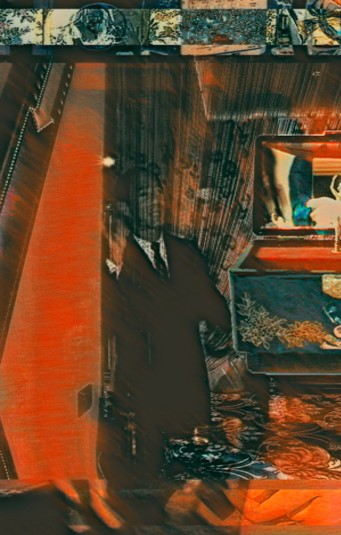 I’ve become quite fond of a specific subset of noise music that is, like so many of the other Pepe Silvia connections and conclusions I’ve mentioned here over the years, easy to identify but difficult to define. Examples are easy—Discrete Vacaction’s Dreaming Through Chlorine, :RAH:’s Songs of the South, Odd Pike and ЖЕРТВА’s recent split tape, and, just in the past week or two, great releases by Vampire Girlfriend and Peasant Farm—but when it comes down to specifying what it is that makes them similar, it gets murkier. And yet here, with The Noise Box, relatively new project Augurio Drama has created such a colorful, ostentatious prime example of precisely what I’m trying to describe that it can just do the work for me. This eight-track full length offers up plenty of noise, there’s no doubt about that, but where others sculpt theirs into mesmerizing currents, chop it into fragments, blast it with inhuman force, Augurio Drama allows it to sputter, screech, slough; more “squeezed” out than “slammed down.” The sluggish, almost careless wrangling of mono-favoring feedback torrents and distortion-smeared rumble; the snatches and shells of jarring atmospheric electronica that feel like fractured afterthoughts; the kinesis that feels just as much gestural as it does passive; the thoroughly comprehensive weirdness of it all—these things are not only the essential features of The Noise Box, but are also key elements of the sort of deconstructed, hollowed-out, ephemeral pseudo-PE that I can’t get enough of.
Review: Roller – Offed (Radical Documents, Jan 5)
 Formed in Ohio and now based in LA, Roller, the duo of Ross Caliendo and Jordan DiDomenico, has operated as a live unit with no recorded material for 15 years—until now, that is. Offed, a C38’s worth of formidably consistent material “[c]ulled from hours of live improvisation,” seems (albeit to a brand new fan) very much worth the wait. With roots in the “frigid warehouses of the mid-western noise scene” and a distinctly freeform and instantaneous approach to collaboration, Caliendo and DiDomenico’s music embodies the furthest remove I’ve encountered from the sacred, reliable rhythms of EDM that still remains firmly in danceable territory. Much of its strength lies in its seamless assimilation of electronic music tricks and tropes—countless samples of all sorts bent and buffeted, pounding patches with beats that bust open as soon as they hit, sawtooth synth transmissions—to the point that it might cast the illusion of careful composition and post-production, and yet its volatility is, after everything, what makes it so spectacular. It’s difficult to put together coherent thoughts about tracks like “Habit Man Zero” or “Homonculus” or “Endo” that check every box I didn’t know I needed, mangled Arca-style cuts over grooving bass slices and wet, stumbling mid-tempo techno and brutal four-on-the-floor broken and bitcrushed just the right amount. Can’t you tell? I’m in love. LISTEN TO THIS!
Review: Wind Tide – Sound from Focused and Found Routines (self-released, Jan 4)
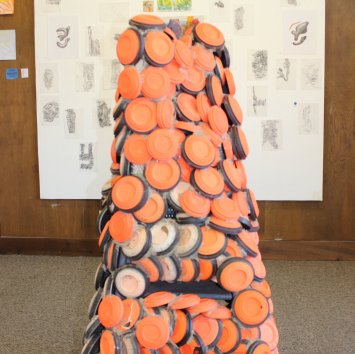 By this point I’ve witnessed a number of (but never enough) sound installations of all shapes, sizes, and substances, plenty of good and plenty of bad and a select amount of great just like any realm of art, but one thing they all have in common with one another is the creation of a new ambience. No matter how simple or quiet or minuscule its contribution is to its surroundings, no matter how much this “new ambience” mostly just comprises the old one, the soundscape is necessarily altered and—often beautifully—remade. And this is certainly the case for Focused and Found Routines, a performance-based piece by Littlefield, TX duo Wind Tide using various sound materials “moved around the gallery space over the course of the evening.” This release presents a 45-minute audio recording of the opening performance for the piece, a languid slice of abstract, hypnotic tedium that returns to the sublime discreet clatter of Journal 2020 after a few releases I wasn’t much into. Throughout the ambling drift, the raw synths squeal incessant smoke-swirls of piercing frequencies into empty space, the space that isn’t occupied by whatever is the sound of rushing water, and what sounds like at least a few radios (with some of the best grabs I’ve heard to boot) and old doorbells and small motors, and—a whole sink, that someone’s doing dishes in? And a blender? A microwave? I have no idea what the specific objects are, or if they were even actually in the room or just previously recorded, but nonetheless their cumulative semiotic aura is easily identifiable: this is domesticity displaced, the intimacies of home rendered in disassembled yet sensible form for . . . what? Examination? Appreciation? Both? Not all sound installations offer a just-as-compelling audio-only experience, but even then there’s always the alluring, unsolvable mystery of the gap in perception, the not-welcome question of “what did I miss?” to keep you occupied. And then this one. Wow. Have I mentioned that I love this band? I love this band.
Review: Nehalennia – Galeophobia (ONN, Jan 3)
 Before even listening to the music, most could probably discern using context clues that galeophobia refers to an irrational fear of sharks. The cultural phenomenon of these unfortunately scary-looking animals being perceived as merciless killers is an interesting one, because the “evidence” can really only be found at two distant points: rare actual shark attacks, and then masterpieces of cinema like Jaws, Open Water, and The Shallows, of which the latter holds considerably more weight in general consciousness. But Galeophobia has little concern with sensationalizing shark attacks in such a way, instead leaning toward the dormant terror submerged beneath the small but persistent twinges of “but what if?” when you find yourself much farther from shore than you thought you were (yes, “you”—no swimming at beaches or open ocean for me, no thank you!). Captured live during a small private performance just after the new year hit, the more recent of Nehalennia’s two new single-track offerings mashes and slices “shark encounter footage” via various effects and faulty tape equipment, working up an ear-splitting racket of horrific harsh that cuts its fin right through whatever’s between the violent immediacy of a really good tabletop set and the queasy environmental psychedelia of laughs and screams heard from across a cavernous aquatic center. Shark-related source material is far from a novel concept in noise, to be sure, but Galeophobia (along with Acolyte of Narcissist Tendency, which preceded it) is a fresh and much more enjoyable take on the approach.
 Noise Not Music