
 There are quite a few keywords that, if included in an album description, are instant attractors for me, but the same isn’t really true for bands, because most comparisons between artists—especially those made by the artist themselves—are notoriously unreliable. That being said, if C.C.C.C. is brought up in any capacity, I’m automatically all in, and Space Beyond Space, the most recent tape from relatively new Finnish duo Fricsvel, thankfully does not disappoint. The aforementioned comparison was made as part of a demonstrative stylistic continuum between the legendary Japanese project and Skullflower, and for the most part it tracks; the two ten-minute slabs of psychedelic mayhem evolve from unstable pedal-distortion rumble and sheet metal shriek to fleeting bouts of delirium, whether it’s the distant, deranged vocal specters at the end of “Within the Outer Planes” or the hallucinatory layers that shift and smother on “History of the Afterlife.” Despite these presumably being studio recordings, they still feel sweeping and gargantuan, and would sound just as majestic flooding the cavernous confines of a massive warehouse venue as they do on cheap earbuds or portable speakers. Fricsvel members Veikko Rajanen and Mikko Ahokas faced multiple tall orders with this release in living up to the high expectations set by both the introductory text and the memorable cover artwork, but their soaring conjurations easily surmount them all. See you on the other side of the asteroid belt.
Category: Reviews
Brief summaries intended to describe and express my enjoyment of albums. My opinions are not the focus: I purely seek to facilitate discovery.
Review: The Pitch – KM28 (Tripticks Tapes, Jul 16)
 I first encountered Berlin ensemble The Pitch via their 2015 live album Frozen Orchestra (Amsterdam), released just a month after their studio debut, and which features an impressive guest roster of Lucio Capece, Valerio Tricoli, Okkyung Lee, and others in addition to the core lineup of Baltschun, Nutters, Olsen, and Thieke. The sublime Sofa release, which remains a staple on my always rotating set of reliably somniferous records, demonstrates the group’s ability to conjure arresting drone meditations that sounds massive and frail at the same time, gathering both density and diaphony from their subdued string-based approach. KM28, a new cassette from formidable new improvised music imprint Tripticks Tapes, documents a live performance from October of last year that presents a few apparently novel directions for the musicians, namely forays into just intonation tuning and duo/trio subsets. Besides “Frozen Just,” a reimagining of a 2018 piece originally recorded with the prodigious Splitter Orchestra, and “Just Pillars (String Redux),” each of the sections of KM28 is titled for the materials used to create it, i.e. various combinations of vibraphone, clarinet, bass, sine wave generator, and custom magnetic tape delay systems. Though the former two tracks will feel the most familiar to existing fans—and the sustained, crystalline trance of “Frozen Just” especially is an otherworldly high point of the whole tape—the more adventurous excursions introduce welcome diversity to this often deliberately glacial music. The pair of cassette delay experiments are particularly strong; despite making use of effervescent electronic textures atypical for The Pitch, they ultimately feel just as relaxed, contained, and purposeful as the rest. What a lovely evening this must have been for those lucky enough to witness it.
Review: Iwate Yamagata – Hanada Will Say “RON” (Bizarre Audio Arts, Jul 9)
 I have never heard of Bizarre Audio Arts, which has apparently been “destruyendo oidos desde 1995” (destroying ears since 1995); nor have I heard of Iwate Yamagata, the “obscure” musician from Japan and Ecuador (!!!); nor have I heard of Yusuke Furusawa, another artist whose photographs are included in a booklet packaged with the cassette and presumably on the cover; nor have I any idea of what Hanada Will Say “RON” means. But even if you’re anything like me, who despite not wanting to admit is always desperately scrambling for context and background information, any and all frustrations will be washed away by the searing molten metal avalanche that is the primary noise palette on this thing. After a brief introduction, “Hyper Object: Thomason” sets the stage for the sort of high-octane psychedelic chaos that is to come, whipping up densely layered storms of howling feedback squall and pummeling mid-range churn. For much of its duration Hanada Will Say “RON” settles into a hypnotic static dynamism on par with the most legendary of harsh noise classics; unrelenting hyper-currents of dense, caustic distortion form a base of shifting scrap-metal sands for contained sound events within the blurring onslaught (it’s nearly impossible to tell when one track ends and another begins), which range from screeching industrial clamor and soaring errant tones to sluggish loops and haunting samples. It’s a wild ride, to be sure, and I feel like having a better understanding of what the hell, if anything, is going on here thematically or conceptually, but I’m content to wallow in ear-destroying ignorance for the foreseeable future.
Review: Bahlasti – Haunted Home (self-released, Jul 12)
 Haunted Home is a concise but dense display of do-it-yourself rough electronics sound design, manifesting across the three bite-sized tracks in the form of simmering static, broken rhythms, and howling abrasions. “Spectre” introduces the infectious structural character of the release right off the bat with its restless volatility; it finds shaky footing on a half-materialized obstacle course of needle-drop punctures, rumbling bass transmissions, and metallic-tube air drones, all the while threatening a coalescence into something more cohesive that never quite occurs—I’m oddly reminded of “There and Back” and its sister track on Lambkin and Lescalleet’s The Breadwinner. The false hints at coherence continue with “The Messenger,” which introduces punchy beat fragments that sound like a hard-hitting EBM track put through the “deconstructed club” blender. With the way it seethes and surges it could be the score to some bleak cinematic post-apocalyptic romp, or perhaps an extra-dramatic walk through an industrial city at night. “Enemies Known & Unknown,” the side-long closer (the whole release would fit comfortably on a C14), is a sort of deconstructed power electronics affair, a shifting mass of strangled bellows and distant noise that succeeds as both an aggressive assault and an atmospheric meditation. Haunted Home certainly won’t feel like “home”—at least, I hope it won’t—but everything in moderation, right?
Review: Reflection of Misery – Total Scorn of Life (self-released, Jul 13)
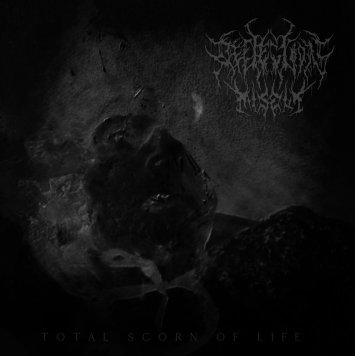 I doubt anyone would expect otherwise from a release titled Total Scorn of Life with “Orgy of Wounds” as its first track, but Nicaraguan duo Reflection of Misery’s debut demo is a dark, ersatz nightmare. Almost every sound on this thing has something… not quite right with it, the magnitude of this uncanniness ranging from slightly off-kilter to deeply unsettling. On the aforementioned opener propulsive drums and crunchy, classic-sounding tremolo guitars rise out of and fall back into ominous ambience—often at the most unexpected moments, just when you’ve become acclimated to whatever’s happening. Despite this comprising the band’s inaugural public recordings, the style and songwriting indicate a deep appreciation for the tropes, textures, and general spirit of the black metal genre as a whole, pulling from so many different influences that the result is both nostalgic and timeless. “Miasma in Decadent Wombs,” beyond somehow outdoing the preceding title’s grotesqueness, is a more focused track that shows off the two musicians’ instrumental chops, as well as their ability to conjure a tremendously hypnotic onslaught of riffs and blasts that retains a shining simplicity. It’s all one big smear of soot, ash, and hellfire-scorched bones, and yet there are also so many memorable bits that anchor our wayward minds: the jarringly hard-panned bell hits in “Orgy,” the halftime climax of “Miasma,” the slinky, lumbering groove that false-starts “Wrong,” the creeping dread and demon-babble of “Perpetual Deluge of Pus,” et cetera et cetera. From the first inhuman growl, Reflection of Misery makes the most of skeletal but worthy production and hacks open a path to an exciting musical future.
Review: dejSOMAjzla – dejSOMAjzla (NEUS-318, Jul 10)
 The eponymous debut from dejSOMAjzla (pronounce it however the hell you want until proven otherwise, I always say) is modestly labeled “IDM,” or “intelligent dance music.” Despite it being one of the worst musical descriptors ever conceived, the infamous label does tend to draw in a wider audience, but at the same time I don’t think it’s quite accurate here—if intelligent dance music is a thing, then this is galaxy-brain dance music. There isn’t a single millisecond of dejSOMAjzla that isn’t fractured and fragmented into microscopic shreds; silence abounds, everything is relentlessly impermanent, and there’s little to no rhythm to latch onto… and yet the music still feels so full and present, like something much larger is being shakily transmitted via a faulty channel, yet despite being splintered into tiny, nonsensically arranged pieces, its holistic energy remains intact within the invisible bonds between them. Each of the three tracks begin with such erratic arrangements that it often sounds as if someone is using a sampler as a punching bag, but the sporadic surges of harsh digital artifacts and electronic pulses soon begin to exude that aforementioned energy, slowly gaining an inexplicably decipherable cadence in their complex subatomic dance. This feels like something that could have come out on fals.ch back in 2000, but that doesn’t mean what it would for most other music; this sort of tinker-glitch is timeless, so if it sounds fresh it is fresh, and—well, you’ve been reading all of this (I hope), so you already know.
Review: Phanes – Phanes (2035, Jul 5)
 Information about the relatively new Paris-based label 2035 Records is sparse, but their small yet formidable catalog speaks for itself. Static-jazz freakout session 18 Luglio was already among my favorites of the year, and now I’ve been introduced to Phanes, a duo whose approach to collaborative improvisation on their debut self-titled release is even more unexpected and uncompromising than that of Where Is Mr. R?. “00000001” (all of the track titles are binary values) is the longest track by far and takes the “metronomic” descriptor to a new level; throughout the six-minute track, electronics operator Luca Ventimiglia and drummer Augustin Bette play what sounds like a game of sci-fi racquetball, any complexities only emerging within the confines of the obstinate tempo. It turns out that each piece is produced with some variation of that adherence to repetition, and piece by piece more of the character of each musician’s contributions is revealed in fleeting snippets, every section a taut, unique cell of volatile incessance. Even in the most mechanical of moments, when it more closely resembles a recording inside a futuristic clock store or a painfully slow copier spitting out pages, there is enough innate imperfection and flexibility to the music that it’s unlikely one would ever mistake them for anything other than a human creation. Though one could place Phanes somewhere in an complex stylistic family tree, that would imply their sound is a combination of things, and it actually feels more like a distillation than anything: the outermost membranes of electronic and improvised music boiled out, reconstituted, and delicately reshaped.
Review: Gemengung – The Indifference of Nature (Black Artifact, Jul 2)
 I already reviewed a Gemengung tape on Black Artifact this year (January’s E.O.T.F., a brutally dissective reimagining of Suffocation’s Effigy for the Forgotten), but the promising new project deserves all the attention it can get, especially for The Indifference of Nature, a shorter and perhaps less intimidating follow-up to the debut. The information on sound sourcing is more scarce for this one, but I’d wager based on the music being “inspired by Nature’s bestial violence” (a wording I’m not sure I’m on board with) that at least some of the crunch ‘n churn has been distilled from outdoor field recordings. Though Kjostad is an obvious comparison based on such an approach, Gemengung takes a route that’s less cracked frost and feedback screech and more catastrophic forest landslide, and in fact stuff like Laurel Noose ends up being a more apt stylistic connection to make—much to my delight. Most of the A side tracks seem to fly by too quickly after the fact, and yet within each the cocoon of restless distortion seems to sustain forever, crumbling with structural imperfections that are quickly patched with shifting sonic platelets, quivering on the edge of piercing chaos. They all contain some sort of movement, which is most likely what enables their paradoxical pace, but that changes with “Autolytic Debridement,” the sole cut on side B and a much more stagnant, sluggish, suffocating slab than the ones preceding it, which makes me excited for the prospect of a future release from Gemengung exploring static noise with their already distinctive focus on shredded, splintered harsh textures.
Review: Pascal Battus & Magali Sanheira – Froid Solaire (Entrefer, Jul 3)
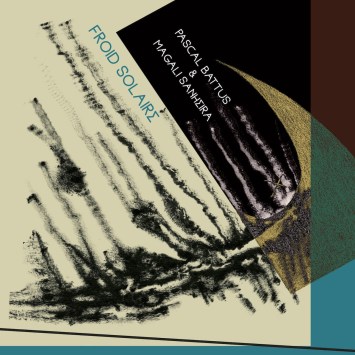 Froid Solaire feels at once intimate and massive, as if microscopic sound events like carefully calculated reactions on a laboratory counter are amplified and empowered tenfold (Anton Mobin immediately comes to mind, of course). And yet in that magnification, the arsenal of manual materials harnessed by the freshly formulated duo of Pascal Battus and Magali Sanheira—pickups, objects, devices, effects, and more—gain a hulking industrial character, with subterranean groans and gnashing machinations tracing the dark recesses of a forgotten factory. Squealing feedback begins to sound more like a terrible impending malfunction or a burst steam valve; small percussive hits are rendered as monstrous, ground-quaking gestures; and contact mic–captured sheet metal skitters become the ear-splitting screech of some gigantic mechano-leviathan scraping its oversized scales across a cracked concrete floor. And as if the atmosphere weren’t already paranoia-inducing enough, the ambient live recording, which no doubt contributes a great deal to the profound size this stuff conveys, also captures the small, near-hallucinatory noises of a restless audience: crying children, shifting seats, the occasional cough (all of which had me constantly removing my earbuds and whirling my head around like an idiot). This release would hardly be what it is without such an approach, however, so the fleeting distractions are worth it—and, to look on the bright side, a comforting and perhaps essential reminder that this is music made by people, not machinery.
Review: The Ɔrinkles Muttenjunk Bubble Floorshow – Frazzledrip Sump (self-released, Jul 1)
 If you haven’t heard of the Ɔrinkles, you’re missing out on something huge—huge, steaming, fouler-smelling than a pile of elephant shit with an entire colony of dead lemurs inside of it, et cetera et cetera, but huge nonetheless. Partially intersecting with other suppliers of surreal salubrity such as Sugar Pills Bone, Smogma, and the rest of the eccentric Buttersound clan (though if a rotten tooth–gnashing family power struggle were to take place, it’s clear our courageous Ɔrinkles would come out on top; who else promises “pandering Christian noise and other kinky aural sex innovations”?) this motley, enigmatic unit of sonic charlatans takes a different name for each release a la Caroliner and reshapes their sound to match. As the Slimane Oracle Bones Hospital they performed onslaughts of unstable filth improv and maxi-collage on par with the mighty micro_penis for Bored Bats Don’t Wrap Bones, embark on a twisted revue of cinema pour l’oreille on Bamblingozzorlutodrome! as the Sapling Flapjack Submarine, and now they turn to the reel-to-reels Joseph Hammer– and/or Yeast Culture–style for Frazzledrip Sump, an extended spurt of finely piped liquid audio-sewage. “Who would want to swim in that?” you might ask, and perhaps total-body submersion in putrid waste isn’t an ideal or sustainable form of musical consumption, but imagery of frothing, rotten runoff are unavoidable, because every drop of the source material used here seems to have come—or, rather, been discarded—from somewhere else. The only kinesis in the currents of flimsy electronic wobbles, macerated pop songs, and radio ramble is that of obstinately flowing water, rushing ever forward with gelatinous waves of magnetic tape tremble… just like “dolly ramen in the chocolate river.” The surge never stops until it reaches the bottom of the sump, and by then you’re fucked, because—as much as I hate to break it to, friend—the real frazzledrip is the slime you accidentally swallowed on the way.
 Noise Not Music