
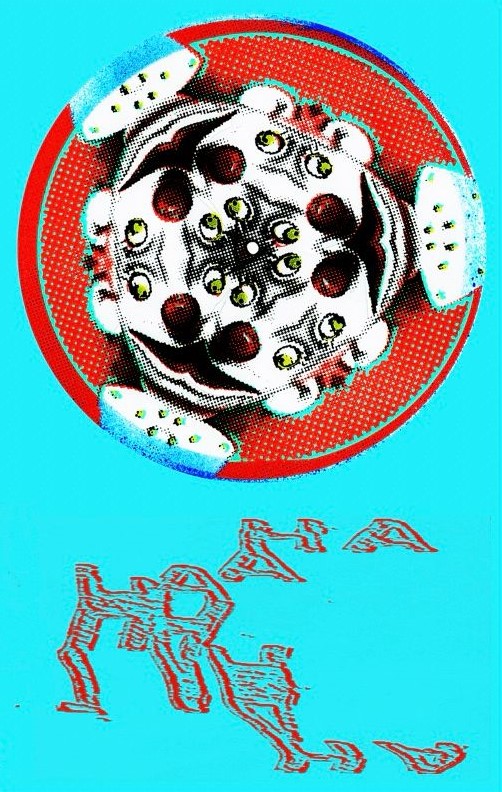
 For those familiar with the work of James “Twig” Harper Johnson, it comes as no surprise that he’s a fan of The Okeh Laughing Record, the infamous 1922 shellac 78 that features a duet of maniacal, infectious hysterics. Harper self-released a limited run of ten lathes of a personal tribute to that landmark work back in January, each one “real time cut and unique with a different algorthmitc [sic] permutation of source audio.” I only became aware of it recently, however, due to Hanson’s standardized cassette edition (it’s also not a shock that Dilloway, who also provided some of the “giggle loops” used, shares an appreciation for the Okeh record). I don’t normally review reissues, but because this one makes available a distinct version of the material—and because it’s such a blast—I elected to laugh in the face of precedent. Knee-slapping paradoxes abound in the musical process of Ha Ha Laughing Record itself: to my ears, much if not all of this is automated digital arrangements and abstractions of analog sources, which clears room for a dual allegiance to craft and caprice. Every second is crammed with gut-busting bells and whistles, all of which emerge, contort, and dissipate with an uncanny logic. I love coughing fits on the B side as well (not for nothing, it’s thanks to Dilloway that I discovered A Child’s Cry: A Clue to Diagnosis, another historic essential for any oddballs enamored with the human voicebox—see also Speech After the Removal of the Larynx). There are chuckles, cackles, and chortles galore across the half-hour duration of Ha Ha, but it’s also sort of a love song to utterance at large, a delirious gallivant around a run-down sound stage with all the freedom of knowing that the line between horror and humor is often nonexistent.
Category: Reviews
Brief summaries intended to describe and express my enjoyment of albums. My opinions are not the focus: I purely seek to facilitate discovery.
Review: Various Artists – Noise of Cologne 3 (Mark e.V., Apr 5)
 The newest installment in the Noise of Cologne compilation series is the most sprawling and ambitious one yet, with over seventy artists contributing around a minute’s worth of material. Unlike the previous two volumes, here the track list is simply alphabetical and shuffle-ready, making it more like a stuffed-full sampler than anything—something that always works for me, and reminds me of a favorite LP in my collection that I return to for the same grab-bag feel: the ESP sampler. Some names return from earlier in the series, others make their debut; some sent an original submissions, others excerpts of existing tracks; but in any case each brief concoction (especially for someone unfamiliar with the Cologne scene) is something entirely fresh and unexpected. The handful of participants I had heard before—Andreas O. Hirsch, Marcus Schmickler, Shuoxin Tan—did not disappoint. There are a lot of different things happening stylistically, of course, and yet the extensive roster makes it possible for throughlines of local trends and traditions to emerge. Oodles of modular synth exploration with echoes of progressive electronic music, for example, of which the more conventionally harmonic pieces like Elisa Metz’s “Yellow” and Neozaïre’s “Absence Killed the Lonely Lover” stood out, but I also enjoyed the abstraction of Sebastian von der Heide’s “Piombino Mobile.” Also some great a cappella/text-sound/spoken word; I’m particularly fond of the sketch-like “thinking on his singing” by Hye Young Sin. The only complaint I could possibly have is that I have a ton of homework to do.
Review: Manja Ristić & Murmer – The Scaffold (Unfathomless, Mar 18)
 I’ve been listening to and writing about the work of Belgrade’s Manja Ristić for as long as this site has been around, and by now I have reviewed more releases by her than anyone else, which, needless to say, is well deserved. Her latest work, The Scaffold, is a collaboration with Estonia-based project Murmer (a.k.a. Patrick Tubin McGinley) and probably my favorite entry in the Unfathomless catalog since 2019’s being there. Born out of a “friendship in sound and constant appreciation for mutual efforts” (Ristić’s words) and conceptually inspired by a preliminary recording made by McGinley of the titular “singing scaffold,” the handsome disc presents a pair of patient, considered phonography pieces full of intrigue and intimacy. This is languid, tranquil music, the colors layered with careful brushstrokes and the canvases sewn together with steady hands, but it also has the subtle tension that builds when domestic interiors become less like shelter and more like confinement (unsurprising, given that the artists began exchanging materials in spring of 2020). Ristić is fond of what I like to call “thin sounds,” which she lifts from the water with her trusty hydrophones and from the air via precise mic placement, and there are plenty at play here; the textures of “Zamišljena Sjena Vjetra” are as fine and fragile as water-strider legs, distant tactility making the smallest of ripples in the whispered drone of a silent home. The final ten-or-so minutes are breathtaking, thanks to a sublime tonal current that pools in through a forgotten pipe. The more active “Kaugpääs; Antenn” gently carries us to an open window, where we can hear the murmur (pun intended) of the rain and the birds and the bustle below, all cast in a nocturnal warmth by the sound of Gregorian chants carried on the breeze.
Review: Max Nordile Hair Clinic – Hanging by a Fan Over Wet Cement (Gilgongo, Mar 15)
 Perhaps the stylings of Max Nordile’s recordings under his own name and those as Hair Clinic were destined to converge. The distinct outlets have always shared a good-natured holism in their approach to soundmaking, prizing wrong notes and accidental overhearings alongside half-arranged basement serenades and focused object-bothering. But the exact relationship between the two is hard to pinpoint, which is likely intentional. Hanging by a Fan Over Wet Cement, credited to Max Nordile Hair Clinic, has a lot in common with the solely eponymous Gilgongo releases Building a Better Void and Copper in the Arts as well as last year’s Hot Bev’s Prime Melters cassette on Nordile’s own Music for People imprint, all of which feature instrumentality and environmental extracts in tandem, but the careless field sketches of “Jim’s Place” and domestic improv of At Work and at Home also belong in the lineage. Long story short, everything this guy puts out is good, and this new LP is no exception. Squeaks and scrapes of all sizes and shapes, whether they come from the squawking reeds of “Autotots” and “Off Yew Sounds” or the tactile rattle of “Lois Tenino” and “Beet Soup,” comprise a sort of unifying set of textures that helps wrangle the sonic potpourri into something more easily digestible. But the ever-shifting supply of sounds also retains its dynamism, making the record feel like a suite that even has a hint of narrative—the nomadic guitar ritual “Mug Under Roof” and dream-logic collage “Holt Larf” especially are dramatic little vignettes, the kind that come to life on stages made from driftwood and flea-market furniture. And closer “RnR Dalmation,” though the shortest, might also be my favorite; where else other than a Max Nordile track can you listen to an orchestra of scrap jinglebells, ripped adhesive tape, squeaky toys, and preloaded plastic keyboard samples?
Review: Death Kneel – Burning Grip (Life of Sensation, Mar 4)
Following the recording and eventual release of the Dawn Simulation full-length CD on Chondritic, perhaps the project’s most ambitious and fully realized work yet, Tomb Mold titan and underground mainstay Max Klebanoff has continued to keep busy with his Death Kneel alias, putting out a series of short ‘n sweet tapes on in-house imprint Life of Sensation over the past seven-or-so months. Each of the succinct slices (a C10, C11, and C14, respectively) has provided an opportunity to explore the more caustic facets of his distinct and multifarious take on heavy electronics: both Seneca Hill Haymaker and Agonizer deal in glitchy cut-up and rough-edged concrète, and the newly available Burning Grip continues this winning trend, hoisting the already intense formula to new heights with an emphasis on density, volatility, and all-around extremity. The limited real estate leaves little to no room for patient dynamic builds or sustained soundscapes; “Dogfish Head Piledriver” gets right down to business with a flailing assault of brittle crunch, the first forty-five seconds alone crammed with so many rapid-fire bursts, stuttering skips, and pulverized samples that it’s just as tempting to start over and take it all in again as it is to keep listening. The remaining six minutes of the track, as well as the B side’s “Mixing My Bastards (Reactive Edit),” burrow further into the possibilities offered by this streamlined yet still diverse approach, cycling texture after texture through a punishing assembly line of automated wringers, mincers, and blenders. It may be a focused and even slightly divergent subset of the sound that made Dawn Simulation and its predecessor Adaptive Emotional Use such rewarding works, but this is still unmistakably Death Kneel: the mongrelized fusion of digital detail and analog grit, the seething mecha-industrial simmer, the gnash and snarl of a caged beast chewing through its chains.
Copies are available via email: lifeofsensation@gmail.com.
Review: Lean – Sounds (G-Tech, Mar 1)
 Improvised music is at its best when it just is, pure expression without pretenses. Necessarily self-funded, this humble approach has sustained itself via open-access internet platforms in recent decades and home-taping/trading long before that. The latter tradition is no relic lost to history, but a stubborn survivor even in a devoutly digital age, and we have it to thank for excellent art like this. When G-Tech operator Seamus Williams (TVE, A[e]yurvedic Tapes) and Mickey O’Hara (whose Bituminous Concrete Curb Detail on Ayurvedic I reviewed here last October) record and/or perform as Lean, they use nebulous junk assemblages that hum, hiss, crackle, and crumble with liquid ease, their considered interactions landing somewhere between Creode and GOD on the homegrown tabletop electronics spectrum. All of the Lean material collected on Sounds, and in fact all of the duo’s work, can be—and are, by Williams himself—described as simply “jams”: low-stakes, open-ended meetings of the minds that are as exploratory as they are expressive. On Sounds, a C60 of new material culled from the past six or so months, it’s pretty much impossible to tell who’s doing what… but that hardly matters with stuff like this. It opens with a bold bout of bass-heavy currents that retreat just as quickly as they arrive, leaving behind a simmer of cracked circuits and brooding drones. Radio plays a prominent role throughout, both as pure static and garbled half-tuned broadcast, always used gently and texturally (instead of disrupting the flow with full-on grabs). These aren’t just jams in terms of mindset, but also with regard to how they pan out: not impatient but not exactly patient either, eager to move and evolve with plenty of attention still paid to a general arc. The lengthy second track ends with a bang, making way for a B side that’s more restrained but no less fun.
Copies are available via email: seamusrwilliams@gmail.com.
Review: Clinton Green – A Conduit (Shame File Music, Feb 25)
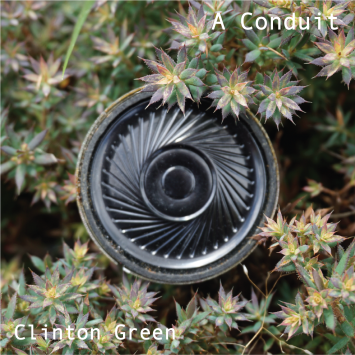 At the heart of Clinton Green’s latest is the humbly bewitching sound of several broken Walkmans looping over themselves and each other in a jittery, microscopic dance. According to the Shame File star himself, “Loose internal speakers from the Walkmans are positioned between the spindle and play-head. The parts cling together magnetically, yet are agitated by the turning spindle, creating not-quite-regular rhythms punctuated by magnetic/electronic interference.” It’s an approach that has a lot of potential despite its minimalism, a potential that is explored in depth throughout. But in a surprising turn of events (literally; beware the jump scare), the textures and twitches of the miniature motorized network are just one element of A Conduit, especially in eclectic opener “Allegations of Ventriloquism.” I already thought it was a great title, but the lengthy track—described as “a psychodrama; an opera”—delves into said allegations in a much more concrete manner than I expected, introducing a paranoid narrative via beamed-in speech scraps (provided by Michael McNab, Allan Stewart, Michael Zulicki, and Green himself), slurred tape delirium, and abstract turntable tactility. This last element acts as a kind of structural glue for the loose-strung collage, harmonizing with the miniscule rattle of the Walkmans as the skips and clunks respond to the bass and color of the sampled bits. The much briefer “Emucounter” is stripped down but no less mysterious, bringing the unmistakable buzz of an electromagnetic swarm to the foreground while guitars and reeds cavort upstage. And “Stopcock (Alleged)” is an almost scientific meditation, examining the effects of different placement configurations in a patient lead-up to a twist ending. I would be interested to hear a release that focused on the Walkmans on their own, but they also work so well here as both vital organ and connective tissue.
Review: Lès Modernos – Ciutats (Bruit Direct Disques, Feb 16)
 Ciutats, for all of the meticulous composition that went into its production, has the spirit of station-surfing as you cruise around on a lazy afternoon. Lès Modernos (Noiseau sound artist and DJ Loïc Ponceau) makes use of an eclectic range of source material for this short suite, each piece a loosely assembled skeleton of soulful loops, spectral dissections, and rebellious harmonies. “Lacques 1” immediately introduces the fleeting, fragile intrigue that drives the brief collages, its fractured rearrangement of a darkly dramatic folk song echoing the haunting palette of Arca’s Entrañas. The various loop fragments have both the stuttering physicality of analog tape and the freedom of digital decontextualization, darting around each other in circles and zigzags, a waltzing sonic shadow-play. “Soleil pour toi” and “Habitat 1” are more overtly synthetic tracks, finding uncanny beauty in the contrast between dusty, delicate melodies and processed vocal samples. The frame narrative of an aimless drive is ever present in the way some sounds are heard directly and others seem to be playing from the dashboard speakers as we sit in the backseat, the notes struggling to slip through despite an imperfectly tuned radio dial. Everything—especially the abstract patchwork of “Au cabanyal”—leads up to “Lacques 2,” a lazy whirlpool of sublime, surreal murk that beckons you to submerge yourself in its humid embrace.
Review: Weston Olencki & Laura Cocks – Music for Two Flutes (Hideous Replica, Feb 6)
 Music for Two Flutes is one of those numerous documents of modern composition with deceptively humble titles. Both Ceòl Meadhonach and SLUB, the pair of pieces presented on this digipak release from Hideous Replica, are certainly written for and performed by flutes, but what each actually sounds like transcends (yet does not hide) such a minimal approach. I’m revealing my own inexperience when I admit I have always associated the instrument with an almost saccharine whimsicality, all delicate twitter and flutter. Artists like Olencki and Cocks, however, are recent fixtures of an extensive avant-garde flute tradition: from Edgard Varèse’s Density 21.5 (1936, rev. 1946) and Luciano Berio’s Sequenza I (1958) to Toshio Hosokawa’s Works for Flute (2021) and Lao Dan’s bamboo flute improvisations, I have a lot of catching up to do. But one doesn’t need that knowledge to enjoy this music, which almost seems to answer my naïveté with a confident Oh, just wait.
Ceòl Meadhonach (Olencki, 2021), literally “middle music” in Scottish Gaelic, takes inspiration from the traditional bagpipe genre of the same name, and its tones and timbres couldn’t be further from my initial expectations. The composition unfolds in the form of repetitive drone-phrasings powered by breaths so forceful they overwhelm the instruments’ normal capacities, the metal bodies rattling and buzzing in a controlled cacophony that would make a purist cover their ears in dismay. But Ceòl Meadhonach isn’t about noise or aggression; like its partner piece, it strives toward a charged meditativeness, hypnotic and electric. Recorded in the same sessions back in July 2021, SLUB (Cocks, unknown year) explores form and physicality in a similarly subversive textural domain (“As an instrument activated via buzzing, the flute’s scales and acoustic systems are reconfigured; SLUB is the act of submerging into the instabilities of this reconfiguration”). In a subdued flurry of atonality and precise extended techniques, the topographies of the flutes themselves are sketched out in increasing detail, every curve and key lit up by sonic contrast dye.
Review: Ashcircle – Yet More Warnings / Object Permanence (Chocolate Monk, Jan 28)
 Offering the irresistible deal of two Ashcircle sessions for the price of one, Yet More Warnings / Object Permanence is some of the best material yet from London’s most incorrigible sampler spammers. I dub Mackle and Macarte as such affectionately rather than accurately; over the past few years they have developed a musical flow and language that is anything but random. The sound-species they have neatly chopped up and rendered as readily accessible custom soundbanks range from physical instruments like winds (Level Up Everywhere) and guitars (Doubling Down, just released on Hideous Replica) to noises made by their kids (Dadcircle) and heavily processed concrète fragments (Off the Cliff Edge, its name taken from the duo’s stalwart Cliff Edge concert series at Hundred Years Gallery). The way they play is both erratic and focused, volatile and thoughtful, the nuances of the spontaneous interaction changing in response to the quirks of each arsenal of audio. Yet More Warnings seems to be cut from a similar cloth as Level Up Everywhere, except this time the strangled shreds are rounder and more colorful,
  the addition of brass squawks making “Spirit of Cooperation” and “Ever More Acidic” resemble big band free jazz played by a handful of wind-up robots. I love the way the musicians exchange fleeting roles: one sets up a looping thread for the other to fray and unravel; the other fills space at the surface while the one breaches it with a hectic array of more targeted tones. Object Permanence has the plasticky blips and yelps of squeaky toys and other bargain-bin trinkets, perhaps a synthetic companion to Jamison Williams’ game call improvisations. This is the joy of letting a rogue circuit burn itself out, a circuit constantly reconfigured by raw creation.

