
 Though surely few predicted as much at the time (as Owen Maercks puts it, “if you had asked me 40 years ago… I would have laughed in your face”), the peerless legacy of Derek Bailey lives on piecemeal in those who find inspiration in his techniques. Sometimes this influence is nestled so deep within the essence of an artist’s music or playing style that it’s difficult to identify at first, and other times it’s so prominent that immediate comparison is inevitable. Guitarist and cellist E. Jason Gibbs’ new Wolves of Heaven CD is kind of both. His agile, gestural use of dissonant harmonics, string rattle, and atonal percussive strikes instantly evoke those of the late legend, but there’s something about Gibbs’ approach that evokes something a bit more homey and folkish. Both the track titles and the music itself imply a reverent earthiness; on cuts named “Raven and Coyote Celebrate Their Good Fortune” and “Wet Rocks and Roots” he’s situated within a clear and palpable organic environment, even though the presence of ambient noise mostly acts as more of an accompaniment than the other side of an improvisational interaction. When I said the Bailey connection was both obvious and subtle I meant that it took me much longer to realize why Wolves of Heaven resonates with me more than most abstract guitar material of similar character: with Gibbs’ breath, surroundings, and bodily movements all captured alongside the foregrounded picks and plucks, he harnesses the same exhilarating physicality that makes records like Music and Dance and Aida so memorable. For all of its primitivist sensibilities and grasps at some semblance of convention, Wolves of Heaven is an addictingly odd outing that demands full attention.
Review: Monte Penumbra – As Blades in the Firmament (End All Life Productions / Oration, Mar 26)
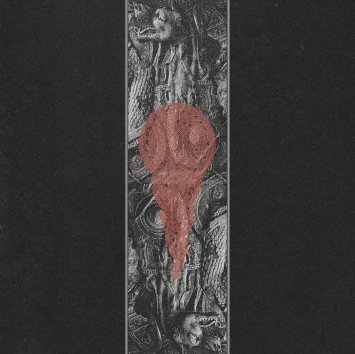 “Firmament” is a loaded word; no matter how your particular use of it behaves it will invariably evoke Biblical themes. The lyrics for reclusive project Monte Penumbra’s newest album aren’t available online, but based on the sound—of both the words and the music—alone they certainly reach as high (or low) as this association implies. Apocalyptic growls and howls emerge from a bottomless chasm in opener “Black Mould on Rye Grass,” and some clever layering throughout this track and more sparingly in some of the others renders the vocals somewhere between the utterances of a single person and that of a group of individuals in shared misery, both intimate, solitary lament and the collective chorus of the crucified. The overall atmosphere of As Blades in the Firmament is a dense and oppressive one, but none of the instruments bleed into each other much, so there’s always at least a few layers to unpack rather than a homogeneous mass of noise—not that I’m ever opposed to that, of course. Such a production style was a great choice for these compositions, especially in complementing the guitar and drum interplay, whose interlocking parts often swap complexity or emphasis to create a constant sense of heavy, monumental shift within the music. There’s this constant uneasy truce between dissonant angularity and triumphant resolution in the riffs, but neither ever seems to win out, and thus the experience of listening to As Blades in the Firmament is equally uneasy. Dread and excitement aren’t meant to coexist like this.
Review: *sigh* – SCH0äDEL_book:~;03222021 (self-released, Mar 24)
 SCH0äDEL_book:~;03222021 is over in less than 28 seconds. It has almost that many songs, but the bite-sized cuts average just a second or two in duration, and some not even that. In a way somewhat similar to i.d’s fals.ch classic ,!_;_:!_7:+!_-+;,.!_g-7/;7_,.;y!_g;,/+Xg;+:yXgg,.- and Greathumour’s more recent Choose the Forceps, half the fun of listening to the newest release from this exasperated-exhale-inspired project is watching the Unicode-nightmare track titles whiz by at lightning speed as the microscopic shot of sound trapped within each tears from its prison for just a few ecstatic milliseconds. Don’t try to stream this one from the Bandcamp web player; true gapless playback is absolutely essential for that dizzying channel-surf effect to fully come across. Snatches of conversations too brief to be in any way intelligible, sprightly video-arcade vignettes, impatient experiments, and chunks of distorted debris are just a few of the countless components that comprise this multifarious collage of addictive, flashy impermanence. The perfect soundtrack for the exponential deterioration of my musical attention span.
Review: Yan Jun & Noel Meek – Mirror One (God in the Music / Zoomin’ Night, Mar 15)
 (I’m not sure what the official release date of this is; I’ve seen the 15th, 24th, and 26th in various places.)
Yan Jun describes Mirror One as “like meteorolites hiting the earth. they are buring in the atmosphere, hiting on ground, smoking, but nobody was hurt. we sitting and watching it from afar. drinking bear, crunching chips through all afternoon. at the end we clapped as well [sic].” The Beijing musician is well known for his practice of artful nonparticipation, often leaving his mysterious electronics systems to do the work on their own while he fixes a cup of tea or “crunches chips,” and one might expect this tape to be no different, especially in conjunction with the artist’s own words on the matter. But even though the two halves of this duo were polarized in separate hemispheres and unexposed to the other’s contributions for the entirety of their collaboration, Yan and Meek’s improvisations are not just active on their own, but actively converse with one another. The Auckland-based Meek, credited with “stone, metal, [and] wood,” is elbows deep in a trunk full of abstract woodland oddities at all times; whether he’s whirling resonant drones from singing bowls and resonant sheets or making a mortar-and-pestle mash of twigs and gravel, his musical gestures are steeped in earthy tactility and wide-eyed exploration, serving as an excellent counterpoint for the raw purity of Yan’s humming, screeching feedback. The pair is at their best, I think, when they’re relegated to completely opposite ends of the texture-spectrum, like in the earlier moments of “M81” when the electronics are stripped to an unstable, anemic whine against percussive clunks like woodpecker pecks recorded from inside the tree. Meek also does some hard-to-define but definitely mesmerizing work with breath on the opening track; I would love to see video footage of the musicians recording their tracks in addition to the layered tracks themselves.
Review: Human Heads – In the Afternoon (Fractal Meat Cuts, Mar 20)
 In the Afternoon is one of those rare releases that I have to really talk myself into actually writing about because they seem to reside beyond what even the most well-arranged and curated words can convey, and certainly beyond what mine can. But in terms of Human Heads’ specific brand of slipperiness, this tape, unlike past documents on Singing Knives (The Beauticinist) and tanzprocesz (Triggers), gives me a useful foothold: I’m kind of in love with it. I’ve never fully glommed onto the strangely synthetic dissection of pop music and poetry that longtime crackerjack collaborators Ben Knight and Hannah Ellul delicately arrange for this duo project (though I was and am all about the various ventures related to their Psykick Dance Hall imprint, especially the now-defunct avant-garde musicology publication Dancehall), but In the Afternoon grabbed hold of my ears—gently, but with thin, frigid fingers made of silicone and metal—and yanked my head to the proper angle for the full Gestalt switch. I don’t know if I’ve ever heard something so surreal and whimsical yet so bleak. Little is left unturned by the artists’ assimilating gazes, Knight reading off scrawled bathroom-door manifestos and mundane journal entries and memories at a stumbling tiptoe while Ellul loudly does the dishes or sweeps her microphone right up next to a bird’s nest or halfhearted pop culture conversation; especially with the unmistakable style of formant shifting used in “FDfsdfas” one can’t help but think of GLaDOS’s cold blue eye raking over facsimiles of domesticity and civilization in general. Yes, there’s a disconcertingly scientific atmosphere at work here, and that’s part of what makes In the Afternoon so unforgettable. No one else could use a default iPhone alarm tone as a motif and get away with it.
Review: Mothmen Ezekiel – Voices (self-released, Mar 21)
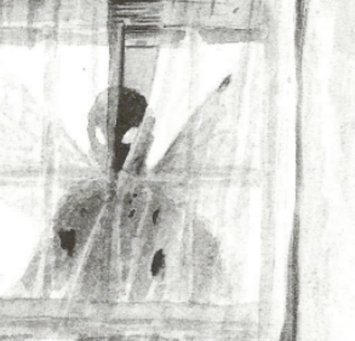 I originally wasn’t going to write a review today because it’s been the absolute worst week—and maybe give myself an extra day off for reaching 800 posts and 100,000 views! Thanks to everyone who reads, listens, or otherwise supports!—but the truth is this debut release from Mothmen Ezekiel has been helping me through, and I want to share it in case anyone else is in a similar situation (and from what I’ve gathered, the malaise seems to be inexplicably universal). Tracked with maxed-out gain to a single skull-drilling mono channel, Voices is a two-part aural lobotomy for speech, screech, and crunch, instruments (whatever those even are) optional. The noise is more dynamic and unpredictable than a traditional wall, yet despite the changes in flavor and intensity it undergoes it always has this tearing, trouncing velocity, the same kind of unrelenting assault that keeps me rooted to my seat during Call Me Lucy or Night of the Bloody Tapes. When “It Stayed With Us When We Accelerated” started I was already on board to get my noggin wrinkles scrubbed by that flaying feedback blast for twelve minutes, but then a lower-pitched input jack hum lumbers into the torrent and makes me grin like an idiot. The “speech” part comes in the form of garbled radio chatter ground into gnashing gibbers, “spluttering and bubbling, jerking and rasping, whistling and screaming.” Two endlessly replayable doses of brutality. Irresponsibly, dangerously loud… if you know you know.
P.S. For completely unrelated reasons, make sure to catch up on Riverdale if you haven’t already (by pirating it only of course, fuck the CW).
Mix: The Spindly Insect Legs of Love and Loss
“The tender gesture says: ask me anything that can put your body to sleep, but also do not forget that I desire you—a little, lightly, without trying to seize anything right away.” —Roland Barthes, A Lover’s Discourse: Fragments
The microscopic unutterables of a doomed love: first the curious, tentative, beautiful pirouettes of fingertips tracing new territory for the first time; next the invisible buildup of stagnancy, doubt, uncertainty, fear, sabotage, still with fleeting spots of light; then the loneliness, despair, longing touches meeting only empty air; and finally the idealistic but ultimately futile look toward something new. Never let go.
00:00. soft tissue – “glass master” from soft tissue (Penultimate Press, 2019)
02:28. Nathaniel Young – “exploit_01” from Stringed Exploits (_phinery, 2016)
04:32. Ivan Palacký – Sanctuary [excerpt] (piece for Amplify 2020 festival)
06:29. Peter Lenaerts – fourth part [excerpt] of Serbian Orthodox Church of the Prophet Elijah (Very Quiet, 2013)
09:16. Kim Cascone & Scanner – “Behavioural Sink” [excerpt] from The Crystalline Address (Sub Rosa, 2002)
10:33. Porcje Rosołowe – “Metua Tympanis” from Insects 4-7 (Crónica, 2015)
13:00. Klaysstar – “Right” from More No Place (Outlet Archival, 2020)
14:52. Sachiko M – Salon de Sachiko [excerpt] (Hitorri, 2007)
20:14. Takamitsu Ohta – “cqicx,qikcco.cqqico,,” from Three Ways to Output from a Recorder (Careful Catalog, 2019)
24:35. Dominique Vaccaro – “05” from Close Distances (Dinzu Artefacts, 2018)
26:09. Massimo Toniutti – “Scraps upon Tempered Fields” [excerpt] from antidocument/groundwork (Vitrine, 2016)
28:54. Shirt Trax – “crtL” from Good News About Space (OR, 1999)
31:49. Climax Golden Twins – fifth untitled track from Dream Cut Short in the Mysterious Clouds (Anomalous, 2000)
35:24. Daphne X – “Yoga” from NaCl (self-released, 2018)
Review: patchbaydoor – Visitors Bureau (self-released, Mar 18)
 Sung Tongs ranks among my least favorite Animal Collective albums, but it has its moments, and the twelve consecutive ones that comprise “Visiting Friends” are simply magical. That track randomly popped into my head as I was getting off the highway yesterday, and now I know why: so I can compare it to the soothing drifts of Visitors Bureau (and not just because of the similar title). “moving expenses” opens this new album by Philadelphia artist Steven R. Hammer’s project patchbaydoor in much the same way as an early-morning warm shower; it’s an instant escape, a cocoon of comfort and safety, a diaphanous capsule of calm that distorts time and keeps the sharp claws of the real world at bay. I bring up “Visiting Friends” because this piece, as well as the following two, perfectly execute that phenomenon of simultaneous movement and stasis—i.e., the tones and textures that remain largely stagnant are so intoxicating that traditional progression is no longer needed. Hammer’s ethereal, often unintelligible vocals, curling in from the edges of the ambience like sweet steam both at normal pitch and distorted into chipmunk croons, make Visitors Bureau a much more personal affair than a lot of conventionally beautiful atmospheric music; on “ca_ways” they adopt a more central role, cycling between crystallization into languorous laments and dissolution into broken layers and bubbling glitches. The radiant resolutions of “breathworks” fully cement this release’s greatness, and if you hadn’t seen the AnCo comparison before you certainly will in this one. It concludes with just enough of a hint of darkness to immediately make me want to curl up in its swathing embrace yet again.
Review: Mellified Man – Sex/Withdrawal (self-released, Mar 16)
 Those of you who follow me on Instagram—I suspect I may have an even larger audience there than I do here—may have seen my story post earlier today about a severe drought of recent material to review. When I go longer than a day without a review it is almost always because I literally cannot find anything I like enough to write about, and believe me, I really try. For the past 36 hours or so neither my inbox nor Bandcamp has yielded any fruit, a frustrating predicament indeed. Thankfully my lovely followers came to the rescue, and one of them introduced me to Worcester, MA project Mellified Man (J. Spotts). As soon as the first shredding slice of feedback rent my ears I sighed with relief; Sex/Withdrawal was exactly what I needed after so much disappointment. It’s bittersweet, though, because volatile high-energy releases like this one tend to remind me how long it’s been since I’ve witnessed live noise. I can almost imagine the unmatched sensation that’s somewhere between physical pain and cathartic bliss as Spotts smashes stretches of piercing, wince-inducing shrieks into grinding chaos or unseats a merciless blast with limp tendrils of analogue decay. “Blood Loss” is an especially relevant track because of the radio grab that begins it (which may also be the original source for all the noise); with violent anti-Asian sentiments on the rise, much of the wanton and misinformed criticism of China’s handling of the coronavirus has been steadily exposed for what it always was: racist propaganda. And Spotts does exactly what the rest of us should do when they obscure and eviscerate the careless rhetoric with cacophonous distortion. Whether it’s from one person’s pedal chains and contact-mic’d scrap metal or from millions of souls and voices coming together as one, bigotry should always be met with the noise (preferably of the harsh variety) of resistance. People are dying, and you owe it to yourself and everyone else to be fucking loud—especially if you’re on top of anywhere near as massive of a steaming shit-pile of privilege as I am. Noise not music: action not complacency.
Review: Wind Tide – Journal 2020 (self-released, Mar 14)
 Wind Tide, the Littlefield, TX–based collaboration between Andrew Weathers and Gretchen Korsmo, will capture the hearts of anyone with an appreciation for subdued clatter within the very first seconds of Journal 2020. It doesn’t matter whether you prefer environmental, unintentional sounds—rainfall, chirping crickets, scrapes and swishes of branches—or ones made by human hands, for the duo makes ample use of both to craft these captivating and delicate pieces. Each exquisite texture is captured with a fidelity somewhere between the sublime stifling of tape recordings and the crystalline clarity of digital, and the result is a gorgeous, spellbinding neutrality that ambles along at a pace no faster than the organic progression of the original natural sound events, making use of an improvisatory language in which listening and making become one. The distant hisses, sparse feedback squeals, and loose granular ambience of “Western Oklahoma” evoke the hermetic magic of Michael Barthel’s Stapel. Efeu-Fährten, while “Palo Duro” crowds up front with incessant sawing, miniature machinations, words and whistles filtered through grime-choked mesh, and innocuous, offhand clunks like the sound of getting the last drops of pasta sauce out of the jar. For me this is one of those releases that I know I’ll have to listen to a million times (give or take) to fully process how much I love it.
 Noise Not Music