
Guest Review: Beautiful Day Design on Lea Bertucci’s Metal Aether (NNA, Feb 9)

Lea Bertucci’s latest album, Metal Aether, sounds like the space its title suggests: a dense, echoing chasm of supernal saxophones and fluttering field recordings. Fans of her previous album, All That Is Solid Melts Into Air, will likely appreciate Metal Aether’s ambient, electroacoustic atmosphere. Her new LP trades All That Is Solid…’s anxious strings for ominous drones. It swaps brief, blissful harmonies with tape collages that sometimes submerge her songs in showers of shifting static. Metal Aether feels like a fresh, natural progression of Bertucci’s style. She retains her strong sense of dynamics and space. A tense energy permeates the record, even during many of its quieter segments.

“Patterns for Alto,” the album’s opener, abounds with this anxious energy. Chaotic saxophones race against each other, building a residual ambient hum. The piece sounds like traffic patterns on a busy city street in a dream — it may reflect the New York-based composer’s urban environment. After “Patterns for Alto”’s breathless buildup and sudden ending, “Accumulations” marks a stylistic shift. Brooding saxophones tentatively creep into the mix and uneasy microtones and shrill brass glissandos seem to foreshadow a harrowing climax. The piece’s title, even, suggests a gradual layering of sound, a buildup of layers into something gigantic. It never reaches that point, however. “Accumulations” instead fades into jittering tape noises, which combine with the saxophones to create a sparse and vaguely jazzy soundscape. One venue’s advertisement for Bertucci describes her as “…unafraid to subvert [listener] expectation[s]”, but perhaps indulging them would have been better here.

“Sustain and Dissolve”’s first ten minutes feel equally insubstantial. Bertucci’s layered saxophones phase in and out like supersaws, creating a fairly peaceful yet disengaging full-on ambient detour. Occasional dissonant moments filigree Metal Aether‘s least developed segment. Eventually, though, the thin wall of brass crumbles into something more interesting: a distorted, muffled prepared piano resonates like a bell while lo-fi field recordings give way to paradoxically chaotic and subdued whirring tapes. The track’s latter half submerges the listener in a warm ocean of bubbling analog glitches and found sounds drenched in dense digital processing. “At Dawn” builds on “Sustain and Dissolve”’s interesting parts. The piano returns as a bell, but far more ominously. Tape recordings rustle and flutter like leaves in a windstorm, creating a natural and organic chaos. Sharp, resonant drones occupy the piece’s higher register briefly, complementing bustling crowd noises. Bertucci puts down her saxophone for this piece, and it feels like welcome sonic variation after its droning omnipresence in the lengthy first halves of the middle two tracks. “At Dawn” ends the album as successfully as “Patterns for Alto” begins it, even though the two pieces bear almost no similarities.

The fact that Metal Aether’s beginning doesn’t resemble its end testifies to the album’s sense of development. Bertucci successfully evokes different emotions and creates distinct atmospheres in each track, yet the album still feels wonderfully cohesive. Overall, Metal Aether surpasses its isolated weaknesses, establishing itself as an original and well-developed work.
Review: Conjurer – Mire (Holy Roar, Mar 9)

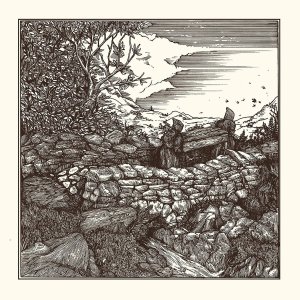
Well, it’s happened again; I’m so excited about an album that I’m reviewing it on the same day it came out. But Mire is so awesome that it’d be an injustice not to attempt to bring it to the attention of as many people as possible. It’s the debut full-length from the U. K. band Conjurer, and though they released an EP back in 2016 it’s the first thing I’ve heard from them. Needless to say, I was blown away. Though elements of various metal subgenres and the anthemic passion of post-hardcore can be found amidst Mire, the final sound is surprisingly unique, forging a new path through this range of styles that touches on each but remains distinct. The riffs are sometimes catchy and other times angular, always bolstered by thick, meaty production that gives everything its own weight in the mix. With emotional vocals shifting between guttural growls and invigorating screams, drums that go from pummeling blast beats to spacious doom hits, and a crushing heaviness that presides over every song, Mire is a crazy trip that I want to experience again and again.

Review: Holy Grinder – Cult of Extermination (self-released, Mar 2)

Aside from the main reason I love Holy Grinder – the fact that they have probably one of the best band names I’ve ever encountered – they pretty much have everything I look for in grind nowadays. Cult of Extermination, their newest independently released album, encapsulates this perfect storm in thirteen brutal minutes. The vocals rip through the invigoratingly heavy mix just the right amount, the instrumentals are tight but never sound too polished, and the whole thing is shrouded in noise and grime yet every hit shakes me right to the bone. Holy Grinder have also somehow accomplished something that many of their contemporaries have not; they don’t take themselves too seriously, which is always a plus in any area of music, but they also take themselves seriously enough not to discredit their music as purely for shock value or awful humor. It’s not usually my modus operandi to talk about a band’s, for lack of a better word, “image” on equal footing with their music, because I usually don’t see it as being nearly as important, but it’s just so refreshing to encounter stuff in this genre without track names like “Fornicating in Pulverized Feces” or an album cover that depicts a similarly disgusting scene. That being said, Cult of Extermination is so pulverizingly awesome that I could probably look past all of that, but thankfully I don’t have to.

Review: Grant Evans – Ergot Dogs (Adversary Electronics, Feb 1)

Grant Evans is a ridiculously prolific artist, releasing an inordinate amount of music over the last ten or so years under his own name, various aliases, and as a part of collaborations. Recently, most of his output has been focused on the Adversary Electronics imprint, which Evans founded with his wife Rachel – also a musician, who goes by the name Motion Sickness of Time Travel – in 2015. Despite the label’s catalog consisting only of both artists’ solo work and their duo project Quiet Evenings, they’ve released over fifteen tapes. Ergot Dogs is one of three Adversary releases in a new 2018 cycle, and is among Evans’ most ambitious material. Immersive field recording collages and rough electronics dominate the thirteen short tracks, soft and jagged textures continuously clashing to amazing effect. I’m never quite sure whether to feel comforted or scared; I suppose it’s a testament to Ergot Dogs‘ uniqueness that I end up experiencing both at the same time. Despite never having been anywhere in rural Georgia, the tape instantly transports me there. I sit in the dilapidated old house depicted on the cover, as the wind howls and the forest groans and sighs around me, wondering where all those voices are coming from; then the sun shines on my face through an open window and somehow everything is beautiful again.

Review: E L U C I D – Shit Don’t Rhyme No More (self-released, Feb 24)

I have a strange relationship with hip-hop. I certainly listen to a decent amount of it, and many of my all-time favorite albums could be classified as hip-hop, but it differs from many of the other genres I enjoy in that, aside from a few exceptions, I am much pickier about what I consider to be “good.” This was made painfully apparent throughout most of last year, during which I only really enjoyed one release (lojii & Swarvy’s excellent collaboration Due Rent). 2018 has unfortunately been the same; that is, until I discovered Shit Don’t Rhyme No More.

It’s usually a good sign when an interesting/odd sample is used right off the bat. In this case, the woozy collage of leading track “Swazi” is built on Björk’s “Pleasure Is All Mine,” also the first song from its respective album. On my first listen, the inclusion felt bizarre and forced, but it’s since grown on me substantially. “Swazi” is one of all but two of the ten tracks that were produced by E L U C I D himself, and is far from the only one constructed around a strange sample/homage; the beat “Rick Ross Moonwalk” bears a strong similarity to “Machine Gun” by Portishead, and on “All of a Sudden We Were in a Vampire Bar,” the EP’s closing track, the iconic vocoder of Laurie Anderson’s “O Superman” emerges. Normally, I’d be annoyed by so much transparent sampling, but each one actually feels at home amidst the other production choices, forming abstract instrumentals that shift and contort under E L U C I D’s cryptic verses and surprisingly catchy hooks. I’m so excited to once again fall in love with a new hip-hop album, and I’m hoping we get a full-length from this promising new artist soon.

Review: Dirch Blewn – Care Work (Soft Error, Feb 21)

“In January 2016, artist David Bloor spent 5 days in Flat Time House, London with a self built robot called Leonard. These are excerpts of recordings made during that time. ”

This is the brief yet very intriguing description of Care Work on Soft Error’s Bandcamp page. Even though, in my opinion, music can never be supported entirely by its concept, this one really piqued my interest. Thankfully, the album is every bit as engaging as its premise would imply, the odd sonic palette creating a truly unique atmosphere. Leonard the robot’s presence is always identifiable, the sounds of its movement and other unknown activities emerging from lethargic clouds of circuit drones and effects. Everything sounds very soft, almost organic; a surprise considering almost every element is electronic. Bloor also plays the Cocoquantus, a bizarre custom instrument that I’ve only ever seen used by Toshiji Mikawa in an incredibly loud noise set, so I have no idea what sound it’s making here. All this uncertainty, however, only adds to the experience. Care Work is mysterious, haunting, and oddly lonely; like I’m alone in a house, but it’s not mine, and there are things moving around just out of my line of sight that are neither malicious nor benevolent. A fascinating release to be sure, and if you’re skeptical because of my vague abstract descriptions, don’t take my word for it.

Side note: I accidentally discovered that this works well as a soundtrack to Brakhage’s Dog Star Man.

Review: Hampshire & Foat – The Honeybear (Athens of the North, Feb 28)

It’s a special thing when an album makes you feel like a little kid again. This profound effect could arise from nostalgia or something even less tangible, a beautiful sense of innocence and carefree wonder that most (including me) sadly seem to have lost. With The Honeybear, Warren Hampshire and Greg Foat seem to have uncovered a relic of childhood daydreams, of imaginative adventures in a sun-drenched forest; it’s a record that perfectly captures a freedom that we may never again experience. Described as a musical representation of a nonexistent children’s book, The Honeybear is comprised of exquisite chamber folk arrangements, neo-medieval melodies, and gorgeous ambient sections. Interspersed throughout the “chapters” are subtle inclusions of field recordings collected around the Isle of Wight, introducing a pleasingly natural atmosphere. Though the record is entirely instrumental, even the least melodic elements seem to be more expressive than words ever could be. Whether you follow along with the story or are content to simply lose yourself amidst the undeniable warmth, The Honeybear is something very special.

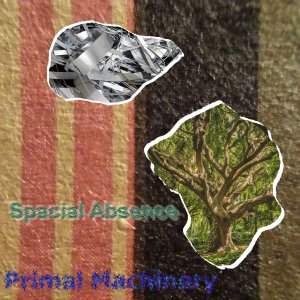
Review: Spacial Absence – Primal Machinery (Deadleg Incident, 2017)

Even though this one came out quite a bit ago, I only recently discovered it and really think it deserves more attention. Primal Machinery is the debut release of Pennsylvania artist Spacial Absence, who also operates under the aliases Cador, Aether, and others. It’s undoubtedly an album that would best be placed under the umbrella of harsh noise wall, but it also approaches the genre in unique ways. Each track is based on field recordings from various sources; according to the artist, “Air Fatigue” uses noises recorded on an international flight to China, “Nighttime Panic 100°C” consists of sounds made by insects, and the two-part “Shower,” unsurprisingly, is formed by a recording of a shower. The odd one out is “Forest Fire Fishing Trip,” which was produced using manipulated microphone feedback, but it’s just as lush and diverse as the others and doesn’t feel out of place in the slightest. The whole album feels just as organic as the source material; the dense walls are static, yet build and contract. Despite the dynamics and structure still being incredibly subtle, the focus is not only placed on the noise itself, but also on how it moves, unfurls, and decays; a concept that makes Primal Machinery one of the most interesting and engaging harsh noise wall albums I’ve ever heard.

Event: Frequency Friday at the Fuse Factory (Mar 2)

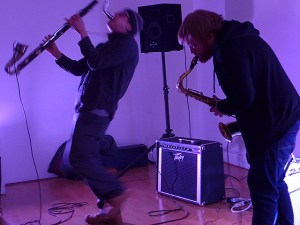
On the first Friday of each month, the Columbus based Fuse Factory Electronic and Digital Arts Lab puts together performances from a variety of experimental musicians and artists, both local and worldwide. I was so happy to discover that such a place existed so close by, and I’ve been to one show so far and am planning to attend some of the workshops they offer. On the bill for tomorrow is Ava Mendoza, a solo guitarist and singer who is also a member of Unnatural Ways; Ann B Clorox, a performance artist; Istvan Medgyesi, an experimental electronic musician; and local Columbus artist Mike Shiflet, who will perform excerpts from his new composition Tetracosa. The latter I am most excited for, because Tetracosa, Volume One was fascinating and I just preordered the next two installments, but every act sounds worth the modest admission price. Stop by and hang out! (Adjacent image is of Wasteland Jazz Unit performing at the February Frequency Friday event, courtesy of FF’s gallery.)