
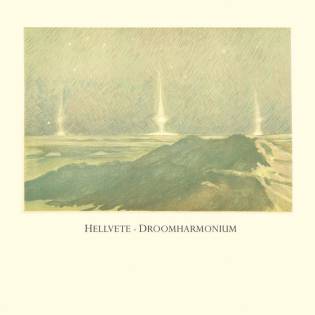
 I wouldn’t exactly call myself a morning person. But one of the greatest things in life is waking up at a decent time, feeling well-rested and energized, while golden sunlight streams in your bedroom window and makes all the dust look like sparkles in the air. And if that unfortunately less-than-common occurrence was audible, it would probably sound a lot like Droomharmonium. It’s the newest album from Silvester Anfang member Glen Steenkiste under the Hellvete alias, a double CD full of warm, flowing drones largely produced by the titular instrument. To call these four long form pieces “beautiful” would be an understatement; they are something far beyond that. Droomharmonium rewards both active and passive listening, lush enough to sustain attention despite its simplicity and unintrusive enough to not be distracting. But I would recommend paying attention. Steenkiste has created music here that is truly heavenly, seraphic, celestial, other synonyms. I hope I’m not being too hyperbolic; Droomharmonium defies any less grandiose descriptions, and easily deserves all of the praise I have heaped upon it.
Month: May 2018
Review: Nonturn – Territory (Audiobulb, May 16)
 Territory is “a soundtrack for an artwork containing nine images of street walls in Tokyo.” Fittingly, the album is entirely composed from sounds recorded on and around those streets; a fact I probably would never have guessed, considering that it is one of the most lush and melodic electronic albums I’ve heard this year. The heavily processed recordings are tuned, rearranged, and sculpted into enticingly beautiful compositions, that ebb and flow with just as much energy as the busy roads they came from. “Evidence,” one of the record’s most immediate pieces, displays the wide spectrum of elements Nonturn (Nozom Yoneda) utilizes, its sonic palette ranging from warbling melodic tones to recognizable clips of objects crashing onto the ground. And here is where the true power of Territory becomes apparent; the more you listen, the origins of the sounds become more apparent; rumbling bass from an idling car stereo, an engine being started, the scraping of tires against pavement, and even the barely audible chirping of birds can all be picked out with an attentive ear. Yoneda finds the delicate, perfect balance between the manipulated and the unaltered, making Territory as gorgeous and impactful as it could possibly be.
Review: The Holocene – Yūrei (Lugubrious Audio, May 11)
 As a huge fan of The Holocene’s (PJ Hamlin) previous tape on Lugubrious Audio, Dead:Unearthed, it was tremendously exciting to see that the U. K. based sample virtuoso had another release. Thankfully, Yūrei has far surpassed expectations, and cements Hamlin as a modern titan of audio collage. The tape is a love letter to traditional Japanese ghost stories, and draws its source material from horror film VHS tapes and various vinyl records from the 70’s and 80’s. The result is a lush, hypnagogic opus full of dusty percussion clips, mysterious spoken word samples, and the warm crackles of the decaying media from which it was all lifted. Yūrei certainly retains much of the horror evocations present in the original material, but the fear it elicits is comforting; more like the nervous excitement one gets from hearing scary stories around a campfire rather than sheer visceral terror. And there’s also an ambiguity in atmosphere, a phenomenon common among albums with such sample-based methodology, but here it is such a mesmerizing companion to Hamlin’s cryptic sonic mishmashes. Yūrei succeeds in embodying both the allure and the danger of the supernatural, and is somehow pretty catchy along the way. Plus it’s capped off by one of the sweetest, most sublime closing tracks I’ve heard all year.
Review: Bart De Paepe – Pagus Wasiae (Beyond Beyond Is Beyond, Apr 20)
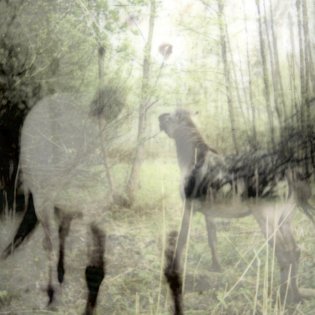 Bart De Paepe’s newest record Pagus Wasiae is a swampy concoction of psychedelia and bubbling electronics. The atmosphere he creates is incredibly vivid. The cover art provides a great visual representation; the music is greenish and soggy, but with enough cohesion to prevent it from falling apart. It’s the sonic equivalent of sunlight trying to break through a thick canopy of trees; the sounds are muffled and distant, tantalizingly close but trapped behind a blanket of murkiness. That is, until moments like the beginning of “Alvinclarvord,” when a scorching, fuzzy, spaced out guitar breaks through, or the tendril-like synth modulations of closing track “Moerassen Van de Gouw.” This unpredictability is one of Pagus Wasiae‘s greatest strengths. It’s almost as if De Paepe mixed and stewed a multitude of sounds like ingredients in a Chinese hot pot, leaving the choice of which elements would dissolve or break apart and which would retain their original structure to be decided organically. This gives the record a pleasing whimsicality, with just enough variation to keep the listener engaged but not enough to be jarring. Pagus Wasiae was an awesome surprise, and so far it’s gotten progressively better with each listen.
Review: Dosis Letalis – Smisao Života Je Sloboda (Lurker Bias, May 7)
 Smisao Života Je Sloboda is one of the most immersive wall noise releases I have heard in a long time. The entire tape runs just under an hour and a half, and though you’ll hear the same thing if you listen to each track for five minutes or their entire duration, this is music to truly get lost in. The first time I listened, I didn’t even plan to get through the whole thing, but found that the hypnotic, stagnant noise put me into a trance-like state. These walls are masterfully crafted, somehow revealing more elements as time progresses without actually changing at all. The static collages of textures are truly astounding, balancing bassy rumblings with lively electrical crackles, almost sounding like a gigantic mountain collapsing in on itself in slow motion. I often compare wall noise in general, and especially stuff like this, to a piece of visual art like a painting or sculpture; it doesn’t change no matter how long you observe it, but more its subtle details and facets become clear the longer you look. Dosis Letalis’ music is something really special; it actively takes a hold of me and doesn’t let go until the wall is over, and then somehow makes me want to listen again. Thankfully, Smisao Života Je Sloboda is no exception.
Review: David Grubbs & Taku Unami – Failed Celestial Creatures (Empty Editions, May 11)
 This is a collaboration that I did not see coming. Certainly, Grubbs and Unami are both accomplished guitarists, each having amassed a considerable catalog of work since the turn of the century; but for some reason seeing their names side by side is still odd to me. Maybe it’s the fact that I associate the two with vastly different styles of music – but as it happens, the musicians’ contrasting backgrounds are part of what makes Failed Celestial Creatures so special. I can hear both Grubbs’ fantastic melodic ability and Unami’s textural, poetic phrasings here; but each seems to have adapted the other’s style into their own, and as a result the two guitars end up being two sides of the same coin rather than opposing forces. And oh man, is it beautiful. The guitars are untouched by invasive effects or manipulation, their clean, pure notes hanging in midair like sweet-smelling smoke before dissipating. Despite the limited palette, Failed Celestial Creatures never fails to captivate, even during the long title track. I was initially disappointed to hear vocals on “The Forest Dictation,” but even those were a welcome addition, fleshing out the vivid imagery somehow supplied by only two instruments. Many times throughout the album, you can almost visualize Grubbs and Unami making eye contact and slightly raising their guitars before striking a beautiful chord in fragile unison. It’s an astounding and intimate experience.
The album is available on most streaming services. Purchase the lossless digital files here. I was unable to find a link to a physical copy.
Review: Wallfahrer – Anthologie Der Abkehr (self-released, Apr 27)
 With Anthologie Der Abkehr, German newcomers Wallfahrer present a fantastic album of classic atmospheric black metal. No, there’s nothing particularly new here, but the throwback sound is done so well and with just enough originality that there’s nothing I could possibly complain about. Each track is unique without stepping too far from the other parts of the album, and each is over the listener is left with a sense of completeness and satisfaction – but also a burning anticipation for what comes next. Wallfahrer also displays an admirable ear for subtle melody, writing riffs I’d even call catchy but never compromising the atmospheric aspect. A prime example is “Wildes Heer (Epilog Des Herbstes),” which is built upon a number of earworms that prevent it from fading into the background, but the murky soup of effects and the distant howls prevent the melodies from taking over. The musicianship is stellar, the songwriting impeccable, the length perfect… I truly think this album could be appreciated by black metal purists and newcomers alike, and accomplishes the difficult task of simultaneously sounding like a blast from the past and a breath of fresh air.
Review: Needful Things / Overviolence Split (Nerve Altar, Apr 11)
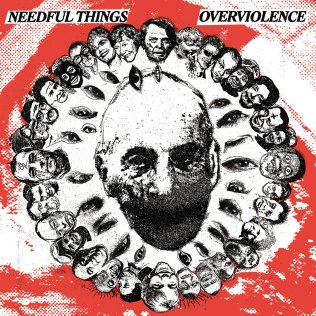 On this short 7-inch split from New York hardcore label Nerve Altar, both bands present four minutes of pulverizing grind-violence. Czech shredders Needful Things’ tracks are longer and more varied, alternating between driving d-beat crust punk and exhilarating blast sections. The songwriting is impeccable, something that isn’t necessary in this type of music but is very welcome nonetheless; from the cascading riffs to the brief flashes of silent anticipation before the chaos on “Hands Full of Sludge,” each track is memorable and powerful on its own. By contrast, Overviolence’s side is made up of much shorter, more direct assaults. The dual vocals between members Esse and Henke are a major highlight. I’m not sure who does the throaty growls and who shrieks, but the presence of both really helps the songs carry even more weight. Look no further than final track “Plockas och Krossas” for an example of Overviolence’s kickassery; the chants of both vocalists belting the titular phrase atop furious drumming and guitar work make it some of the most fulfilling 25 seconds in recent memory.
This is a reissue of the original release; the physical edition is available here. Make sure to check out the upcoming split LP between Water Torture and Stimulant, also on Nerve Altar – it’s going to be amazing.
Review: Sissy Spacek – L/L (Helicopter, May 7)
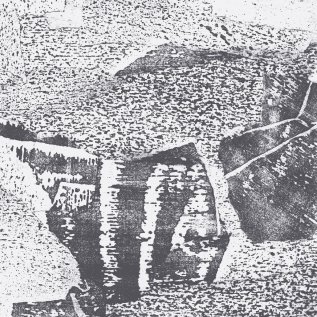 Listening to a new Sissy Spacek album is always a toss-up. The music put out by John Wiese and crew ranges from blistering noisegrind to bizarre musique concrète miniatures to full-blown harsh noise assaults, with the only common denominator being top-notch quality. L/L, one of two new CDs from the project released on Helicopter yesterday, is constructed from recordings from their ensemble tour back in January of this year. Its spastic group improvisations recall some of my favorite material from Sissy Spacek, the performances of Wiese’s visual scores for ensemble in Los Angeles and Oakland; but here even the minute restrictions are lifted. The first and longest track, “Distance,” highlights legendary percussionist Tim Barnes’ textural, free-form drumming; Wiese’s chunky electronics and tape manipulations; and what sounds like trumpet and guitar from two musicians with whom I am unfamiliar. Unbounded by any sort of formal direction or control, it is somehow both aimless and purposeful, reveling in the interactions between the instruments but never sticking around in the same place too long. There are even moments of beauty here too. The muffled sample breaking through the fragile cacophony midway through “Distance” and the unearthly ambiance of “City Limits” are surprisingly sublime; and even the ugliest bits, like the freakish climax of “Horse People,” are exhilarating in a way only Sissy Spacek can pull off.
Pick up the CD here.
Review: Black Moth Super Rainbow – Panic Blooms (Rad Cult, May 4)
 Black Moth Super Rainbow (hereafter BMSR) are back, and with possibly their best album yet. It’s the band’s first full-length since 2012; but the music feels as fresh as ever, and that youthful charm and wonder that makes me love BMSR’s music is still present – albeit with a more serious edge. Gone are the sickeningly sweet, noise-drenched dance songs of Cobra Juicy, in favor of a woozier, more subdued atmosphere that’s somewhat reminiscent of the band’s earlier work. But where those albums were sunny and warm, Panic Blooms is nocturnal and depressive, steeped in internal turmoil and emotion. Frontman and vocalist Tobacco’s heartbreaking lyrics hit close to home too often, and their impact is only intensified by his frail delivery and the multitude of effects that frame his voice, especially the glitchy fragmenting on “New Breeze.” It feels like more of a collaborative effort this time around; unlike Cobra Juicy, Tobacco’s predilection for energetic electronica is tempered by Maureen Boyle’s (The Seven Fields of Aphelion) airy ambiance, Ryan Graveface’s haunted folkisms, and others. Each time I listen (which has been many times since it came out) I like Panic Blooms even more, and it makes me really hope that BMSR will be back with more music soon.
 Noise Not Music