
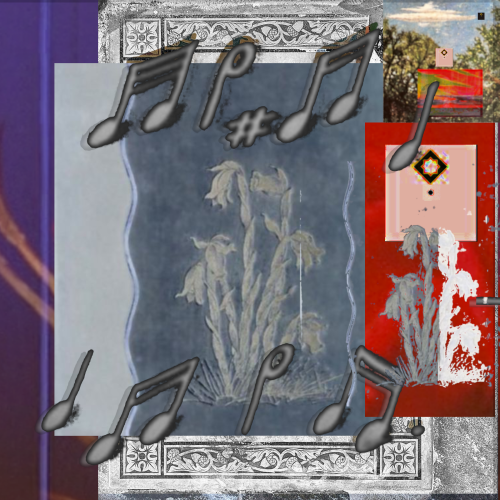
 The reason I haven’t posted any reviews since the beginning of the month is that I’ve been wrestling with how to approach Sunik Kim’s titanic EXISTENZ: The Third Malformation, or Combinatorial Rotation of The City / The Tunnels / The House / The Beach (Fragment 3.1 Folio X “ANOMALY”). The 6-hour, 6xCD‑R set is one of three inaugural entries in the LA-based polymath’s new in-house imprint Castrati, alongside the single CD‑R Evanescent Sequence and the handbound essay anthology Brainstorm / Two Short Guns. No single creation by an artist exists in a vacuum and can always be interpreted as a part of the continuum of their oeuvre, but here it is an absolute necessity. Since her 2019 debut Zero Chime, Kim has expanded her body of work with a disciplined, thoughtful dialectics befitting of its Marxist underpinnings, from the frenzied sonic superpositions Raid on the White Tiger Regiment (2022) and Potential (2023) to the history-steeped fractured rave electronics of Tears of Rage (2024). A more distinct theoretical backbone began to materialize with Formenverwandler (2025), “an exploration of the shock and terror of time” via Conlon Nancarrow’s “temporal-perceptual” compositional practices. All of it has led to this, a new frontier in computer music.
In “Zones of Illusion”, Kim tracks the tradition’s evolution from dance music into a novel but problematic art form in which “all music is reduced to interchangeable surface,” a fate inevitable in even the most abstract of its manifestations. In this sense the “experiment” of computer music is a failed one, just another base corruption of capital. And yet there remains an “escape hatch”; by foregrounding the artifice, the interchangeability, music can become a revelatory tautology for the subject—me, you, the listener—such that we become its own “zone of illusion.” EXISTENZ is proof of concept. In the accompanying essay, Kim writes,
If my recent work has been tinged with a kind of optimism in exhaustion—seeking out the potentials nearer to the swoop of zero—stringing dead matter into sheaves and lattices—I am increasingly interested in traversing that zero in search of a music of active negativity.
From this starting point, we can think of EXISTENZ as a journey toward something, or, to use Kim’s terminology, a map of a journey. In the spirit of true subversion, it is not the music itself that progresses. Where in the past her SuperCollider algorithms were deployed in order to generate sound that flows outward, this is an exhaustive, self-conscious turn inward. Each of the four segments (dubbed without separation across the six discs) flails in wracked stasis, coalescing in isolated bursts of activity that range from the frenetic to the lethargic. When confronted with the former, one feels exhilarated, while the latter often only invite bewilderment. And in between are bouts of near-silence, in which the loudest thing is anticipation. The first few minutes of the second segment, “EXISTENZ AB(f)AB(r)”, serve as an example: bitcrushed tendrils coil in writhing motion, exploding in crackling cybernetic lashes, building toward… silence, a loose mess of halting MIDI-like tones, then more silence. Nothing advances, nothing develops. We are left with a structural logic that is catachrestic at best, nonexistent at worst. Sparks across the void. Where do we find meaning when by design there is none to be found?
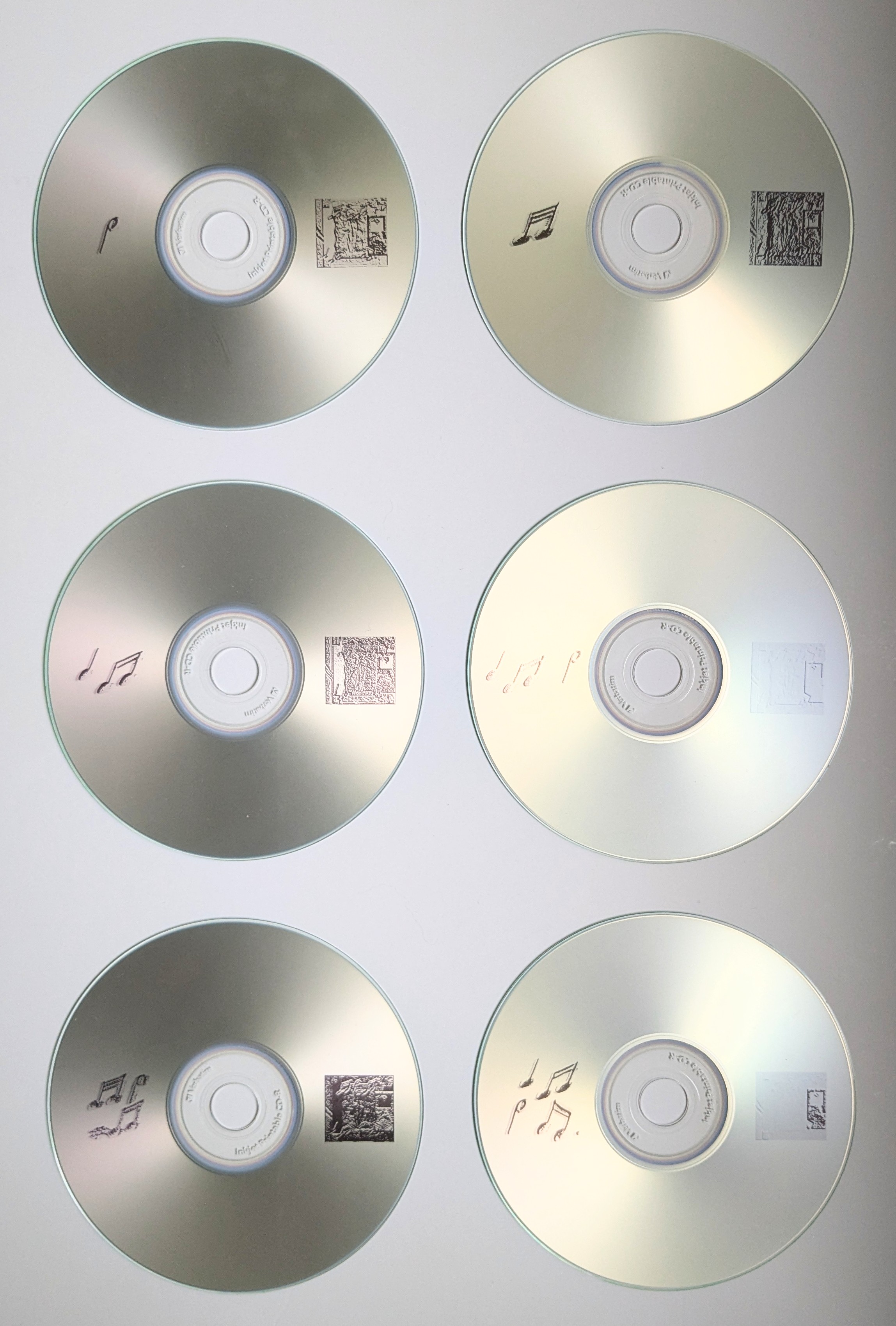 Kim’s essays are whirlwinds of eclectic synthesis, conversing with everything from Mao and Hồ to Orlando and Resident Evil, and in reading them to try and make sense of this behemoth I’m inspired to sketch my own wide-ranging connections. The intimidating runtime brings to mind Hecker’s absurd 51-hour composition Syn As Tex [AC], but EXISTENZ is the result of much more curation and tangibility due to its explicit conceptual backing, titled sections, and existence as a hand-assembled physical edition. The intentional, artful glitch-tedium resembles recent releases by Luciano Maggiore like self-talk, but the movement here is denser, more mercurial. The most apt comparison I could make isn’t to a piece of music at all, but rather to literature: Richard Makin’s “non-generic prose” trilogy (Work, Dwelling, Mourning), which embarks on a similar project of totally oblique semantic architecture, actively disruptive of its own momentums. In stripping away any and all substance of human convention while retaining its machinic scaffolding, the human becomes more present than it ever could be before—another practice that Kim absorbed from Nancarrow.
In The History of the Devil, Vilém Flusser claims that “When listening to music we are being confronted with the structures of reality.” In a roundabout way, this particular axiom was the key I needed to unlock the “black box” that is EXISTENZ. It is not the structures of reality as a whole that it reveals. It is their opacity, the impossibility of such a primordial revelation. It is the phenomenal reality we ascribe to materiality—something that has always been a central concern of this site. Those punishing storms of dissonant collisions are charged with the electricity of experience; those waddling synth notes are the 8-bit soundtrack to the grand game, the “mastery” of which is “fleeting, isolated and local.” Toward the end of “Fragment 3.1 Folio X ‘EXCEPTION’ SUM 88”, I swear there are voices. Kim asks, “What would it feel like to experience music as a traversal or navigation through a space? What would it feel like to experience music as ‘going through something’—surviving against all odds?” It feels like this. The perspective is singular but not exclusive. It melds with ours through listening. The contradictions resolve through social connection, a hard-won catharsis that only art this radical can achieve. It resists understanding at all costs, but understand it we must. I agree with Kim that there is political potential here too, but that’s something I’ll dig into elsewhere.
EXISTENZ, and by extension this whole first Castrati batch, represents a level of ambition with little precedent. Don’t let the small scale of its distribution mislead you; this is more exciting and challenging music than anything being produced with institutional support. True guerrilla avant-garde. Read, listen, think, count. “We have barely begun to hear music.”

