
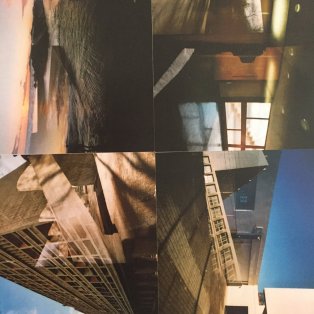
 If I’m not mistaken, this is the third release by Matthew Atkins that I’ve written about this year (a fact easily verified by searching for all instances of his name in post titles, but I’d rather use the phrase “if I’m not mistaken” instead). Cryptic System comes to us via Falt, a small independent French label with a DIY attitude toward making and presenting avant-garde music, an approach with which Matthew Atkins is quite familiar. The tape continues in the areas of object acoustics and electronic tones explored by Porous Inner Montage. Across two twelve minutes tracks, the listener is placed in the midst of the clutter created by these concrete sounds; it’s difficult to discern which interactions are taking place in the same recording and which are pasted on top, an obfuscation that gives the physical sound environments a crowded and disorienting form. But the individual elements provide a lifeline within the din of rattle and wobble; each component, whether a half-buried field recording or a plasticky whoosh like that of a waved piece of laminate, travels its own path, and following each one as they evolve through the piece keeps you grounded. The end of the second part is one of the tape’s most interesting and adventurous moments, with a dynamic swishing battling for space with the barely intelligible words of an unidentified voice. It builds a mysterious, abstract environment beyond the senses, juxtaposing the familiar and unfamiliar and landing somewhere in between. Needless to say, I’m excited for the spaces to which Atkins will take us next time.
Author: Jack Davidson
I like to listen to, read and write about, and play music.
Review: Jean-Luc Guionnet & Miguel A. García – Siticidelhous (Moving Furniture, Oct 19)
 Siticidelhous feels like it might explode at any moment. Across two long-form pieces, improvisers Jean-Luc Guionnet and Miguel A. García build countless layers of tension that swirl and simmer beneath the fragile surface tension of dissonant drones and electronic tendrils. While this sort of setting usually finds Guionnet on the alto saxophone, here, like his duo record with Seijiro Murayama earlier this year, he plays the organ, while García sticks to his electroacoustic manipulations. ‘Play’ doesn’t seem to be the right word for how Guionnet coaxes sound from the instrument, however…it’s more like he squeezes it like an almost-empty toothpaste tube, forcing thin clusters of piercing high notes from the pipes that prick the listener’s ears like small needles. Despite both the musicians’ sound sources having the ability to produce loud cacophonies, they persist with a largely reductionist approach, and the busiest either piece gets is probably the soft interplay that emerges two-thirds of the way through “Lomburthstific.” But even then, as the crackling electric embers and anxious organ get louder and louder, none of that exquisite tension is released, remaining trapped forever within these barely substantial walls of delicate sound.
Review: Tom White – Run Amok (Glistening Examples, Oct 17)
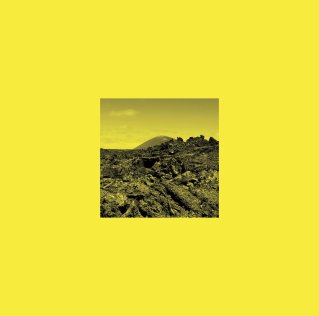 With Run Amok, a gorgeous new CD out on Glistening Examples, artist Tom White examines the volcanic landscape of Lanzarote, a Spanish island west of Morocco in the Atlantic. Lanzarote was the location where Werner Herzog filmed his absurdist black comedy Even Dwarfs Started Small. The 1971 movie, featuring the ridiculous escapades of a group of dwarfs as they rebel against the nameless institution in which they are confined, has a unique and elusive atmosphere despite its whimsicality, largely due to the mysterious environment in which it was filmed. Herzog and White each capture this environment in their own way, the former with beautiful blacks and whites and a wanton mixture of shaky camera work and static shots, and the latter with carefully mixed audio recordings. Though White doesn’t rely heavily on the use effects or processing techniques on these recordings, they are largely unidentifiable, spinning up into tactile, rocky whirlwinds like gravel in an air-popped popcorn machine. He makes use of many small scraping sounds, overlaying them and playing them backwards to create crackle collages that are both gritty and effervescent. When effects are used, they only increase the alien-ness of Lanzarote’s sound palette, whittled down to a dark, electric meditation on “Del Rio.” With ten tracks, White presents a lot of ideas, each distinct but naturally evolving into each other. While I’m not sure that Run Amok would make a good score for Even Dwarfs Started Small, the two works demonstrate how the attributes of a physical place can be communicated in different ways.
Review: Uboa – The Sky May Be (Art As Catharsis, Oct 18)
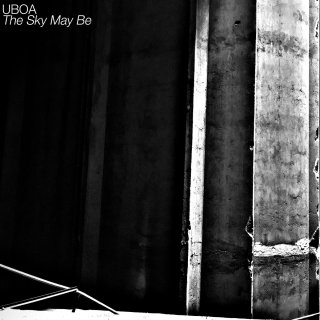 If you let your mind wander for even a minute or two while listening to The Sky May Be, you will most certainly be surprised at how much ground it has covered during that time. Not that it’s even easy to lose focus; Uboa’s new record, “a work about poverty, sex, anxiety, and love,” commands every bit of the listener’s attention. It is equal parts nightmarish and comforting, angry and peaceful, pessimistic and hopeful, juxtaposing noise freakouts and brooding drones with lush, even pretty ambience. “Salivate on Cue” is a cut-up masterpiece, blasting the ears with schizophrenic contortions of screeching feedback, while “Dementia,” the first part of the “The Sky May Be” suite, combines backwards-played melodies, reverb, and processed vocals to conjure a uniquely gorgeous nocturnal soundscape. This latter track is just breathtaking, even more so when tortured, distorted shrieks emerge toward the end, cracking the already fragile foundations of beauty and crumbling into the piercing metallic squeals of “Entropy.” Despite its eclecticism, the powerful driving force of Xandra Metcalfe’s versatile voice unifies even the most disparate elements, grounding a monster of an album that threatens to break its chains at any moment. I challenge anyone to find a track this year as cathartic as “Extus.”
Review: Giovanni Lami – In Chiaro / In Guardia (Sounds Against Humanity, Oct 19)
 From just looking at the cover of In Chiaro / In Guardia, one would probably have a sense of what they think the tape will sound like that is very different from how it actually sounds. The reaching, clear sky, kite-flying people, and rolling green hills imply an atmosphere of comfort and nature. But the soundscapes created by sound artist Giovanni Lami on this new tape are as subversive as always, almost entirely concealing any of that organic source material below shifting layers of dusky drones and synth textures. The latter half of the first side, “In Chiaro,” is quite illustrative of that mysterious reticence, as hints of luminous beauty struggle to rise above a blanket of reverb-drenched clacking and clicking; it’s especially elusive after the beginning of the piece, in which these more participatory elements are less prominent. As a huge fan of Lami’s work, I am beyond excited to see these two areas colliding — those being unprocessed field recording soundscapes and the profound dark greyness of concrète works like Bias—on one album. “In Guardia” pushes the palette even farther, agitating a bubbling hum of electricity with muffled object sounds and what sounds like some buried environmental recordings. Though the physical setting of In Chiaro / In Guardia initially seems important to its identity, the tape ends up examining far more abstract and intangible sound worlds, a realm in which Giovanni Lami thrives.
Review: SkullxPiercer – First Degree Murder (Bruxism, Oct 14)
 First Degree Murder is LOUD and FAST. And if you’re anything like me, that’s enough of a description to give it a shot, especially considering that the transnational duo SkullxPiercer’s debut tape is only eleven minutes. Stuffed chock-full with samples that are equal parts silly and terrifying, furious blast beats, heavily distorted shrieks, and brief interjections of squalling noise, it’s an exhausting but exhilarating ride. With song durations ranging from almost two minutes to a mere one second, First Degree Murder establishes an unyielding momentum that barrels mercilessly through the entire tape, stubbornly grasping onto every last bit of energy. Even on tracks with whiplash transitions — like penultimate pummeler “Cannibal Hamburger Nightmare,” in which a guy nonchalantly describing cutting up crack whores in his trailer to make his ‘special meat’ splits time with crusty sludge riffs and blasts — the murderous vigor and volume never budges from pushing hard against the far right of the dial. Check out First Degree Murder if (a) You’re tired of fun, spooky Halloween festivities and want something truly evil and terrifying, (b) You’ve got some crack whores to slice up and need some brutal hardcore for a soundtrack, or (c) you want music that is LOUD and FAST.
Review: O Yama O – O Yama O (Mana, Oct 5)
 I’m not entirely sure what I was expecting when I pressed play on O Yama O’s self titled album, but I am sure that I was not expecting what I heard. As you may know, Rie Nakajima is one of my favorite sound artists and creatives in general, but what I usually enjoy about her work is its formlessness and textural inclination, examining the sounds of objects and how they fit together without concerning itself with conventional structure. But on O Yama O, the debut studio release of her project with Cafe OTO co-founder Keiko Yamamoto that has been performing since 2014 (and has somehow remained completely under my radar until now), Nakajima’s object orchestras are molded into odd folk songs, providing whimsical bases and flirtations with Yamamoto’s impassioned vocalizing. “Oni” is an early example of the two artists’ unique and successful intermingling, blending rollicking clatters of small items and toy wind instruments with the joyful cries of the titular word, which means, if I am not mistaken, ‘demon.’ This persistent contrast of fun, happy stamping and the alien unknown plays out in various ways throughout the record, venturing farthest into mystery on tracks like “Iroha” that probe dark, uncomfortably intimate timbres.
Buy the physical LP here.
Review: Bob Drake – l’Isola dei Lupi (Morphius, Oct 4)
 No one, and I mean no one, writes vocal harmonies quite like Bob Drake. The first track on his new LP l’Isola dei Lupi, “Isola dei Lupi,” is almost entirely composed of his own layered singing, with exquisitely crafted chords introducing tension and dissonance that is resolved almost immediately. This impatience is what makes Drake’s music so unique and special. Across his now ten albums, songs longer than five minutes are extreme rarities; Drake chooses instead to focus his songwriting on a miniature scale, often developing an impossible amount of elements within songs that end before you even knew they started. l’Isola dei Lupi goes a much more folk-oriented route than the maximalist glam-pop of Arx Pilosa, with the angular, space-filled guitar lines and wistful piano being more reminiscent of his earlier albums. Its more reserved approach prevents it from being as immediate as some of my favorite records of Drake’s, mainly Medallion Animal Carpet, but I have no doubt that his unparalleled attention to detail and meticulous songwriting/production process will reveal countless idiosyncrasies upon further listens. “Ycnarr’s Rock Collection Pleached Path to the Cliff” is one of his best songs ever, a bombastic prog number condensed by a junkyard crusher into a two-and-a-half minute powerhouse of evolving melodies, and penultimate centerpiece “The Ascension of Greyfoot Badger” gives me the same gleeful catharsis as “I Wish It Had Been a Dream.” As always, even when l’Isola dei Lupi is at its most serious it’s still a ton of fun, and there is something here for pretty much everyone.
Review: Excretion Geometry – Household (Absent Erratum, Oct 2)
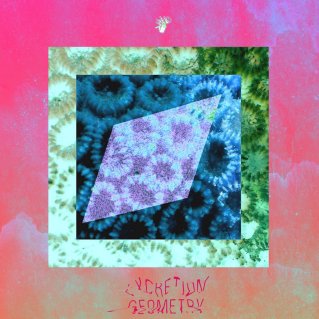 As an amateur phonographer, I spend a lot of time outside with my headphones plugged into my digital recorder, just listening to the sounds of rustling trees, birds, and distant voices. This ambient environmental sound is what opens Household, the first and only release (as is Absent Erratum’s MO) by anonymous project Excretion Geometry. “Home of Embers – Prelude” presents an unprocessed recording of a windy day, the gusts of air intermittently filling the low end of the frequencies; and just as your patience begins to wear thin, an interjection of overheard conversation leads us into “Home of Embers.” When this wall — fence might be a better description — emerged on my first listen, I uttered an audible gasp. It’s one of the most subtle, meditative static noise pieces I have ever heard, throwing stuttering, distorted blips at each channel. This stereo-reliant approach without a central basis in the form of a rumble or drone is unconventional to say the least, and simultaneously disorients and lulls. The following “Bramble Guardian” explores similar territory, with the intensity slightly amped up; but that contrast is dwarfed by the punishing “Flux,” which shatters the fragile constructions of the previous tracks with an unstoppable wall of chunky distortion. “Interstitial Malfunction” backs off slightly, but maintains the intensity. I’m not sure whether the prelude at the beginning of the album was the source material for these walls, but regardless of where they came from, every single one is hypnotic in its own way.
Review: Mosquitoes – Drip Water Hollow Out Stone (ever/never, Jul 13)
 This one came out quite a while back, but I only recently discovered it — and liked it so much that I felt the need to write about it. “New-ish” UK project Mosquitoes picks up where many bands in the short-lived no wave scene left off. In my experience, no wave revival mostly takes the form of irreverent, angular noise rock with deranged vocals, and most of the records I have heard don’t offer much in the way of new territory in either a modern context or with reference to the original movement. Mosquitoes, however, takes the deconstructed rock formula explored by acts like DNA and Mars even further, using conventional instruments in unconventional ways on their debut release Drip Water Hollow Out Stone. In this case, unconventional is a gross understatement; if DNA dropped rock music on the hard concrete floor and worked with the broken pieces, Mosquitoes kicks those pieces around until they break into dust. These unsettling, hulking “songs” build themselves on rickety foundations of rattling drums, stumbling bass, hypnotic vocal repetitions, and unpredictable guitar interjections. On opener “Drip,” tremolo guitar drones unseat a tentative groove created by a disjointed rhythm section, while the vocalist forces ragged cries out of a resistant throat. “Out” is a bizarre masterpiece, with disintegrating guitars and indecipherable words in an alien language building to a violent climax. I could go on and on; Drip Water Hollow Out Stone’s 24 minutes are stuffed with surreal density that even after listening to it every day for the last week or so I’m still discovering new things.
 Noise Not Music