
 The digital-only Digging for Diameters collects seven pieces by the enigmatic artist Three Bulb Cyclist, released over the course of 2018 across four releases on Rota Frangitur Records. It is also my first encounter with their music, and after the first two tracks I wasn’t quite drawn in yet. But upon the opening synth spirals of “La Chicle En La Boca,” a 16 minute piece with a mind all its own, I was hooked. The free-form electronic synthesis (I don’t know enough about this stuff to identify modular vs. granular or whatever) tumbles and whirls over itself, phasing in and out from dissonant sonorities to gorgeous plasticky twinkles. It’s hard to imagine a human executing these manipulations; the progressions are so natural that it almost gives the sense that the sounds were programmed and then just let loose. “La Chicle En La Boca” and the ensuing compositions explore synthetic tones and beauty amidst stridency and tension, in the same vein as some of my favorite adventurous electronic records (I was frequently reminded of Animal Collective’s brilliant Danse Manatee and even the electronic stochastic music of Xenakis), but Three Bulb Cyclist employs a subtle lushness, a hint of profound color, even in the collection’s sparsest moments.
Author: Jack Davidson
I like to listen to, read and write about, and play music.
Review: Depleted – Conjurations of Void (Nailbat Tapes, Sep 21)
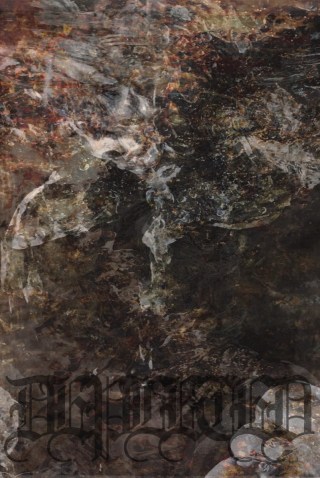 Many types of metal benefit from a scrappy, do-it-yourself approach. I’m not partial to the idea of a one-person, lo-fi tech death record or something like that, but the more emotionally intimate subgenres pair much better with such a format. Conjurations of Void, the first and, as of now, only tape from Portland project Depleted, is an up close and personal bedroom doom release that infuses formless harsh noise textures into the standard riffs and beats. Initially, I was disappointed that opening track “Spent” doesn’t introduce any of these elements until its conclusion, which leads into the rhythmless swirls of “Depletion.” But upon further listens, this lower level of integration accomplishes something entirely unexpected; it’s almost like the noise is eating away at the music that precedes it, dissolving the slow guitar chugs into howls of distortion. The reverse happens at the beginning of “Void,” which emerges out of a deafening wave of effect-ridden vocals. This time, however, the noise stays, albeit subtly, a hint of tension underneath the ensuing death doom sludge that rises like a leviathan from the murky depths of tape hiss and fuzz. Would I have liked Conjurations of Void to be longer, and further explore this interesting duality? Yes. Is it awesome the way it is? Definitely.
Review: Damien De Coene – The Present Is a Hostile Place (Geräuschmanufaktur, Oct 7)
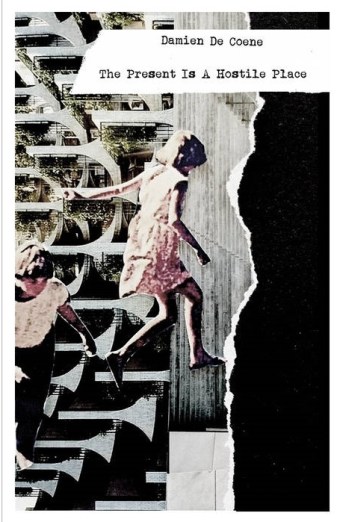 The HNW series of Jan Warnke’s Geräuschmanufaktur label has been regularly churning out tapes filled with some of the most innovative work in the genre. Most releases have a unique approach or style that it explores (e.g. Constructionis, which I reviewed here a few months ago, and 2017’s Clavilis Muri, which pairs dark static with piano). But none have hit me in the way that Damien De Coene’s tape The Present Is a Hostile Place did. Loneliness, whether meditative solitude or aching desolation, is a feeling frequently elicited by wall artists, but “Homesick Orphan” makes me feel completely isolated, like I am in a dark hole by myself and can barely make out the things passing overhead. This profound stifling is accomplished through the masterful use of stereo space; amidst the crackles — which on the left crumble into a deep, earthy rumble and on the right stay in a higher range — is a gaping hole, a complete absence of sound that calls as much attention to itself as the noise beside it, a physically oppressive darkness. “The Benefits of Destructive Behavior,” beginning with an odd synth sample, adopts largely the same structure, but with enough variation that it is distinct yet just as hypnotic, along with some muffled glitches that subtly disrupt and distort the wall. The Present Is a Hostile Place will put you into a trance; the 60 minutes feel so much shorter, and at the end it’s like stepping out of a pitch black cave into the sunlight.
Review: Candy – Good to Feel (Triple B, Sep 28)
 And the award for the grooviest, angriest hardcore record of 2018 goes to…
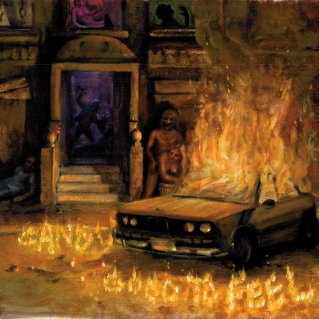
Good to Feel sounds every bit as fiery as the graphic album cover. The guitars, while chunky and full with plenty of low end, have a sharp flaming edge to them that blasts right through the mix, only matched by the furious vocals. Though Candy largely abandons the beatdown-indebted sound of previous releases, Good to Feel still slams unfathomably hard, with each track offering fast-paced punk pounds, invigorating mid-tempo chugs, and deliberately slow breakdowns that drip with sludge. The latter element is probably the record’s standout feature: the breakdowns are fucking amazing. Unlike many more metalcore-informed bands, when Candy slows down the anger doesn’t; even during the most sluggish sections a palpable, electric fury remains. Because of this, the longer tracks like “Distorted Dreams” hit just as hard as the brief blasters such as “Burning Water.” Good to Feel is only 17 minutes, so it doesn’t have time for mercy. Whether you’re banging your head furiously to thrashing hardcore or more slowly while that distinctive “oh man this is heavy” expression spreads across your face (I challenge you to listen to “Human Target” without doing so), Good to Feel drives a hot metal spike straight into the amygdala.
Review: Rodrigo Ambriz – Una silueta se precipita en arcadas (Szara Reneta, Sep 15)
 Despite being arguably the most personal and innate instrument, the human voice is hard to master — and it’s even more difficult to surpass mastery, and venture into uncovered, original musical territory. Rodrigo Ambriz is an improviser whose control over his voice is astonishing. He uses it to create drones and form surreal clouds of nonsense verbalization, gagging and contorting his mouth in almost horrifying ways. On Una silueta se precipita en arcadas, Ambriz also makes use of auxiliary devices, like tape machines and miscellaneous electronics, to extend these unfamiliar timbres even further. In this regard he is not dissimilar from other, equally masterful abstract vocalizers (Yoshida, Junko, etc), but Ambriz’s approach is uniquely aggressive and passionate, much more focused on visceral assault and clashing textures. His ragged breaths are the listener’s only repose, especially on seemingly effect-less pieces like opener “Trayecto subterráneo. Espejos, dientes, sedimento.” At other times, he layers and builds loops for more patient progressions; “Páramo agreste, área exclusiva para digresiones fatigosas” is like a restless pit of unspeakable monsters, struggling and fighting each other to escape, until the whole thing eventually boils over. And “Despojado al fin por su propio soplo,” probably my favorite cut, initially sounds like a kid making sound effects while playing with action figures…but then you begin to realize how sinister and violent it sounds, like Ambriz isn’t just imitating the sound of some horrific scene but instead it’s being played through him, like a speaker or something. Needless to say, Una silueta se precipita en arcadas is a wild ride. I once read someone say that after listening to Derek Bailey the guitar becomes “an incredible alien artifact of immense power.” Similarly, after Ambriz, I’m looking at my vocal cords in a very different way.
Review: Ipek Gorgun – Ecce Homo (Touch, Sep 7)
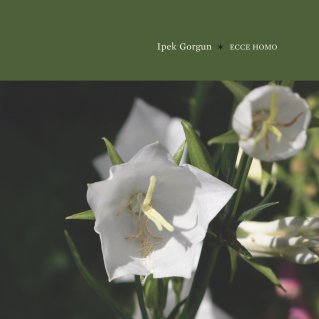 Ecce homo! Behold the man! Having just read Tom Kristensen’s novel Hærværk a few weeks ago, it’s a phrase that’s been on my mind recently. A sarcastic and sardonic one nowadays, when our shortcomings, vices, and darknesses are at the forefront of our lives; behold us in all our imperfections and evils. Ipek Gorgun’s new record, also titled Ecce Homo, is said to explore “the lighter and darker shades of the human psyche, behaviour and existence, and humanity’s ability to create beauty and destruction.” The latter pair dominates Gorgun’s musical approach in a variety of permutations: beauty through the destruction of the crushed and gutted sounds that form “Tserin Dopchut,” destruction of the beauty that the musical samples of “Neroli” might once have held. Gorgun’s compositions follow our disastrous path as a species; nature is bulldozed into screeching mechanical constructions, those constructions break apart and fold on themselves, until reaching a climax in “To Cross Great Rivers,” described as the embodiment of humanity’s eternal greed and imperialism. Without context, the sonic palette of Ecce Homo is painful, unsettling, immersive; when paired with these unfortunate truths, it becomes excruciating, terrifying, way too close for comfort.
“Let me give you a revelation: they are in control.”
Review: Intestinal Disgorge – Everlasting Fractal Nightmare (Meat 5000, Sep 25)
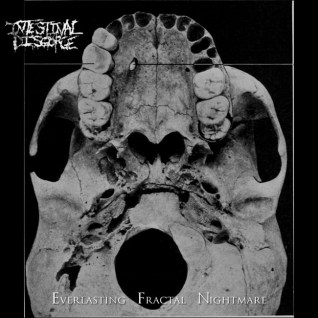 Texas goregrinders Intestinal Disgorge have come a long way since the release of their debut full-length, Drowned in Rectal Sludge, in 2000. After a lot of stylistic exploration, they are honing in on a sound that bonds the unhinged noise blasts of their early work with a more refined, but still hideously brutal death grind format. Everlasting Fractal Nightmare picks up right where last year’s Sonic Shrapnel left off, and it’s pretty much the culmination of what the band seems to have been working toward. The drums keep every single track barreling at an uncompromising pace; I don’t think the bass drum ever lets up for more than five seconds at a time, it just beats you into the ground and keeps you there. The vocals are as unpredictable and disturbing as ever, climbing from down-tuned gurgles to piercing shrieks atop the putrid atmosphere whipped up by the guitars. Intestinal Disgorge have completely mastered the conjuring of a dark, horrifying sonic environment, which is brewed at the forefront on texture-focused tracks like “Shambling Cyclopean Terrors” and “Where They Breed” and presides over the rest of the album with pestilent persistence. Yes, 35 mins seems long for an unrelenting gore record; I thought the exact same thing. But Everlasting Fractal Nightmare is paced perfectly, and by the end there’s not even a hint of the exhaustion I normally get from too much of this sort of stuff. If you can’t tell, I’m super excited about this release.
Preorder the physical CD here.
Mix: Object-ivity
If you’re at all familiar with experimental music or adventurous sounds in general, it’s not an uncommon sight to see a musician credited with playing “objects” in the liner notes of a release. “Object” is clearly not a very specific classification, but here we take it to refer to something whose primary purpose is not music-making yielding sound, whether melodic or textural. The field of sound art is often concerned with exploring the acoustic properties and potentials of such objects, and they are also used in abstract improvisational contexts or as unconventional percussion devices. The tracks selected for this mix range from the primitive junk-painting of early Japanese pioneers Group Ongaku to manipulations of electric circuits and robotics to layered compositions formed from recordings of household appliances. I love this kind of stuff for many reasons: the use of objects requires no formal musical training or knowledge, their unique timbres can be harnessed for such a wide variety of purposes, and, most importantly, unexpected beauty is the best kind of beauty. Enjoy.

00:00. Group Ongaku – “Object” from Music of Group Ongaku (Hear Sound Art Library, 1996)
04:57. Akio Suzuki – “Aeolian Harp” from Odds and Ends (Hören, 2002)
08:49. Jean-Luc Guionnet & Thomas Tilly – “Window, contact recording #1” from Stones, Air, Axioms / Delme (Fragment Factory, 2018)
10:56. John Collins McCormick – “7” from One Bone in the Arm (Pan y Rosas, 2018)
14:32. Joe Colley – “Untitled Unstable Stereo Circuit” from Disasters of Self (C.I.P., 2010)
19:00. Annea Lockwood – “Water Gong” from Glass World of Anna Lockwood (Tangent Recordings, 1970)
24:48. Pierre Henry – “Balancement 2” from Variations Pour Une Porte Et Un Soupir (Philips, 1967)
27:23. Max Eastley – “Half Speed Metal Installation” from Installation Recordings 1973-2008 (Paradigm Discs, 2010)
31:14. Dirch Blewn – “Day 3” from Care Work (Soft Error, 2018)
36:01. Manja Ristić – “Buzzy & the Teapot” from Fairy & the River Teeth (Sonospace, 2018)
39:50. Jeph Jerman, Giacomo Salis & Paolo Sanna – 2nd untitled track from KIO GE (Confront Recordings, 2016)
43:24. Peter Brötzmann & Han Bennink – “Aufen 2” from Schwarzwaldfahrt (FMP, 1977)
45:52. Loren Chasse – “Arbor Pore I” from The Footpath (Naturestrip, 2008)
Review: Klara Lewis & Simon Fisher Turner – Care (Editions Mego, Sep 28)
 Usually, I don’t have to listen to an album very many times before I feel like I can describe and express what I enjoy about it. With Care, things happened differently. I listened to it once, and afterwards I wasn’t really sure what to make of it. I listened another time, still ambivalent. I only knew that I wanted to hear it again. Now, after five or six times through, I can confidently say that Care is one of this year’s most enigmatic and elusive releases…and one of its best. Sound artist Klara Lewis and composer Simon Fisher Turner team up to create blissful, dense soundscapes with metallic edges. Opener “8” traipses across a wide map of textures, somehow feeling gradual and sudden at the same time; the swirling, airy drones flow in and out, their distance and intangibility lulling you into a trance — and then whiplashing flashes of samples and processed noises force you back to earth. This is a sonic relationship that the rest of the album continues to explore, to amazing results. The sound these two artists have achieved resides in some inexplicable middle ground between calming ambience and industrial punch, though overall the effect is calming, not so far off from the soft pink gossamer strands on the cover. A truly impressive, unique release, one that requires a lot of time to fully decipher (at least it did for me).
Review: Sunflo’er – No Hell (Noise Salvation, Sep 28)
 No Hell is a record that covers a lot of ground in a relatively short amount of time. These three musicians, whose work outside this album I unfortunately know nothing about, take the listener on an angry odyssey through ambitious style experiments, atmosphere building, and incendiary blasts of all-out aggression. No Hell could easily have fallen apart at the seams, overstuffed with the staggering amount of stuff that gets thrown at you, but it doesn’t. Not even close. Each time the final notes of beautiful closer “Good Old Way (Reprise)” arrive, it feels like the album just started a few minutes ago. “Loup Garou” is a fiery start with labyrinthine songwriting, “No Gate to Close” adds almost black metal-esque flavors with its fast-picked guitars and driving drum blasts even as the anthem “there is hope beyond these teeth!” is called out, “No Hell” delivers more scalding fury in under a minute than many artists can introduce in ten, “Days Gone” slowly crushes with its patient texture layering and false crescendos…and that’s all in the first six tracks of the LP, about twenty minutes! The sheer eclectic density and the cohesive package in which it is presented is what keeps me coming back to No Hell pretty much every day since its release.
 Noise Not Music