Review: Suppression – Placebo Reality (Chaotic Noise Productions, May 16)

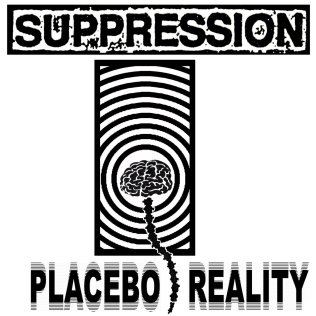
Suppression’s irresistible brand of breakneck, noisy powerviolence is more hectic than ever on their new LP from Chaotic Noise Productions. The long-running Roanoke project, which has been active since 1992, has been ramping up both the creativity and intensity on their recent releases (notably the Rats in the Control Room and Oblivion Riders tapes, also from CNP), and the trend continues with Placebo Reality. Running just under a half hour throughout 73 tracks, its length made me skeptical at first; Suppression seems to work best with short album durations, and maintaining such a high energy level is difficult to do. Luckily, I need not have worried. Placebo Reality is a nonstop onslaught of blown-out hardcore, comically brief noisecore blasts, animalistic growls, and surprising moments of catchiness. No, it never slows down, and no, it never gets old; when it ended I found myself asking, already? Everything is dialed up to the max, blending the perfect amount of ridiculousness with the perfect amount of brain melting heaviness to make one unforgettable LP. In my opinion, it’s the band’s best work yet.

Pick up the disarmingly fairly-priced cassette and vinyl releases here.
Review: Nathan Corder & Tom Weeks – Anaconda (Noise Pelican, Apr 5)

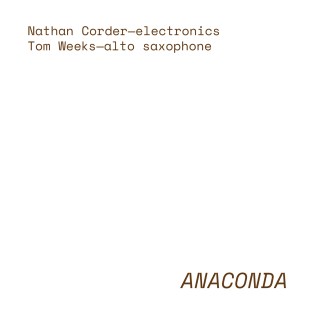
On Anaconda, the newest offering from Florida label Noise Pelican Records, abstract virtuosos Nathan Corder and Tom Weeks’ improvisations coil and slither just like the album’s titular serpent. The unlikely pairing of Weeks’ very harmonic, scalar saxophone playing with Corder’s bizarre electronic spasms is an interesting one. But after “Knot,” the short and schizophrenic opening track, it starts to become clear that the contributions of the two musicians do not create as much of a juxtaposition as it would originally seem. “Lean” begins with a jazzy serenade by Weeks, which is slowly joined by brief, segmented electronic bursts that begin to build in intensity. I’d describe the piece as more of a conversation than anything; it almost seems like the artists are learning from each other as it progresses, with the saxophone becoming more frenetic and atonal to match Corder’s increasing presence. And the rest of the record is no different. From the explosive, body wracking intro to “Swallowed” to the mechanical oscillations of “Cycle” (where the moments of unity between the cracking electronics and saxophone flurries are some of the album’s most mind-blowing), it all cements the alluring chemistry of these two improvisers.

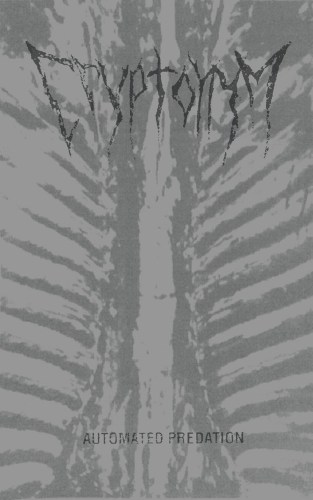
Review: Cryptonym – Automated Predation (Castle Bravo, Jun 1)

Automated Predation is short but sharp as a rusty nail. The new project, which I know pretty much nothing about, combines the aggressive, distorted synths and pounding rhythms of industrial techno with the dark atmosphere and anger of black metal. None of the EP’s nearly twenty-minute run time is wasted, as Cryptonym explores and experiments with the wide territory this combination of styles makes available. “Cavern of Mirror” starts strong with a bitcrushed blast beat and twisting synthscapes, only becoming more awesome when the vocals kick in with a snare that sounds like two giant pieces of sheet metal being smashed together. One of Automated Predation’s main strengths is its use of catchy synth arpeggios, a unifying element across all four tracks despite each one being pretty different. Even on “Speak to Flames,” where a more formless approach is taken, the distinct dark effervescings still push through at the end. And on the EP’s centerpiece, the driving title track, anyone who thinks an electro-infused black metal track can’t get stuck in their head will be proven very wrong. Automated Predation was the tape I was most skeptical about among Castle Bravo’s eclectic mid-year lineup, but ended up being a pretty awesome surprise.

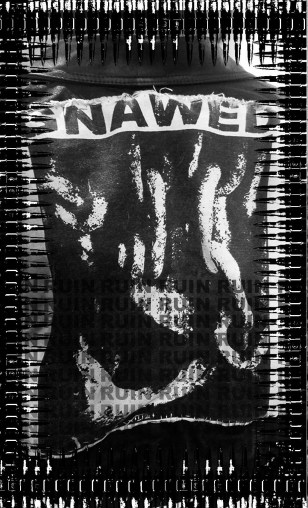
Review: Gnawed – Ruin (No Rent, May 21)

Along a bike path near my home town there is an abandoned, burned down powder factory. Its dilapidated exterior and ominous empty windows have loomed over me every time I’ve passed it, and the only thing stopping me from exploring inside is that it is quite heavily patrolled (baffling, I know; God forbid kids be allowed to explore an extremely dangerous and unsupervised environment). But if I ever were to step inside, I imagine I would hear a lot of the same sounds as are present on Ruin. Gnawed (Grant Richardson) paints an uncanny dark, industrial landscape, steeped in unsettling anticipation and a visceral feeling of dread. Though the shouted vocals and relatively faster sections on the A side were enjoyable, I found myself much more immersed in the more patient passages. The track that makes up the majority of Side B is definitely one of the most impactful death industrial pieces I’ve heard, creeping along at a lethargic but deliberate pace, with the metallic creaking of machinery conjuring images of terrifying, rust filled urban caverns. Richardson could not have picked a better titled for Ruin; every minute of the tape exudes age, decay, and death.

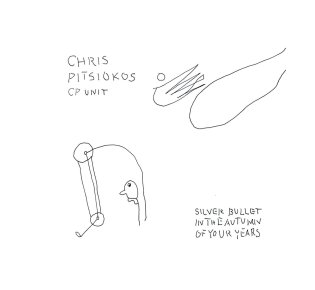
Review: Chris Pitsiokos Unit – Silver Bullet in the Autumn of Your Years (Clean Feed, May 11)

Silver Bullet in the Autumn of Your Years is American saxophonist Chris Pitsiokos’ second record with his Unit, and improves upon the first in virtually every way. It’s an atonal adventure through arrhythmic free improvisation, invigorating broken funk grooves, and astonishing displays of musical rapport. An early highlight is the eclectic “Orelius,” which begins with an inferno of instrumental chaos before retracting into a mesmerizing stew of sax noodling, electronic gurgles, and crunchy guitar spasms that quickly builds into another cacophony. The extended lengths of many of the songs is a welcome change from Before the Heat Death, and give the band more time to flesh out these fluid improvisations. It’s so entertaining to hear the way these tracks progress; it almost sounds like the musicians are trying to outrun each other, forcing their peers to follow along at disorienting, breakneck speed. In other hands this could be disastrous, but it ends up giving the record a whimsical, energetic, and ultimately exhilarating atmosphere. Then there are the moments of structure during the bass and drum jams of “Once Upon a Time Called Now” and the title track, placed just right so that the whole thing doesn’t fall apart. As someone who hasn’t had much luck with new jazz this year, Silver Bullet is the breath of fresh air I desperately needed.

Review: Stimulant / Water Torture Split LP (Nerve Altar, May 18)

Like a lot of other hardcore fans, I was under the impression that I wouldn’t ever hear any more new material from Water Torture. The New York trio disbanded almost three years ago, just months after releasing their only full-length, 2014’s brutal and brilliant PillboxBut fortunately there wasn’t much to complain about; members Thomas Leyh and Ian Woodrick moved on to form Stimulant, a powerhouse of sludge-filled grindviolence whose self titled LP last year blew any of Water Torture’s releases out of the, erm, water. But fortunately, both bands appear on this surprising split release from Nerve Altar, and there is no mercy to be had throughout these 35 pummeling minutes. Stimulant’s side continues everything I loved about their previous record, fusing metallic noise bursts and harrowing sample interjections with furious blasts and blown out vocals. In my opinion, the duo is at their best on their short songs, and there are plenty of those here; but the three minute “Strangled Thought” that closes their half is equally vicious. Water Torture, by contrast, seems to take things slower. Their brand of body wracking, noisy sludge feels as fresh as ever, but by the end I felt myself wanting them to let loose more. The vocals are the most unhinged part but even they seem held back by the middling tempos and riffs that aren’t nearly as heavy as they should be. A bittersweet release, because as far as I know this is Water Torture’s swan song; but personally I am much more excited for where Stimulant goes next anyway.

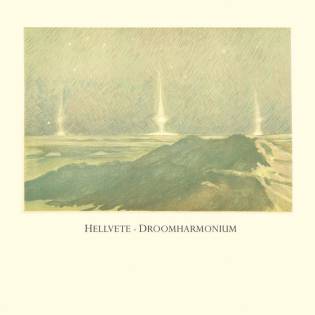
Review: Hellvete – Droomharmonium (Morc Tapes, May 23)

I wouldn’t exactly call myself a morning person. But one of the greatest things in life is waking up at a decent time, feeling well-rested and energized, while golden sunlight streams in your bedroom window and makes all the dust look like sparkles in the air. And if that unfortunately less-than-common occurrence was audible, it would probably sound a lot like Droomharmonium. It’s the newest album from Silvester Anfang member Glen Steenkiste under the Hellvete alias, a double CD full of warm, flowing drones largely produced by the titular instrument. To call these four long form pieces “beautiful” would be an understatement; they are something far beyond that. Droomharmonium rewards both active and passive listening, lush enough to sustain attention despite its simplicity and unintrusive enough to not be distracting. But I would recommend paying attention. Steenkiste has created music here that is truly heavenly, seraphic, celestial, other synonyms. I hope I’m not being too hyperbolic; Droomharmonium defies any less grandiose descriptions, and easily deserves all of the praise I have heaped upon it.

Review: Nonturn – Territory (Audiobulb, May 16)

Territory is “a soundtrack for an artwork containing nine images of street walls in Tokyo.” Fittingly, the album is entirely composed from sounds recorded on and around those streets; a fact I probably would never have guessed, considering that it is one of the most lush and melodic electronic albums I’ve heard this year. The heavily processed recordings are tuned, rearranged, and sculpted into enticingly beautiful compositions, that ebb and flow with just as much energy as the busy roads they came from. “Evidence,” one of the record’s most immediate pieces, displays the wide spectrum of elements Nonturn (Nozom Yoneda) utilizes, its sonic palette ranging from warbling melodic tones to recognizable clips of objects crashing onto the ground. And here is where the true power of Territory becomes apparent; the more you listen, the origins of the sounds become more apparent; rumbling bass from an idling car stereo, an engine being started, the scraping of tires against pavement, and even the barely audible chirping of birds can all be picked out with an attentive ear. Yoneda finds the delicate, perfect balance between the manipulated and the unaltered, making Territory  as gorgeous and impactful as it could possibly be.

Review: The Holocene – Yūrei (Lugubrious Audio, May 11)

As a huge fan of The Holocene’s (PJ Hamlin) previous tape on Lugubrious Audio, Dead:Unearthed, it was tremendously exciting to see that the U. K. based sample virtuoso had another release. Thankfully, Yūrei has far surpassed expectations, and cements Hamlin as a modern titan of audio collage. The tape is a love letter to traditional Japanese ghost stories, and draws its source material from horror film VHS tapes and various vinyl records from the 70’s and 80’s. The result is a lush, hypnagogic opus full of dusty percussion clips, mysterious spoken word samples, and the warm crackles of the decaying media from which it was all lifted. Yūrei certainly retains much of the horror evocations present in the original material, but the fear it elicits is comforting; more like the nervous excitement one gets from hearing scary stories around a campfire rather than sheer visceral terror. And there’s also an ambiguity in atmosphere, a phenomenon common among albums with such sample-based methodology, but here it is such a mesmerizing companion to Hamlin’s cryptic sonic mishmashes. Yūrei succeeds in embodying both the allure and the danger of the supernatural, and is somehow pretty catchy along the way. Plus it’s capped off by one of the sweetest, most sublime closing tracks I’ve heard all year.

Review: Bart De Paepe – Pagus Wasiae (Beyond Beyond Is Beyond, Apr 20)

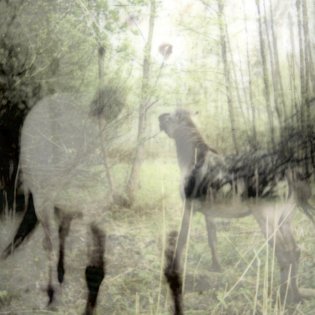
Bart De Paepe’s newest record Pagus Wasiae is a swampy concoction of psychedelia and bubbling electronics. The atmosphere he creates is incredibly vivid. The cover art provides a great visual representation; the music is greenish and soggy, but with enough cohesion to prevent it from falling apart. It’s the sonic equivalent of sunlight trying to break through a thick canopy of trees; the sounds are muffled and distant, tantalizingly close but trapped behind a blanket of murkiness. That is, until moments like the beginning of “Alvinclarvord,” when a scorching, fuzzy, spaced out guitar breaks through, or the tendril-like synth modulations of closing track “Moerassen Van de Gouw.” This unpredictability is one of Pagus Wasiae‘s greatest strengths. It’s almost as if De Paepe mixed and stewed a multitude of sounds like ingredients in a Chinese hot pot, leaving the choice of which elements would dissolve or break apart and which would retain their original structure to be decided organically. This gives the record a pleasing whimsicality, with just enough variation to keep the listener engaged but not enough to be jarring. Pagus Wasiae was an awesome surprise, and so far it’s gotten progressively better with each listen.