
 Following 2019’s L’impatience directe des corps CD on Glistening Examples, Stay Still is the newest release from French poet and sound artist Erell Latimier. The LP comprises two extended pieces commissioned and composed within the last few years that continue her exploration of the web of connections between voice and sound. She’s far from the first to embark on this voyage—see last month’s review of Victual Vittle Bottle Cunt—but both “Ils seront silencieux après” and the title track display a more focused and singular trajectory than her previous work. The former is a spellbinding drama of both text and texture, making use of jarring junctures between lulling concrète vignettes and unaccompanied speech to imbue the narrative with a haunting dislocation. The spoken delivery of the tale of a profoundly removed woman (many thanks to the artist herself for providing a translation so I could follow along with the French) is at once forlorn and detached, as if the speaker is grasping onto these memories one last time before letting them go forever. It turns out that this process is audible too: the sentences begin to echo, then fracture as they’re laden with distortion and tape slur, before finally dissolving into a fraught harmonic coda. Latimier spotlights the spaces where distinctions are difficult. “Ils seront” ends with a dry bubbling noise that could be the rattling of undecided vocal cords, while “Stay Still” enlists a cast of guest speakers—Camille Belhoradsky, Eric Cordier, and Will Guthrie—to stitch a rotting lattice of half-formed phrases and abandoned thoughts. The artist’s own words are once again the unifying element, here doomed to be vivisected into jagged glitches. There’s a moment around the 13-minute mark, so fleeting you’ll miss it if you’re not listening closely, when a rare wail of raw emotion cuts through the murk and is immediately, mercilessly silenced. How horrific it is to break… or rather, to be broken, because there is indeed someone else here: “They noticed it and came to watch us. They stocked us in a large room and kept telling us: don’t move, don’t move—and after, louder, stay still.”
Review: Erell Latimier – Stay Still (Kythibong, Nov 18)
Following 2019’s L’impatience directe des corps CD on Glistening Examples, Stay Still is the newest release from French poet and sound artist Erell Latimier. The LP comprises two extended pieces commissioned and composed within the last few years that continue her exploration of the web of connections between voice and sound. She’s far from the first to embark on this voyage—see last month’s review of Victual Vittle Bottle Cunt—but both “Ils seront silencieux après” and the title track display a more focused and singular trajectory than her previous work. The former is a spellbinding drama of both text and texture, making use of jarring junctures between lulling concrète vignettes and unaccompanied speech to imbue the narrative with a haunting dislocation. The spoken delivery of the tale of a profoundly removed woman (many thanks to the artist herself for providing a translation so I could follow along with the French) is at once forlorn and detached, as if the speaker is grasping onto these memories one last time before letting them go forever. It turns out that this process is audible too: the sentences begin to echo, then fracture as they’re laden with distortion and tape slur, before finally dissolving into a fraught harmonic coda. Latimier spotlights the spaces where distinctions are difficult. “Ils seront” ends with a dry bubbling noise that could be the rattling of undecided vocal cords, while “Stay Still” enlists a cast of guest speakers—Camille Belhoradsky, Eric Cordier, and Will Guthrie—to stitch a rotting lattice of half-formed phrases and abandoned thoughts. The artist’s own words are once again the unifying element, here doomed to be vivisected into jagged glitches. There’s a moment around the 13-minute mark, so fleeting you’ll miss it if you’re not listening closely, when a rare wail of raw emotion cuts through the murk and is immediately, mercilessly silenced. How horrific it is to break… or rather, to be broken, because there is indeed someone else here: “They noticed it and came to watch us. They stocked us in a large room and kept telling us: don’t move, don’t move—and after, louder, stay still.”






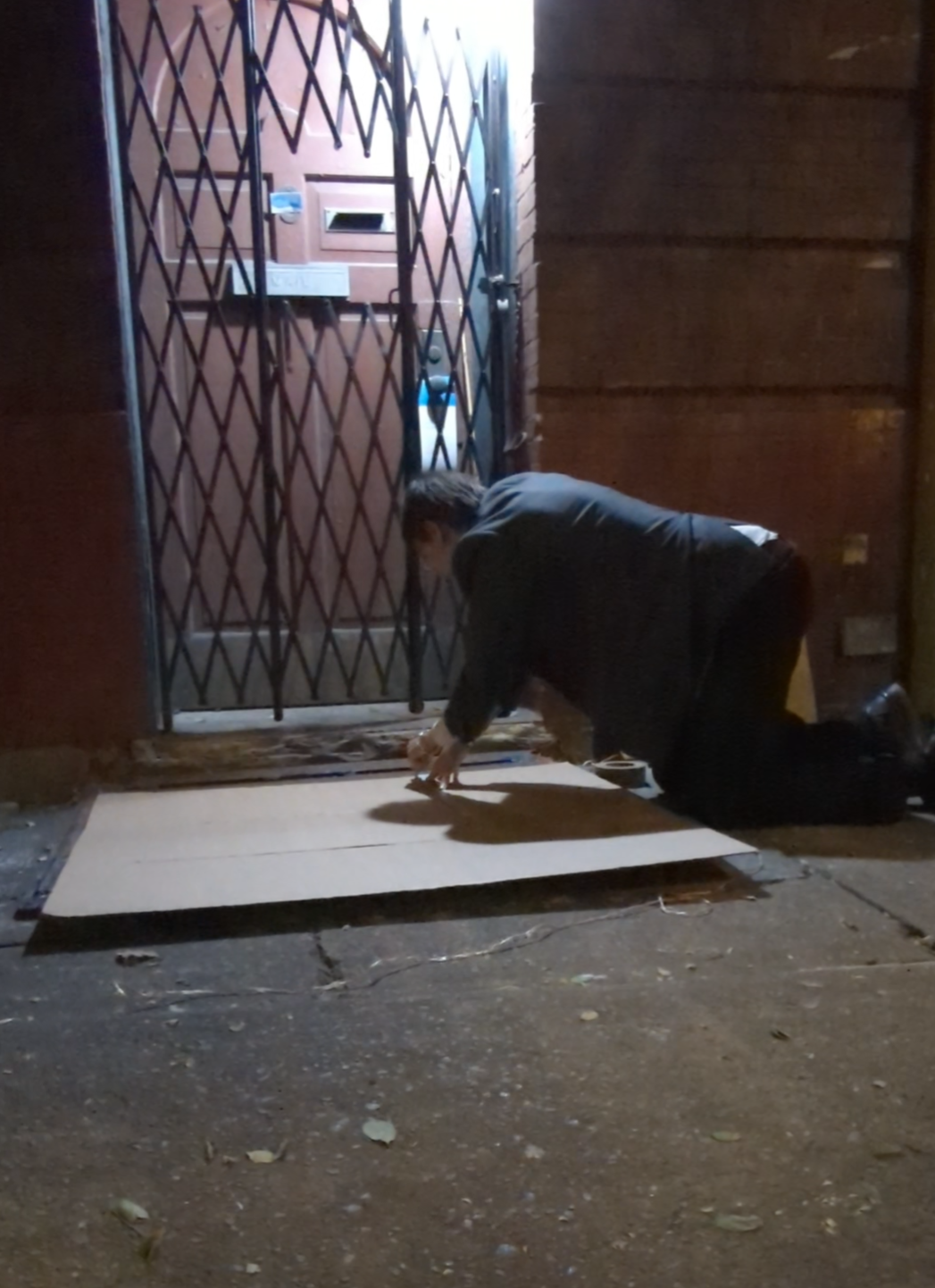 BENJAMIN G. SCOTT knelt over a large cardboard sheet in the middle of the sidewalk with a boxcutter and tape measure, marking and cutting the material into squares at a scrambling yet deliberate pace. Adding an extra layer was the playback via small bluetooth speaker of what was ostensibly the audio of a previous instance of the same action. The two timelines, past and present, unfolded in tandem, sometimes clashing and other times syncing up in a satisfying way. It eventually became clear that the objective was to build a cubic box out of individual panels and packing tape, inside of which Scott placed the speaker before sealing it in. It seems that practice indeed makes perfect, because this time the assembly was completed more quickly; the last few minutes were spent listening to the rest of the recording, slightly muffled from within its new container. Though I do love the raw simplicity of cardboard sounds (Partly Zombish’s August Cake and the Cardboard Sessions tape comes to mind) and the immediacy of manual process, this awkward coda was my favorite part.
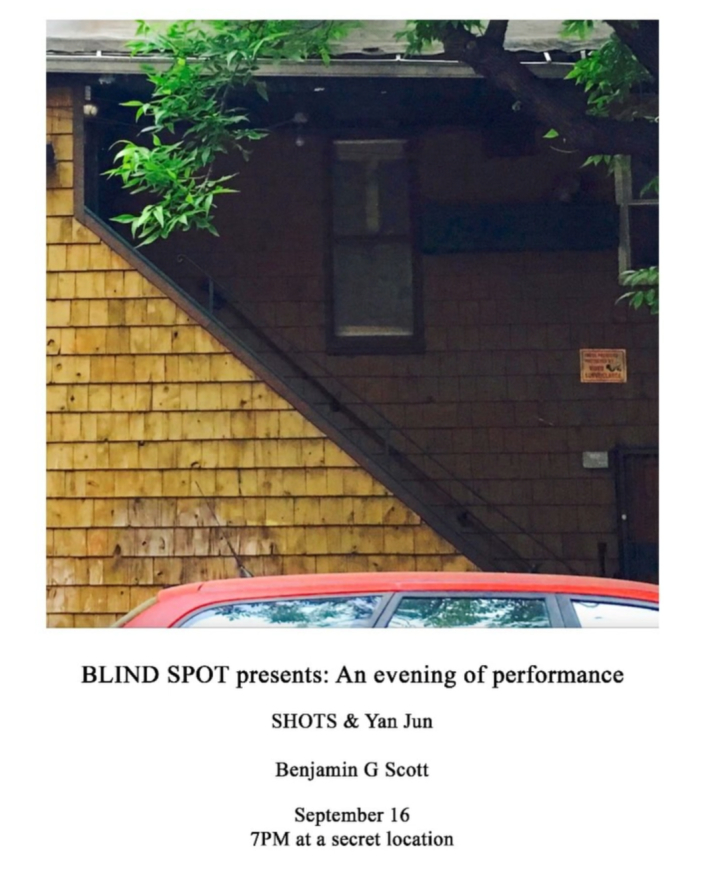
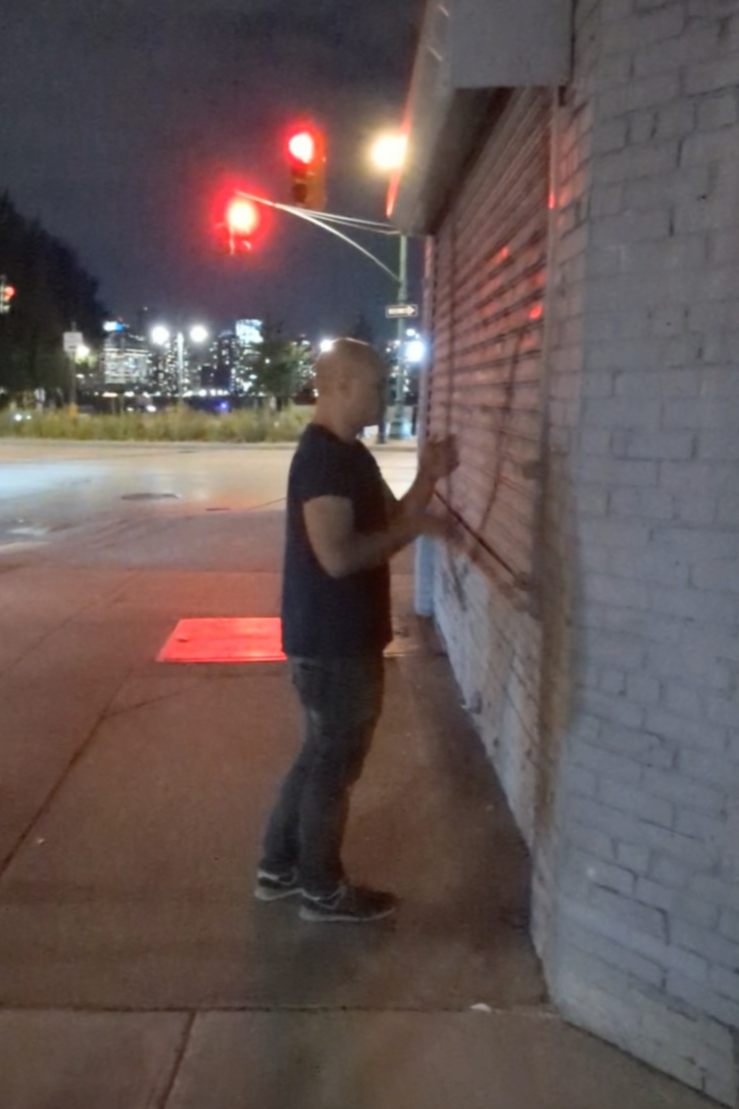
 SHOTS were joined by the legendary YAN JUN for the second time, following a set at Providence’s Apartment 13 gallery back in 2023. The pairing is a no-brainer based on their respective bodies of work, and if their first collaboration was proof of concept, the remarkable synergy on display on this cool, cloudy night was a realization of full potential. Daniel DiMaggio and John Friberg, two-thirds of the trio, extended their usual location-spanning setup to every nook and cranny of the block: a small speaker affixed to the awning of the historic Market House remnant at 6 Weehawken squawked out birdsong and emergency sirens, Nakajima-esque gadgets whirred under trees and between parked cars, mystery feedback sliced through the air this way and that. Friberg posted up with a pile of electronics behind a beached carriage bicycle, while DiMaggio was more mobile, at one point rounding the corner onto Christopher to tug at the gate chain of an abandoned storefront.
  Yan was also always on the move, setting up his chair at various places on the opposite end of the street to vocalize and make hand gestures. It was a joy to amble around the haphazard network of miniature events. A highlight was seeing a small crowd crouched around something on the ground and wandering over to reveal an upside-down coffee cup vibrating on a motor—and then it was over, and we were on to the next wonder. The decentralization ensured that no two attendees had the same experience, even though everyone witnessed the same performance. Beyond the superficial similarities of Shots’ and Yan’s approaches, the unifying essence that also served as bedrock for this open-ended meeting is their shared intentionality. No matter how random and/or inscrutable an incident might appear, it was meant to be so. Such purposefulness produces a fascinating energy, an energy that joined disparate parts into a single web of sound, etc. I’ll be thinking about this one for a long time.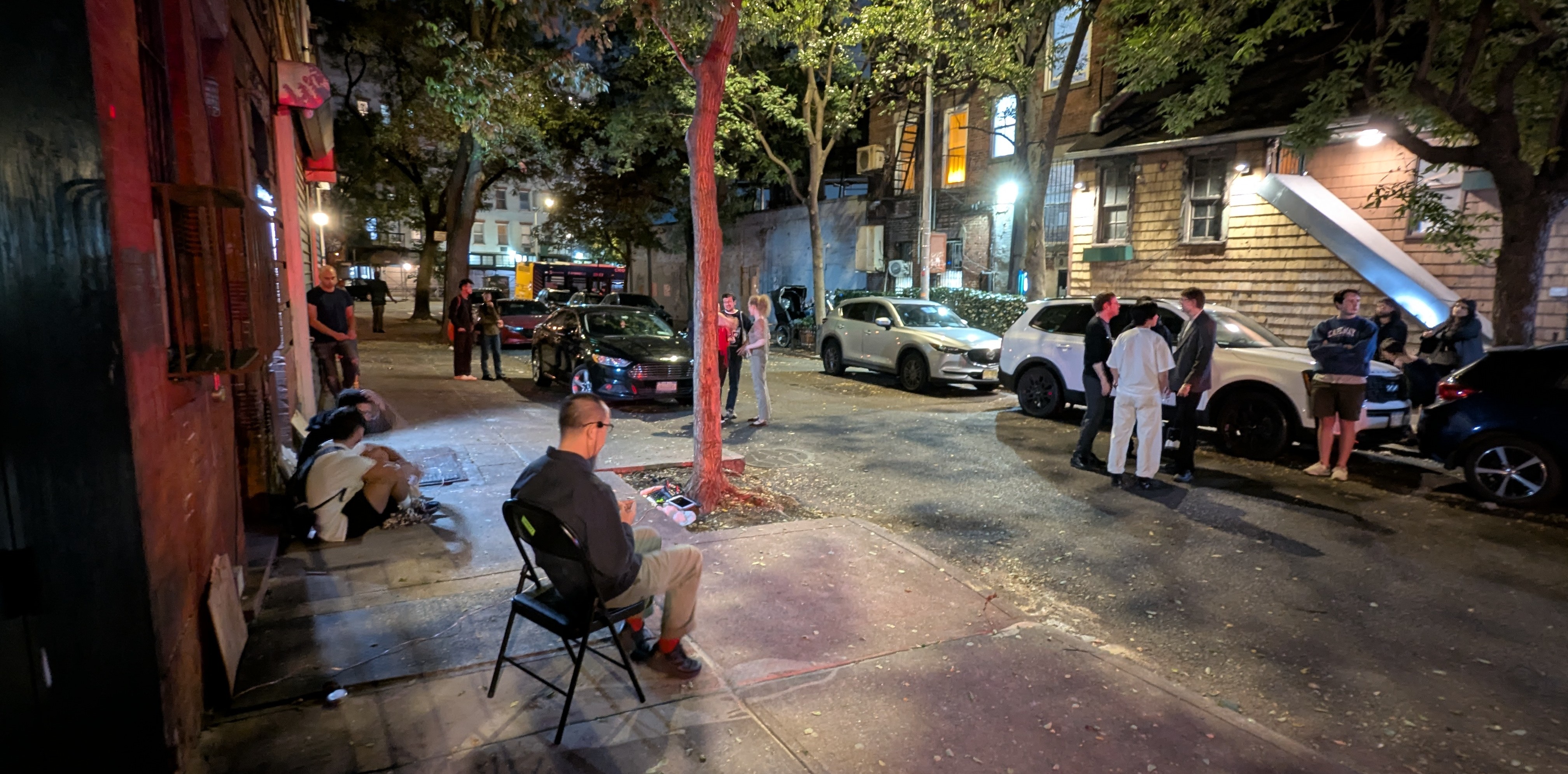
 Feedback Destroyer is a misleading title. On his first outing as Stalking, Matt Hex does plenty of gating, chopping, strangling, crushing, warping, all actions that one might call destructive. But feedback is like energy—indestructible. In lieu of being ground into nothing, it escapes to areas of less pressure, contorting into unpredictable and exciting shapes. This is the essence of feedback noise, and it has been for decades; this new CD-R from underappreciated Dubuque imprint Breaching Static doesn’t try to reinvent the wheel. What it does do is carve out ample space in a surging cut-up harsh revival that spans the States and beyond. Stalking is not yet another high-tech modular initiative doomed to stand in the shadows of modern titans Negation or 886VG, nor is it a novel deconstruction of the tradition itself in the vein of Prolepsis or Parasite Nurse. The closest comparison that comes to mind is Developer: no-frills, muscular pedal-chain frenzy that doesn’t waste a single second. At 21 tracks, there’s no shortage of ideas. Other artists might have shelved some of these sketches for future releases, but Hex lays it all out on the table, opting to offer an LP’s worth of material for his first outing. No samples, no silent stretches, no ambient interludes, just noise. The stereo field gets a comprehensive pummeling, the crunch blasting through mono, left, right, and all over, always changing up just as you start to find your footing. The pace is incessant and intense, but Hex isn’t afraid to fuck around a bit now and then either; there’s more than one grin-inducing delay noodle. Solid, satisfying stuff, and a great debut for this project.
 Noise Not Music