
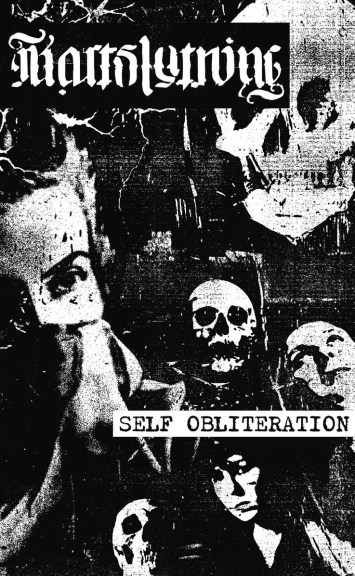
 More relentless sonic destruction from the southern hemisphere arrives in the form of this half-hour monstrosity from Ecuador’s Cynthia Velasquez as Kortslutning. Self Obliteration, among other things, is mastered so ridiculously loud that you won’t be able to see straight, and it’s glorious. If one were to recover from the initial impact quickly enough, the doubled-mono style stereo profile might seem a bit tedious despite the mighty force of the stems themselves, but Velasquez makes it work with thick, chewing movements that bridge the gap, spires of scalding feedback that jet into the center, and jarring dropouts that rip the razor-threaded rug out from under your feet over and over again, taking your soles with it. All three tracks start strong, but also steadily get better as they progress; “Anachronism” culminates with those blasting feedback screeches I mentioned, “Derealization” (a nightmare after my own heart) sculpts some structural failures and high-/low-end interplay into a thrashing crescendo and its smoldering aftermath, “Visions” dissolves from piercing chaos to an incendiary wasteland of distortion mudslides, sci-fi pulses, and fleeting ghosts of melodies shredded to near-oblivion. This is another case where the album cover is a J-card but there doesn’t seem to be any physical edition available; I hope that changes soon.
Author: Jack Davidson
I like to listen to, read and write about, and play music.
Review: LDQ Ysimaro / Mente-Atada – Disembodied (Antenna Non Grata, Jan 22)
 For the most part, I tend to stay away from artists who are extremely prolific. It’s not that I believe it’s impossible that high levels of quality and quantity can coexist—I’m just never convinced. Calling Argentinian project Mente-Atada “prolific” is a bit of undersell; they’ve released nearly 100 albums, EPs, and splits since member Mosca took up the mantle solo in October 2020. Like I said, digging into that much isn’t really my thing, but when a more reticent label like Poland’s Antenna Non Grata highlights some material (in this case in the form of Disembodied) it’s a good way to check in. I don’t know much about LDQ Ysimaro, not even where they’re from, but just based on the music itself, this split pairing of a very infrequent and a very frequent releaser is a great one. Both artists deliver ersatz monoliths of grinding, churning, gnashing harsh noise and other unruly live electronic bedlam that make use of both stasis and dynamism in roughly equal measure. On LDQ’s side, heavy apocalypse-synths crack under the weight of unrelenting distortion drill bits, which shatter the more palatable textures into shards that flit around the ensuing tornado of debris for the remainder of the track. Mente-Atada’s is more traditionally harsh, but it keeps things interesting by assimilating a whole host of techniques and styles—cut-up, stop/start, power electronics, wall—into a single, brutish assault. ANG states their cassettes are “made with love”; I’m not sure I would wager the same about the music. And in this case, that’s a good thing.
Review: Jelly Bark – BARK, PARK! (self-released, Jan 19)
 “Sounds collected by recording walks with human Bom, Maltese Bbangdol, and Jindo dog Yeonhee. Pigs Saebyuk and Jandee, and countless other beings participated. It’s the first collective album.” Translated from Korean, these are the only words auxiliary to the music itself that give context to BARK, PARK!, the debut release from Jelly Bark, a project ostensibly composed of all of the aforementioned “beings.” Bom is a silent guide of sorts, initiating the recording process for each track but remaining both physically and sonically removed to direct emphasis toward the artist in focus, and thus we end up learning a great deal about all of them. Bbangdol is first, a quiet and determined contributor who effects various subtleties all drawn into a trotting forward momentum, barely audible breath and gentle jingling pulls of the leash and pitter-patter feet on wood and concrete (“Jazz & Dinosaur” is positively gorgeous). Yeonhee is more vocal, scattered, active: loud, breathless panting and the click of toenails on the ground dominate most of the two parts of “Ballad in NATURE,” in which there are great moments of connections with other dogs barking and howling in the distance; and the free, unconfined bounding and curious scrabble of “Without Leash” are wonderful. Pensive soundscapes featuring various birds and the pigs Saebyuk and Jandee follow, and if you weren’t spellbound already, the closing “A Companion Songline” diptych is a stunning exercise in everyday concrète collage that concludes by closing a loose, wide loop. A beautiful and important work of art.
Mix: Righteous Radio Rock
Perhaps a spiritual sequel of sorts to the Inimitable Indie Introductories mix. I know most of you probably don’t come here for this sort of music, but for better or worse this is the stuff that’s getting me through the dark, frigid doldrums. Naïve lyrics, earworm anthem-choruses, brickwalled overproduction (almost all of these tracks have noticeable artifacting—part of the charm, if you ask me), and just, well, righteous. No idea if anyone other than me will get anything out of it, but when have I ever cared about that?

The Sheila Divine, the self-described “Buffalo Bills of music”
00:00. The Sheila Divine – “Kardashian Plastic” from The Things That Once Were (Zippah, 2012)
02:09. Wintersleep – “Jaws of Life” from Untitled (Dine Alone, 2005)
05:12. Foreignfox – “Exit Frame” from The Long Jump (self-released, 2021)
09:14. Vigo Thieves – “Forever” from Heartbeats (Hijacked, 2016)
13:31. Laivue – “Saattoväkeä” from Laivue (Ektro, 2010)
18:52. Then Thickens – “My Amsterdam” from Colic (Hatch, 2015)
24:48. Restorations – “The Red Door” from LP5000 (Tiny Engines, 2018)
28:23. Outsider – “Míol Mór Mara” from Karma of Youth (OK! Good, 2020)
32:08. Kodaline – “Ready” from Coming Up for Air (B-Unique, 2015)
36:00. Kings of Leon – “Waste a Moment” from Walls (RCA, 2016)
39:02. Casa Murilo – “Head for the Door” from The Rise and Fall (Sony, 2012)
42:51. Sleeperstar – “Everything Must Find Its Place” from Just Another Ghost (Duckpin, 2010)
Review: Takahiro Mukai – Spell (Nazlo, Jan 18)
 The Moscow-based Nazlo Records uses the same eclectic set of neologisms to tag each of their releases on Bandcamp: “animal music,” “obviously-experimental,” “post-human,” “ritual glitch,” and “ultrahardcore.” Usually when labels do this it leads to some misleading mismatches, but somehow every entry in Nazlo’s catalog, no matter how radically different from its peers, seems to fit quite nicely under that mutant umbrella of labels. Spell is no exception; the newest tape from consistently prolific Osaka producer Takahiro Mukai, even after the artist has amassed a considerable body of work that treads far beyond the bounds of electronic dance music (with an impressive list of imprints as well: Fort Evil Fruit, Cruel Nature, Cudighi, Moss Archive, ERR REC, Never Anything, Alien Passengers, Lal Lal Lal, and many more), may be his best fusion of conventional appeal and subversive abstraction yet. The contrast between the A and B sides is night and day: the former is dotted with fragmented glitches and shortwave warble, a mesmerizing swarm of erroneous transmissions in the vein of Shunt or the Vacuum Boys, while the latter first lulls with a stretch of beautiful, sincere ambient (Mukai’s 500th numbered piece!) and then bobs back to shore across gently lapping waves of synth tones. Each track is unassumingly gorgeous in its own unique way, and all together they seem to say something that can’t actually be said. A good entry point into an intimidating discography.
Review: Lonely Water – Après Nous, le Déluge (self-released, Jan 17)
 If you’ve somehow managed to keep your cognitive functions intact while in the throes of her majesty Charybdis, Après Nous, le Déluge is a pretty close approximation of what you’d hear once she’s swallowed you whole. The newest release from UK south coast project Lonely Water joins the recently NNM-reviewed Galeophobia in an elusive tradition of mortally fractured, gutted aquatics, each an abrasive manifestation of both the unfathomable expanse of the ocean and the brutal immediacy of its many horrors. The four parts that comprise Après Nous, le Déluge can be confidently classified as static noise, a distinct element that introduces something new to the dialogue. Part one sears like a seashell frying pan filled with salt water, bursting forth with a forceful but ultimately lifeless current, at once violent and indifferent in much the same way as the giga-tons of pressure folding your paper skeleton in half over and over and over. After that we descend even deeper; part two is even more anemic than the first, and ends with a purposeful bout of silence that serves as a chilling transition to the volatile, haunted fissure-flares of III. There’s even more silence following the relatively short section, and then the looming swarm of grotesque bottom-feeders takes full control as IV tears into existence, its field-filling lushness the sound of kelp corpses absorbing the life force bubbling off your soggy dead flesh. As the artist themselves says, “Volume high for suffocation. Volume low for meditation.” But to be honest, I’m fine with both at once.
Review: Tetuzi Akiyama & John Krausbauer – Gift (Erototox Decodings, Jan 15)
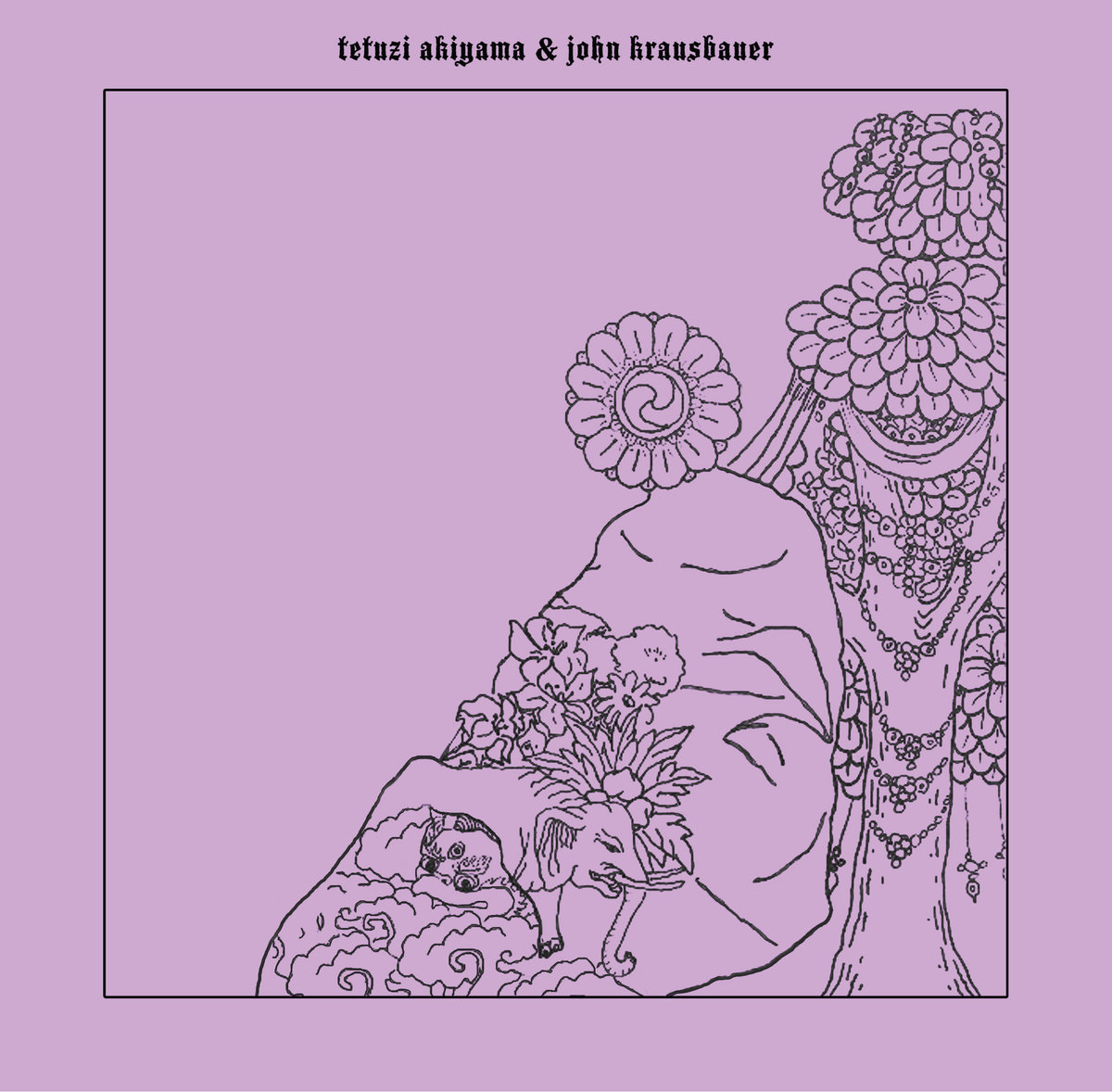 Granted, I haven’t heard too much of Tetuzi Akiyama’s music—in improvisational contexts, the sparse, clear, tonal guitar style he often uses doesn’t appeal to me at all—but what I have heard definitely did not prepare me for the startling radiance of Gift, a new 7″ collaboration with composer/curator John Krausbauer that strips drone music back to its raw acoustic roots. Both “A Prayer” and “An Omen” are five-minute beams of dust-encrusted light, generated via the primordial fusion of electric guitar, effects, and delay (Akiyama) and amplified violin and feedback (Krausbauer). The grandiose yet restrained energy behind the reverential meditations is easily reminiscent of the genre’s founding legends—the Dream Syndicate/ToEM, Flynt, Oliveros—but not to the point that it feels like just a tribute or throwback. Both musicians are playing with purpose here, conjuring their own tapestries of thick, gritty transcendence and then filling in any blanks left by the other’s like collaborative painters, forming a majestic twofold current whose halves ebb, flow, and melt around and into each other. One could say that it’s Krausbauer’s slicing bow and high-octane melodicism that steals the show on “A Prayer,” while Akiyama asserts more of a presence on “An Omen” with some room-shaking amp resonance, but to try to separate that which is so powerfully unified is pointless.
Review: Slowbleed – The Blazing Sun, a Fiery Dawn (self-released, Jan 15)
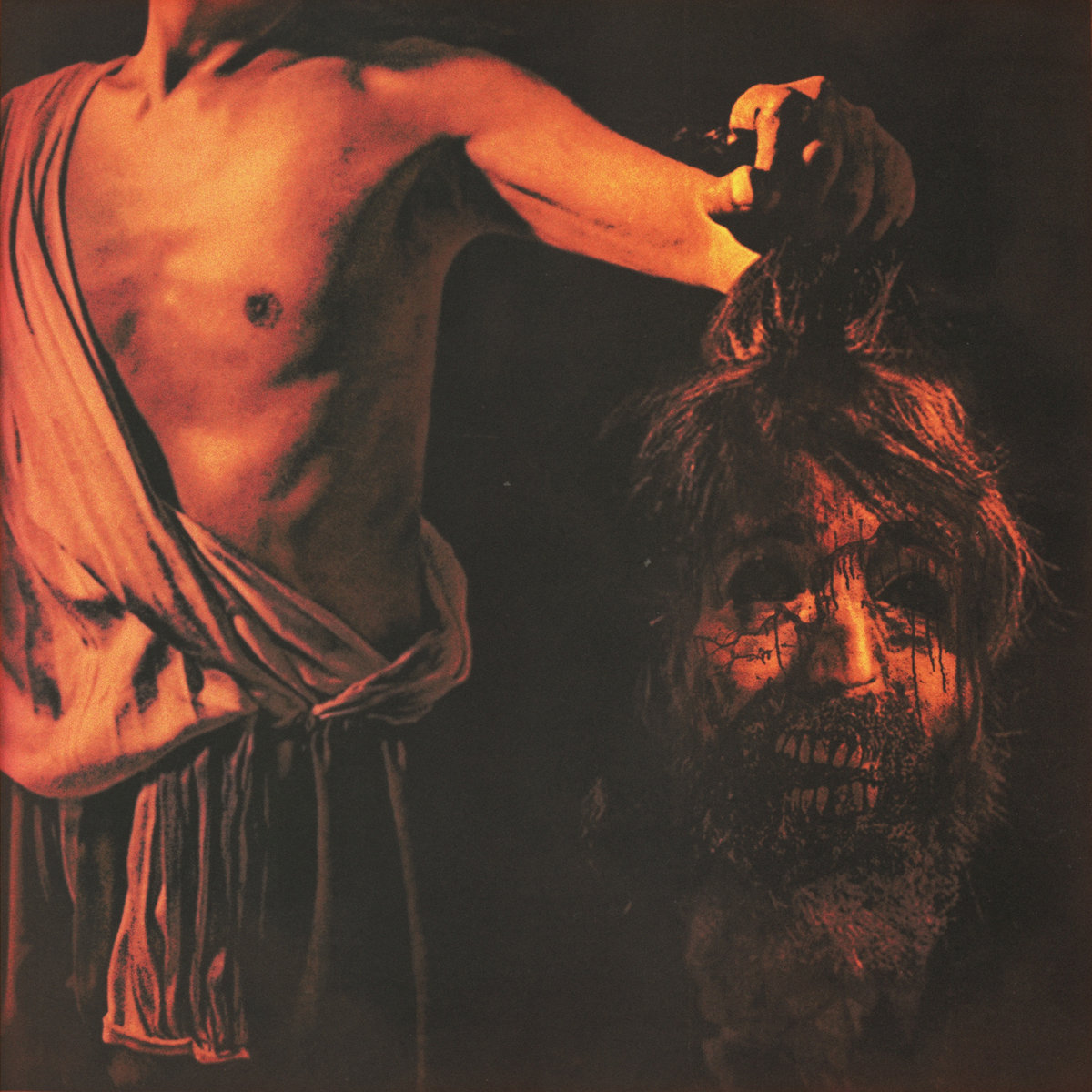 The pairing of conventionally technical guitars breezing through thrash chugs and heavy metal–esque melodicism with dark, hard-hitting, mean metalcore is what I loved most about Santa Paula quintet Slowbleed’s debut EP, Never Been Worse. It was also more than enough to make me extremely excited for their first full-length release, excitement that I now know was completely warranted. The Blazing Sun, a Fiery Dawn is a huge step up for the band in every possible way, from the disturbing cover art (and Never Been Worse‘s was already great) to the execution of the exterior metallic influences that put even more weight behind the vicious hardcore assaults. The 48-second “Aurora” is an innocuous enough intro, but the following “Ice Cold Odyssey” makes it clear there is no fucking around to be found here. And from then on, there’s little to no mercy either; each track lashes out with dizzying solos, vocals straight from the depths of hell, and plodding, ridiculously brutal breakdowns that feel like being repeatedly clubbed over the head. Don’t believe me? Listen to “Sangre” through to the end and then we’ll talk. “The Law (Atonement Through Blood)” is another standout that seems to distill everything great about Slowbleed into a single blow (to the head, again). The unrelenting heaviness finally breaks for a brief moment on “Driven by Fire”—a quiet/loud-whiplashing track that, despite only being four minutes and 26 seconds long, feels nothing short of epic—and the subsequent acoustic interlude “Diluculum” before the awe-inspiring culmination that is “Graves (Pours of Earth).” I’m not usually one for the almost cheesy guitar shredding, but my god, it’s just perfect here.
Review: Nameless Mist – II (Fólkvangr, Jan 14)
 The music of Lauren Straily’s Nameless Mist solo project, despite not being too widely circulated (yet), is heavily associated with DSBM; the genre is even explicitly mentioned in the Raleigh multi-instrumentalist’s Bandcamp bio. But make no mistake—this is, at its core, beneath all the dark loathsome layers, profoundly cathartic and sometimes even triumphant music, particularly in the case of II. I don’t mean to imply that tracks like “The Behemoth” and “The Dead Woman” aren’t the abrasive, harrowing expressions of pain and hatred that they are, and there are plenty of familiar DS tropes to go around with all the plodding slowcore breaks, blasts blurred into drones, and vocals that sound like the howling knives of ice cold wind that slice at your ears when you forget your hat. I just want to make it clear that II won’t make you sad (unless you’re already sad, in which case it’ll definitely make you sadder, but you probably planned for that anyway). At least for me, the effect of this sublime opus of perfectly underproduced black metal is the reintroduction of a violent, feral appreciation for life and all of its misery and violence and impossibility, an appreciation for it as a foe rather than a friend. Existing sucks. Let’s not pretend it doesn’t. But we face it together, and that’s something. And, of course, nonexistence necessarily precludes witnessing the majesty that is “The Queen of Shadows.” Life wins again.
Review: Muster – _am_ (Slightly Off Kilter, Jan 10)
 _am_ is Muster’s follow-up to debut tape Find a City to Live in on (fittingly) Invisible Cities, an album I could have sworn I’d at least mentioned on the site before, but it turns out that not only have I never namedropped the duo of James O’Sullivan and Dan Powell, I’ve also never used the word “muster” in any context. (Which is strangely unsettling, given I’m close to a thousand posts and every single one is filled with my thesaura regurgita you all seem to not hate.) That ends today, clearly, because even though I loved Find a City enough to pick up the tape after one listen, I think I might like _am_ even more. The first three shorter pieces were improvised remotely, each consisting of a solo recording by both O’Sullivan (guitar) in London and Powell (electronics) in Brighton that were subsequently responded to by the other and then combined. The approach doesn’t erase all of the collaborative momentum that makes the band’s in-person live sessions so compelling, far from it, but the layers of separation allow for a sort of intricate aimlessness to set in, and it’s amazing. “Verser” might be the best example, a brief but meticulously detailed bricolage of hypnotic tonal resonance, impatient dial-twiddling, and assorted scratches and scrapes that are like the track’s pholcidae legs. “On the Hoof” is the only cut to have been performed in real time, and its more spacious, sprawling, mercurial application of similar ideas is a great counterpoint on which to conclude.

