
 Any kind of “paranormal investigation” through auditory art will always interest me, as will self-described “attempts” at pretty much anything—I have a soft spot for humility, failure, and preferably both at once in a musical context. Based on the haunting forces immortalized by Attempts to Bend and Capture Frequencies from the Old Otherworlds, however, it seems like the reclusive Unk (a.k.a. Hans Lo of More Surgery) may actually have succeeded in their ostensibly impossible task. Traveling to “specific sites [known] for their potential sonic anomalies and spiritual histories” throughout Cornwall, England—“college ruins in Penryn, Kennall Vale in Ponsanooth, and Halliggye Fogou in Helston”—Lo recorded the playback of simple electronic drone devices in harmony with the murk and mutter of the surrounding area: wheezes of wind, spectral rustlings, thumps and bumps in the night. In the opening triptych of “College Conjuring” pieces, tense, strained feedback strands seep and hiss from cleaved cobblestone like buzzing locust phantoms, while “Helston Hallows – Layby Dry Cows 004” begins so quietly it can barely be heard at baseline volume before ravaged, shrieking spirit-echoes pierce the corporeal. I was excited to see that the “Ghillie Wrapped Halliggye” tracks feature a “droning contraption” that adds a pleasant incessance like the familiar but never quite normal sound of a malfunctioning home appliance, but my clear favorite ended up being the closing “Summon Me Hither – Twilight Still 001,” a darkly gorgeous and meditative final statement. Especially in this last track, there are important messages for you from those who have already passed on… listen closely.
Author: Jack Davidson
I like to listen to, read and write about, and play music.
Review: djdillydrops – Digital Ghouls (Grink Collective, Sep 8)
 I review a lot of bizarre shit on this website, but some releases, even in the context of this already obscure subset of music, seem to bellow “Look on my works, ye Mighty, and despair” with feeling. Digital Ghouls is certainly one of those, complete with a cover collage of a Little Caesars ad, Windows XP dropdown menus, and low-res images of Michelangelo the turtle, a dildo, and a flip phone; an overpriced and extremely limited physical cassette edition called the Special “Michael” Bootleg; typo-ridden track titles; and some of the most brutal, irreverent digital harsh noise one could ever hear. djdillydrops disregards the cut-up, unpredictable volatility that often comes packaged with computer- or code-based approaches and instead opts for an all-out assault of endlessly layered stems of raw data, most likely sourced from images and other incompatible filetypes run through a DAW. Fittingly, the introductory “Bitch” is perhaps the short release’s most intense track, finding little footing in any sort of bass register yet to optimize the causticity of the slicing, stabbing static plumed to perfection throughout the expanse of the high-end. “Swallow the LaCroix” offers somewhat of a relative respite in the form of chunkier, less shrill glitch-murk, approaching the kinetic pseudo-physicality of some of Gintas K’s work. All in all it’s incredible, and probably the most inappropriate thing I could be listening to while surrounded by trees, greenery, and wildlife… all hail the Grink.
Review: Accoutrements – Palm (self-released, Sep 8)
 Depending on who you ask, Palm might be the closest one can possibly get to “ambient done right”; among other things, it’s quite upfront about the fact that “[n]o synthesizers were used in any of the productions,” something that’s revealed before the play button is even pressed. I’m here to write about an album, though, not petulantly dunk on the lowest-hanging fruits of the electronic music world, so no more A-word, I promise. But regardless of what specific genre you ascribe to it, this homemade debut tape from Portland project Accoutrements deals heavy in ambience, sometimes as hazy and diaphanous as a cloudy, breezy day and other times veering toward heavier territory with industrial crumble or sluggish noise. The vow of a synth-free affair is faithfully kept, but that doesn’t mean notes and harmonies and the like are just discarded; instead, they emerge from the cracks and creases between the atonal slabs of mechanical shuffling and aquatic analog-delay ripples, bubbling up and out like sweet steaming sap from a tapped trunk. The sublime mixture is perhaps at its best in the third part, when creaking, clattering rustles that may or may not have originated in the groaning sways of the titular trees loosely frame the earnest swell of an alternating ghost-note loop. The concluding section and its delicate timbral juxtapositions give even that a run for its money, though, and I’m helplessly obsessed with the almost alarm-like tonal drones that thread through its murky mass. True to the continuity that ties the four separate tracks together, each side of the physical C90 edition plays the album in full (and by the way, if anyone reading this has ever made a one-sided tape that doesn’t repeat the program on both sides, you SUCK). Only four copies left—don’t miss out!
Review: Death Glaze – Despair in the Gutter I (self-released, Sep 3)
 It shouldn’t be a surprise to see yet another wall noise album at the top of this page. At this point 2021 seems fully incapable of disappointing me in this regard; a small sliver of the pie, no doubt, but I’ll take whatever size piece I can get. Despair in the Gutter I, a new release from prolific Ontario project Death Glaze—which I know next to nothing about—is somewhat of a midpoint between the last two I wrote about (Being the Contents of an Unsigned Letter and 136), seething in a spiny mass of squealing, crunching transmission sputter and fuzz-poisoned punctures. “Creature of Evil” could be an unruly symphony of missed or faulty audio-cable connections; each of its multifarious parts, carefully spread across the full range of the stereo field, is its own source point of disorderly rake and rattle, one of many in a haphazard, anti-Cartesian grid of barbed wire and rusted spikes. “Sex Worker Prey,” like many B-side walls, very much feels like a continuation or reimagining of a similar idea: the distortion is fuller, more shrouding, but it fills the spaces between the aforementioned micro-sites rather than draping itself over them completely, retaining the detailed, piecemeal structure of agitation of the preceding track while offering something new and contrastive. Ever wanted to know how your bottle of detergent feels as it rattles around on the sharp metal top of your washer/dryer unit before falling off and spilling its viscous liquid contents everywhere? Now you can.
Review: The Lethal Temple – Being the Contents of an Unsigned Letter (Petite Soles, Sep 3)
 Being the Contents of an Unsigned Letter is one of those rare wall releases that is both so loud and intense that it drowns out not just external sound but brain activity as well, and so seductively hypnotizing that it just seems to fade into the background at times. These paradoxical effects often occur simultaneously, somehow; I find myself so mesmerized by the detailed auditory craftsmanship by the trio of Scott Kindberg (A Woman’s Glove and others), Sean E. Ramirez-Matzus (Pallid Mask and others), and Thomas Puopolo (Forests of Brittany and others) that I lose track of time and eventually even the fact that I’m listening to it, despite the fact that my ears are being mercilessly ravaged all the while. All three artists are associated with the Pittsburgh-based Black Leather Jesus collective, but here the S&M imagery is traded for something more enigmatic and poetic in the invocation of the “unsigned letter” idea: thoughts and communication externalized, physicalized, but without an explicit source. The exact aspects of meaning lost as a result of this omission certainly vary from case to case, but a clear universal casualty is the remote channel of intimacy that letters open between correspondents. To reclaim any semblance of that would require either deducing the true author or attributing the message to someone else entirely, both options being processes that often involve examining elements of the letter beyond its contents: the ink and stationery used, handwriting, the return address (or lack thereof), etc. This compact digital release is plainly attributed to The Lethal Temple, so it in itself cannot be the titular letter, nor can the tracks themselves since they are also identified as “contents.” Is the rest—the analog to the aforementioned superficial characteristics—just the things that happen in our heads as we listen? Do the blazing stampedes of crunching distortion fuse with the bizarre brain patterns they incite to form some sort of intangible, Derridean communicative construction, which must be unsigned because each person who hears the music is themselves both author and recipient? Probably not. This is some fantastic noise though.
Review: The Troubled Belief Program – Standing Forever at the Front Door (self-released, Sep 1)
 Edited and mixed earlier this year by Jim Lemanowicz (an artist, improviser, and curator from Massapequa, NY, whose sparing musical presence on the internet seems to spread like a thin spiderweb out from the Troubled Belief Program Quartet page), the recordings that would eventually comprise Standing Forever at the Front Door were begun more than a decade ago in 2008, then revisited in 2017 and 2018. Though the digital liner notes do not hide the fact that the original chamber abstractions were spliced together in Ableton rather than simply presented as-is, the resulting music ends up mining something from both sides of its ambiguous form and character, retaining plenty of the instantaneous, interactive energy that can only flow between musicians performing simultaneously yet gaining new flexibility from the meta-alterations executed later. Other than Lemanowicz, the three remaining string players are Ralph Dar, Emily Fulton, and Joachim Kovač, none of whom appear to have participated in any other releases despite the clear virtuosity of their collective technique implying seasoned careers; I have no idea who “GF” is or what tragedy would prompt a loved one to state that they “didn’t have to die”; nor do I much of any inkling of the reason for this material finally being released now. But little to none of that matters, because even words themselves lose their footing during moments like the drift of the rhythmic legato dirge that surfaces behind the thorny tangle of Bradfield-scrabble and atonal arco squawks in “Not Ready to Be Unwrapped.” Listen!
Review: Wilbury Scum – 136 (self-released, Sep 2)
 As someone who was deeply affected by being assaulted by the boys in blue during my own mental health crisis, Letchworth Garden City project Wilbury Scum, described by the artist behind it as “a way of trying to get to grips with [the] experience” of being “sectioned by the police and taken to A&E,” truly resonates with me. In the aftermath, they heavily manipulated sounds and spaces captured in the immediate area of the incident via DAW to produce the recordings that comprise 136, an engrossing tour-de-force of brittle, fractured wall(ish) noise whose microscopic, insectoid texture worlds rival that of actual insect recordings (see Jana Winderen’s The Noisiest Guys on the Planet, Dave Phillips’ Insect, Tom Lawrence’s Water Beetles of Pollardstown Fen). To experience such brutal, callous treatment and violence while in such a vulnerable state is a profound violation, a perceptional and emotional fracturing that leaves an already compromised mind even more damaged; Wilbury Scum’s lengthy chain-link quilts of seething statics and caustic, surgical processing are a mesmeric but no less harrowing embodiment of that painful state, in a way immortalizing it in a safely external vessel. As it crunches and crackles like cold blue flames over dry wood, 136 can be whatever you want it to be—though I do adore the music, I don’t wish it being what it is for me, or for the artist, on anyone else.
Review: Haved Jabib – Skin Weights (ONNO Collective, Aug 31)
 Just since last year, Kolkata producer and musician Revant Dasgupta has already accumulated an impressive and eclectic discography as Haved Jabib, dabbling in everything from full-on psychedelic harsh/power noise (Animal Rites, Mother Eats Her Food with a Straw) to searing cut-up collages (Table Manners) and feedback-wracked brain-bash noisecore (Royal Canin). The ominously titled Skin Weights arrives as one of the first releases by the promising new ONNO Collective, also based in the West Bengal cultural hub-city, and offers a dark, heavy, often theatrical dark ambient phantasmagoria filled with distorted speech, groaning industrial machinations, and well-placed moments of punishing noise. The first four tracks on the digital-only album all seem to based around extracts of varying sorts taken from one or several unnamed records: many of the voices seem to be sourced from the wax, and in the background—and occasionally more prominently when things are quieter like at the subdued outset of “People Talking, Airplane House”—lurks the familiar undercurrent of crackles, pops, and stylus-skipping. It’s an interesting choice, and one that might give unaware listeners the impression that the digital master is just a vinyl rip, but several moments where the analog imperfections are noticeably absent, including the entirety of the concluding title track, make it clear that’s not the case. It didn’t take very long for the near-omnipresent texture to grow on me as a deliberate artistic choice, because the way Dasgupta shrouds his multifarious masses of sonics in oppressive fuzz and gloom evokes the dusty sputter of an old film projector, its weak window of light broadcasting something unfamiliar and abstract yet nonetheless deeply unsettling onto a dirty basement wall.
Review: Mute Frequencies – Echo Chamber (self-released, Aug 30)
 Conceptually speaking, London sound art collective Mute Frequencies’ first release firmly situates itself in reference and response to “times of pandemic,” but unlike many other creative works I’ve seen, heard, read, etc. with the same topic, Echo Chamber has a timelessness that will endure long beyond the times in which life is still significantly changed, or even when those changes either last and become old hat or disappear into faded memory. The (re)new(ed) poetic interest in daily tedium recently embraced by artists of all kinds has delved even further into the unutterable truths hidden within our routines than we all already have in the process of experiencing the paring of our lives down to very nearly them and them alone, and this gorgeous 15-minute piece is just one of many artful odes to domestic mundanity that wordless remind us that the banal is not to be taken for granted; not necessarily appreciated, or derided, or avoided, but simply not neglected. According to the trio of Ilia Rogatchevski and Laura and Kitsuné Rogatchevskaia, the more abrasive textures—seething emf clouds and cranked-up radios set to dead air—“periodically interrupt” what often presents as tranquility in an effort to “remind the listener of the unfortunate global context” that inspired the music, but to me, admittedly someone who is quite partial to “abrasive textures,” the intrusions play several important roles in supporting the familiar sounds of bird chirps, babbling children, and playground equipment in the breeze, none of which turn out to be so negative. Beyond their “periodic” nature providing a loose, abstract sort of rhythm to glom on to, and their sharper edges engaging in compelling contrast-interplay with the outdoor field recordings, the sudden surges and swarms of electronics act as up-close, almost confrontational channels through which to experience the overall soundscape, much more tactile and therefore graspable than their ephemeral partners. I’m sure everyone will find their way to their own meaning via these conspicuous conduits, but the purpose behind Mute Frequencies’ work here will inevitably surface, somehow, in any analysis; the eminent neutrality of their auditory lens leaves room for subjective interpretation, even as its very existence affirms the impossibility of these base, innate things ever being fully explained. Round and round we go.
Review: Clinton Green – Here? / Secret (Shame File Music, Aug 29)
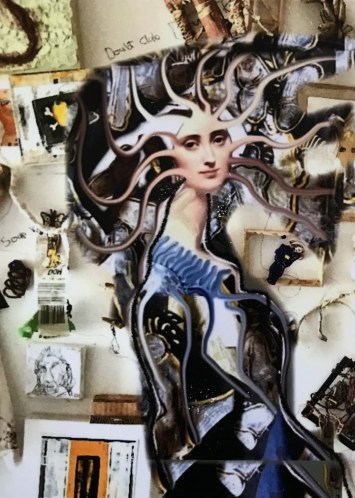 Shame File creator and curator Clinton Green is far from a new name in weirdo music culture, but his formal solo efforts are a more recent development, with the record-wrack and turntable exploitation of In Situ (2015), Turntable at Dawn (2016), and Young Women of Asia (2019) alongside the hallucinatory tape-theater of Thylacine (2018) and now Here? / Secret embodying a strong praxis evolved from the previous role of simply giving a voice to new music—although, with how eclectically sourced these collages end up being, in a way he still is. This newly released two-track set makes no attempt to conceal the ugly, knobby seams and blemishes inherent to physical media and fusions or exhumations thereof; like a zealous dig through the bargain cassette bin at your local thrift store—old answering machine archives and sound effects collections and obsolete dictations and forgotten world music thrown (in)discriminately into the “yes” bag—“Here?” stitches an abstractly (yet disturbingly) coherent sequence from voices mangled to oblivion and harsh analog ephemera, while “Secret” plays with sputtering negative space, radio squawks, and sporadic bursts of raucous, chattering chaos made even more gleefully caustic by the hiss and screech of the low-fidelity playback. Moments of warm beauty also lurk quietly in the marshes of both halves, only briefly emerging when absolutely necessary to avoid wasted impact: a flutter of buzzing drone like a ray of light through the dust, a snatch of familiar innocence amidst bedlam. Lovely stuff.
 Noise Not Music