
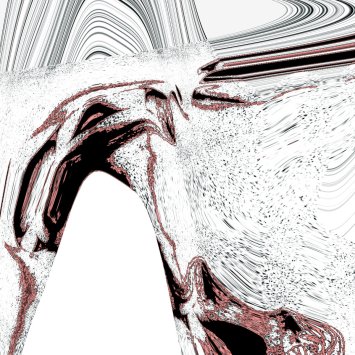
 It’s been less than a month since I last wrote about something from Flower Ark, and yet I am already compelled to do so again for Seep. There’s always something more appealing about harsh noise artists and labels that don’t make a big deal out of their material or aesthetic but still take themselves seriously enough that one is actually inclined to listen; Fishing Boat and the other acts I’ve come across via the Melbourne web imprint fit that description perfectly, presenting very little aside from the music itself. There are no clues as to how literal a role the aquatic/maritime imagery plays other than a release-specific “electroacoustic” tag, which may indicate a primitive concrète approach to water-related or even undersea site recordings a la Thousands of Dead Gods or David Gatten’s film What the Water Said. Identifying the true source of whatever sounds lurk beneath the barbaric processing on these three tracks would be an impossible task, however, because much of Seep, especially opener “Wildlife Water Source,” is an uncompromising Charybdis of no-fi pedal crunch, crammed into glorious, punishing mostly-mono for maximum baptism efficiency. Like all good tracks in this style, the 17-minute introduction is at once distant and oppressive, a sustained slab of roiling distortion that constantly breaks and reforms itself. I would’ve been happy with another one of those to complete the album, but Fishing Boat guarantees I’ll be on the lookout for their name in the future with “Powerline,” a breathtaking junk-glitch masterpiece that summons a razor-edged psychedelia with a cauldron of piercing electronic pulses and fractured frequency serrations. And while you’re still reeling from that, “Failed Dam” combines the two in a heaving mass of broken, stuttering static that seems to permeate every inch of one’s head. Pick this up and experience the overwhelming terror of open water in the warm, dry, leviathan-less (I hope) comfort of your own home.
Author: Jack Davidson
I like to listen to, read and write about, and play music.
Review: Kidnapped – Nowhere Is Sterile (self-released, May 21)
 Any band would be hard pressed to successfully follow up the short, slamming dose of thrashcore fury that was the Connecticut four-piece’s 2020 demo, but Kidnapped is hardly “any band.” Either they’re ingenious prodigies or they listen to even more hardcore than I do (or both) because there are countless moments throughout Nowhere Is Sterile that briefly remind me of other fantastic bands—Iron Lung in the way the blurring blasts and elastic tempo changes of opening track “Bled” feel at once boneheadedly brutal and artfully intricate; Aerosols in the strangely infectious harsh-vocal motifs and gunked-up gallops; even (at the risk of making your ears bleed from hearing about them too damn much lately) Gulch in how basic power chord plods are used in a manner somewhat analogous to breakdowns—but even as I’m writing the comparisons down they feel somewhat tenuous, because Kidnapped’s style is not just entirely their own, but also tightly bound into a seamless package of musical aggression, allowing them to pull off things like the vicious, chugging 7-time coda of “Circling the Drain” or light-speed cacophony of bite-sized closer “Unwound” without fraying at the edges. I might be imagining things, but the drums seem to have markedly improved for this first full-length effort, mapping the serpentine skeleton of the dizzying riff arrangements on “Pedestal” and pulling together “Herd” for a thrashing close that I’m surprised hasn’t resulted in any holes in my wall (yet). The whole thing is over in barely ten minutes—but it will remain ricocheting around your skull long after that. Best hope you don’t have too much brain for it to tear up.
Review: Shotty Jon – Sketches (KBM Sound, May 17)
 The music found on Sketches isn’t the flesh-and-blood creature that slithers out of that ominous archway set into the rock, but rather the reality-bending mass of cold, grey ones and zeroes that seeps into your vulnerable brain when you look at the image on an electronic screen. It has just enough tangibility and uneasy familiarity to pass itself off as homemade clutter-concrète, but much heavier processing in the form of gelatinous synth slaps, damaged artifacts from extremely low sample rates, and silicon-sheened frequency extracts is pervasive, poisoning even the most earthbound tracks like the queasily ritualistic “Spinal Drop” with skin-crawling artificiality and necrotizing bit rot. An odd optimism emerges on “49,” which contrasts bleak, faltering text-to-speech laments with conventional, if slightly chilly harmonic ambience, yet any true resolution is again unseated by stubborn imperfections: chopped-and-stitched creaks spread like a digitized rainstorm, cloying currents of spectral decay. The careless, largely uninteresting percussion experimenting of “Mechanomics” is an unfortunate low point, but the singular appeal Shotty Jon introduces without full commitment returns with the closing track, a moody collage of dross, doldrum, and distance whose pairing of piano elegy with muffled murk and domestic abstraction echoes the addictive melancholia of trans-Atlantic colleagues barn sour. Won’t you crawl on in with me?
Review: Fuct as Punk – Suffering to Sovereignty (self-released, May 18)
 It seems intuitive that the more one writes about, assesses, or analyzes some sort of esoteric object that innately tends to defy description, the more language itself will start to fail, its limitations exposing the gaps in linguistic representation between two things that are clearly different yet don’t appear to be “on paper.” But it turns out it’s the opposite; one doesn’t just discover new words and syntactical structures that provide more outlets for accurate conveyance, but also previously concealed nuances and implicit currents that lurk and work well below the sentence level, which can often only be deployed instinctively via a deep, holistic personal appreciation for the topic at hand. I refer, of course, to wall noise, a genre with which I’ve come a long way in terms of satisfying review coverage—hell, these days it’s frequently the only thing I can seem to bring myself to write about, or even find new material in the first place. Several years ago I certainly would not have had the capacity to communicate what precisely I enjoy about Suffering to Sovereignty, the first full-length digital release from Massachusetts duo Fuct as Punk; it is, ostensibly, “typical” near-stagnant harsh noise fare, for the most part just crunchy analogue pedal distortion doing its thing. But what really prevent these two tracks from being at all forgettable are their consistent anchor points, spots of palpably physical interaction by the musicians that affect the noise somehow: briefly halt it, strip it down to an isolated frequency, force it in a new direction. The approach is such that the thick electronic squall is not dynamic, exactly, but not static either, rather a brutal, deadlocked battle of incremental assaults between an unyielding pile of screaming junk and its makers (who, appropriately, are never quite satisfied with what that screaming sounds like). Grounded by these tangible exchanges of blows, Fuct as Punk’s walls climb to the sooty heavens in an escalating feedback loop of violence, culminating in spectacular messes such as the hyperactive delay pedal glitching in the title track. Both exhilarating and exhausting, Suffering to Sovereignty is not the most conceptually compelling wall noise release we’ve seen this year, but there’s always a place for crude sonic annihilation, especially the sort that gives rise to things within ourselves that we’d rather stay buried.
Review: Dino – Pulsations (Karma Detonation Tapes, May 14)
 Every time I try to sit down and write this review with Pulsations in my ears I barely make it a few sentences in before falling back into the tape’s powerful hypnosis. There is something so remarkably special about this release from Dino, who, despite being apparently a “seminal figure” in the Taipei noise scene and having won awards for his film sound effects work, I have somehow never heard of. It turns out that’s not entirely my fault, because before this he’s only put out one other tape under this alias, and that was just a few years ago in 2018, so it appears that his “seminal” status has been achieved entirely through the reputation of his live performances, which seems an exceedingly likely explanation given the strength of the “outdoor guerilla gig” recordings collected here. Dino’s approach lies somewhere between traditional scavenged-electronics harsh noise and more texturally nuanced electroacoustic improvisation, with countless other bizarre yet quite fitting tinctures that imbue the music with magnetic intrigue: mangled loops of Fisher-Price jingles and circuit chirps; twinges of skittering psychedelia; yawning expanses of empty space under even the loudest, harshest churns. The tracks are ambiguously referred to as “the first 4 of Dino’s live recording[s]” (they could be the first ever or the first of that series of sets) so I’m not sure whether they were recorded two decades ago or last month, but it doesn’t really matter, because while the outdoor environment plays an important and sometimes highly audible role in the unique listening experience that is Pulsations, it’s not something that distracts or is simply auxiliary. Piercing, often painfully caustic scrap-scrabble shrieking into the muffling endlessness of the air—I won’t be forgetting these sounds anytime soon.
Review: Paul Ramage – Détours de Manège (Dasa Tapes, May 13)
 I once read an excellent pseudo-topological analysis of Beckett’s Malone Dies and The Unnamable that focused on the renowned author’s linguistic construction of narrative selves as “vessels,” specifically a Klein bottle, a “container-contained” object that defies conventional concepts of inside and outside (Dukes, Hunter. “Beckett’s Vessels and the Animation of Containers.” Journal of Modern Literature 40.4 (Summer 2017): 75–89). In The Lost Ones, a later and lesser-known but no less essential work, the geometric figure of interest is a cylinder—“fifty metres round and sixteen high for the sake of harmony” (202)—in which mobile bodies absent of any recognizable humanness act out a bleak semblance of existence. The first and title piece on accomplished sound artist Paul Ramage’s new tape Détours de Manège (Carousel Detour) is influenced by this setting, and in collaboration with choreographer Flora Gaudin aims to “stage the desperate quest for an outcome that we all know does not exist within our hearts”—some Beckett shit for sure. The dense, kinetic music seems rhythmic in the absolute loosest sense of the word; it appropriately “throbs with constant unchanging beat and fast but not so fast that the pulse is no longer felt,” cascading tendrils of burbling electronics, crystalline concrète, and dizzying stereo sweeps “brush[ing],” like the cylinder-bound entities, “together with a rustle of dry leaves” (Beckett 203, 213). To see this piece performed in full would most likely be awe-inspiring with an undercurrent of profound dread (sound familiar?). After a brief interlude, “Changement de cap” (“Change of course”) takes a similar approach to abstract dance scoring, this time highly allusive to “traditional” forms and genres even as its haunting, loop-stitched, near-formless soundscape pulls further and further away from familiarity. All in all a brief but deceptively difficult release that succeeds in connecting the nigh-unconnectable.
See Jonathan Boulter’s recent book Posthuman Space in Beckett’s Short Prose for some excellent writing on The Lost Ones and other works collected in Grove Press’s Complete Short Prose volume.
Review: Sun Yizhou & Mai Mai – Shanghai Live: Electronic Duo (self-released, May 10)
 I miss live music so goddamn much. It’s not like it’s likely that I would have seen this Shanghai duo set by Chinese sound artists Sun Yizhou and Mai Mai even if there weren’t a global pandemic still persisting, but so many things about it remind me of what we have all been missing: the unique resonance, both acoustic and atmospheric, of particular venue spaces; the infectious serendipity that only seems to fully manifest in truly spontaneous improvisation; the feeling of bearing witness to something lost to time even as it occurs. Both Sun (who is—get this—even younger than I am!) and Mai are relatively new faces in the global scene, with only a small handful of releases between them prior to this performance, but despite the exploratory, almost primitive presence that their minimal electronics setup possesses, Shanghai Live feels like a meeting of two established musicians who fundamentally understand each other. Mai, usually a guitarist, relies solely on a basic pulse generator for his contributions, a rather plucky, somewhat naïve-sounding device whose restrictive artificiality favorably resembles Eric Laska’s oscillator assaults or Sachiko M’s empty samplers. The twiddling arpeggios and pure frequencies twist in and out of sublime harmony, both tonal and textural, with Sun’s mixer feedback, the two elements often melding in moments of indistinguishable unity. This piece exudes “liveness” through and through; it’s quiet and reticent but never timid in its ever-moving experimentation, and thus the familiar visual of performers hunched over arsenals of arcane soundmaking supplies is abstractly embedded in the music itself.
Review: uœrhe – 1 (self-released, May 9)
 There’s not a single moment on 1 in which I’m able to shake the subtle but pervasive feeling that something is about to happen. Good, bad, catastrophic, inconsequential—I have no idea. But these skeletal compositions always seethe and brood with powerful portent as if immortalizations of the unassuming periods of time before a notable event occurs, captured and truncated to preserve that slippery, evocative atmosphere. Both field recordings and electronics are used throughout the six tracks (the former on the “1” segments, the latter on “2”), but even though their innate sonic differences aren’t obscured or erased the two approaches feel unusually unified in their passivity. Between stretches of uncanny reverbed darkness-scapes and clatter kept at an ominous distance, “2.1” and “2.2” seem less like performances and more like documents, perhaps simply observations with a much more magnified lens than their counterparts—with crackling hum, garbled radio artifacts, and an overall sense of inconsequence, they could just as easily be recordings of invisible wave phenomena or mysterious spectra as conscious “musical” actions. All in all, the enigmatic uœrhe’s debut release feels barely there at all, like tinges and tinctures and abstract semblances scraped from tangibility and stripped of context, leaving only raw, indefinable emotional signification. And because of this, it may be the case that whatever responses 1 elicits are more illustrative of the one doing the responding than the music itself.
Mix: Based Bass
The double bass was actually the first instrument I ever properly learned how to play. For me it was simply a stepping stone to the electric bass guitar, but I still hold a deep appreciation for those who devote their lives to taming these giant wooden beasts, stretching their physical, tonal, and timbral possibilities to new heights (and nadirs, depending on how you look at it). There are few contexts in which the double bass feels more fully actualized than on its own; stripped to the raw duality of performer and instrument, solo bass playing mines the true potential of the object on either end of the dynamic spectrum—both brutality and delicacy.

Luke Stewart (photo by Jake Meginsky)
00:00. Joëlle Léandre – “Hein ! Quoi, Je T’entends Plus” from Sincerely (Plainisphare, 1985)
05:39. Luke Stewart – January 17, 2019 [excerpt] (Fire Over Heaven, 2021)
13:16. Peter Kowald – part 16 of Was Da Ist (FMP, 1995)
15:44. Kent Kessler – “Furthermore” from Bull Fiddle (Okka Disk, 2002)
17:11. Michael Formanek – “Crawlspace” from Am I Bothering You? (Screwgun, 1998)
21:31. Brandon Lopez – “The Full of Good Ideas” from The Church of Plenty Empty (No Rent, 2018)
26:42. Djuna Lee – untitled track from #1 Solo Improvisations V/A compilation (Residence, 2016)
31:13. Otto Willberg – first untitled track from short album (self-released, 2020)
35:01. Félicie Bazelaire – “the night” from Pyramids (self-released, 2020)
Review: Igor Stangliczky – Empty My Sin Recycle Bin (Labud KUP, May 8)
 Belgrade musician Igor Stangliczky fortifies his debut solo improvisation document Empty My Sin Recycle Bin, which presents two successive takes of a piece entitled “Purgatory,” with every possible preparation for musical impact and longevity: virtuosic assimilation of several tools (no-input mixer, effects pedals, synthesizers) into a unified, gestural dynamism; engrossing overall progressions packed with hyperactive micro-events; moments of abrasive intensity and delicate flourish alike. I have no idea how Stangliczky achieved such detailed sound design by recording the two takes with a portable tape recorder (which often lack stereo functionality in addition to having subpar fidelity), and I doubt I’ll ever figure it out for certain, but for now I’m happy with the choice because it gives the release a fullness of presence that many digitally captured solo electronics recordings neglect. The sharp edges and volatile blasts consistently threaten a descent into complete harsh noise chaos, and Stangliczky is as much wrangler as he is controller, seemingly spending more time pushing and nudging sonic emissions where he wants them to go rather than pulling them into an exact, forced schematic. This innate turbulence only makes the final product more exhilarating to listen to; I’m especially obsessed with moments that somehow combine natural escalation and sudden materialization, such as about seven minutes into movement one when a swelling tendril of distortion, itself born from a temporary disintegration, shatters into a multifaceted mass of crystalline deconstruction. Don’t let the trivial (and yet somehow fitting?) cover fool you; this is one of the best improvised-electronics releases I’ve heard this year.
 Noise Not Music