
 Tim Thornton’s newest tape as Tiger Village, Modern Drummer, is a colorful romp through complex rhythms, off-kilter percussion, and occasional mangled fragments of arrestingly beautiful melodies. Much like its overstimulating cover art, the tape is a bubbling, shifting amalgam of elements both synthetic and organic. None of its components are anywhere close to quiet or submissive, so each track plays out almost like an auditory grudge match between disparate drum loops and plasticky synth patches, fighting against each other as well as Thornton’s jagged, unpredictable sampling technique. Despite the heavy emphasis on rhythm, many of the songs become so complex and saturated with indifferently brash ingredients that they turn into something much more formless, drawing abstractness from structure in a way that’s fascinating and unique—closing piece “Tightly” is a great example of this. But Modern Drummer isn’t all dizzying, disorienting blasts of electronic mayhem; Thornton also has a great ear for the sublime, and knows when a respite from the insanity would be appreciated. Tracks like “Modern Drummer II,” with its pleasing, subdued kick drum stampedes, or “Beat Tape,” which enthralls with its slow disintegration, offer opportunities to breathe amidst their more frenetic neighbors, making Modern Drummer feel like a well-composed and complete album despite its concise length.
Author: Jack Davidson
I like to listen to, read and write about, and play music.
Review: Domenico Crisci – Velvet (Opal Tapes, Mar 29)
 A problem I’ve always had with industrial techno is that much of what I’ve heard from the genre just isn’t as aggressive as I’d like it to be. The big names in the genre, like Surgeon and Regis, are enjoyable enough for their stripped-down hypnotism, but to me “industrial” implies something truly abrasive and crushing. With recent releases like offworldcolonies’ Iconoclast, DJ Speedsick’s Nothing Lasts, and now Domenico Crisci’s new 12″ Velvet, however, my thirst for violent, hammering four-on-the-floors has been more than quenched. Velvet frames its repetitive beats with a forcefully minimalist approach, each track subtly expanding the elements that are squeezed and squashed into submission at the outset. Also contributing to the restless tension are the polyrhythms that are slowly introduced, off-kilter beat augmentations that throw off the steady 4/4 pulse and cast the track into disarray. On songs like “You Are Hot,” these rhythmic distortions make the return of the pounding bass throb even more impacting, the catharsis provided by the return to order amplified by the vanquished disruptions. And even outside of the compositional tools Crisci uses to flesh out his cuts, this is simply some of the most ferocious techno I’ve heard in a while—just listen to the first few seconds of “Valzer” or “I Lost Myself” if you don’t believe me.
Review: The Sadnesses – Fäustchenamt (self-released, Mar 26)
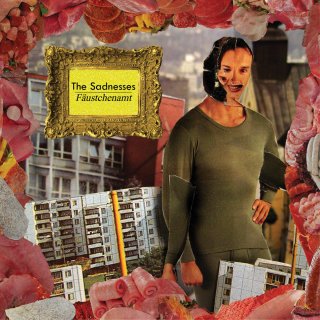 Collaging, at its heart, is the art of combining various elements to create a new whole, one that both retains the identities of the things used to create it and takes on one of its own. Fäustchenamt presents collages on two fronts: its aggressively harlequin album cover constructs a mishmash of pink, red, and orange food products that surrounds more patchy combinations of photographs of buildings and a human body; and, of course, the music, which takes the form of seventeen delirious hodgepodges of field recordings, deconstructed musical performance, disarming electronic textures, and the occasional funky hip-hop beat. Even before listening to the album you could probably assume it to be overwhelming, an assumption with which I would agree, but the enigmatic Berlin artist(s?) known only as The Sadnesses aren’t just throwing things at the wall (or your ears) and seeing what sticks. Each short track is a carefully composed conversation of disparate sounds, and really the only overwhelming thing is how dizzyingly varied the sonic palette really is; once the initial bewilderment at bizarre fusions of cut-up conversations and guitar solos (“These Bags of Vanity”), or the mass of static that tears apart the surreal pop pastiche of “Lance Armstrong,” or uncanny harmonies between violins and what sounds like the rocking of a boat (“Swimless Fish”)—yes, all that occurs in that less than four minute stretch—wears off, there are some truly sublime moments to be found. At the very least Fäustchenamt is often downright hilarious. If you’re a fan of the dada totalism of LAFMS bands like Le Forte Four, this will be right up your alley.
Review: Maxo – Lil Big Man (Def Jam, Mar 15)
 Getting pulled into the woozy, half-asleep world of Lil Big Man is pretty much the easiest thing in the world. From the opening cut “Time” the LA newcomer Maxo commands his arsenal of shuffling hi-hats, buried vocal samples, and dreamy keyboards with a buttery, infectious flow that draws charisma from both the ease at which it’s delivered and the sense that Maxo actually believes the things he’s saying, an all-too-uncommon quality in recent hip-hop I’ve heard. The production is handled almost entirely by lastnamedavid and Swarvy (Due Rent, Swarvy’s collaborative tape with rapper lojii, who also appears on Lil Big Man, was my pick for hip-hop release of the year in 2017), its eclectic instrumental palette borrowing liberally from soul and jazz to craft lush beds for Maxo’s bars. The percussion is rhythmic in a wobbly, tumbling way, consistently groovy yet seemingly never strict or metronomic, a calm and detached approach that couldn’t complement Maxo’s delivery better. The young wordsmith’s focus is mostly directed inward, at war with himself and success on “No Love” and meditating on uncertainty with “Lucky,” his earnest musings ornamented with interlocking rhyme schemes and abstract imagery. Though the production is possibly the more immediate appeal of Lil Big Man, further listens readily endear Maxo and his words, the rapper subverting any need to ‘prove himself’ on his label debut and instead just saying what he wants—or needs—to say.
Review: Weak Flesh – A Bird in Hand (self-released, Mar 9)
 It will probably take longer to read this review than it would to listen to any of the songs on A Bird in Hand, the second installment of Austin hardcore quartet’s brutally concise LP releases following 2016’s Blood Mouth. The band tears through fourteen tracks in as many minutes, each full of crushing unison riffs, dizzying technicality, desperate stretches of light-speed blasting, and the amazing heights that come when all of those elements are seamlessly combined with each other. At its heart, A Bird in Hand is a grind album with plenty of hardcore grit, but Weak Flesh are far from opposed to drawing from other subgenres to, pardon the pun, flesh out their own unique sound. The guitars frequently claw their way to angular, dissonant stabs reminiscent of more traditional mathcore, the chugging stomps and unpredictable tempo changes pay tribute to west coast powerviolence, and occasionally something unlike anything else is achieved, like the nightmarish atmospherics of the blasts on “Hand Foot Mouth.” My breaking down of the stylistic genealogy of A Bird in Hand is not intended to diminish the record’s uniqueness—which it possesses in spades—or to argue that any of the band members had those things in mind when writing the music; instead, it’s just a way for me to communicate how much of an eclectic, creative, and completely eviscerating experience this album is.
Review: Ultio – Fera (Brucia, Mar 17)
 The inaugural release from Genoa-based label Brucia Records arrives in the form of the recorded debut from enigmatic solo project Ultio. Information on the artist is scarce (the only revelatory detail provided on the Metal Archives is that its lyrical themes are “evil”), but the music speaks for itself. Fera is twenty minutes of seething fire and fury buried beneath a pile of suffocating earth that threatens to give way at any second, the propulsive blast beats and frenzied tremolo riffs constantly pushing to escape their tomb. While the music is veiled in a canopy of fuzz and blur, an aesthetic choice that effectively complements both the atmosphere and subject matter that Ultio explores, the mixing leaves no desire for further clarity, and even the most subtle of elements are allowed due definition. At an average length of five minutes, each of the four tracks are consistently concise, mining from a focused but fruitful palette of inhuman shrieks, frantic dissonance, brief fragments of melody, and cathartic moments of masterful tension release. The EP’s short length couldn’t be more misleading; there’s more here to explore than in countless other more bloated black metal releases I’ve heard, whether it’s picking out the buried screams in the harrowing coda of “Beyond the Fog” or reveling in the glorious climax that concludes “The Right Weapon.”
Review: Bridges of Königsberg – Considered Parallel to Borders (Or Dividers) (Flag Day Recordings, Mar 22)
 The first five or so minutes of “The Greatest Awful,” which opens the set of six extended tracks that comprise Considered Parallel to Borders (Or Dividers), is an immediately unsettling dada collage that acts as a fitting tone-setter for the remainder of the album. Recordings of smacking and gurgling mouth sounds; erratic, percussive spasms of distortion; mangled synthesizers; and countless layers of shifting, contorting noise coagulate into something both frightening and enthralling, trapping the unwitting listener in its knotted claws. But Bridges of Königsberg, a trio composed of Christopher Burns, David Collins, and Peter J. Woods, don’t seem to have the goal of making the most disturbing sounds possible, even though it’s often accomplished anyway. They’re more concerned with the interactions between elements: how the cracked, broken techno loops give structure and rhythm to much less compliant noises, how tension-filled drones can slowly force things into a new direction, how bulbous pulses amidst waves of static and fuzzed-out recordings can sound like some sort of terrifying monster forcing its way out of a pit of tar. Considered Parallel to Borders is certainly a harrowing record, but even though its sonic explorations are as angular and jarringly contrastive as the sharp black lines on its cover, the images and atmospheres it evokes are spell-bindingly lush.
Review: Nusquama – Horizon Ontheemt (Eisenwald, Mar 22)
 What was it Tenacious D said? “You don’t always have to play black metal hard… I’m gonna blast softly”? Yeah, that sounds right.
Not that Horizon Ontheemt is a “soft” album. Nusquama, a new quintet comprised of musicians from bands such as Laster, Northward, and Turia, have plenty of aggression and anger to expend, and—coupled with all five members’ superb musicianship—that makes for an intense and emotionally draining journey. But still, there is a beautiful frailty to these fluid compositions, even when the band is at its most structured and rhythmic. The guitars are swathed in threadbare blankets of incorporeal effects, allowing them to enshroud and float above the other instruments to evoke space and atmosphere. They’re often tempered by the earthy punch of the drums, which somewhat frequently relegate the rhythmic backbone to more grounded beats, but when the blast beats set in the band’s true ear for textural transcendence is revealed. Every tremolo chord, every snare hit, every agonized wail is delivered with exactly the right amount of power, just enough to establish presence but not so much that anything distracts from the gorgeous maelstroms of unified sound created by a group of artists who it seems couldn’t compliment each other any better. Horizon Ontheemt isn’t even 40 minutes, but it’s a giant of a record, a giant with its feet on the ground but its head and shoulders in the clouds.
Mix: Peculiar and Prophetic Post-Punk
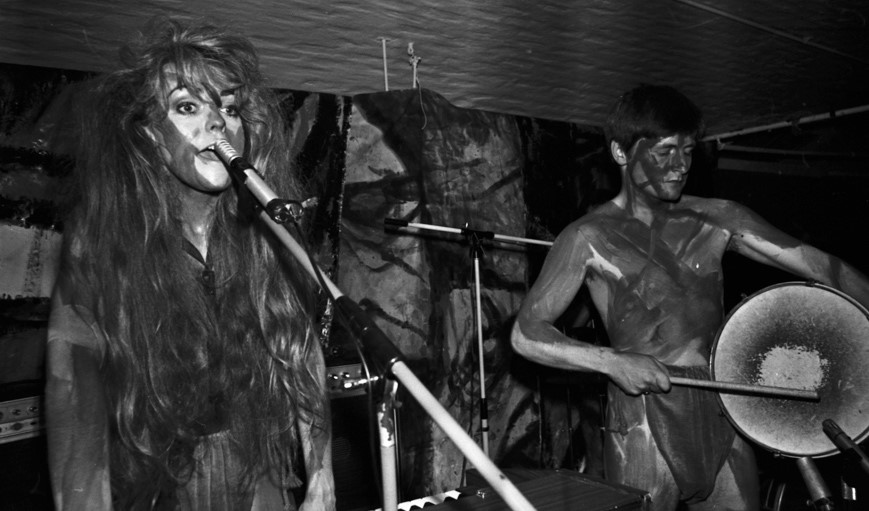
As soon as you attempt to classify (in this case, a more vivid–and fitting–verb might be ‘coagulate’) an artistic movement as fearless and wide-ranging as the mass of eclectic avant-garde rock music that arose in the late 70’s and early 80’s, it begins to break down. While these bands and artists are commonly grouped under the umbrella term “post-punk,” much of it owes little debt to traditional punk, instead drawing from funk, jazz, industrial, surrealist art, krautrock, and many other areas. In addition to looking backward in time for inspiration, many artists arrived at remarkably prescient stylistic cocktails. The often rough, do-it-yourself music foreshadowed things whose full potential wouldn’t be realized until much later, working with anything from collage and primitive musique concrète to tribal rhythms and free improvisation. Here are my picks for the best examples of this awe-inspiring creativity, somewhat skewed towards obscurities that have been lost to time.
00:00. Mars – “Helen Forsdale” from No New York compilation (Antilles, 1978)
02:28. Clock DVA – “White Cell” from Thirst (Fetish, 1981)
07:00. A Certain Ratio – “Choir” from To Each (Factory, 1981)
09:44. L. Voag – “Living Room” from The Way Out (self-released, 1979)
12:11. 23 Skidoo – “IY” from Seven Songs (Fetish, 1982)
17:12. Lemon Kittens – “Nudies” from …The Big Dentist (Illuminated, 1982)
20:30. The Stick Men – “Tail Dragger” from This Is the Master Brew (Red, 1982)
22:32. Stutter – “These Are Small Times (Not Good Enough)” from Broken Snakes (Check, 1989)
25:31. D.A.F. – 8th untitled track from Produkt Der Deutsch-Amerikanischen Freundschaft (Warning, 1979)
28:40. Savage Republic – “Flesh That Walks” from Tragic Figures (Independent Project, 1982)
32:00. Milk From Cheltenham – “Snappy Fingers” from Triptych of Poisoners (It’s War Boys, 1983)
34:31. Alternative TV – “Graves of Deluxe Green” from Vibing Up the Senile Man (Deptford Fun City, 1979)
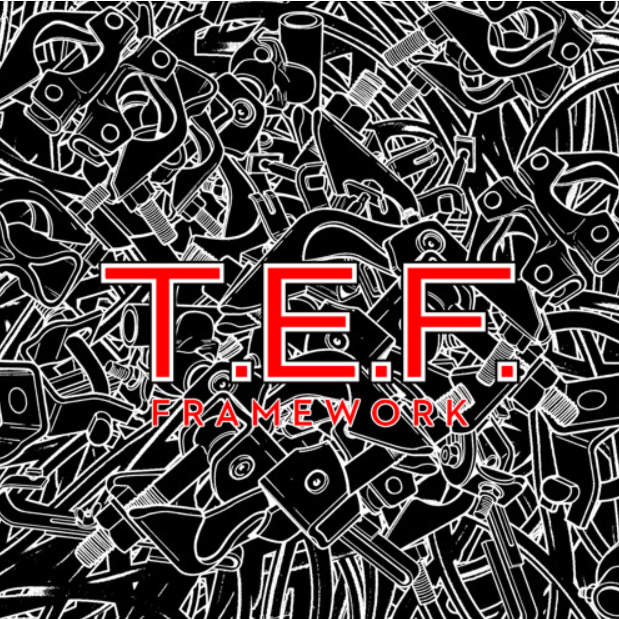
Review: T.E.F. – Framework (Dada Drumming, Mar 19)
 What did I do to deserve two of the most important American harsh noise acts releasing new music on the same day? Nothing. Absolutely nothing. Here’s to being a spoiled little bastard with a hefty supply of eardrum punishment.
Houston-based artist Kevin Novak has been releasing recordings as T.E.F. since the late 90’s, and even his earliest recordings, like Tokyo Eternal Folly, display a truly distinct understanding of the harsh noise medium. With Novak, it’s always been quality over quantity, a mantra attested to by his relatively small body of work—compared to many noise artists’ notorious prolificacy—and the stunning heights reached on genre-defining achievements such as Symptomatic Harbinger and Consequences in Conversation. The latter was Novak’s last full-length album as T.E.F., and nearly a decade later its formidable dynamics and cut-up spastics are rivaled by Framework, also on Dada Drumming. This new CD absolutely seethes with restless aggression, its deafening collages of breakneck sample mishmosh, squalling feedback, and god knows what other distortion-smothered sound sources tearing through brief respites with a vengeance. The trademark density that makes T.E.F. releases so replayable is in full force here; though repeated listens won’t make it any quieter, you’ll constantly be picking up on new things, and the overall chunkiness gives Novak’s noise an unmatched set of teeth.
Framework can be ordered directly from the label, and is available digitally on most streaming platforms.
 Noise Not Music