
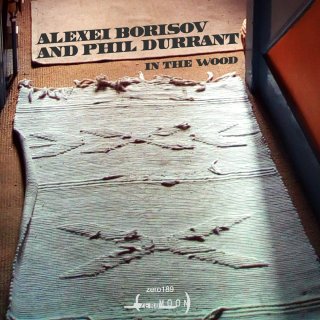
 The harsh electronic improvisations of In the Wood are a far cry from both the reductionist works I associate with Durrant, such as Dach with Thomas Lehn and Radu Malfatti or Open with Matt Davis and Mark Wastell, and the more composed, glitch-plagued noise produced by Borisov. Instead, the two artists seem to meet somewhere in the middle of their extreme styles, translating the piercing tones and buzz of the electronic devices used into fluid, freely played pieces. It’s mostly unclear who’s making which sounds, or even what is making those sounds, but to me it sounds like modular synthesis and circuit bending, with each musician able to produce both unpredictable flurries and sustained drones. There’s hardly ever any silence; the most reserved that In the Wood gets is during moments like in the beginning of “Part 4,” when the clocking of a modified circuit is left running on its own, and even then it’s soon interrupted by some of the most violent interplay on the whole record. Despite the abstractness of the sounds, In the Wood is persistently loud, intense, and confrontational, with every blast of glitches adopting almost disconcerting levels of tactility.
Author: Jack Davidson
I like to listen to, read and write about, and play music.
Review: Ushinawareta Tamashī – Shinda Yuki (Dark Field Recordings, Dec 19)
 I first encountered the music of Ushinawareta Tamashī on his split C120 with Warui Yume, one of Lurker Bias’s last releases in 2018. Though both walls were great, Tamashī’s really sucked me in. The dark soundscape of “Runessansu,” formed by an oppressive rumbling and a distant, persistent scraping, is claustrophobic but natural, and before I knew it I’d listened to the whole 60 minutes. Shinda Yuki is a less overtly wall release, with both tracks consisting of largely unmanipulated nature recordings, but the meditative, stagnant atmosphere is still present. The first part presents a much less compressed palette of textures than “Runessansu,” capturing the soft, tactile sounds of falling rain and rustling branches. Both tracks are recordings of storms, and as such the howling of the wind plays a significant role in each; in part one, the wind is a distant presence, occasionally creeping in the sides of the mix, while in part two, the gusts are much more isolated, cast into clarity by the muffling of the rain sounds. My favorite thing about Shinda Yuki is how much movement it evokes without, in a manner of speaking, going anywhere; even in subtle ways that aren’t immediately apparent, like the barely discernible crinkling noise amidst the din of part two.
Review: Potion / Car Made of Glass Split Tape (List of Lake Arts, Jan 1)
 This split C20 from two new California hardcore bands came out on the first day of 2019, and I love the idea of Potion’s “Sentenced to Death in the High Court of Judith Sheindlin” leading into “David Blaine Trapped Under Ice Pt. 2” being the first thing someone hears in the new year. Because oh boy, the A side of this tape is one of the most viciously intense grind I have heard in a while. The impossibly shrill vocals are like a dying animal, presumably being killed by whatever the fuck is making the contorting, dizzying electronic sounds that form Potion’s instrumental backbone (member Hunter Peterson is only credited with guitar, bass, and keyboards, so there must be some Ichirou Agata level craziness going on). The drums are just as brutal as everything else, all slamming double bass and furious blasts, until a sample from what sounds suspiciously like an episode of Xavier: Renegade Angel abruptly leads into Car Made of Glass’s side. Which—surprise!— is just as heavy. Here we get some (relatively) more straightforward grind-violence, frequently interrupted by bizarre interludes. The drums on the B side, both the way they’re played and how they’re recorded, are the driving force behind the insanity. Unfortunately, both bands end up relying way too much on samples, to the point where the flow is just disrupted, but everything else is so crazy I almost just don’t care.
Both Potion’s and Car Made of Glass’s sides can be downloaded from their Bandcamp pages, and a preorder for the actual tape release can be found here.
Review: Double Goocher Shop – Double Goocher Shop (Regional Bears, Dec 5)
 This tape came out almost immediately after I began my review hiatus for the month of December, an unfortunate circumstance because all I wanted to do was write about it. Double Goocher Shop is the self-titled debut release from the duo of Matthew P. Hopkins and Renato Grieco; the solo work of the former I am very familiar with, but I cannot say the same about the latter. The tape is a playful but dark romp through mysterious speech, nocturnal concrète ambience, and a distinct penchant for unseating and altering its already haphazard sonic constructions. By this I mean that even the most abstract moments on Double Goocher Shop are never immune from interference, whether it’s the disarming intermittent playback of the spoken nonsense that begins “#1,” the intrusion of silence and slow disintegration of what appears to be a live performance recording on “#parole,” or the bassy clunks that disturb the fragile atmosphere of “#3.” While there are many other elements to the music than just the words, they are what make me remain mesmerized by the tape on every listen. The way each line progresses into the next, how certain words or phrases are repeated several times, the almost uncomfortably hypnotizing effect; Double Goocher Shop belongs amongst the greats of the text-sound medium.
Feature: Favorite Albums of 2018
Well, here it is. I listened to nearly 500 new releases this year, and as with any amount of music that size I found some things I truly love. I am excited to share them with you in the hopes that we agree, disagree, or I can introduce you to something new…or all three. The order is not important here. I adore all of these albums and I won’t diminish that by comparing them to each other. Writing about every single one would be exhausting (for both me AND you), so I plan to write about the first ten that come to mind and let the rest speak for themselves.
To everyone who somehow participated in this website in 2018, thank you. This was my first year doing consistent reviews and I couldn’t have had more fun. See you all in 2019!
 Daughters – You Won’t Get What You Want (Ipecac, Oct 26)
2022 Note: Leaving this as is because I don’t believe in revising the past, but I want to make it clear that I no longer listen to Daughters. Fuck you Alexis.
Words cannot describe the excitement I felt when Daughters, after eight years since their flawless self-titled album, released “Satan in the Wait” as a lead single back in July. The seven-minute epic dethroned “Cheers, Pricks” as the band’s longest song, and ventured into dark, unfamiliar territory with its post-punk influenced guitar slices and repetitive structures, all areas that were further explored on the masterpiece that is You Won’t Get What You Want. I won’t hesitate to say that this record deserves every single ounce of the exorbitant praise being thrown its way. From the nightmarish mood-setting on “City Song” to industrial-plagued noise rock tracks like “Long Road, No Turns” and “The Reason They Hate Me” to frenetic fretboard attacks that hearken back to the band’s earlier work on “The Flammable Man” and “The Lords Song,” everything is exactly what it needs to be. You Won’t Get What You Want is a confident entry in the awe-inspiring artistic evolution that is Daughters’ discography, and easily joins the others in my endless rotations.
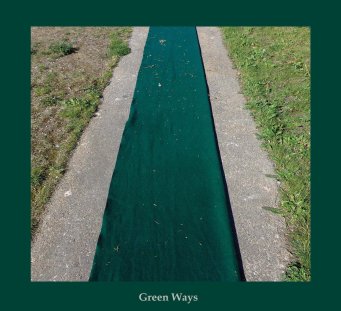 Graham Lambkin & Áine O’Dwyer – Green Ways (Erstwhile, Nov 27)
Green, a beautiful color. I began my review of this double CD a month or so ago with the words “I’m fairly certain I will remember the first time I heard Green Ways for the rest of my life.” I stand by that assertion. Lambkin and O’Dwyer have captured something both familiar and impossibly unique with this album, adopting an unparalleled minimalistic approach to music-making to convey so many different scenes, emotions, and sensations. The listener is trapped inside the portable recorder the artists used to capture these sounds, but the effect is anything but limiting; we are there when the audience erupts into applause at the end of a bizarre group performance, we are there when the soft plinks of an old piano shakes the ground, we are there in that bustling crowd of people in a lively Irish town. Green Ways, despite its unapologetic sparseness, oozes with more things than music seems able to convey, than it should be able to convey. (Original review)
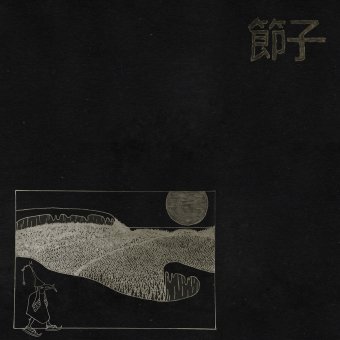 Setsuko – The Shackles of Birth (Dog Knights Productions, Mar 5)
There’s emoviolence with a sharp edge, and then there’s this. The Shackles of Birth is an unyielding assault of anger, barreling toward anyone who chooses to listen with its twisted hybrids of grinding blast beats and buzzsaw guitars. The LP is capped at a concise 17-minute run time, and there are absolutely no stray hairs or meandering moments; everything about this album contributes to its formidable intensity in one way or another. The production is oppressive and muddy, lending weight to the pounding rhythms and chugging, distorted bass, but also allowing the jagged, chaotic roils of tortured vocals and guitars to cut straight through. I consider The Shackles of Birth to be a modern classic of the genre (or at least it will be eventually); it easily ranks among the most intense chaotic hardcore in its ability to grab hold and not let go. (Original review)
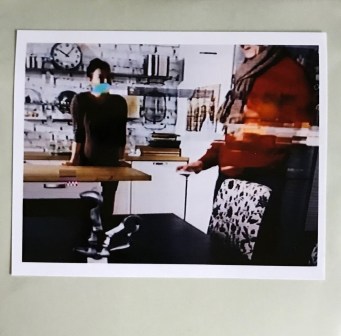 Posset – Totally Corporate! (Kirigirisu Recordings, Mar 17)
Joe Murray has been working with the acoustic properties of low fidelity audio material for a long time, and Totally Corporate! seems to be the embodiment of everything the medium has to offer. Murray transforms even the simplest and most mundane of sources into spellbinding spiderworks of tape hiss, distorted garble, and discomfiting clicks and clacks. The fractured, damaged operations of dictaphones and other tape recorders opens up a world of mystery, unease, and beauty, echoing the murky distance of faded memories and parts of life long gone. “Reading the Track List for Napalm Death’s ‘Scum’ Into a Broken Tape Recorder” is exactly what its title states, but even this moment of transparency does little to disrupt the immersive atmosphere that Murray has created.
 Earl Sweatshirt – Some Rap Songs (Tan Cressida, Nov 30)
From its blurred cover photograph to its minuscule run time, I wouldn’t blame anyone who worried that Some Rap Songs would feel sloppy and thrown together. Actually, those are two descriptions that I would confidently apply to this album, but in the most positive way possible. On his first studio album in three years, Earl Sweatshirt ventures further into the hallucinatory sample collages and dense wordplay first hinted at by I Don’t Like Shit, I Don’t Go Outside and its companion Solace, messily chopping up old soul records to form the basis for an odyssey through a mind that’s as lonely and tortured as ever. The album moves through its series of flitting vignettes at a brisk but natural pace, with Earl’s tumbling flows and free-associative imagery often forming the basis for the dizzying beats instead of the other way around. The last three tracks are simply gorgeous, from the achingly beautiful piano cascades and spoken words of parents Cheryl Harris and Keorapetse Kgositsile on “Playing Possum” to the shifting static of “Peanut” and the concluding “Riot!,” which somehow brings this fever dream to an organic close.
 Poppy – Am I a Girl? (Mad Decent, Oct 31)
I’m only half joking when I say I could write a dissertation about this album. On Am I a Girl?, Moriah Rose Pereira takes her character of Poppy past the cutesy robotic pop of Poppy.computer and into a tour de force of polished electropop hits, mind-bending genre experiments, and a new level of social commentary. “In a Minute” starts things off strong with its addictive bass curls and the infectious vapidity of its chorus, with Poppy’s assertion that she is “busy and important” taking control of the album’s first act, which is full of more gloriously shallow expressions of vanity. The adventurous pair of interludes in turn take us into the second and third sections, which take things to new heights of absurdity. It’s impossible not to simultaneously dance your heart out while bursting out laughing at the ridiculous lyrics of “Aristocrat” or “Girls in Bikinis,” or to laugh even harder at the genre fusions of the final three tracks while headbanging to the gloriously hard-hitting metal riffs. I can’t say enough good things. (Original review)
 Amuleto – Misztériumok (Three:Four, Apr 6)
The sounds of Amuleto’s Misztériumok radiate the same tension as the strings of the instruments largely used to create them. The duo sculpts physical, impacting electroacoustics from a variety of sources, but even at its most abstract and electronics-heavy the album retains the earthy feel and energy of an intimate folk song. From the second that layer of mesmerizing bass tones breaks through the bowed drones that begin “Der Turm,” Misztériumok is a sonic journey through taut, tensile compositions that exude a primordial warmth. “Urlicht” is the album’s most conventionally beautiful track, weaving fuzz-soaked harmonies in and out of each other, while “Untitled With Eye, Hand, Moon and Dog” achieves breathtaking heights through its unpredictable stop-start approach. (Original review)
 Mosquitoes – Drip Water Hollow Out Stone (Ever/Never, Jul 13)
The U.K.-based avant-rock outfit Mosquitoes was one of my favorite discoveries this year, along with their closely related side project Komare. Drip Water Hollow Out Stone is the band’s first official label studio release, providing a more accessible platform to experience their uncompromising brand of fractured rock music. The LP echoes the anxious, angular guitars and unintelligible vocals of New York no wave pioneers like DNA and Mars, but there’s something much more elusive, even sinister about it. The stutter-step rhythm section forms broken grooves that amble along at a stumbling but deliberate pace, the sparse instrumental interplay somehow creating hulking, intimidating soundscapes. The vocals are nothing short of terrifying, echoing the wordless rhythms of sound poetry as they slither across these songs. (Original review)
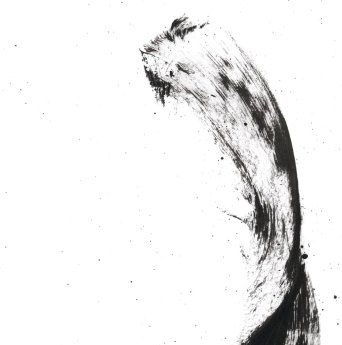 Manja Ristić – The Nightfall (Naviar, Apr 26)
Serbian sound artist Manja Ristić has had an incredible year, but The Nightfall, her sublime meditation on the four seasons, is undoubtedly the highlight. I still struggle to find words to discuss this album despite its rare departure from my cassette player. It explores tension and freedom in equal measure, with anything from ominous guitar melodies to percussive vibraphone accompanying Ristić’s lush collages of field recordings. I won’t pretend that basing pieces of music on the cycle of seasons is anything incredibly revolutionary, but the way each season is viewed and conveyed definitely is—I can’t say I’ve ever heard a musical depiction of summer that is as foreboding as it is here. “Spring” on its own makes this album a formidable force this year; its combination of comforting melodies and sounds of laughing children is almost too beautiful to describe. (Original review)
 Guttersnipe – My Mother the Vent (Upset the Rhythm, Oct 26)
The deafening racket that is My Mother the Vent is only made more impressive with the knowledge that it was produced by just two people. Guttersnipe, a duo from Leeds that features one member on guitar, electronics, and vocals and the other on drums (their real names are unknown to me), nearly perfects their semi-improvised brand of harsh rock music on this album. To say My Mother the Vent is impenetrable would be an understatement; the shrieking vocals sound like the wails of a straight-jacketed psychopath and the drums switch between Chris Corsano-esque rock improv to fiendish blast beats at the drop of a hat. The band occupies an incredible neutral zone between concise songwriting and meandering free music, frequently letting their instrumental chemistry take the songs to new places but always knowing when to reel it all back in. (Original review)
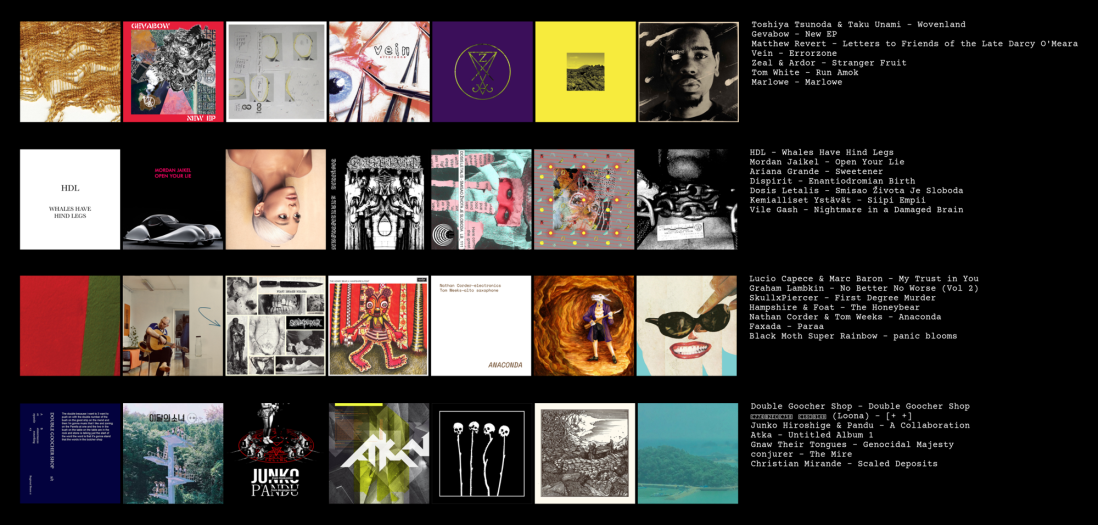
Some… “Honorable Mentions” (Feel free to zoom in, it’s a large image)
Feature: Favorite Compilations, Reissues, and Archival Material from 2018
In December, the month of end-of-year lists galore, I’ll be focusing more on summarizing my favorite music that I heard this year rather than reviewing new things—among obvious other reasons, I need a break from the constant new music! For me, December is not too early to assess the year as a whole, because I won’t be able to spend enough time with anything that comes out this close to the end of the year to confidently put it on a list. As with everything on this site, these lists and features will be intended to encourage discovery of new things; the fact that they are my opinions is secondary.
2018 was a year of looking forward for many artists, but brand-new music wasn’t the only thing dominating my listening these past eleven months. From reprints of old, hard-to-find albums to collections of tracks that hadn’t previously been available at all, here are my favorite archival releases from 2018.
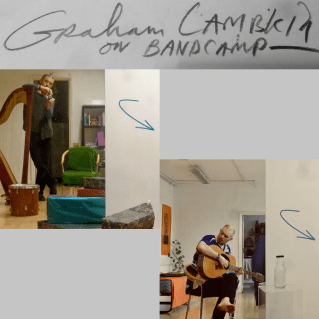 Graham Lambkin – No Better No Worse Vol. 1 & 2 (self-released, Jan 25 & Jun 21)
This year, legendary sound collage artist Graham Lambkin made many of his releases available digitally on Bandcamp. It was the first time many of his beloved albums had seen official digital versions; many of them were released as LPs and cassettes on Lambkin’s now-defunct label, Kye, including the wonderful Poem (for Voice & Tape) and Amateur Doubles. But the uploads were also accompanied by a compilation of unreleased material that was soon followed by a second volume, and both collections rank handily among Lambkin’s best work. Vol. 1 brought us the fluid, personal “Summer Tape Work,” the mundane beauty of “The Pack,” and some informal experiments such as “Concert Review.” Vol. 2 somehow upped the ante, unveiling the gorgeous staticked sighs of “Ghost Boxes,” an abridged version of Lambkin’s arresting sound poetry piece “Unfocused Hands,” and the first official digital appearance of “Abersayne” and “Attersaye,” two of the most uncanny and affecting songs ever created.
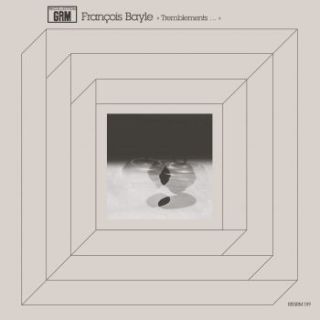 François Bayle – Tremblements… (Recollection GRM, Feb 23)
Recollection GRM, a sub-label of Editions Mego, has been reissuing collections of significant avant-garde works, mainly in the realms of electroacoustic composition. Tremblements… comprises two pieces by François Bayle, the composer who famously coined the concept of ‘acousmatic music’ and founded INA-GRM, the label whose releases Recollection GRM reprints. Both pieces, “Tremblement de terre très doux” and “Toupie dans le ciel,” maintain a reserved, almost ambient atmosphere despite the large quantity of both synthesized and recorded sounds used throughout. This was not my first of Bayle’s works, but it was the first that I fell in love with; here, he easily matches (and often even surpasses) the skill and techniques of his mentor Pierre Schaeffer, the father of musique concrète, creating abstract soundscapes that are as focused as they are eclectic.
 International Debris – 2T: Experimental Works 1995-2017 (self-released, Mar 27)
I’d like to say I listened to every minute of music contained on this massive collection, but if I did I’d be lying. Experimental Works collects the complete output of Ross Baker’s 2T project, as well as some releases under various other releases, from 1995 to 2017. It contains nearly fifteen hours of material that ranges from varyingly active radio play and sloppy plunderphonics to well-crafted concrète music and patient, if occasionally indulgent, drone pieces. Baker didn’t exactly use any fine-tooth combs when releasing his music, but the sprawling unfiltered-ness of Experimental Works allows it to be an imperfect but comprehensive auditory document, and listening sequentially tells the fascinating story and evolution of a developing sound artist. From laugh-out-loud moments of anti-music irreverence to periods of admirable focus like the “Headache Therapy” series, this is a compilation that shouldn’t be overlooked.
 Cold Electric Fire – The Alchemist: The Complete Recordings (No Rent, Apr 24)
Even in their maelstrom of 2018 releases, No Rent Records made time for some not-so-new material. Gary Tedder’s brief stint as Cold Electric Fire yielded two CD releases and a split 10″ with Facedowninshit, and the music from all three of which is present on The Alchemist along with completely new tracks that were never released (a track from 2002’s In Night’s Dream We Are Ghosts was repurposed for the Facedowninshit split). As typical of No Rent, the packaging for this two-tape set is incredible, and the innocuous image used as the cover is a perfect representation of the meditative, droning analog ambience that was so diligently created by Tedder, radiating a comforting warmth even at the compilation’s tensest moments. The highlight of The Alchemist may be the unreleased project A Cursory Sweep of the Insurmountable, an ambitious collection of processed instrument drones. Every aspect of this release makes it one not to miss, even the beautiful photographs that color its twin J-cards and Jason Crumer’s meticulous and thoughtful introduction.
 The Four Horsemen – Nada Canadada (Holidays, Nov 9)
Originally released as Canadada on Griffin House in 1974, The Four Horsemen’s debut LP was one of the finest examples of text-sound, or sound poetry, when the art form was arguably at its creative peak with peers such as Sten Hanson and Charles Amirkhanian. But Nada Canadada stands out even now, mainly because of its profound sense of community. The members, including bpNichol, Rafael Barreto-Rivera, Paul Dutton, and Steve McCaffery, always made an effort to keep their abstract poetry attached to its roots, and their words are almost entirely discernible even amidst the chaos whipped up in “Seasons” or “Monotony.” I think Rafael Barreto-Rivera puts it best: “The number of words we still use in our poetry comes as somewhat of a surprise to us, especially in the light of this album. Strictly speaking we cannot call what we do sound poetry if by it is meant that poetry which has its basis in non-verbal, vocal, and sub-vocal elements of sound. Nor are we into the electronic ramifications of sound in any sense beyond doing a record. We are in fact reluctant to pin the aesthetic continuum on which we operate to the first wall available. Still, perhaps the best name for what we do is what it always has been: poetry.”
Feature: Favorite Labels of 2018
As we enter December, the month of end-of-year lists galore, I’ll be focusing more on summarizing my favorite music that I heard this year rather than reviewing new things—among obvious other reasons, I need a break from the constant new music! For me, December is not too early to assess the year as a whole, because I won’t be able to spend enough time with anything that comes out this close to the end of the year to confidently put it on a list. As with everything on this site, these lists and features will be intended to encourage discovery of new things; the fact that they are my opinions is secondary.
Even in this era where digital music and streaming dominate, independent CD and tape labels are the lifeblood of the underground and avant-garde music community. So many, way more than we deserve, are admirable platforms for musicians and artists to get their music to new audiences, focused on supporting creativity rather than profit (though they still need your financial support too). With this piece, I hope to give recognition for the longer running labels that are still consistently great, as well as bring some newer discoveries into the spotlight.
‘Old Standbys’
 Erstwhile
Though 2017 only saw three new Ersts—which, to be fair, were two fantastic double CDs and one monstrous five-disc set—the label doubled that number in 2018, releasing three single discs in March, two more in August, and wrapped things up with the spectacular Green Ways, a two-disc collaboration between Áine O’Dwyer and Graham Lambkin, which also happens to be my pick for the best thing I heard this year. With this year’s roster, Erstwhile continues its long running tradition of being at the forefront of contemporary improvised music, with the tense, percussive interplay of Hong Chulki and Will Guthrie on Mosquitoes and Crabs and the whimsical live sound-plundering of Lucio Capece and Marc Baron on My Trust in You, but it also maintains its expansion into other areas, with the remaining four albums all but defying conventional classification. Thank you to Jon Abbey, who runs and produces for the label, and to Yuko Zama, who does most of the CD case designs.
 Glistening Examples
Jason Lescalleet’s formidable imprint continued to present some of the most interesting and forward-thinking works in the areas of electroacoustic and acousmatic music this year. Its first offerings came from sound researcher Thomas Tilly, whose wonderful Codex Amphibia explored the breeding frenzies of frogs, as well as the sonic quilting offered by Taneli Viljanen and the warm but tense drones of Caroline Park. Lescalleet also released two of his own works on the label, a CD reissue of last year’s Almost Is Almost Good Enough cassette and the 20th installment of his This Is What I Do series. Three more release batches were released throughout the year, from which my personal highlights were Run Amok, a series of tactile sound interventions by Tom White, and Hardworking Families’ deceptively dense EMERGENCY WINDOW. Thank you to Jason Lescalleet, whose mastering work is reliably great on every release.
 No Rent
The Philadelphia-based No Rent Records just might have every other physical media label that I can think of beat with the staggering amount of tapes they put in 2018, which numbers more than thirty. THIRTY tapes. I admit I missed one here and there, but I’ve liked pretty much every release I’ve heard from No Rent this year, an amazing feat for that amount of prolificacy. My favorites include Buck Young’s Proud Trash Sound, a cassette originally released in January and later pressed as an LP which also happens to be the greatest—and, possibly, only—example of ‘country noise’ I can think of; Fashion Tape from Vanessa Rosetto, whose unique synthesis of sound sources is housed within one of the best looking cassettes I own; a two-tape comprehensive compilation of ambient works by Cold Electric Fire; and Collin McKelvey’s glorious The Golden Ass. Jason Crumer’s Ottoman Black was also reissued as a cassette. Thank you to Jason Crumer and Rose Actor-Engel, who work tirelessly to give countless experimental artists a valuable platform.
 Youth Attack
In 2018, the label that takes its name from one of the greatest hardcore releases in history released more than several albums that are well-equipped to steal that crown. I would have been happy if the only two punk LPs I had this year were January’s Dying Breed and Nightmare in a Damaged Brain, the furious masterpieces by Cadaver Dog and Vile Gash respectively, but Youth Attack wasn’t done. Mark McCoy’s own band Suburbanite also released a self-titled LP, and the year was brought to a close with another forceful double-punch from City Hunter and Creep Stare. Youth Attack also released an official digital version of the Cancer Kids’ peerless opus The Possible Dream, which originally came out in 2002. Thank you to Mark McCoy, who is always determined to bring us the best that modern hardcore has to offer.
New Discoveries
 Castle Bravo
This Indiana-based imprint only releases three tapes every June, but this year’s batch was more consistent than most others. Each of the three barely left the vicinity of my tape player since I got them in the mail, with Cryptonym’s vicious mixture of black metal and distorted electronic music on Predation, Gateway’s avant-jazz-plagued brand of improvised music on Dawn of the Civil Savage, and the debut release from Truth Decay filling many an intolerable silence throughout the second half of 2018. I also feel compelled to mention the tape that introduced me to Castle Bravo: Death Ranch by guitarist, droner, and collager Jacob Sunderlin.
 Dinzu Artefacts
Dinzu’s gorgeous tape releases are reserved for “the contemporary art of sound by artists interested in tape manipulation, field recordings, noise and experimental practices.” It’s no surprise, then, that pretty much every DNZ cassette can be counted on to be tremendously unique and innovative, from the muffled mechanical whirrings of Sebastiano Carghini’s Habituated by Reason and tape-miniatures of Dominique Vaccaro’s Close Distances to the amplified environments of SiAl by Matthias Urban.
 elsewhere
Started as a sister label to Erstwhile, elsewhere is run by designer and producer Yuko Zama, who focuses on releases grounded in contemporary classical music. Though 2018 was the label’s first year in operation, it already has put out five titles, including a triple CD from Biliana Voutchkova and Michael Thieke, a performance of Clara de Asís’s piece “Without” by Erik Carlson and Greg Stuart, and a collection of two compositions by Wandelweiser legend Jürg Frey, all packaged in beautiful cases with a unique design template.
Geräuschmanufaktur
Geräuschmanufaktur mainly operates in the endlessly fruitful wall noise renaissance, as well as releasing titles in other areas of music. The label’s 2018 roster is dominated by Constructionis, a three-tape set credited to Architectonicum, a trio of wallers backed by founder Jan Warnke’s own ‘architectural noise’ manifesto. Other releases included a double header from concrète collective The Dead Mauriacs, the short Pathways released under Warnke’s own name, and walls from Damien de Coene and Cannibal Ritual.
Honorable Mentions
I’d also like to recognize some other labels who brought me some of my favorite music this year, including Round Bale Recordings, Lurker Bias, Chaotic Noise Productions, Katuktu Collective, Plus Timbre, Sentient Ruin, Ascetic House, Kirigirisu Recordings, and ACR.
Feature: MVPs of 2018
As we enter December, the month of end-of-year lists galore, I’ll be focusing more on summarizing my favorite music that I heard this year rather than reviewing new things—among obvious other reasons, I need a break from the constant new music! For me, December is not too early to assess the year as a whole, because I won’t be able to spend enough time with anything that comes out this close to the end of the year to confidently put it on a list. As with everything on this site, these lists and features will be intended to encourage discovery of new things; the fact that they are my opinions is secondary.
2018 was a year in which I discovered lots of new artists and got to hear new music from artists I already love. There were, however, several artists who managed to occupy both voids due to their prolificacy throughout the year. These are my personal picks for the “most valuable players” in music this year.
 Carlo Giustini
I first encountered Giustini’s work when ACR released La stanza di fronte back in January. It was one of the first tapes I heard this year and introduced me to the Italian cassette slinger, whose love for tape goes beyond his collecting and DJing and seeps into his fractured, hiss-marred ambient music. Giustini has released tapes on five different labels this year, including Purlieu (Sant’Angelo), Bad Cake (Eden), and Lontano Series (Manifestazioni), with each exploring a unique nuance or theme that keeps his style fresh and exciting. The frigid, frosty Non Uscire, released by No Rent just a few weeks ago, may be the most fitting for the winter months, but you can be sure to find a tape of Giustini’s to fit almost any state of mind.
 Manja Ristić
January’s Fairy & the River Teeth, released by net-label Sonospace, was one of the first things I formally reviewed for this site. Since then, Serbian musician and researcher Manja Ristić has darkened her already indelible mark on the field of contemporary sound art. She’s released several albums that explore phonography in more musical contexts, such as the breathtaking The Nightfall on Naviar and Further East, a collaboration with guitarist Mirian Kolev (also known as E.U.E.R.P.I.), published recorded sound maps on her Sonic Matter Bandcamp page, and given lectures on topics like “the culture of sensing.” She also improvises and composes on the violin, working with Urša Rahne on the multimedia release Dead in April and an entire host of performers to produce The Struggle of Man.
 Dosis Letalis (Nemanja Nikolić)
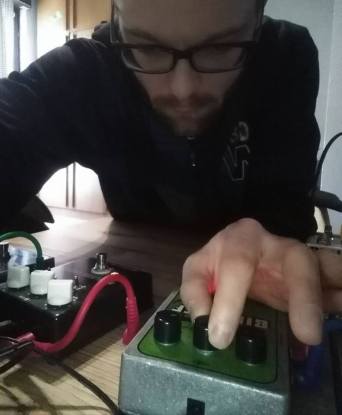
My final pick also hails from Serbia. Nemanja Nikolić releases most of his music as Dosis Letalis, and is arguably at or near the forefront of a fast-expanding outbreak of creativity in the wall noise genre. Nikolić’s walls are not made with the nihilistic philosophies that are commonly associated with this approach to noise; instead, he seeks to express emotion and a want for change. Confronting the Inhuman, released by Breaching Static in January, conjures a thick but calming atmosphere of soft, insectile sounds, while Hellscape HN’s The Culture of Fear crashes against the ears (and our society) with a cathartic blast of harsh frequencies. Nikolić’s productivity this year is impressive even for a HNW musician, with a roster that includes splits with Bug Catcher and Phyllomedusa as well as the arresting Smisao Života Je Sloboda and meditative Scales of Justice.
Review: Bingo Trappers – Elizabethan (Morc Tapes, Nov 26)
 With a frigid Midwestern winter fast approaching, the temperatures are dropping, the wind is picking up, and the sun is going into hiding. Needless to say, I need all the happy music I can get. Luckily, the new album from long-running pop outfit Bingo Trappers, Elizabethan, is exactly that. The Amsterdam band, despite being active since 1995 and having a style that’s undeniably indebted to 60’s sunshine pop, sounds as fresh as ever. The songs are deceptively simple, with complexities that only make themselves apparent after repeated listens. One of my favorite things about this record is how the drums fit in with everything else; the bass and guitars are thuddy enough that they’re percussive in their own right, and it took me a while to notice that “Signs of Comfort” doesn’t even have any drums until midway through. The frequent slide guitar adds a sense of motion and direction as well, though it’s more fluid than rhythmic, winding in and out of the other instruments with evolving melodies and smile-inducing solos. Waldemar Noë’s lyrics are unsurprisingly fantastic, drawing equally from the frank storytelling of country music and more abstract sources (according to the band’s website, the song “Don’t Steal My Line” is largely based on the 1966 film version of Who’s Afraid of Virginia Woolf). Coupled with the cheerful, whimsical arrangements, I can’t help but be reminded of The Deep Freeze Mice and their masterpiece Hang on Constance, Let Me Hear the News, which, I think, is one of the best compliments I’m able to bestow.
Review: Fergus Kelly – Trembling Embers (Room Temperature, Nov 25)
 Many musicians, especially in the area of experimental music, are indebted to or engage with visual art on some level, whether it gives them inspiration, provides a different creative outlet, augments their recordings or performances, etc. But a select few create beautiful pieces of visual art in the process of making music, intentionally or unintentionally. A personally significant example is the collection of tabletop setups utilized by improviser Keith Rowe, whose layouts of haphazard objects, modified guitars, and electronics seem to have an energy of their own, even separate from the music they help produce. Dublin-based artist Fergus Kelly takes things a step further with his complex arrangements of custom built instruments, arsenals of makeshift string instruments and transducers that are physical manifestations of the artist’s inner creativity. The full potential of Kelly’s inventions is explored on his new CD Trembling Embers, whose rhythmic title (this naming scheme continues to the track list, with names like “Vestige From the Wreckage” and “Spoiled Coinage”) foreshadows the agitated and unpredictable sounds found within. The first few tracks are largely unmanipulated improvisations, relying on tense clatter and metallic whirring to create a formidable atmosphere. As the album progresses, however, more elements are added; processing allows for the darkly immersive environments of “Plow a Flaw to the Far Shore,” and injected field recordings in “Paradox Lost” provide both a textural and thematic counterpoint. Though, obviously, listening to the CD doesn’t offer any insight into the visual aspect of what Kelly is doing, he masterfully communicates a profound concreteness, a tactility, that ensures even the most manipulated compositions on Trembling Embers feel up close and personal.

