
 Departure Crash has its fair share of abrasive, annihilating stagnant noise, but for the most part the five pieces that comprise this new CD from one of my favorite of Richard Ramirez’s literally countless aliases have such potent staying power because of how fully and comprehensively immobilizing their presence is. The harsh static of the first untitled track is expectedly loud and punishing right out of the gate, one soon becomes aware of a subtle but palpable reticence at its base (it may be easier to pick this out if you’ve previously heard Ramirez’s other wall-based projects, many of which do not share this quality), a meditative current that transforms the listening experience from appreciative cowering and grimacing to contemplative introspection. This structure continues throughout the contents of the disc despite the ensuing tracks’ sonic diversity; the second sluggishly materializes into and dissipates out of its soot cloud–like form, while the fourth rides an overblown but somehow nonintrusive rumble of distorted crunch. Personally I could do without the news samples that crop up in the final two sections, which greatly reduce the enjoyment factor of the fourth and infuriatingly delay the actual noise part of the fifth, but the approach taken in constructing these walls is unique and successful enough that I can mostly overlook those missteps. Ever wonder what that thick, uncomfortable silence following those graphic car crash videos you had to watch in secondary school would sound like run through a pedal chain? Now you know.
Category: Reviews
Review: Symbiotique – The Maximal Effect (Mother Brain, Apr 2)
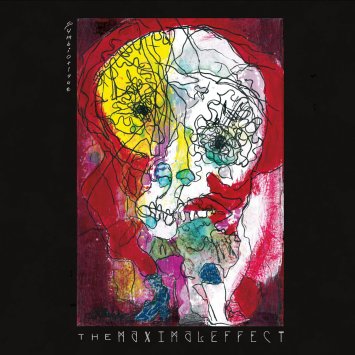 Much like an album with a similar approach I reviewed quite a while ago (Nathan Corder and Tom Weeks’s Anaconda), the pairing of instruments that characterizes Symbiotique seems like it shouldn’t work. By that I mean the idea of coupling extremely abstract, atonal electronic synthesis with largely conventional reed and brass playing doesn’t look very auspicious on paper, at least not to me, but The Maximal Effect immediately won me over regardless; not only does Seth Andrew Davis contribute lush layers of plasticky, artificial effervescence, but he also processes Michael Eaton’s saxophone and/or flute in real time, rendering even the most straightforward licks and runs in an unstable, fragmentary light. After the opening title track, each of the lengthy improvised pieces arise from some sort of conceptual inspiration—e.g., “Accumulation by Dispossession” from the ideas of David Harvey and Karl Marx, “Via Affirmativa” from Barth’s “A Few Words on Minimalism”—which may be why they never feel noodly or aimless. These are musical conversations first and foremost, and one imagines what a fascinating spectacle seeing the duo perform live would be, but in more holistic terms the swirls of sound always seem to flow from a single source, as if a mysterious pressurized gas canister has sprung a leak or someone lifted the lid of the devil’s toybox for a bit too long. The sprawling “Plastic Capitalism” is a great example of this and a clear standout on the album; the momentum of the interplay that mounts in the first half is exhilarating, and even when the pair calms things down the music quietly but stubbornly persists, seeping under the doorway with a creeping hiss.
Review: Raung Jagat Synthetic – Synthetic Vocabulary (Prakarsa, Mar 29)
 As terrifying as the prospect is, Synthetic Vocabulary may provide a glimpse into the bleak future that lurks beyond the stubborn development of increasingly sapient artificial intelligence. I’m not talking about the technological singularity itself, but rather the point a few centuries beyond that, when the dwindling human race are now used as forced labor, entertainment, and every other fucked-up way we abuse animals now while the bourgeois androids and disembodied operating systems sit atop sleek chrome thrones. Having evolved beyond the need for any sort of audible verbal communication, archaic “text-to-speech” programs are now mean-spirited novelties, used to spam unintelligible gibberish at their flesh-and-blood servants who lost all language long ago. But this auditory abuse ends up having an unintended effect. As abstract vocalist Rully Shabara is quoted as saying on the release page, language is “also capable as a medium of much more complex multi layered message such as expression and non-verbal intents [sic]”; what sounds like innocuous nonsense to the machines holds emotion and catharsis that only our brains can unlock. Alliterative semiotic deconstructions like “Max, Lisa” evoke the unutterables of lightning-fast thought processes and inner musings, almost entirely wordless pieces such as “Thena” resonate with a peculiar poignance, and the title track may just be the revolutionary anthem of the future—is there anything more powerfully human that plastic and fucking?
Review: Adam Bohman, Keisuke Matsui & Graham MacKeachan – Tommy Rot Trio (Hundred Years Gallery, Apr 1)
Tommy Rot Trio is kind of a terrible base phrase for an acrostic—and the album deserves much more of an in-depth analysis than this. But my head hurts and I’m kind of set on this idea now, so.
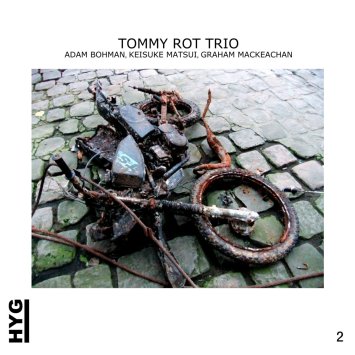 Tensile strands and strings pulled to breaking.
Obtuse in its whimsical yet restless skitter.
Metallic scrapes, squeaks, and shudders reign supreme.
Mazelike, winding, spacious.
You can almost hear the absences in between.
Rigidity made fluid.
Oscillating roles: strings, objects, electronics.
The tactile textures of tautness and tension.
Triangular configuration.
Rips, rattles, shakes, clatter.
Intimate despite its alienness.
Open and closed spaces.
Review: Phicus – Liquid (Tripticks Tapes, Mar 26)
 With Liquid, Spanish trio Phicus takes a significant step beyond their previous work toward something much greater. Recorded as a stylistic foil of sorts to the sessions that yielded last year’s fiery but ultimately edgeless Solid, the lengthy improvised takes that became “Hg” and “Br” (interestingly, both mercury and bromine are liquids at room temperature, but together, as HgBr2, they form a crystalline solid) are patient, considered, and meditative. A careful extended-technique delicacy in each member’s approach results in the band’s most spellbindingly atmospheric interactions yet: muscular double-bass lumbers are traded for hypnotizing legato and high-on-the-neck squeaking that bears an uncanny resemblance to some kind of brass instrument; shredding scales and dissonant chords have been dissolved into Surface of the Earth–esque amp rumble; and the skilled hands that once harnessed virtuosic percussion cacophony now deal in textural resonance and feedback-wracked Prévost bowings. The entirety of the nearly full-LP-length “Hg” swells with subtle but deliberate momentum, slowly asserting the true extent of its massiveness like an impossibly sluggish subway train emerging from a tunnel, brakes squealing and sparking, heavy metal hull groaning and grumbling, and it’s only once this train has departed that one can truly fathom what was in front of their eyes/ears to begin with. The more diminutive “Br,” which runs for just over 12% of the previous track’s duration, brings the tape to a fitting close with fragile, almost elegiac strings, strikes, and shrieks. For those who sorely miss trio-era AMM, Marginal Consort, or (more recently) Mural.
Review: E. Jason Gibbs – Wolves of Heaven (Orbit577, Mar 27)
 Though surely few predicted as much at the time (as Owen Maercks puts it, “if you had asked me 40 years ago… I would have laughed in your face”), the peerless legacy of Derek Bailey lives on piecemeal in those who find inspiration in his techniques. Sometimes this influence is nestled so deep within the essence of an artist’s music or playing style that it’s difficult to identify at first, and other times it’s so prominent that immediate comparison is inevitable. Guitarist and cellist E. Jason Gibbs’ new Wolves of Heaven CD is kind of both. His agile, gestural use of dissonant harmonics, string rattle, and atonal percussive strikes instantly evoke those of the late legend, but there’s something about Gibbs’ approach that evokes something a bit more homey and folkish. Both the track titles and the music itself imply a reverent earthiness; on cuts named “Raven and Coyote Celebrate Their Good Fortune” and “Wet Rocks and Roots” he’s situated within a clear and palpable organic environment, even though the presence of ambient noise mostly acts as more of an accompaniment than the other side of an improvisational interaction. When I said the Bailey connection was both obvious and subtle I meant that it took me much longer to realize why Wolves of Heaven resonates with me more than most abstract guitar material of similar character: with Gibbs’ breath, surroundings, and bodily movements all captured alongside the foregrounded picks and plucks, he harnesses the same exhilarating physicality that makes records like Music and Dance and Aida so memorable. For all of its primitivist sensibilities and grasps at some semblance of convention, Wolves of Heaven is an addictingly odd outing that demands full attention.
Review: Monte Penumbra – As Blades in the Firmament (End All Life Productions / Oration, Mar 26)
 “Firmament” is a loaded word; no matter how your particular use of it behaves it will invariably evoke Biblical themes. The lyrics for reclusive project Monte Penumbra’s newest album aren’t available online, but based on the sound—of both the words and the music—alone they certainly reach as high (or low) as this association implies. Apocalyptic growls and howls emerge from a bottomless chasm in opener “Black Mould on Rye Grass,” and some clever layering throughout this track and more sparingly in some of the others renders the vocals somewhere between the utterances of a single person and that of a group of individuals in shared misery, both intimate, solitary lament and the collective chorus of the crucified. The overall atmosphere of As Blades in the Firmament is a dense and oppressive one, but none of the instruments bleed into each other much, so there’s always at least a few layers to unpack rather than a homogeneous mass of noise—not that I’m ever opposed to that, of course. Such a production style was a great choice for these compositions, especially in complementing the guitar and drum interplay, whose interlocking parts often swap complexity or emphasis to create a constant sense of heavy, monumental shift within the music. There’s this constant uneasy truce between dissonant angularity and triumphant resolution in the riffs, but neither ever seems to win out, and thus the experience of listening to As Blades in the Firmament is equally uneasy. Dread and excitement aren’t meant to coexist like this.
Review: *sigh* – SCH0äDEL_book:~;03222021 (self-released, Mar 24)
 SCH0äDEL_book:~;03222021 is over in less than 28 seconds. It has almost that many songs, but the bite-sized cuts average just a second or two in duration, and some not even that. In a way somewhat similar to i.d’s fals.ch classic ,!_;_:!_7:+!_-+;,.!_g-7/;7_,.;y!_g;,/+Xg;+:yXgg,.- and Greathumour’s more recent Choose the Forceps, half the fun of listening to the newest release from this exasperated-exhale-inspired project is watching the Unicode-nightmare track titles whiz by at lightning speed as the microscopic shot of sound trapped within each tears from its prison for just a few ecstatic milliseconds. Don’t try to stream this one from the Bandcamp web player; true gapless playback is absolutely essential for that dizzying channel-surf effect to fully come across. Snatches of conversations too brief to be in any way intelligible, sprightly video-arcade vignettes, impatient experiments, and chunks of distorted debris are just a few of the countless components that comprise this multifarious collage of addictive, flashy impermanence. The perfect soundtrack for the exponential deterioration of my musical attention span.
Review: Yan Jun & Noel Meek – Mirror One (God in the Music / Zoomin’ Night, Mar 15)
 (I’m not sure what the official release date of this is; I’ve seen the 15th, 24th, and 26th in various places.)
Yan Jun describes Mirror One as “like meteorolites hiting the earth. they are buring in the atmosphere, hiting on ground, smoking, but nobody was hurt. we sitting and watching it from afar. drinking bear, crunching chips through all afternoon. at the end we clapped as well [sic].” The Beijing musician is well known for his practice of artful nonparticipation, often leaving his mysterious electronics systems to do the work on their own while he fixes a cup of tea or “crunches chips,” and one might expect this tape to be no different, especially in conjunction with the artist’s own words on the matter. But even though the two halves of this duo were polarized in separate hemispheres and unexposed to the other’s contributions for the entirety of their collaboration, Yan and Meek’s improvisations are not just active on their own, but actively converse with one another. The Auckland-based Meek, credited with “stone, metal, [and] wood,” is elbows deep in a trunk full of abstract woodland oddities at all times; whether he’s whirling resonant drones from singing bowls and resonant sheets or making a mortar-and-pestle mash of twigs and gravel, his musical gestures are steeped in earthy tactility and wide-eyed exploration, serving as an excellent counterpoint for the raw purity of Yan’s humming, screeching feedback. The pair is at their best, I think, when they’re relegated to completely opposite ends of the texture-spectrum, like in the earlier moments of “M81” when the electronics are stripped to an unstable, anemic whine against percussive clunks like woodpecker pecks recorded from inside the tree. Meek also does some hard-to-define but definitely mesmerizing work with breath on the opening track; I would love to see video footage of the musicians recording their tracks in addition to the layered tracks themselves.
Review: Human Heads – In the Afternoon (Fractal Meat Cuts, Mar 20)
 In the Afternoon is one of those rare releases that I have to really talk myself into actually writing about because they seem to reside beyond what even the most well-arranged and curated words can convey, and certainly beyond what mine can. But in terms of Human Heads’ specific brand of slipperiness, this tape, unlike past documents on Singing Knives (The Beauticinist) and tanzprocesz (Triggers), gives me a useful foothold: I’m kind of in love with it. I’ve never fully glommed onto the strangely synthetic dissection of pop music and poetry that longtime crackerjack collaborators Ben Knight and Hannah Ellul delicately arrange for this duo project (though I was and am all about the various ventures related to their Psykick Dance Hall imprint, especially the now-defunct avant-garde musicology publication Dancehall), but In the Afternoon grabbed hold of my ears—gently, but with thin, frigid fingers made of silicone and metal—and yanked my head to the proper angle for the full Gestalt switch. I don’t know if I’ve ever heard something so surreal and whimsical yet so bleak. Little is left unturned by the artists’ assimilating gazes, Knight reading off scrawled bathroom-door manifestos and mundane journal entries and memories at a stumbling tiptoe while Ellul loudly does the dishes or sweeps her microphone right up next to a bird’s nest or halfhearted pop culture conversation; especially with the unmistakable style of formant shifting used in “FDfsdfas” one can’t help but think of GLaDOS’s cold blue eye raking over facsimiles of domesticity and civilization in general. Yes, there’s a disconcertingly scientific atmosphere at work here, and that’s part of what makes In the Afternoon so unforgettable. No one else could use a default iPhone alarm tone as a motif and get away with it.
 Noise Not Music