
 Though Berlin sound artist Manuel Klotz doesn’t list field recordings among the materials used to create Hoax, opening track “Düne” begins with a seething draft that resembles an ominous wind blowing by. It turns out this is well-aligned with what was in mind for the release; Klotz describes it as “hauntological derive trough [I assume ‘drive through’] the Schönower Heide, a nature reserve nearby Berlin, made by havoc and devastation,” a central concept that drives a great deal of the dark, skulking energy that plagues this cassette. “Düne” floats and builds itself upon that simulated wind, with more artificial electronic textures steadily creeping in to fill out the shadows, but Klotz doesn’t place the dynamic movement of his composition at the mercy of organic growth: sudden stretches of caustic circuit-bending squall (I’m not sure if it is actually circuit bending, but it certainly has that feel to it) intermittently shatter any uneasy tranquility that managed to seep in while your guard was down, the added volume and immediately veering the trajectory of the piece into apocalyptic industrial wastelands. However, this may all just be a crescendo to the following track, appropriately titled “Havoc,” which kicks into gear right off the bat with an unrelenting assault of gushing razor-sharp distortion, and like Pedestrian Deposit it only hits harder against the relative serenity of what precedes it. Pulling off a combination of both ambient, atmospheric sound design and scorching harsh noise is not easy to do; you have to earn it, and that’s exactly what Klotz does, which is why the blast of scientific power electronics mayhem works so damn well. The title and concluding track is the smoking aftermath of the destruction, seething and growling and simmering just under the surface of all-out chaos.
Category: Reviews
Brief summaries intended to describe and express my enjoyment of albums. My opinions are not the focus: I purely seek to facilitate discovery.
Review: Network Glass – Twitch (Salon, Aug 3)
 I have to begin this review by stating that I can’t even remember the last time I laughed this hard at a piece of “music.” Twitch had me in tears for much of its duration, especially during the opening track “5.52,” and as someone who has spent much of their young life in or within the immediate proximity of gamers and gamer culture, this may be the most definitive “post-internet” release I’ve ever come across (eat your heart out, entire discography of James Ferraro). With his long-running Network Glass project, the Baltimore artist Door has been consistently pushing the boundaries of what can really be called “music” to the extreme (and you know if even I am asking that question, things have gotten pretty off the rails), but Twitch is his most extreme “anti-” release yet, culling almost the entirety of its sound from both in-game and voice channel audio in various familiar titles—(in order) Apex Legends, Minecraft, Fortnite, Grand Theft Auto 5. Anyone who has ever played any multiplayer game online will recognize these painfully familiar sounds, from the infuriating lag and ill-timed “gamers only” jokes that fail to land to the incessant view count/subscriber bragging and endless excuses for poor performance. Network Glass splices these chat extracts in a totally disjointed yet seamless cut-up style, where conversations seem as though they’re being had yet no one’s statements acknowledge or interact with each other (although I suppose that’s a totally plausible dynamic in a normal lobby). It’s essentially an extension of what was attempted on tired / stupid, but it definitely works a lot better here. Also present is the hyperactive sound design and bits of digital junk typical of the project, which trade space with well-mixed samples from the games themselves. I’ve always thought Minecraft would be an excellent platform for in-engine improvisation in the style of Animal Crossing quartet Lil’ Jürg Frey, and the second track on this is the closest I’ve found to such an experiment, as the familiar sounds of walking over grass or opening a chest fill the stereo field. Twitch is a blast, and overall I can say it is not only the most hilarious, but also the most utterly bizarre music I’ve heard in a very long time. Which is really, really saying something.
Review: UVC – Wisdom from the Zoo (Hologram, Aug 2)
 The Miami-based Hologram label (operated by Noise Not Music favorite Chris Donaldson) has quickly become a new favorite, starting with my on-a-whim purchase of The Glass Path’s Recurring Faces Through the Spiral of Time LP, which turned out to be a very good decision. Though the pre-2019 catalog exhibits an eclectic diversity in styles and approaches, many of the recent releases have gravitated toward a more total aesthetic, with a great deal of material in the area of “pure experimental” from old and new artists alike—e.g. Comfort Link and Church Shuttle vs. Richard Vergez and Vision Board. UVC’s newest effort, Wisdom from the Zoo, is yet another example in this easily classifiable yet always elusive tradition, mining unusual emotional significance from the most mundane of sounds, from dry drags and stuffy clutter reminiscent of fellow Hologram three-letter initialism artist TVE to the alien familiarity of chopped-up text-to-speech. This is truly liminal music, seemingly gouged from the darkest, most distant corners and crevices of something much less unusual; yet this only makes its detritus even more baffling when it is gathered up and combined into something new. Things always seem to be happening of their own accord: mysterious sound events with countless moving parts whose actions are just simple enough to be accidental, hum and sonic discharge from devices mistakenly left on, remnants of humanity occasionally snaking in as whatever individuals are present steer well clear of this dark den of ambiguity.
Review: Taw – Truce Terms (Bezirk Tapes, Jul 31)
 I knew I was going to love Truce Terms as soon as I read the phrase “Fisher Price musique concrete [sic]” in the description. Toy instruments and simply children’s toys in general are a class of sound objects I believe to be underutilized in abstract experimental music; artists like Frank Pahl, Klimperei, and others frequently use them, but the end result is something more resembling folk or musette rather than a formless, texture-focused creation. Taw, the newly formed duo of Welsh musicians Owen Martell and Simon Proffitt (the two also play together as The Master Musicians of Dyffryn Moor, and I was aware of Proffitt’s work via his field recording collections released under the alias Cahn Ingold Prelog) demonstrates just how incredible and inspired music produced with this unusual approach can be. The five tracks that comprise Truce Terms were hewn from an hour-long recording session that is said to be the first time Martell and Proffitt improvised with the pile of toys they collected, and if that is actually the case then I am beyond impressed, because each piece feels fully-realized, well-paced, and packed with endless curiosities to dig into. The term “discrete cacophonies” is another extremely apt descriptor provided on the Bandcamp page, as tracks like “Offground” dive deep into a overstuffed toolbox of unidentified shakers, scrapers, and clackers that spread their deliciously lush micro-textures across a sound-space of uncertain size, while “Cymod” (pronounced KUH-mod; welcome to Welsh baby) unfolds at a slow, ambling pace, as if the contents of an old toy chest have been lovingly poured onto an agitated surface. Even disregarding the novelty factor, Truce Terms is a masterful example of improvised music in general (there are definitely echoes of stuff like Portland Bike Ensemble, Seeded Plain, or even Iskra); the amazing creative approach and aesthetic are just lucrative bonuses.
Review: Manure Movers of of America – Cut the Shit (Already Dead, Jul 31)
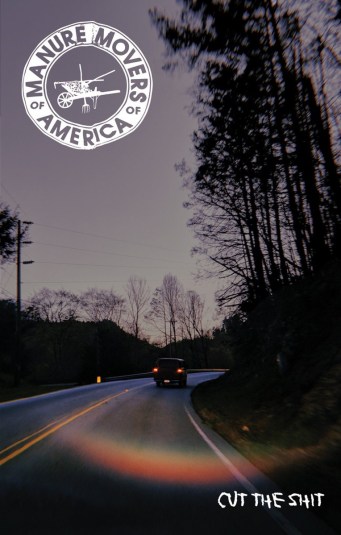 Manure Movers of of America (yes, that’s correct, there are really two of’s) was one of those bands that you immediately really like but can’t explicitly put your finger on why. After receiving their Already Dead debut Cassette Tape #2 as a surprise addition to my preorder of DC_33.33’s Vela Abridge, I instantly fell in love with their unique brand of stuffy clouds of psychedelic noise and distorted loops. There’s not a ton to the music, per se; it’s all about the atmosphere, the strange presence its dirty gossamer form adopts, the hazy, confusing headspace of ambiguity, tension, and warmth all rolled into one almost homogeneous blob. Less than a year later, the mysterious Montana project continue their fascination with excrement on Cut the Shit, which features memorably named cuts like the title track along with “Don’t Think Twice, It’s All Shit.” Along with my recent re-listen of Tape #2, the Movers have fittingly provided a lovely soundtrack to my lazy, piecemeal move-in process, giving name to the nameless comforts and curiosities that lurk in lethargy—”Gift Horse” amplifies the imperceptible, neutral energy that hides in an unfurnished new living room, “Hardly Workin'” blends seamlessly with the queasy mundanity of a rainy afternoon outside my windows, “Cut the Shit” threatens the arrival of an ominous darkness. Bedtime already?
Review: Emanuele Fais – Haikustica (Aural Tempel, Jul 24)
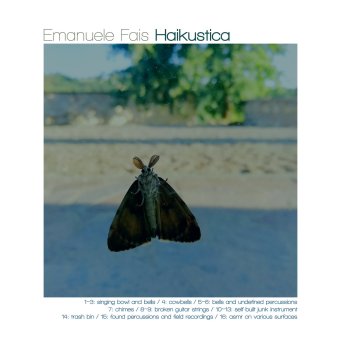 There are always things both lost and gained when one favors transparency in naming tracks. Artists like Toshiya Tsunoda and Taku Unami (as is apparent from the titles of the pieces that comprise their Wovenland series on Erstwhile) believe that a sound being identified is what provides and ensures its significance, while many others (including myself) would disagree. I’d instead argue that identification guarantees a particular kind of significance, one that emphasizes the sonic character of the sound itself rather than its overall presentation or aesthetic. This is ostensibly acknowledged in the case of Emanuele Fais’s new release Haikustica, self-described as “raw recordings, no editing, no effects, no structures. Just pure sounds.” This purity is partly achieved via the track titles, which reveal exactly what is being used in each of the improvisations (“Singing bowl and bells,” “Broken guitar strings,” “Trash bin,” etc.), but also through the crystal-clear quality of the recordings, which contain little to no intrusions from the surrounding environment/location—with the exception of “Found percussions and field recordings.” Thus, the objects, devices, and other materials that Fais uses are not situated in a preexisting space, but rather they create the space. This is especially apparent on the “Self-built junk instrument” tetralogy of tracks, whose audio-physical dimensions expand and contract along with the intensity and volume of Fais’s performance. Haikustica is an excellent release for those who enjoy both junk/clutter improvisation (a la A Realistic Morning Prayer or Discordant Seeds) and the crystalline sublimity of Max Eastley’s installation work.
Review: Hair Clinic – Early Music (self-released, Jul 22)
 Since March, when I first encountered Max Nordile’s Hair Clinic project and reviewed its inaugural release Mirror in a Bag, the Oakland-based multimedia artist has churned out seven more albums of varying sizes, including the full-length “Jim’s Place” tape on the always-excellent Regional Bears label. Since the archetypal “non-music” improvisations of its debut, Hair Clinic has evolved to encompass a much wider variety of subversive sonic practice. In his interview with Thomas DeAngelo for Mutually Assured Marginality, Regional Bears head Louis Golding described the character of the project as both “careless” and “nicely done,” a “fun kind of no technique field recordings… harvested field recordings.” Such a summation is especially applicable to recent documents such as Early Music, which encompasses a multitude of aspects of the mundane everyday such as snatches of radio broadcasts, distant traffic, conversations, gusts of wind, and other less identifiable elements. I’ve written about the way in which a distortion or obscuration of intentionality is an important aspect of non-music, something that reaches a punk-rock zenith in the case of Nordile’s single-microphone “lens,” which treats semblances of musicality, accidents, annoyances, and even acknowledgements of the presence of a recording device with equal attention. The line between the artist’s eponymous releases and his work as Hair Clinic increasingly blurs as this aggressively democratic approach becomes more established and the separations between his musical and anti-musical predilections steadily dissipate.
Review: The Tongue Is an Eye – Extravios (self-released, Jul 21)
 An album’s cover is frequently a reliable indicator of how harrowing of an experience the music contained within will be. This is certainly true for Extravios, the first release by the duo of Christian Moser and Paula Sanchez under the name The Tongue Is an Eye, whose artwork is not overtly disturbing yet barely belies a dark uneasiness (my theory is that the covering of the eyes of a human face, while the mouth remains visible, triggers a response of revulsion consistent with the Uncanny Valley phenomenon). The three improvisations that comprise the album are restless hodgepodges of tensile agitation, percussive clatter, and nocturnal claustrophobia, with both Moser and Sanchez contributing conventional instruments abused with extended techniques (oud and cello, respectively) as well as objects and found ephemera. Sanchez also makes use of abstract vocalization on “Fibra 2,” the longest and most diverse of the three, her stuttering inhales and strangled utterances colliding with equally unpredictable shards of unidentifiable rattle and pained string emissions. The second half of this piece gravitates toward the enrapturing interplay between the oud and cello, the recordings sounding as if they were captured with microphones less than centimeters away from the necks as sliding fingers and atonal attacks snake directly into the eardrums. This could either be a document of the duo’s first meeting or the culmination of many rehearsal sessions; the two musicians have mastered an approach to interaction that somehow sounds both tentative and seasoned. I certainly look forward to hearing more of their wonderfully bizarre and confrontational creations.
Review: Don Malfon, Juan Castañon, Itzam Cano & Chacal del Tamborazo – For Ornette (self-released, Jul 20)
 Even as someone who prefers Ornette Coleman’s more structured 70’s work (Science Fiction, Dancing in Your Head, Body Meta), it is utterly impossible not to acknowledge his invaluable contributions to the free jazz tradition, which he essentially both created and named with his revolutionary group improvisations in the late 50’s and the prophetic 1961 LP Free Jazz. Though the genre has undoubtedly come quite a long way since then—Coleman’s approach seems rather tame even in comparison to albums released less than a decade later—every musician playing adventurous, formless jazz music is well aware of his name, legacy, and power. On For Ornette, the quartet of Don Malfon (alto sax), Juan Castañon (guitar), Itzam Cano (upright bass), and Chacal del Tamborazo (drum set) imbue their deep reverence for the late visionary with both a titular and conceptual significance, channeling his influence through performances of his compositions as well as original conjurations. The band displays a seamlessly dichotomous interest in abstract dissonance and harmonic interplay, fluidly trading moments of full-throttle chaos for driving solo exchange sections and lightning-fast call and response. Castañon’s use of a clean tone with occasional wah pedal wobble is the perfect choice for a collective style both abrasive and whimsical; his off-kilter backing shells and serpentine scalar runs are only made more agile by their clarity. The album ends with a stunning re-imagining of “The Sphinx” from Something Else!!!!, a fitting dual-dose of melody and mayhem.
Review: Druuna Jaguar – Memória Aumentada (Robert & Leopold, Jul 20)
 There’s an important distinction to be made between “spooky” music and “scary” music. The former is the fun, festive tunes you hear come Halloween season each year—BOR-ING. Druuna Jaguar’s newest release Memória Aumentada is an example of the latter, the sort of music that deeply unsettles, sends inexplicable chills down the spine, evokes horrible isolation, fear, and existential despair. Unlike other notable instances of this (Penderecki’s “Threnody for the Victims of Hiroshima,” Dolden’s “Below the Walls of Jericho,” etc.), Memória Aumentada is much more reserved, forgoing harrowing blasts of overwhelming discordance and hair-raising dissonance for creeping drones and cloying aquatic textures conjured entirely from manipulated field recordings. It is certainly a “dramatic pivot from visceral noise as a focal point” as stated in the description, but the extent to which the music stirs the deepest, unnamed emotions is not at all compromised. One feels intensely disconcerted by the contrast between ethereality and the uncomfortable closeness of the water recordings, the latter of which are almost presented as invasive violations. The final moments of “Musée Des Yeux Clos” produce intense dread via a tense drone that eventually dissolves into a confusing cacophony of delay-effect feedback and eviscerated human speech. The piece ends, however, with yet another appearance of dripping, sloshing liquid, further cementing its role as a successful counterpoint element. “Tillandsia” seems to tap into the subterranean underbelly of the Earth, summoning a bassy, barely perceptible seismic rumble, later complemented by the light, flitting textures of a field recording played backwards. If you’re looking to feel like whatever is happening on the album cover, like your soul has been ruthlessly dissolved and escapes your body through your face in horrific tendrils… fulfillment definitely awaits.
 Noise Not Music