
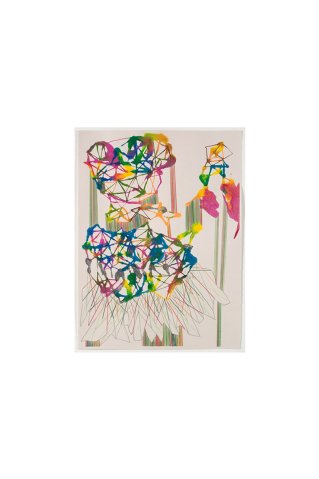
 Silence is a thing often associated with Steve Roden. The California-based sound artist is most famous (and infamous) for his pioneering of lowercase music, along with the composers associated with the Wandelweiser group. His early works are mainly concerned with amplifying extremely quiet sounds, creating a unique feeling of hollowness in his music, or, as I like to call it, ‘audible silence.’ That being said, there’s not much silence on Red Lath Work Paths Criss-Cross the Garden, a tape released nearly twenty years after such genre-defining works as Crop Circles or Four Possible Landscapes. Instead, the C60 shares more qualities with Stars of Ice, perhaps my favorite of Roden’s albums. Apart from the spaces in between segments (the two side-long tracks are split up into short vignettes), there’s hardly a quiet moment; instead, Roden paints vivid soundscapes as vibrant and colorful as the artwork on the cover, conveying a peaceful, organic atmosphere with a wide variety of sounds. I find it difficult to get the title of the album out of my head when listening, because the small compositions’ airy drifts and calming harmonies really do evoke the image of a garden. Even the more synthetic, electronic sources used feel just as natural as the nature recordings and objects. The way they waltz woozily together is what gives Red Lath Work Paths its pleasant charm, a quality best heard at the end of “Cut Up Twice and With Orange Stars,” which swirls up a mixture of chirping crickets, electric buzzing, washing synth melodies, and soft waves of delay feedback to ease you into a warm, deep sleep. But you should probably wake up at some point to listen to side B, because—surprise!—it’s just as good.
Category: Reviews
Brief summaries intended to describe and express my enjoyment of albums. My opinions are not the focus: I purely seek to facilitate discovery.
Review: Morso – Lo Zen E L’Arte Del Rigetto (Dischi Bervisti, Jan 18)
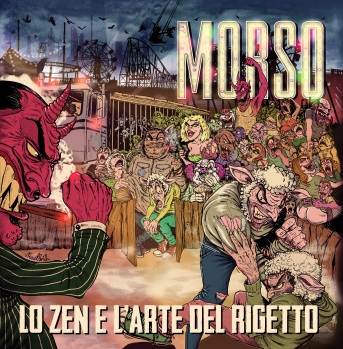 The first time I listened to Lo Zen E L’Arte Del Rigetto, my only consistent thought throughout the eleven songs was what the fuck—in a good way. A very good way. Apart from the insane and overwhelming cover, I didn’t really know what to expect, but it turns out that insane and overwhelming are fitting descriptors for the record as well. As far as I can tell, it’s the debut release by Italian quartet Morso, who combine breakneck thrash gallops and angular breakdowns with eclectic interjections of sensual pop rock. The entire thing is a constant whiplash of on-a-dime changes in mood, tempo, and style, bolstered along by the powerful, versatile vocals of member Guido. His delivery ranges from ragged, barely discernible shouts to masterfully tonal pop croons, and you don’t need to understand Italian to absorb the passion that’s been stuffed into this music. With such a profuse album as this, I’m not surprised that I found myself latching onto this single element on my first time through; but upon (many) further listens it’s clear that each member of the band fills a very specific role in the carefully composed maelstrom. Matteo’s snare fills and crushing down beat pounds on “CMC,” the dizzingly technical interlocking bass and guitar work on “Non Si Muore Ogni Dicembre,” and—oh my GOD—the flawless bonding of two completely disparate styles on “Il Fine Giustifica I Mezzi”… yeah. This is good stuff.
Review: Concrete Colored Paint / Tap Water Split (Lighten Up Sounds, Jan 19)
 On his side of this new split tape from Lighten Up, Peter Kris of German Army glues together chunks of heavily processed field recordings taken while on a trip through Portugal. “Lost River” is much more subdued than any of the industrial or minimal synth heavy releases Kris has put out as German Army. With Concrete Colored Paint, rhythm is abandoned, and the sounds settle into a lethargic flow of decay, hiss, and murk. Some of the elements are more recognizable than others, such as the slightly slowed bird calls near the end of the piece, a quality that places “Lost River” somewhere in a sonic uncanny valley. It’s equally haunting and comforting, conjuring up familiar scenes of cavernous, echoing museum halls and mist-drenched city streets. This rich atmosphere isn’t exactly shared by Tap Water’s contribution to the split; where “Lost River” is aquatic and stuffy, the duo’s untitled track is dry and unpredictable. The two sound-plunderers bounce whimsical modular blips off of distortion and playback manipulation, almost completely abandoning the flooded organics of “Lost River.” That is, until around two thirds of the way through, when a stack of spectral, effects-laden tape loops swirl into the fray, bringing the track to a close not unlike the A side. It’d be easy to say that the two sides of the tape don’t share much common ground about thirty minutes in, but as a whole, they stand quite well together.
Review: Giovanni Lami & Glauco Salvo – Ife (Dinzu Artefacts, Jan 15)
 There are a lot of words I could use to describe the patient, reserved tape music of Ife, a collaboration between Italian artists Giovanni Lami and Glauco Salvo. One that immediately comes to mind is ‘simmering;’ especially with the track that occupies the entirety of the A side, there is a tense, quiet energy that seems to always be on the edge of boiling over. The loudest, most intrusive elements of the track are the clear electronic pulses that occasionally emerge, and even then they are neither loud nor intrusive on their own. These thin, fragile drones are a sound I’ve come to heavily associate with Lami’s work, but here they are tempered and thickened by Salvo’s tape playback and water recordings, and the resulting music is more dense than, say, In Chiaro / In Guardia from last year. But Salvo’s contributions don’t really inject a sense of naturality or invoke a real-life location; instead, they push the shifting mixtures of sounds into a unique physical environment of textures. Even on the sparser beginning of side B, Lami’s soft reel to reel manipulations are forced to occupy a very different role than they would on their own, with the looping bleeps and fractured rhythms again creating a defined structure, this time a hollow framework that seems to softly tumble along. While I was unfamiliar with Salvo’s work prior to Ife, the tape is certainly the most impressive collaborative outing I’ve heard from Lami, and yields much more than its relatively short length would imply.
Review: Offworldcolonies – Iconoclast (Offworldcolonies Ltd., Dec 19)
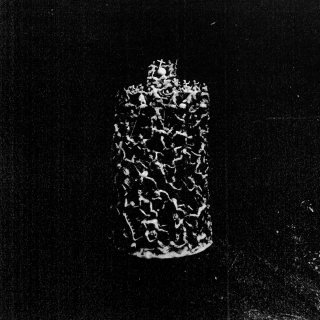 The best industrial techno doesn’t just crush you with oppressive repetition and hard-hitting mechanical rhythms; it has teeth, bite, sharp edges that introduce tension and provide much-needed contrast. Iconoclast is oppressive and hard-hitting, sure, a fact apparent from the very first moments of opening track “Leviathan.” It’s the longest track on this newest LP from Swedish techno project Offworldcolonies, and evolves through its eight minute run time with rolling, kinetic percussion loops and some less confrontational elements that are gradually pulled out and developed. The title is perfect for the song; like most of the tracks on Iconoclast, “Leviathan” conceals a hulking energy beneath its minimal structure that is teased out through subtle escalation. It’s a format that’s expanded upon throughout the remaining tracks, albeit in more compact time frames. Higher-register elements like the checkout scanner-esque beeps of “Ravening” or the piercing pulses of “Execration” add more than just teeth; they also serve as a counterpoint for the dark, brooding rhythms, introducing a quite unexpected level of color to the mix. “Rend,” however, is a hypnotic, punishing closer, bringing the album to a close with the same sort of ultra-strength beat contortions that began it. An excellent release from Offworldcolonies on the label of the same name, and one not to be missed.
Review: TARAB – HOUSEKEEPING (self-released, Dec 27)
 Over the course of avant-garde music history, the ‘symphony of objects’ has always been a mainstay in unconventional sound sourcing and composition, bolstered along by such landmark works and recordings as Luigi Russolo’s 1913 manifesto The Art of Noise, Group Ongaku’s domestic improvisations on the archival release Music of Group Ongaku, and Michael Siegel’s Sounds of the Junk Yard recordings for the Smithsonian Folkways label. The use of items we see and use every day to create new, separate, even alien sonic constructions is an often rewarding paradox, as demonstrated by TARAB’s HOUSEKEEPING, an album in two parts derived from a multimedia installation presented in 2017. “Rather than a documentation of an installation, this iteration has been arranged from the debris collected during the process of making one.” HOUSEKEEPING is an agile, dynamic work, embracing the potential of the smaller sounds we often take for granted. Part I begins with breezes of tumbling impacts, the high level of processing still retaining each individual object’s weight and motion. Later in the piece, it progresses into less manipulated recordings of what is presumably the performance of the original installation, which is phased in and out with cut-up style clatters of pans and utensils, an interesting and disarming contrast that still maintains the energy of the items chosen. Part II resides in a much more spectral atmosphere; we are kept in the shadows, listening from a distance or from another room as clunks and clanks reverberate through the heavy air.
Review: Anthony Osborne – The Language of the Birds (MuteAnt Sounds, Jan 15)
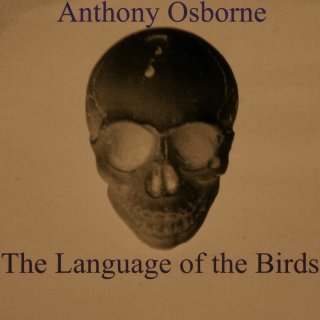 If this is the language of birds, I really do not want to know what those evil little fuckers are talking about.
The Language of the Birds is the newest album from London-based saxophonist Anthony Osborne, best known to me for his James Joyce inspired works such as Wakeschrift and Ofter the Fall, and sees the composer and improviser expanding his unique language of industrial-strength horn skronk, heavy electronics, and oppressive atmosphere. Despite the album’s relatively nondescript cover art, there’s a whole hell of a lot going on here; the tracks ebb and flow with all the easygoing naturality of well-composed electroacoustic pieces, but noise still bursts through the murk when Osborne attacks his saxophone, often completely without warning. The electronic elements harmonize with the furious flurries at some points, and are at odds with them at others. Both sometimes occur on the same track, as is the case with “But Ronald, Why Are You Laughing?,” which nearly collapses at the forceful entry of a particularly grating burst of sax, but the elements soon assimilate and flow to an organic conclusion. The Language of the Birds makes amazing use of a very unique sonic palette, at once harsh and calming, fractured and undeniably complete.
Review: Vasoconstriction – Occupation (self-released, Jan 13)
 The opening track to Vasoconstriction’s new Occupation EP, “Dixie Cups,” deserves recognition purely for how much of a bait and switch it is. Up until around the one minute mark, I wasn’t even close to sold. Grind is a genre that’s unfortunately dominated by cliches, and the opening with a misanthropic spoken word sample into a tremolo guitar intro is definitely one of them. But the New Jersey three piece throws expectations into the incinerator with the furious d-beat riff that kicks in halfway through the track, immediately putting the immense energy and aggression they bring to the table on display. That penchant for sudden, unexpected changes in dynamics crops up many other times throughout Occupation, from the free chords that disrupt the palm-muted chugging on “Springer” (and the three-second blast outro on the same track) to the unapologetic crashing-through of “Brittle Bodies,” possibly the EP’s fastest and most unrelenting cut. Occupation is a refreshing and passionate studio debut from Vasoconstriction, with as much speed and screams as a kid could ask for.
Review: Endless Chasm & Dosis Letalis – Channeling Fire (Big Pharma, Jan 5)
 The dynamic movement of “Inner Fire,” the first of the two tracks on Channeling Fire, reminds me of the Shepard tone, a combination of sine waves of varying octaves that creates the illusion of perpetual tonal ascent despite the wave never actually changing. The wall is an impeccably crafted slab of crunching noise, droning electronics, and other more subtle sounds that always seem to building toward some impressive climax. But other than the crescendo at the beginning of the piece, nothing ever changes, and this seemingly paradoxical coexistence of motion and stagnancy is what makes Channeling Fire so enthralling. “Inner Fire,” despite being backed by a considerable amount of energy, is the smoldering embers that lights the inferno of “Inner Void.” The initial blast of this second piece is so punishingly cathartic, cleansing all extraneous thoughts and forcing you to focus on its monolithic construction, which reveals itself to be just as, if not more, lush and detailed as “Inner Fire.” Pretty much everything about Channeling Fire is amazing, but on my first few listens, it was the structure that stood out to me. These two pieces and the way they’re constructed could not be a better fit.
Review: Howard Stelzer & Brendan Murray – Commuter (Humanhood Recordings, Jan 3)
 The past two nights have brought the most lasting snow my city has seen so far this season, and waking up in the morning to my neighborhood blanketed in drifts of sparkling white is quite a calming experience. But there’s also a mysterious energy that pervades these winter landscapes, especially when it’s quiet outside, and the only sounds are the distant hum of cars slipping and sliding on the roads and your boots crunching on the sidewalk. Commuter is the perfect soundtrack for that lonely, frigid walk on a frozen road, all of the cars draped in fluffy white sweaters. The tape is the second official collaborative release from electronic musicians Howard Stelzer and Brendan Murray, the first being 2017’s Connector on the Helen Scarsdale Agency. The two artists paint brittle, suspenseful soundscapes using a mixture of ethereal drones and more concrete electronic sounds and recordings, the latter being the glue that holds even the 27-minute closer “Let the Children Guard What the Sires Have Won” together. Lethargic clouds of fuzz breathe in and out of “Molina,” a track that fits just right somewhere in between lackadaisical and driven and might just be the centerpiece of the tape. Commuter offers a lot regardless of how much attention and patience you pay it; inattentive background listening is rewarded almost as much as actively picking apart the countless layers carefully laid to create these compositions.
 Noise Not Music