
 The beauty of the avant-garde is that it both constantly evolves and remains the same; contexts, attitudes, and technologies are always changing, and yet the same core tenets—subvert, defy, experiment, express—will always be embodied by anyone who has or will ever fuck around with pedals or delve into extended techniques or record the rain outside their window. I mention this fairly apparent truth because one of the first things that came to mind when I heard the skittering tactility of Canyon (Los Angeles) was Yeast Culture’s IYS, an obscure but beloved record that came out more than thirty years ago. Both reside in a space that feels both dissected and organic, claustrophobic and expansive, all scrapes and rustles and pitter-patters that soothe the brain. But despite a shared lineage in focus and texture (and a passion for the foliage of the West Coast), R. Pierre’s latest document of “absolute music” is very much a fresh entry in a decidedly new canon of field recordings–based, stasis-inclined sound art exemplified by the work of the Modern Concern roster, Tsunoda/Unami, Abby Lee Tee, Norman W Long, and others. It is as confounding as it is relaxing—the thin, hissing constrictions of part two especially are almost unnerving at first—and perfect for a quiet moment here, there, or everywhere.
Review: Aya Metwalli & Calamita – Al Saher (Zehra, May 19)
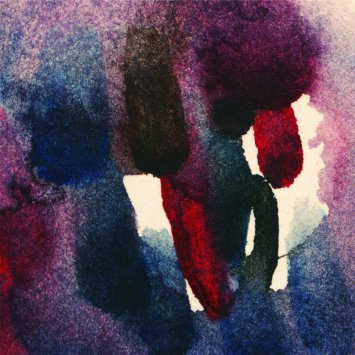 An unlikely yet inspired pairing if there ever was one, Cairo’s Aya Metwalli and Beirut’s Calamita (Tony Elieh, Sharif Sehnaoui, Davide Zolli) have created something truly unique with Al Saher. The latter is totally new to me, but Metwalli I’ve been following since I discovered her 2016 EP Beitak. She’s branched out into wildly new stylistic territory since then, experimenting with loops, uncanny effects, and a longform electronics-based approach to her solo sets that almost feels like death industrial at times (check this performance at MozBox), all of which sow the seeds for a fruitful collaboration with the Lebanese improv-rock trio. “Hazihi Laylati” begins with ringing Branca-esque strums wracked with microtonal tension, but by the halfway point there’s already been a generous freeform-freakout, a seamless slither into a killer groove, and a vocal re-entrance that couldn’t be more perfectly timed. Calamita sounds the most locked-in they’ve ever been, executing countless sudden rhythmic and/or tonal shifts with a precision that almost seems to contradict the confident looseness of their playing. The whole thing is pretty dark, especially the title track with its brooding ambience and bleak autotune deadpan, but the record’s tarab roots (Egyptian icon Oum Kalthoum’s songs were used as starting points) are still evident in its playful, total freedom of movement. The first time I listened I was busy and let a lot of it fade into the background—don’t make the same mistake! Al Saher demands, and rewards, rapt attention.
Mix: Drumless Duos
A special kind of improvisational intimacy, one that often generates the most “jazzy”-sounding jazz. These selections lean recent—which is not indicative of any actual historical trend but rather the massive gaps in my knowledge/taste—and free.

Julius Hemphill & Abdul Wadud (photos from Live in New York LP and Michael Wilderman)
00:00. Spoons & Bones – “All the Ears” from Spoons & Bones (Czaszka, 2020)
02:19. Ramsey Ameen & Sirone (of Cecil Taylor Unit) – duet from One Too Many Salty Swift and Not Goodbye (Hat Hut, 1980)
08:14. Julius Hemphill & Abdul K. Wadud – “In Space” from Live in New York (Red, 1978)
14:59. Frode Gjerstad & Isach Skeidsvoll – “Third hand. Fourth finger.” from Twenty Fingers (Relative Pitch, 2021)
20:28. Jessica Ackerley & Daniel Carter – “Welcome Our Friends” from Friendship: Lucid Shared Dreams and Time Travel (577, 2022)
25:47. Shelley Burgon & Trevor Dunn – fourth part of Baltimore (Skirl, 2006)
29:43. Patrick Shiroishi & Zachary Paul – “At the Moment of Being Heard” from Of the Shapes of Hearts and Humans (The Tapeworm, 2021)
35:33. Nick Mazzarella & Tomeka Reid – “Blues for Julius and Abdul” from Signaling (Nessa, 2017)
Review: Cyess Afxzs – No Bull One Left Behind (Krim Kram, May 5)
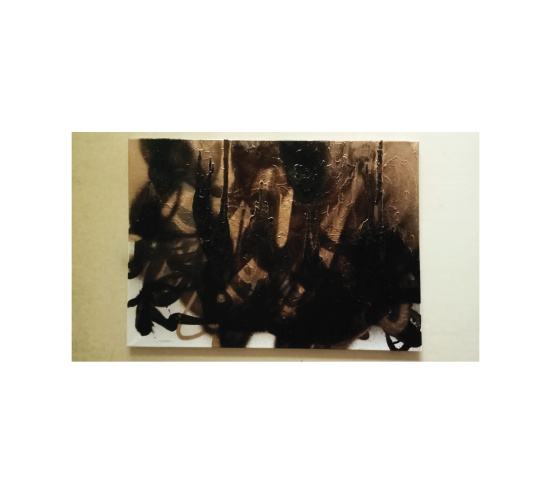 Krim Kram’s third batch maintains the label’s MO of eclectic selections new and old, and also delivers yet another definitive disc from a noteworthy noise newcomer; first it was Ireland’s Dressing, now it’s Cyess Afxzs (a.k.a. Stuart McCune) hailing from Switzerland. Having already begun making the EU rounds with releases on Industrial Coast and White Centipede, I see this project as aligned with an amorphous tradition of “post-harsh” that’s hard to qualify, but I always know it when I hear it. No Bull One Left Behind especially deals in complex textures that resist simple divisions of abrasive vs. atmospheric, processed vs. pure, etc., wielded in tensile strands that are rattled, strung, and braided across an expansive stereo field. Opening couplet “Shine 96” and “Everything’s Alright” are probably the most straightforward tracks, building anticipation with shuffled clutter and feedback-wracked downtime then fulfilling it with dense, caustic blasts. The title track introduces more of the earthy, psychedelic concrète core that makes this CD so memorable, and it’s expanded upon throughout the lengthy and enthralling “Longer Ticket.” I want to reserve any description of “Scared Money Never Wins” because, as with much of the best noise music, better to experience it unspoiled.
Review: John Collins McCormick plays World War I Fighter Jets in Action (Garbage Strike, May 4)
 I first saw John Collins McCormick play in December of 2017, and his fiveish-minute “set” (as well as his recommendation that I check out Rie Nakajima) has lived on in my head and heart since. Part improvisation, part installation, most of the performance consisted of him placing objects on a speaker-agitated surface and adjusting the array of warm incandescent lights illuminating it. There was an ostensible “start” and “finish” to the main action, but it never really began or ended, at once blurring into the space/its occupants and taking place without much concern for it/them at all. World War I Fighter Jets in Action, a work from 2015 that comprises one of four recently released tapes of both old and new material (just $15 for all of them!), accepts the impermanence of performance in a similar way. The liner notes state that McCormick “performed this perfect recording of [Fighter Jets] many times, sometimes alone, sometimes for an audience who would walk out and [he] would be alone again”; together with the sound of the piece itself, how the swirl and pop of the turntable playback during silent sections feels almost as loud as the sweltering rattle of exhaust-choked engines that seem to nearly tear the speakers apart, how the planes zoom by and fade into distant, ghostly trajectories, it’s a lovely synthesis of concrete and abstract experience, a mashup of form and function. In a literal sense it scratches the same itch as other loose-slung documentations/reapplications like Drag Boats World Championships, Slick Flicks Tricks and Licks, or Ace Combat. Excellent stuff.
I’m not yet sure if this is my favorite of the four tapes, it’s just the one I had the most to say about. All of them are worth your time. And everything else he’s put out too.
Review: Andrew Coltrane – Self-Amputation (Oxidation, May 1)
 Though Detroit mainstay Andrew Coltrane has previously dabbled in the level of prolificacy often associated with noise artists—from 2008 to 2010, among other activities, he produced and distributed more than two hundred tapes of his own work on his homemade imprint Hermitage—he hasn’t put anything out under his own name since 2016, which makes Self-Amputation a bit of an event. True to form, however, nothing about the release suggests such significance; from the banal gruesomeness of the cover to the cheap equipment used in the recording, this is a no-frills noise affair, soft and longform enough to rumble in the background yet crafted to a level that rewards active listening. I’m not sure whether both cuts are a single take split in two or distinct sessions, but either way they both feel like the culmination of so many different techniques—that is to say, only someone who’s been in the game for this long could track this eclectic tabletop array (ARP synth, tapes, contact mic, sine waves, tape delay, drum machine) to a shoebox and make it sound so lush. There’s a really nice, almost cozy improvisational fluidity to even the most passive crumble, and I can foresee myself putting this tape in for many morning coffees to come.
Review: Ermes Marana – Ransom Note (self-released, Apr 26)
To whomever deserves to be so inclined,
We are being held captive in an undisclosed location. Below is a list of demands that are to be fulfilled within specified deadlines. If our wishes are not respected, we’ll have our rations cut, and we will burn the deed to our estate. The implications we refer to are as real as pain. If, however our demands are met in a timely manner we’ll be able to relinquish our captors of their duties and transfer the funds directly to your bank account. Furthermore, instructions to the locations of the incriminating photos will be sent to an unspecified mailing address.
The repeating sample that frames the unsettling, nested interview threads of “What Does the Future Mean to You?” instructs anyone within earshot to both “listen closely” (once) and “listen again” (thrice), the irony of course being that Ransom Note consistently seems to mock the very idea of anyone actually hearing it. Much like Rich Teenager’s similarly brilliant Sardanapalus, the first public message received from the captive(s?) known as Ermes Marana is a multimedia tract of surreal, bleak late-capitalist tedium—the kind of “posthumanism” that doesn’t give the silicon dung-heaps of humankind the dignity of having any sense made of it. Worthless samples loop ad nauseam, news broadcasts and self-help tapes melt together in a flaming trashcan, radio grabs collapse into noxious clumps of noise. Many more comparisons could be made based on the way the album plays with speech and electronics on surface level, but none would capture the cynicism, paranoia, and total detachment that radiate from the void at its core. Music that makes you wish you never learned what a wish was. “…that’s the real fear, right?”
Stream/download lossless files here. I have been told a physical edition was in the works; when I know more info I will update “whomever deserves to be so inclined.”
Review: Klaysstarr Nets – Fifty-One Aural Selfies // Real Time (pan y rosas discos, Apr 17)
 Perhaps part of the reason why the music Scotsman Iain Findlay-Walsh makes as Klaysstarr is how rarely new material shows up—meaning that when it does, you know it’s been either meticulously crafted or at least well thought-out, or both. But the thing is, this one-of-a-kind sonic language is so open-ended and holistic that it feels unfinished in some fundamental, beautiful way. I’ll still be singing the praises of the 2019 Entr’acte disc w/hair ph<> n mus|x when I’m well on the way to my grave; I have never heard music so sublime and so singular, and I’m starting to doubt I ever will… until there’s a new Klaysstarr release, that is. Which brings me to Fifty-One Aural Selfies // Real Time. The significance of the minor name change escapes me, but deliberate, playful obscurity is indeed the project’s modus operandi (just look at the cover). Maybe it’s a reference to the way Findlay-Walsh’s very direct field recording collage technique seems to unfold and collapse the dimensions of the environments it captures, or how in that act of capturing there’s so much that slips through. All of the familiar ingredients are here—restless jingling of keys, zippers, leashes; claustrophobic expanses; jarring structural movement—and even another moment of serendipitous pop music ambience much like that of “b|rn wa|king on”, albeit this time with a much more recognizable song. Absolutely no one else is doing it like this right now. Not even close.
Review: 281-330-8004 – May Your Days Be Few (SLVR, Apr 21)
 In the (unlikely) event my thoughts and prayers are totally inconsequential and none of the Big Five suddenly go belly-up and instantly cede all of their misused capital to the countless small presses gasping under their boots, the beloved Internet Archive may not be long for this world. As growing global efforts to restrict, surveil, and outright prohibit free internet use become impossible to ignore, making a racket is more important than ever. And that’s exactly what May Your Days Be Few is: a racket, and at that one well suited to act as a scorched-earth death knell for open-access information. The titular curse might be directed at anyone or anything the listener chooses, the antiseptic sear of the harsh and repetitive soundscapes applied to wounds large or small, metaphorical or literal (not counting the ones it’ll leave on your eardrums, of course). I never expect intense glitch-noise in this vein to be that varied, but 281-330-8004—before you ask, no, as far as I know our lord and savior has not returned to lend us His holy ear—keeps things diverse on this short debut release, dropping to some cutup-esque lulls in “Hell Prisoner” and draping the screeches of “Screams from the Below” in cavernous reverb. For fans of SW1n-Hunter, Pigeon Discrimination, and Daniel Iván Bruno’s Brazo. Let this be your motivation to make a racket of your own.
Review: Max Nordile – Copper in the Arts (Gilgongo, Apr 14)
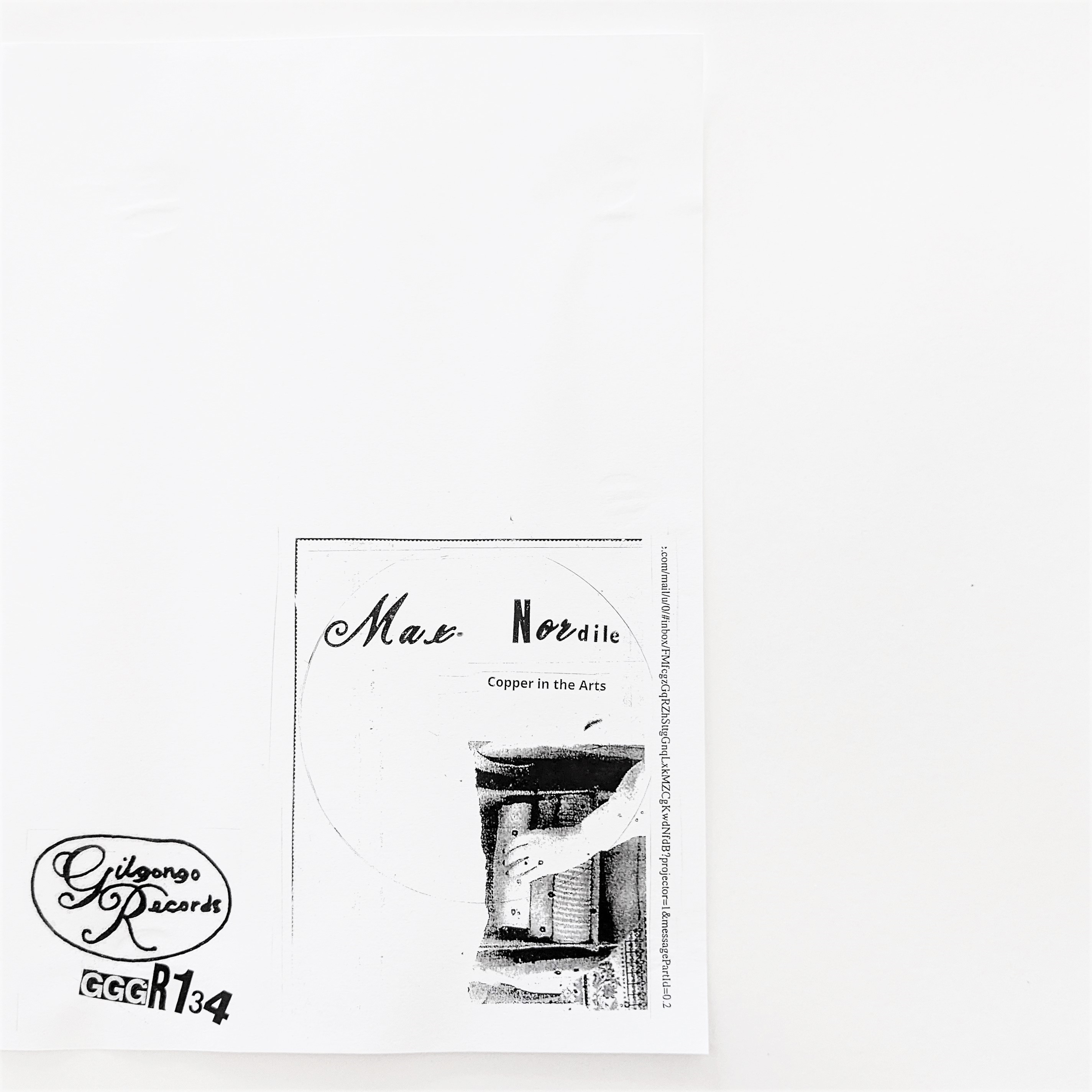 Though I don’t own many myself, I have to say a 12″ lathe is a fitting format for what might be Max Nordile’s best release to date, music and medium sharing a crude, homespun charisma. The famed Oakland-based junk-sound purveyor is usually working on multiple collaborative projects at any given time, but his most memorable work is often solo under Hair Clinic, his own name, or both, and in many ways Copper in the Arts is the culmination of all of it. All the usual suspects—wailing, broken sax ditties; dingy drones; tape-muffled clatter of knickknacks and doodads; fleeting environs—show up in spades across both distinct yet complementary sides of the slightly oversized slab, and while I’m not 100% sure which side is A (“Rats Are the Souls of Dead Landlords”) and which is B (title track) I can still say both are wonderful. The choppy lo-fi recordings seem specifically designed to blur and blend with the churning distortion of the lathe cut, often to the point of sounding like it’s stuck on a locked groove before some subtle new element starts to creep in. It’s both a tragedy and a blessing that this edition of fifty hasn’t sold out yet—go forth and support one of the best artists and one of the best labels doing it at the moment!
 Noise Not Music