
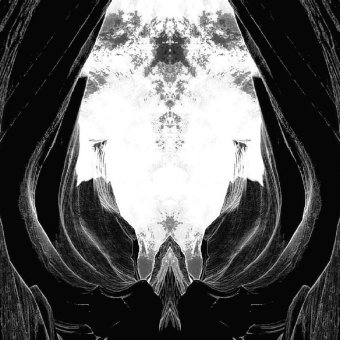
 There’s something to be said for albums that are just interesting, that immediately seem like puzzles to solve or codes to crack, that present or examine beloved genres and tropes in a singular way. Warp Whistle’s enigmatic release 7D80-0C is one of those albums. There’s not much in the way of illuminating information on the Bandcamp page—just some extremely auspicious genre tags and ambiguously numbered track titles—but this unique debut thrives on its own opacity. Partitioned by several interlude tracks (“5-2,” “5-5,” etc.) are a series of considered, deconstructive tech-hardcore jams, played with both ease and grit to create a sound that is at once intellectual and muscular, complex yet easily graspable. The interplay between the spidery tapped guitar leads and slinking bass is magnetic, and when matched against a forceful, plodding drum backing creates a captivatingly sluggish and sludgy atmosphere (the only other case I can think of where a similar sort of thing is achieved is on Inside the Beehive’s “Bio-Feedback”). Warp Whistle’s music speaks for itself; it is clear that the members have incredible musical chemistry, which allows them to play these subtly elaborate songs in such an enrapturing way. Jagged, metallic, and multifaceted, 7D80-0C, in my opinion, is already on its way to modern obscure classic status.
Review: Joke Lanz & Jonas Kocher – Abstract Musette (corvo, Feb 13)
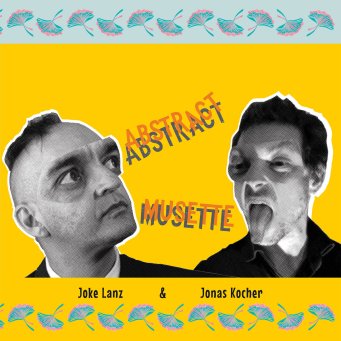 Playfulness is something in which we all should indulge from time to time. Releases like Abstract Musette illustrate that it’s a welcome presence even in musics traditionally thought of as erudite or academic. The gleeful, irreverent sampling and the sprightly musette influence don’t at all detract from the considered improvisational interactions between turntablist Joke Lanz and accordion player Jonas Kocher—they only enhance them. Lanz’s jarring swipes and scratches are often purely textural, occasionally humorous or serendipitous, but always engaging; together with the familiar waltzing slices of the accordion the two musicians’ creations take the form of wobbly, unpredictable cascades and tumbles, almost like a chopped-up field recording of a particularly odd carnival attraction. The short track lengths complement the music well, yet “Rêve de Clarinette,” the longest piece on the album, is undoubtedly its centerpiece, a roiling cornucopia of fleeting horn samples, record crackle loops, pitched-down vocal extracts, and breathtaking extended techniques. The instruments Lanz and Kocher use, historically speaking, obviously have very different levels of involvement with improvised music in general, but the record nonetheless showcases a pair of revolutionary unconventional approaches that are fascinating enough on their own—and even more so amidst the infectious stylistic territory achieved on Abstract Musette.
Review: Yol – Hideous Response (Cardboard Club, Feb 14)
 “IF I WAS A TINY FASHION DOG I WOULD PISS EVERYWHERE IN CONSTANT RAGE AT THE EUGENICS PROGRAM THAT STOPPED ME FROM BEING A WOLF!” screams UK poet, improviser, and musician Yol on “Fashion Dog,” but it takes them quite a long time to arrive at that lucid of a sentence. The opening track on Hideous Response, the artist’s new tape release for Cardboard Club, is everything abstract lingual performance should be: humorous, confusing, harrowing, unsettling, fun. Yol stumbles and sputters over the bizarre hypothetical with the shuddering inconsistency of someone wracked with tears and (appropriately) the anger of a tiny fashion dog who wasn’t allowed to be a wolf, forcing out words and phrases out of order, repeating things incorrectly, shouting until the limitations of their own body cuts them off. One might think there’s no way this maniacal intensity can be maintained for the album’s full duration—and one would be very, very wrong. The bewildering vocal utterances are absent on “Flooring,” but the high volumes and overall abrasiveness are still very much present throughout the nearly five minute snare drum improvisation, recorded at such a close distance that the impacts and hits are nothing short of deafening. The curiously ethereal instrumentals and lunatic babbling of “Updated Fairground Ride” gives off barn sour vibes, “Shutting Up” whips up screeching object clatter into punishing harsh noise–scapes, words die battered and bloody in the artist’s throat on “Sanding Off” despite being surrounded by a tranquil outdoor environment. This is an uncompromising study of sound and a human’s role in its production, manifested as the ramblings and discarded litter of a complete madman. Try not having nightmares after hearing the title track. I dare you.
Review: Appliancide – lowest common denominator (Black Ring Rituals, Feb 10)
 I have a modestly sized list of music-related key words that, should I see them in any tags or blurbs for a release, guarantee that I’ll at least try to listen to something. One of the first of these that comes to mind, as well as the one that applies to this particular album, is “cut-up”; while the phrase has become far more nuanced as a stylistic descriptor since its coining by William S. Burroughs (at least for auditory/musical purposes) in the late 50’s, its association to a wide range of artists who are all personal favorites of mine—John Wiese, Developer, Chlorgeschlect, Kazumoto Endo, Andrea Pensado, Facialmess, Otomo Yoshihide, etc.—validates its buzzword status. Appliancide’s new tape lowest common denominator, which also appears to be the Fargo project’s debut full-length release, immediately cements its worthiness of the “cut-up” label with the opening title track: a restless, hyperactive frenzy of high-speed noise collaging, shattered industrial rhythms, and a ridiculously eclectic array of auxiliary samples. Appliancide’s approach is instantly magnetic, and maintains its frenetic pace over the course of the eight minute track with ease. Things slow down a bit when we get to “purity balls deep,” a more subdued patchwork of dated speech extracts and context-scooped conversations, while “The Rectal Escalator” offers up a splintered racket of tactile concrete sounds. At its heart, lowest common denominator is a noise album, but the pleasingly indiscriminate sample use and surrealist sensibilities will also appeal to fans of LAFMS dada choppers like Joseph Hammer or forgotten oddball classics such as Mind / Body / Split’s If It’s Not On It’s Not On. This tape is not only the best thing I’ve heard from Black Ring Rituals; it’s also the best cut-up noise I’ve heard in recent memory.
Review: Light Collapse – Untitled CD (Perpetual Abjection, Feb 12)
 Vitaly Maklakov’s static noise on his new untitled release for Perpetual Abjection (as Light Collapse) is lo-fi, dirty, crusted, like urban grime collected on the undercarriage of an old taxi or the nameless coagulant between the seams of ancient cobblestones. No, this five-track CD does not possess the same enrapturing clarity and immersive channel arrangement as, say, Vilgoć’s recent release Granice, but that doesn’t make it any less captivating. The first piece is the longest at 16 mins (the others hover around the 8 min mark) and sets the stage for Maklakov’s minimal, earthy palette with a subdued stretch of muffled crumble. It bores into your head with a subtle but deliberate force, and will begin to eat away at your sense of time until you end up at the other end without much memory of how you got there. The coarse, unrefined nature is further constructed by the transition into the second track, which begins unassumingly with what appears to be a slow fade-in of hiss and crackle, but those slight sounds are immediately smothered by the central drone: a throaty, bassy hum that evokes a strangely detached sense of claustrophobia. The following pieces are even more unstable, loping into existence with barely any force or drive, unstable nocturnal soundscapes devoid of much for the listener to hold on to at all. PA015 is artfully anemic, challenging not our patience but instead our desire, our need for substance and weight by refusing it entirely. Wall noise broken and fatigued on a mud-encrusted sickbed.
Review: Human Flourishing – Cmon Human (Lurker Bias, Feb 12)
 It’s a pretty unique occurrence for me to have written about three releases from the same label in the span of a month, but at the same time it should come as no surprise in the case of Lurker Bias. From freely improvised music and avant-garde jazz to some of the most exciting releases in contemporary wall noise, the Chicago-based tape label never ceases in constructing its ridiculously eclectic catalog. The latest in a run of particularly fascinating endeavors for LB, Human Flourishing’s new cassette Cmon Human is a vivid, enrapturing coalescence of intimate bedroom pop tropes, ersatz electronica, and a host of other unidentifiable flavors. From what I can tell, this is the first full length from the Connecticut duo (there are some shorter self-released albums on their Bandcamp page), but already they seem to have carved out a dimension of musical abstraction not unlike the soupy rock detritus of Triple Negative or the fragmented collage-pop of sneeze awfull. In a series of fluid, colorful cascades as familiar and wholesome as that patch of green shag on the cover, Human Flourishing reverently guides us on a journey through languid instrumental meanderings, saccharine synth ambience, homey found sound, and even some soulful vocals that at every moment exudes a calming domestic tranquility. It’s so easy get lost in these soft layers of warmth and beauty. Maybe secure yourself to reality with a rope or something though, because it’s not so easy to find your way back—or to even want to do so.
Review: Thewhitehorse – White Rock (Deathbed Tapes, Feb 10)
 For Sean E. Matzus’s solo wall project Thewhitehorse, the creative mantra is firmly “quality over quantity.” According to Discogs, since 2010 there have been just 21 releases credited to the alias, a number that many contemporary wallers rack up in less than a years’ time. The more sparing, judicious approach Matzus takes is palpable in each of his releases, whether it’s last year’s single-track monolith Wine-Dark Sea, 2018’s ambitious 3-CD opus The Spirit of the Lonely Places, or the various Twin Peaks homages he’s released over the years (e.g. This Is the Water, An Eternity of Black and Red, “Laura’s Angel”)—each feels like an event, something special. White Rock is no different, and in fact might be my favorite Thewhitehorse material I’ve heard so far. Complemented by the always excellent black and white noise-collage aesthetic of Deathbed Tapes (like a more tasteful and evolved version of stereotypical “noise art”), Matzus presents a C32 with two somber, lonely walls, each thick and dense and immersive yet with a very free sense of motion, like tattered shrouds whipping in the wind. “Polly Williams” materializes as dark, oppressive layers, the atmosphere somewhat light and meditative but opaque enough to still feel like complete imprisonment. The apocalyptic rumble and crumble is amped up on “Lover’s Leap” along with the addition of a distant, higher-pitched element that I can never seem to put my finger on or describe. White Rock is the sound of ancient boulders tumbling down a never-ending cliff, forgotten immortal giants stirring in primordial depths, the black nothingness of reality finally closing in. How it manages to evoke such things in just over half an hour, I’m not sure.
Review: Philip Sulidae – Perplexor (LINE, Feb 7)
 For over a decade, Australian artist Philip Sulidae has been probing the most remote depths of sound to create his spellbindingly fragile works, with releases on Unfathomless (History of Violence, Ramshead), Verz (Glass), Linear Obsessional (Conurb), Audio. Visuals. Atmosphere. (Le Voile), and his own Hemisphäreの空虚 (Variations on Plastic, Petrification and Strife), among others. His newest release, Perplexor on LINE, is a deeply conceptual work of electrical interference, delicate whispers, and empty space. Described quite ambiguously as “a deference and conjecture for past and present sound,” the set of three pieces are carefully assembled from the wispy, crumbling remnants of sounds and memories lost to time. Each acts as a humbly vague reconstruction of a particular place at a particular time, but since those times are so long ago (1970, 1929, 1894), both the reconstructor and the listener are left only with a few vestigial fixtures swathed in the ghostly shroud of all the moments that have been trampled by history’s ever-surging stampede. As we drift through the barely-substantial forms of Sulidae’s diaphanous weavings, we latch onto the few sonic landmarks that occasionally surface amidst the void—car honks, rainfall, distant clatter—but they’re gone as soon as they arrive, leaving us scrambling for purchase, a futile action when surrounded by nothingness. Perplexor, perhaps appropriately, is an uncanny experience, a skillful construction of absence-with-presence, but it is also tremendously beautiful.
Review: A. F. Jones – harborside (self-released, Feb 5)
 Field recordists often use latitude and longitude coordinates as titles for their pieces, and as listeners we trust that those coordinates point to the actual location where the recordings were made. But at the same time, it doesn’t really matter if they do or not. The role of a phonographer is hardly ever to create a comprehensive auditory portrayal of their environment; much more frequently, they aim to provide a particular perspective on a sonic event or series of events, and that particularity is inherently guaranteed by the observer’s uniqueness as an individual—and, of course, can be supplemented by unconventional techniques or post-capture synthesis. I don’t have any doubt that the coordinates given for A. F. Jones’ release harborside are accurate (according to Google Maps, the precise location is quite close to the artist’s home base of Tracyton, WA, just east of Seattle), but his careful presentation of both on-site recordings and interactive synthesis transcends simple documentation or representation—when listening to “47°33’41.3″N | 122°37’31.7″W,” we aren’t transported to that quaint dock in Bremerton, but instead to a singular soundscape that integrates space, tension, and immersion with the location’s specific quirks. Swells of excited conversations, hypnotic drones, and windswept rustle rush in and out just like the waves that persistently lap at the shore, constructing a balance of meditative headspace and human unpredictability in a similar vein as Ludwig Berger’s Cargo. Meticulously composed and paced, harborside is one of the most engaging field recording compositions I’ve heard in a long time.
Review: Tijana Stanković – Freezer (LOM, Feb 2)
 Artistic comparisons, in my opinion, are not something that should be used carelessly. Too often we fail to examine a work holistically, and instead focus on particular aspects that may allow us to make easy connections to things we already know. This is a misstep that I think is rooted in a human desire for familiarity, a need to break new and unknown things down into fragments that we can connect to existing experiences. I say all this because I immediately compared the new release from Serbian improviser Tijana Stanković, Freezer, to Polly Bradfield’s infamous classic Solo Violin Improvisations based purely on the approach taken. Any improvised work that makes use of the creaks and squeals of a small-bodied string instrument is inevitably indebted to Bradfield’s landmark opus, whether intentionally or not, but as sympathetic listeners it is an egregious disservice to in any way disregard the infinite nuance and creativity that freely improvised music makes possible—especially in this case, for Freezer is in a league all its own. Stanković not only makes use of the standard palette of extended techniques, preparations, pizzicato, and unconventional bowing to produce these pieces; she adds further detail with vocal elements that draw influence from Balkan folk music, the agitated, trembling drones almost imitating the shivers that might creep into one’s voice if one were actually trapped in the meat freezer where she recorded the album. “To freeze is to preserve,” Stanković states, a fitting mantra for a permanent document of music that is inherently impermanent and instantaneous. Fans of Solo Violin Improvisations will no doubt greatly enjoy Freezer, but don’t go in expecting a simple modern reimagining; this new work is a singular exploration into both personal and universal ideas that defy verbal communication.
 Noise Not Music