
 The well-documented and well-love hardcore subgenre commonly referred to as “mathcore” holds a very special place in my heart. Exemplary artists like Hayworth, Gaza, Inside the Beehive, Arms, and others reach absolutely spectacular and soul-crushing heights through their unholy marriage of extreme, teeth-gnashing breakdowns, hardcore energy, and technical experimentation. It is perhaps the last artist I mentioned (Arms) to which the singular style of newcomer band Kucoshka comes closest; both share the melodic post-hardcore inclinations and complex, prog-indebted arrangements, but where BLACKOUT was a claustrophobic descent into dense, dark, noisy depths, this new project’s first (though maybe second?) full-length Women and Police Everywhere sprawls itself across a much wider area. The vocal performances are endlessly various, ranging from the Infest-esque tough-guy shouts (which themselves have an amazing versatility, from screaming “I’m a fucking physicist, bitch” on cacophonous opener “Young Turks to adorning the bizarre, swinging pub-punk at the beginning of “Info Wars”) to disarmingly clean, ersatz melodic hardcore breaks to unhinged shrieks. Though the production style isn’t the cleanest, it was a great choice for this album despite its emphasis on technicality, as much of the enjoyment of listening to Women and Police Everywhere is getting hopelessly lost amidst the chaos; and trust me, there’s plenty of it.
Review: Vessel of Iniquity – Star of the Morning (self-released, Nov 2)
 So what are the chances that I mention Vessel of Iniquity (the solo moniker of multi-instrumentalist A. White) in a review of similar-spirited music and then the day after discover they’ve released a new album? They seem pretty slim, but who cares—because it happened. Hot on the heels of the Void of Infinite Horror LP released earlier this year on Sentient Ruin (which was a hair’s breadth away from appearing on my midyear top ten list) and the self-released Conjuration of the Fire God last month, Star of the Morning continues with more of the project’s harrowing descents into shadow and caverns of nocturnal terror, auspiciously opening with the ritualistic percussive buildup of “Maledictum” before the blast beats first appear in “Deo Non Estis.” The expectedly formidable, atmospheric maelstrom of guitar and keyboard is less clean this time around, the densely packed layers instead plagued with rot and oppressive lo-fi smog. “Stella Matutinam,” despite it translating to the album’s somewhat optimistic-sounding title “star of the morning,” is definitely one of White’s most disturbing tracks yet, plowing through a shroud of consuming darkness with propulsive, thundering programmed drums whose unpredictable rhythms both temper and contribute to the chaos. The drum machine isn’t anything new for the project, and I usually don’t welcome such a choice of instrumentation in this sort of music, but once again White proves his mettle at making the synthetic rhythm section sound anything but, imbuing the crashing cymbal cacophonies with razor sharp bite and the pummeling double bass stampedes with bone-crushing weight. White’s agonized shrieks are also in top form here, tearing up from the pit of despair and melding with the tumult of pitch-black distortion. With a strong finish in the form of the extended nightmarish havoc of “Descende,” Star of the Morning is yet another excellent release from Vessel of Iniquity.
Review: Caïna – Gentle Illness (Apocalyptic Witchcraft, Nov 1)
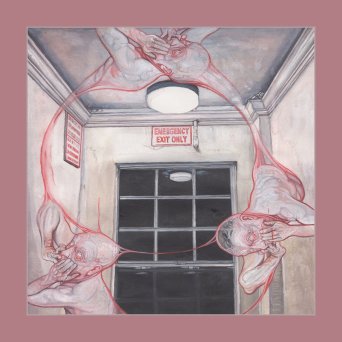 As an avid consumer of experimental art, I come across a lot of music in the form of abstract sonic amalgamation, much of which is constructed from quite disparate sound objects. That being said, though, few pieces have made me as strangely unsettled as “Wellness Policy,” the sparse introduction to Gentle Illness, multi-instrumentalist Andrew Curtis-Brignell’s newest album as Caïna. There’s nothing particularly immersive or captivating about the track, which is perhaps why it’s so effectively disturbing; in and around the relatively unassuming sounds of what sounds like an old therapy session recording and somber piano lies that loud, grating, completely emotionless cloud of electronic squall, deafening and defiant in its opacity, which makes the sudden excursion into much more conventional black metal once “Your Life Was Probably Pointless” hits even more startling. Between Curtis-Brignell’s furious bouts of shadowed growls, layered guitar lines, and surgical drum machine blasting (the latter of which definitely reminds me of Vessel of Iniquity’s brilliant Void of Infinite Horror from earlier this year) are more in the vein of those elusive atmospherics, but something the entire album is concerned with is the careful construction and release of tension, from the cathartic assault after three minutes of building unease in “Your Life Was Probably Pointless” to the synthetic, rhythmic mood piece of “Canto IV” and fluid dynamic structure of “My Mind Is Completely Disintegrating.” Buried beneath the noise are largely indecipherable lyrics with subject matter “ranging from the UK’s lack of mental health provision to extraterrestrial psychics via demonic possession and the metaphysics of suicide,” but the overall tone of despair, anger, and horror is more than intelligible.
Mix: Into Winter
Today was our first biting, bitterly cold day of the forthcoming Midwest winter, so I thought it fitting to put together a mix of my favorite raw black metal. Pained shrieks, stifling atmosphere, and percussive rumble are sometimes encased within a lo-fi haze; other times they stab through with piercing, feedback-wracked squall. I’ve assembled a combination of both ends of (and anywhere in between) the spectrum.

00:00. Luminous Shadow – “A Formless Reflection” from Demo II (Midnite’s Darkness, 2017)
03:00. Graveflowers – “Handful of Dust” from The Hyacinth Garden (Path of Silence, 2017)
05:34. Nocturnal Chalice – “Possessed by Burning Hatred” from The Hidden Order (Tour De Garde, 2016)
10:12. Burier – “Disease & Deluge” from Burier (self-released, 2019)
14:02. Ythogtha – “Sunken City” from False Faith (self-released, 2007)
15:33. Yoga – “Open Sesame” from Skinwalker (Holy Mountain, 2012)
20:55. La Torture Des Ténèbres – “Descent Into Wolves’ Wound” from Choirs of Emptiness (self-released, 2016)
23:44. El-Ahrairah – “Flora” from Demo (A Terre, 2009)
27:12. Lonesummer – “I Miss You Still, Ma Bête” from Satisfaction Feels Like a Tomb (self-released, 2010)
30:00. Black Cilice – “Channeling Forgotten Energies” from Banished from Time (Iron Bonehead, 2017)
35:10. Vegas Martyrs – “A Part from the Cross” from Vancouver Missing Women (Hospital, 2010)
Review: Validine Chronus – Blood Moon (self-released, Oct 31)
 In 1998, the debut album by Validine Chronus (hereafter VC), Ultia, became the first release on Cyclene, a community and label for producers of experimental electronic music (other VC releases on Cyclene include Tofu, Cellulose, Agar [1999, CYC-002] and Quinto [2006, CYC-021]). I don’t know much about what happened in the time between those releases and the recent 20th anniversary reissue of Ultia in March of last year, but I do know that VC’s career has now restarted in earnest, with wonderful releases like Transdermal and now Blood Moon. VC’s penchant for textural ingredients like soft, brooding drones that often emulate the otherworldly transmissions of shortwave radio; buried tactility; and metallic, subtly melodic synth cells is quite pronounced on Blood Moon, a C66 whose six patient compositions occupy a particularly dark and brooding milieu. There’s somewhat of a nautical theme present, and not just from track titles like “Shipwrecked” and “Storm”; in fact, it’s on “Mission Control (Concern)” that we observe the first palpable sign of this element, as the unmistakable rattle of metal cables and aquatic flow of shifting static evoke a strangely synthetic maritime environment. The second part of the staggered “Mission Control” suite is the tape’s most overtly tonal excursion, forming itself around a dense cluster of progressive electronic arpeggios before its structure collapses into the foggy, menacing tension of “Storm.” In my opinion this is the tape’s best track, a slowly shifting mass of pitch-black thunderclouds and oppressive murkiness that flows into the reserved but still somewhat terrifying “Consequence.”
Review: Carlo Giustini – Custodi (Lᴏɴᴛᴀɴᴏ Series, Oct 28)
 Since the release of La Stanza di Fronte, Treviso sound artist and cassette tape lover Carlo Giustini’s debut album, on ACR at the beginning of last year, the young musician’s music has traveled along a clear trajectory. The spectral drones and use of fidelity/absence-as-sound that dominated that curious tape have remained steadfast elements in Giustini’s work, but as he progressed through various releases on labels such as Bad Cake, Purlieu, and No Rent the presence of melody and other more traditional ambient qualities have become increasingly prominent. Custodi, his second release on the Rohs! Records imprint Lontano Series, is perhaps the furthest removed from the ghostly abstractions of La Stanza di Fronte, for almost every track—excluding perhaps the best one, “La sala più a Nord”—has a clear harmonic backbone that weaves throughout the familiarly fuzzy field recordings and reverb-soaked ennui. Profoundly nostalgic, Custodi attempts to answer a particularly difficult question: “Is it possible to capture the sound of a state of being, of a memory, of a past sensation? Is there a possibility to translate [sic] a thought which once was into vibrational waves?” Magnetic tape, especially in cassette form, is often heavily associated with memory, from the murky sonic qualities of the medium itself to the things it frequently captures: thoughts, conversations, etc. But portraying the “sound of a state of being” is more complex than just replaying a concrete auditory keepsake, something Giustini obviously understands judging from his abstract approach. The three tracks on side A of the album are gorgeous meditations that make use of guitar and keyboard along with Walkman/microcassette recordings, and like last year’s Non Uscire there’s a soothing evocation of winter folded within the music’s dreamy drifts. But the essence of Custodi is best represented by the aforementioned “La sala più a Nord,” which combines deeply domestic recordings with soft environmental textures and is the only track that does not include musical instruments. Such a beautiful vignette perfectly communicates the incommunicable feeling of home, going about a routine in the comforting silence of your own dwelling, mundane moments whose significance isn’t known until they’re long gone.
Review: Million Brazilians – Strange Oasis (Nonlocal Research, Oct 28)
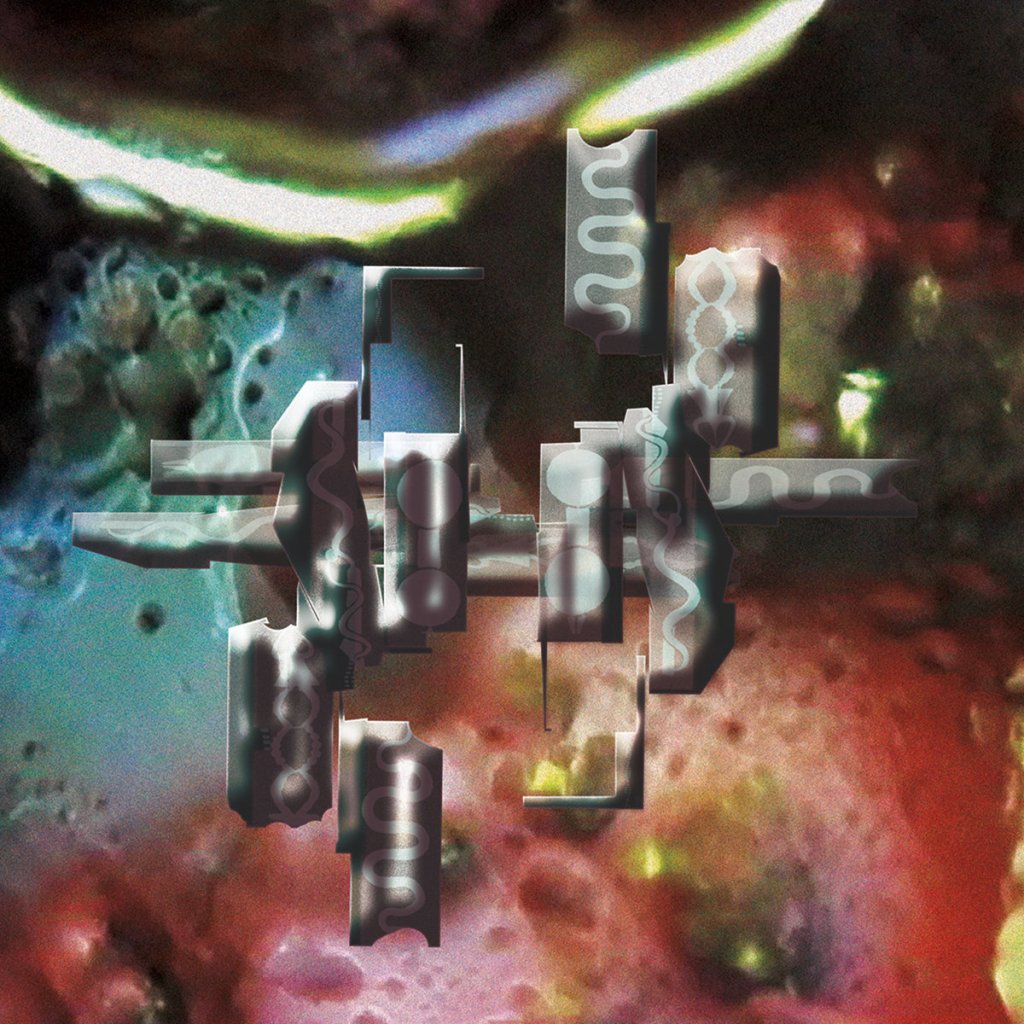 Art made by humans has long been concerned with ideas of oases, sanctums, or convergence points that lie at the heart of mysterious environments. Often at the heart of these fantasies, whether consciously or otherwise, is the concept of a singularity, the point at the center of a black hole where matter possesses infinite density (but this definition can also be extrapolated to any point where the discernible qualities of an entity become indistinguishable from one another). But what does it sound like when we get there, when we finally reach the mysterious room at the center of Stalker’s Zone, or when Percy Harrison Fawcett stumbles onto the “lost city of Z” hidden somewhere within the sprawling jungles of Brazil? Million Brazilians, in this instance a trio composed of Grant Corum (The Orchardist, Mummy Dust Trippers, Gili Gili Men), Suzanne Stone (White Gourd), and James Shaver (Beyond), attempt to portray the latter through Strange Oasis, their newest full length. Its unique brand of colorful, aquatic avant-exotica is a brave stylistic approach to problem because its strangeness is seemingly both too much and not enough—i.e. too bizarre for conventional audiences but not sufficiently singular to represent an “inverted oasis” where flora and fauna become “a unified harmonic tissue of organic matter.” But Million Brazilians have shrugged off the solution that seems obvious to me (the ultra-dense synthesis of projects like Yeast Culture or Rudolf Eb.er) for a reason. The barely-there ghosts of tribal rhythm, bubbling tropical synths, the spectral gusts of voice and reed instruments like the sweaty chill of humid air… it’s more than just a representation of a place where dividing lines cease to exist. Strange Oasis is actually about the journey along the way, most likely the true form of such a place; where there’s no single spot in the depth of the jungle where abundance becomes oneness, but instead only the slow disintegration of sanity and perception as one travels deeper into an ever-darkening pocket of excess, the eventual inability to properly process or identify the overwhelming stimuli that surround them.
Review: Maria Chavez – Plays (Macro, Sep 20)
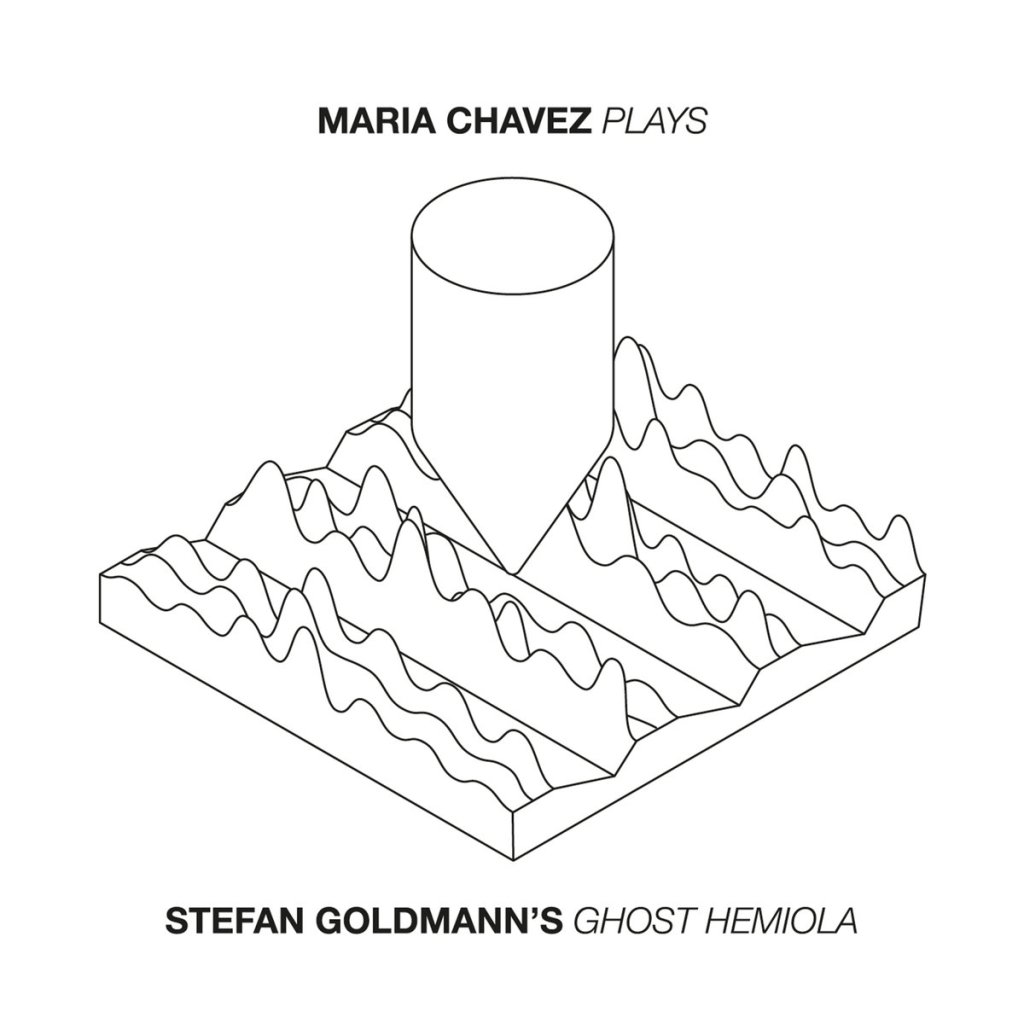
The minimal graphic on the cover of Plays, established abstract turntablist Maria Chavez’s interpretation of Stefan Goldmann’s Ghost Hemiola, reminds us that on the surface of the seeming flat discs we place on record players every day have rolling peaks and valleys, towering landscapes too tiny for us to see or even notice (apart from the sounds they encode). Chavez is well-known for her experiments with and unconventional presentations of the vinyl medium, from solo improvised performances to educational workshops to ambitious interactive installations, but Plays, her first full-length release since 2004, is something else entirely. Contained within its 60 minutes and 27 seconds are those same peaks and valleys and landscapes, this time in the form of heavily processed sound objects sourced from the customizable lockgrooves of Ghost Hemiola’s pair of prepared blank records. Chavez cited the curious concept of “something from nothing” when describing the work, an idea that many artists have explored, but none have delved into this particular—and highly unusual—knotted paradox of mediums. We know that “digitization liberated content from its physical carrier. [Then], Ghost Hemiola liberate[d] the physical carrier from its content.” And now, Plays hovers its spectral, synthetic form somewhere within that elusive neutral space; the sounds are audible but irreconcilable, only existing because of the sounds that are made when emptiness is lifted from the object that contains it, or when that now noisy emptiness is translated into the digital space. Amidst the meticulous excursions into stretched sonics, pseudo-industrial rumble, alien electronic pulse, and stretches of careful reductionism or even silence exist fundamental questions about the relationship between audible sound and physical media, questions that Chavez has been asking and attempting to answer for quite a while now—but no work, hers or anyone else’s, has dealt with the massive array of intrigue and uncertainty that Plays opens up.
Review: King Princess – Cheap Queen (Zelig / Columbia, Oct 25)
 Every once in a while, there’s a major label pop album that I just need to write about (incidentally, a year ago today Poppy’s masterpiece Am I a Girl? was released; I hope this occasion inspires you to revisit it). I know these huge record conglomerates don’t need any more business than they already get, but the appreciation for the artist themselves outweighs this (for me at least). I’ve been awaiting the debut LP from New York artist Mikaela Straus, known by her doubly royal moniker King Princess, for quite some time now. Her rich voice graced the pillowy instrumentals of last year’s Make My Bed EP and the “Pussy Is God” single, both of which sidled somewhere between infectious contemporary pop and smooth, silky R&B—I immediately fell in love. On Cheap Queen, Straus’s often achingly bare vocals continue their earnest explorations into and meditations on love, love that for the artist often comes fraught with hardship and oppression as she navigates romantic relationships with women. We already witnessed the pain Straus feels when she has to hide who she is on “1950,” and Cheap Queen doesn’t hold back on her inner turmoil and heartbreak, whether she’s distant from the person she loves (“Ain’t Together”) or being secretly intimate with a friend (“Homegirl”). The latter track is one of the record’s most gorgeous tracks, the production beautifully languid and even subtly orchestral as Straus’s vocals somehow soar despite their quiet delivery. Remarkably, King Princess’s career is still young (and so is she—I’m only four months younger than her!); the struggles, emotions, and personal growth she conveys on these carefully crafted songs is communicated with an amazing wisdom.
Review: Oliver the 2nd – R+ Vol. 1 (self-released, Oct 24)
 Fontana-based MC and producer Joseph Perry, better known as his alias Oliver the 2nd, comes out of the gate swinging on R+ Vol. 1, his first self-released solo effort since 2013’s The Kill Off. Other than that and Rawhyde, his wonderful collaboration with Jeremiah Jae that also came out in 2013, Perry hasn’t released anything else until now. Hopefully the “Vol. 1” subheading implies that there will be more soon, but for now this short EP is an enrapturing and entertaining slice of abstract hip-hop. Perry’s position as both beatmaker and rapper on this release makes for an interesting dichotomy between the two elements—or, rather, a lack thereof. The lush lo-fi patchworks of samples of everything from jazz to funk are more than just beats for Perry to rhyme over. Instead, the vocals often blend with the instrumentals until they are largely indistinguishable from each other; both the effects placed on Perry’s earnest flows and the various approaches he utilizes imitate the atmosphere and sonic qualities of the production, creating an entirely unified flow of rhythm and lyrics on each track. “noideashi,” as I mentioned previously, is a sudden and instantly magnetic introduction to the EP, the delirious collage of pulsing bass lines and snare cracks very much in line with the loose, fluid sampling technique popularized by artists like Earl Sweatshirt and MIKE. Perry is far from just an imitator, however; the rest of the eclectic proceedings clearly demonstrate his unique ear for unconventional structure. “slowdwn” is one of the more fascinating tracks, sticking with a sparse arrangement of jazzy walking bass and piano meanderings while a pitch-altered voice croons in its midst for the majority of its duration before Perry’s rapping even appears. And thought-provoking density aside, many of the tunes here are just fun. Songs like “imtheshtbtch” and “GodofRp” are groovy as hell and make me excited for what Perry puts out next—and I really hope we won’t have to wait another six years.
 Noise Not Music