
 Spricht Editions, run by prolific Danish sound poet and artist Claus Haxholm, semi-frequently upload mysterious albums to their Bandcamp page with no artist listed. Since the last instance of this, Past Vocalisms, was eventually claimed under the label operator’s abbreviated solo moniker c.haxholm, one could probably assume that CKQ is his work as well, but until it’s confirmed the artist remains unknown. Two mid-length pieces comprise the release, the first consisting of nonverbal, senseless utterances like those used for Past Vocalisms and brief moments of fleeting lingual lucidity pitted against what sounds like writhing connection crackles. But it’s quickly revealed that this is, for the most part, a single “speaker” at the mercy of an extremely overblown, low fidelity recording, with occasional cleaner layers added. What follows is a bizarre revue of lip-smacking nonsense, incoherent babbling, and mimicry of alarm tones and/or cuckoo clocks delivered too-close-for-comfort into a broken microphone. The clearer voice recording occasionally resurfaces, but for the most part it’s an abrasive, confusing stumble as you process the moans and cries of this creature who may or may not be human, even the moments where it seems like actual words are being said blocked and shattered by the oppressive static. The second track’s auxiliary elements take the opposite form of more clarity, unseating the original performer’s presence with bassy rumbles and the humming, scratching distance of a broken tape player. It’s at this point the piece becomes truly mesmerizing, mining the evocative essence of dead frequencies and errors in a way not dissimilar to 010001111000 (if CKQ is Claus’s doing, he’ll definitely be happy to hear that comparison). Things don’t stagnate for long, unsurprisingly, and the extradimensional fanfare concludes with a final series of slurps, shrieks, and slaps. A wild ride in just over 22 minutes. What are you waiting for?
Month: September 2020
Review: Osmiroid – Zener_15 (Sensory Leakage, Sep 7)
 Osmiroid’s most recent cassette is a heaping helping of pungent “audio gruel,” too gunky to be just audio milk but without enough lumps to be audio porridge, boiled trappings of an old dwelling’s supernatural remnants. I say “supernatural” because while Zener_15 isn’t entirely nightmarish and actually has a subtle sense of humor, the sluggish, smeared, shadowy sounds chosen to swirl in this congealing stew—muffled bass drones, chattering static, pitched-down speech like the slobbering jowls of some dream-beast, wobbling delay pedal loops, obscured, distant radio grabs—all feel spectral, haunted, emitted from some place beyond our perception. The physical tape also comes with an old Xeroxed photograph by an unknown photographer showing a one of the more harrowing examples of paranormal occurrences “caught on film” (the Bandcamp page for the release provides a thoughtful and involved analysis of the image by H Downing, which is also read by an automated voice on “The Astral and the Infernal”), adding to the spook factor of the whole affair. Osmiroid’s slightly cold but lovingly prepared gruel is poured out in various forms across the album, from the lethargic slug-drag of “untitled_improvisation_ live_in_orbital_april_the_ twenty-first_two_thousand_ and_eighteen” to the horror-organ-melody-turned-synth-frenzy, squalling feedback, and distant, ominous, near-unintelligible spoken word, which is most likely delivered using a text-to-speech program, but it honestly sounds like a human voice at times. Creepy. I won’t spoil what happens in the closing track, which I think greatly benefits from surprise. Fans of Lindus, e. mordrake, the Abandoned Chamber in Batman: Arkham Asylum, and other mysterious, spooky channel openings, look no further.
Review: Odoacer – There the Vultures Will Gather (Church Road, Sep 4)
 When a black metal album starts out with an extended, subdued stretch of atmosphere-building, I can hardly ever shake the fear that it’s not going to go anywhere. That thought didn’t even enter my mind upon my first listen of “Den of Fossils,” the opening track of Odoacer’s debut release There the Vultures Will Gather. Even though its full intensity doesn’t kick in until about halfway through its nearly seven-minute run time, the sense that something big is about to happen is never absent; the minimal guitars subtly crescendo between climbing repetitions, and moments of silent rest only cause more agonizing tension to amass before suddenly, gloriously, we are thrown into a dense nocturnal maelstrom. “Dirge Unto Nemesis” is the first of two 16-minute tracks that comprise the meat of the tape, and is one of the first songs in a while to which I feel comfortable applying the descriptor “cinematic”; after nearly eight minutes of sludgy, hypnotic, mid-paced plod the rug’s pulled out and once again only a solitary distorted guitar remains, intertwining with a barely intelligible but still quite harrowing spoken word sample until the sky crackles with apocalyptic electricity and the cathartic waves of pounding drums and lushly smeared tremolo chords return. This climactic coda features some of the album’s strongest vocal performances, and also made me realize that I don’t think there’s a single blast beat in the entirety of “Dirge Unto Nemesis”—just goes to show you how much else it has to offer for me, who is probably the closest to being a human blast beat if there were ever such a thing, to enjoy it so much. “Left Only with Your Grief Amongst Carrion” has us covered, though, only waiting about 30 seconds before rocketing into loud, dissonant, labyrinthine guitar work with vicious snare at a breakneck pace. I don’t think the production job on this could have been any better; it’s loud and clear but still plenty dark and dirty, full-bodied enough to sufficiently bolster the anthemic moments yet rough-edged enough to render the stretches of high-speed riffs even more blurred and cacophonous. Finishing off with the epic closer “Cyclops,” There the Vultures Will Gather cements itself as one of the best debuts I’ve ever heard in this genre.
Review: Shirts – Shirt Noise (Moon Myst Music, Sep 4)
 I’ve been thinking about consumer fabric a lot lately. I was recently exposed to the horrors of the fashion industry’s environmental impact by some admirably committed friends, so I’ve become much more wary of where I buy clothes and other textiles (if at all) as well as what I do with them once they’re no longer wearable. To be honest, the only articles of clothing I ever really buy anymore are t-shirts, which are usually not produced via the most sustainable means, but do support the artist or independent designer. I’m not sure what kind of shirts that Shirts uses to produce their music; maybe they’re graphic tees or single-use throwaways or collared shirts or V-necks or weird thrift store denim shirts or cotton undershirts or blouses or some hodgepodge arsenal with every type you could think of, but it doesn’t really matter, since on Shirt Noise, ostensibly the project’s debut release, it all congeals into a homogeneous gunk of chunky, overblown distortion, presumably the result of contact microphones plugged into inputs turned up to the max. There doesn’t seem to be much processing, though; the restless tactile sifts are not run through many, if any pedals or other electronics, live or in post-production, and instead whatever dedicated, patient musician (or—although I think it’s unlikely— musicians?) is behind Shirts relies solely on the raucous rumble of muffled wrinkling, folding, crumpling, dragging, and thumping produced by their irreverent improvisations (I assume these are not composed pieces) with a generous helping of gain and brief but scary twinges of feedback. It’s noisy, but it’s also stuffy, claustrophobic, unsettling in its often overwhelming motion, hypnotic in its humble totalism. And it’s all shirts! Holy shirt!
Review: Tasting Menu – Mueller Tunnel (Full Spectrum, Sep 3)
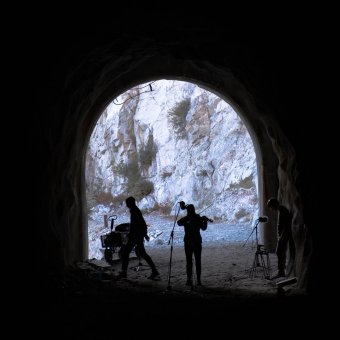 What a lovely piece of art this is. Mueller Tunnel offers a different sort of escapism for me amidst this collective isolation than, say, Jessie Ware’s What’s Your Pleasure?, instead following a trio who aim to become one with surroundings far from civilization. Tim Feeney, Cody Putnam, and Cassia Streb, along with photographer Eric Basta, “hiked in with a wagon full of recording equipment and instruments strapped to their backs,”all of which appear to have been harnessed to create this final product. “windward” begins with the familiar sound of a creaking door—familiar, that is, in a domestic space, but contextually it seems strange in a half-buried mountain tunnel. That’s only true if you’re aware of the recording location before listening, however. Unlike many performances I’ve heard in singular, meaningful spaces, the geometry of the tunnel is largely kept a secret, the oppressive stone walls smothering any reverberating remnants. Shuffling plant matter, chirping birds and other animal noises, receding and approaching footsteps, intimate object clatter, inhales and exhales, the rumble of distant traffic, a train rushing by almost too close for comfort, tentative but sublime violin scratching; all of these elements, whether incidental or intentional or perhaps both, form the three delicate soundscapes that comprise Mueller Tunnel, each its own natural, ebbing coalescence of various sounds, large and small (mostly small, I’d say). The expanse between those large and small sounds is often jarring, especially in “warren,” when the up-to-that-point-constant metal/concrete swirl abruptly ceases, leaving only a distant, ominous, slowly encroaching rumble. From there it evolves into more kinetic, involved improvisation (a term I use cautiously and conditionally, considering the pieces have corresponding graphic scores), miniature rock-slides and cave-ins, space both stretched and punctured by a consistently moving body and the incessant xylophone ring, respectively. Once the fragile ray-of-sunshine string chord drone kicks in, I’m a goner. This album is exactly what I needed this month. Heart eyes (or heart ears? I suppose both, because of the photos) 100%.
Mueller Tunnel can be purchased as both a digital download or a limited edition art book with CD featuring Basta’s photographs here.
Review: Seyarse – Congealed Releases (Zegema Beach, Sep 3)
 Since finding the long-defunct Seyarse (pronounced say-ar-say, which I only just learned) via the tremendous Open Mind / Saturated Brain blog, both their 2003 self-titled 7″ and 2004 split with La Mantra De Fhiqria have been dear favorites. Both of those are collected on Congealed Releases, new cassette/digital release by Zegema Beach, along with a live recording from a performance on 88.7 WLUW, a station in the band’s home town of Chicago. It’s great to finally have “definitive” versions of these tracks, of which I’ve only ever had secondhand rips (the 7″ tracks on Congealed Releases are also just a rip, to be fair, but it is the best rip I’ve heard by far). The following three, which originally alternated in the track list with songs by La Mantra De Fhiqria on an unusually structured single-sided LP, are noticeably punchier and clearer than the digital copies I have, and a chaotic, cacophonous hardcore band can only benefit from a more dynamic sound that still retains a gritty roughness—which this definitely does. The WLUW set is surprisingly well-recorded, and while there wasn’t any unreleased material performed other than a pretty bad ass intro jam. It’s my first time hearing who is presumably the vocalist talk, and his soft, pleasant speaking voice, which emerges to introduce the band and thank various people between most of the songs along with hilariously out-of-place acoustic guitar strumming, is such a great contrast to his shrill shrieks, some of the best I’ve ever heard in emotional hardcore music. For those of you who have never encountered Seyarse, this is the best possible way to be introduced to their powerful, complex, incendiary music.
Review: Suburban Cracked Collective – Swimming Amongst the Dregs (A Colourful Storm, Sep 2)
 There is something so deeply mysterious about Suburban Cracked Collective (the solo project of musician Shaun Leacy), and I’m really can’t put my finger on specifically what it is. It could be the curious mixture of convention and abstraction that forms the very heart of his dense, enigmatic music; maybe it’s the inexplicably wistful, saddening artwork on the covers of many of his releases; I’m not sure. What I do know is that Swimming Amongst the Dregs features Leacy’s most beautiful cover art and music yet, and has kept me coming back nearly every day since it’s release under the false guise of revealing some of its secrets. I have a thing for lush mixtures of room cacophony and gorgeous atmospheric electronica (for my favorite example, check out this field recording I captured several years ago) and thankfully such a pairing is also of immense interest to Leacy, who seamlessly interweaves clattering performances with unknown objects, machines, and god knows what else with undulating currents of sublime synthesizer patchworks whose satisfying harmonic resolutions more than make up for the tension introduced by such unusual counter-elements. I honestly have no idea how these homey yet always slightly industrial cornucopias of subdued metallic cacophony were generated; sometimes they sound like someone just making dinner, others they resemble something more like some sort of homemade Rube Goldberg contraption, and on “It’s All Gone Sideways” an earthy, rhythmic quality is adopted, structuring the LP’s final moments as a hypnotic, languid lumber into silence as the track slowly fades out. When attempting to describe what’s happening on Swimming Amongst the Dregs, I feel as though my foundation is much shakier than usual, even more so than when I’m writing about something completely abstract and detached; I hope I did so well enough to motivate you to check it out. In this case, “something special” is an egregious understatement.
Review: Cold Electric Fire – The Mule (No Rent, Sep 1)
 After an agonizingly long hiatus from new releases—by their standards that is; for a prolific label with near-inhuman efficiency, that put out over 30 tapes in 2018, nearly 40 in 2019, and 17 just in the first four month of this year, five months is an agonizingly long time—the beloved No Rent Records is starting over from catalog number one with a reimagined logo. And what better pair of artists to start things off than Darksmith, who’s never released anything on No Rent and makes for a captivating aesthetic collision, and Cold Electric Fire, whose long-forgotten work was revived in 2018 by the reverently crafted The Alchemist discography double cassette. The Mule is Gary Tedder’s first recorded work since 2002’s In Nights Dream We Are Ghosts, and falls somewhere further along the more abstract, processed trajectory hinted at by the last three tracks on The Alchemist, yet retains everything on that album’s slightly alien but no less comforting warmth. Cold Electric Fire has always been about detail and layers—his work is often, if not all produced by meticulously tracking hundreds and even thousands of separate elements to conjure shifting, lush, kaleidoscopic phantasmagorias of fluid sound—but there seems to be more versatility here, from the dense spacial concrète of “Ferrier” to the seismic, subterranean siren songs of the title track. The Mule, especially at those aforementioned times, can be cold, removed and abstract even, but beauty is never far away from drifting in and hovering naturally like it’s always been there. Tedder conceivably could have made this album at any time, but I like to think of it as a product of the conditions in which we find ourselves now; there’s a peculiar loneliness to this music, not at all unwelcome or discomfiting, but instead the solitary, knowing solace of knowing you’re both alone and not alone.
Mix: Motivational Motorik
A collection of my favorite propulsive, driving motorik(ish) grooves. There’s more of a unifying vibe than that, but you’ll see what I mean. For the most part, the intensity ramps up as it progresses. Use it for a cleaning day or maybe a nice drive.

00:00. Broken Social Scene – “Pacific Theme” from We Forgot It in People (Arts & Crafts, 2002)
04:52. Caudal – “Well, I Suppose” from Fight Cry Fight (Katuktu Collective, 2018)
09:01. Salaryman – “The Companion” from Karoshi (City Slang, 1999)
12:54. Blue Man Group – “3 to 1” from Three (Rhino, 2016)
16:51. Public Service Broadcasting – “Spitfire” from Inform-Educate-Entertain (Test Card, 2013)
20:40. Maserati – “Synchronicity IV” [excerpt] from Inventions for the New Season (Temporary Residence, 2007)
24:35. Pell Mell – “Vegetable Kingdom” from Interstate (DGC, 1995)
30:34. Holy Fuck – “Silva & Grimes” from Latin (Young Turks, 2010)
35:42. Oneida – “The Adversary” from Happy New Year (Jagjaguwar, 2006)
Review: Feghoots – Loiter Adjourned (Beartown, Aug 22)
 Until today, I had no knowledge of Feghoots, the solo project of Leeds artist Pete Cann, but I’m happy that’s changed. His most recent release, Loiter Adjourned, is a masterwork of sleazy, slurred synthesis, dense phantasmagorias of the patches, frequencies, and samples that no one else wanted. The atmosphere is captured well by Paul Tone’s artwork; the seven tracks are extracts from a surreal Videodrome television purgatory, filled with the ghosts of mass media long forgotten, the electrical humming and crackling of digital entities beyond our perception, garbled voices of unwitting human prisoners who accidentally got sucked in through the screen of their home set. There is… some semblance of space here but it doesn’t work the same way; Cann’s arrangements and layerings sit naturally, but think too hard about the actual geometry of what is happening and the brain immediately goes kaput. Erroneous signal chatter, the buzzing whine of a cable half plugged in, dead air possessed by dismal spirits, some sublimely inaccurate manual channel surfing—it’s all amplified via the mysterious magnifier/manufacturer/manipulator that is the modular synthesizer and glued together with peculiar panache.
Loiter Adjourned is also available for streaming and name-your-price download here.
 Noise Not Music