
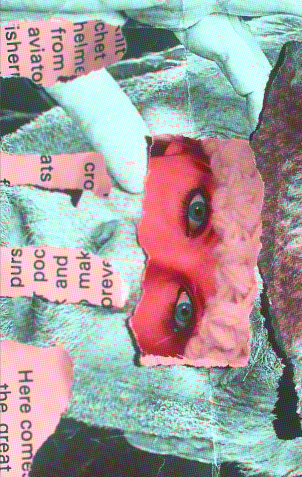
 Smisao Života Je Sloboda is one of the most immersive wall noise releases I have heard in a long time. The entire tape runs just under an hour and a half, and though you’ll hear the same thing if you listen to each track for five minutes or their entire duration, this is music to truly get lost in. The first time I listened, I didn’t even plan to get through the whole thing, but found that the hypnotic, stagnant noise put me into a trance-like state. These walls are masterfully crafted, somehow revealing more elements as time progresses without actually changing at all. The static collages of textures are truly astounding, balancing bassy rumblings with lively electrical crackles, almost sounding like a gigantic mountain collapsing in on itself in slow motion. I often compare wall noise in general, and especially stuff like this, to a piece of visual art like a painting or sculpture; it doesn’t change no matter how long you observe it, but more its subtle details and facets become clear the longer you look. Dosis Letalis’ music is something really special; it actively takes a hold of me and doesn’t let go until the wall is over, and then somehow makes me want to listen again. Thankfully, Smisao Života Je Sloboda is no exception.
Author: Jack Davidson
I like to listen to, read and write about, and play music.
Review: David Grubbs & Taku Unami – Failed Celestial Creatures (Empty Editions, May 11)
 This is a collaboration that I did not see coming. Certainly, Grubbs and Unami are both accomplished guitarists, each having amassed a considerable catalog of work since the turn of the century; but for some reason seeing their names side by side is still odd to me. Maybe it’s the fact that I associate the two with vastly different styles of music – but as it happens, the musicians’ contrasting backgrounds are part of what makes Failed Celestial Creatures so special. I can hear both Grubbs’ fantastic melodic ability and Unami’s textural, poetic phrasings here; but each seems to have adapted the other’s style into their own, and as a result the two guitars end up being two sides of the same coin rather than opposing forces. And oh man, is it beautiful. The guitars are untouched by invasive effects or manipulation, their clean, pure notes hanging in midair like sweet-smelling smoke before dissipating. Despite the limited palette, Failed Celestial Creatures never fails to captivate, even during the long title track. I was initially disappointed to hear vocals on “The Forest Dictation,” but even those were a welcome addition, fleshing out the vivid imagery somehow supplied by only two instruments. Many times throughout the album, you can almost visualize Grubbs and Unami making eye contact and slightly raising their guitars before striking a beautiful chord in fragile unison. It’s an astounding and intimate experience.
The album is available on most streaming services. Purchase the lossless digital files here. I was unable to find a link to a physical copy.
Review: Wallfahrer – Anthologie Der Abkehr (self-released, Apr 27)
 With Anthologie Der Abkehr, German newcomers Wallfahrer present a fantastic album of classic atmospheric black metal. No, there’s nothing particularly new here, but the throwback sound is done so well and with just enough originality that there’s nothing I could possibly complain about. Each track is unique without stepping too far from the other parts of the album, and each is over the listener is left with a sense of completeness and satisfaction – but also a burning anticipation for what comes next. Wallfahrer also displays an admirable ear for subtle melody, writing riffs I’d even call catchy but never compromising the atmospheric aspect. A prime example is “Wildes Heer (Epilog Des Herbstes),” which is built upon a number of earworms that prevent it from fading into the background, but the murky soup of effects and the distant howls prevent the melodies from taking over. The musicianship is stellar, the songwriting impeccable, the length perfect… I truly think this album could be appreciated by black metal purists and newcomers alike, and accomplishes the difficult task of simultaneously sounding like a blast from the past and a breath of fresh air.
Review: Needful Things / Overviolence Split (Nerve Altar, Apr 11)
 On this short 7-inch split from New York hardcore label Nerve Altar, both bands present four minutes of pulverizing grind-violence. Czech shredders Needful Things’ tracks are longer and more varied, alternating between driving d-beat crust punk and exhilarating blast sections. The songwriting is impeccable, something that isn’t necessary in this type of music but is very welcome nonetheless; from the cascading riffs to the brief flashes of silent anticipation before the chaos on “Hands Full of Sludge,” each track is memorable and powerful on its own. By contrast, Overviolence’s side is made up of much shorter, more direct assaults. The dual vocals between members Esse and Henke are a major highlight. I’m not sure who does the throaty growls and who shrieks, but the presence of both really helps the songs carry even more weight. Look no further than final track “Plockas och Krossas” for an example of Overviolence’s kickassery; the chants of both vocalists belting the titular phrase atop furious drumming and guitar work make it some of the most fulfilling 25 seconds in recent memory.
This is a reissue of the original release; the physical edition is available here. Make sure to check out the upcoming split LP between Water Torture and Stimulant, also on Nerve Altar – it’s going to be amazing.
Review: Sissy Spacek – L/L (Helicopter, May 7)
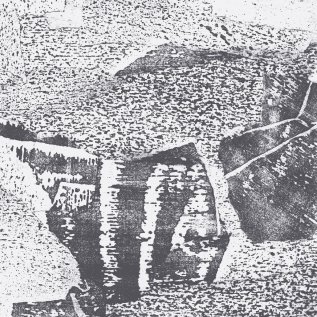 Listening to a new Sissy Spacek album is always a toss-up. The music put out by John Wiese and crew ranges from blistering noisegrind to bizarre musique concrète miniatures to full-blown harsh noise assaults, with the only common denominator being top-notch quality. L/L, one of two new CDs from the project released on Helicopter yesterday, is constructed from recordings from their ensemble tour back in January of this year. Its spastic group improvisations recall some of my favorite material from Sissy Spacek, the performances of Wiese’s visual scores for ensemble in Los Angeles and Oakland; but here even the minute restrictions are lifted. The first and longest track, “Distance,” highlights legendary percussionist Tim Barnes’ textural, free-form drumming; Wiese’s chunky electronics and tape manipulations; and what sounds like trumpet and guitar from two musicians with whom I am unfamiliar. Unbounded by any sort of formal direction or control, it is somehow both aimless and purposeful, reveling in the interactions between the instruments but never sticking around in the same place too long. There are even moments of beauty here too. The muffled sample breaking through the fragile cacophony midway through “Distance” and the unearthly ambiance of “City Limits” are surprisingly sublime; and even the ugliest bits, like the freakish climax of “Horse People,” are exhilarating in a way only Sissy Spacek can pull off.
Pick up the CD here.
Review: Black Moth Super Rainbow – Panic Blooms (Rad Cult, May 4)
 Black Moth Super Rainbow (hereafter BMSR) are back, and with possibly their best album yet. It’s the band’s first full-length since 2012; but the music feels as fresh as ever, and that youthful charm and wonder that makes me love BMSR’s music is still present – albeit with a more serious edge. Gone are the sickeningly sweet, noise-drenched dance songs of Cobra Juicy, in favor of a woozier, more subdued atmosphere that’s somewhat reminiscent of the band’s earlier work. But where those albums were sunny and warm, Panic Blooms is nocturnal and depressive, steeped in internal turmoil and emotion. Frontman and vocalist Tobacco’s heartbreaking lyrics hit close to home too often, and their impact is only intensified by his frail delivery and the multitude of effects that frame his voice, especially the glitchy fragmenting on “New Breeze.” It feels like more of a collaborative effort this time around; unlike Cobra Juicy, Tobacco’s predilection for energetic electronica is tempered by Maureen Boyle’s (The Seven Fields of Aphelion) airy ambiance, Ryan Graveface’s haunted folkisms, and others. Each time I listen (which has been many times since it came out) I like Panic Blooms even more, and it makes me really hope that BMSR will be back with more music soon.
Review: Blank Realm – Last Seen (Hobbies Galore, Apr 30)
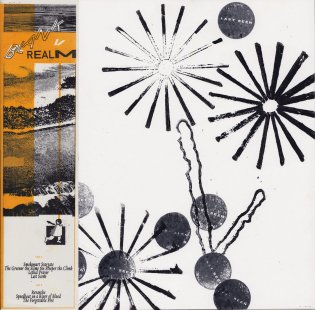 Last Seen is nothing like what I expected it to be. Based on Australian project Blank Realm’s stylistic trajectory on their last few records, one would probably anticipate a slightly adventurous rock outing with some psychedelic leanings. Instead, Last Seen embraces an almost completely new sound, flirting with a variety of elements from ambient, drone, and electronic music. Fortunately, unlike comparable progressions of other artists, the move toward a less rhythmically grounded style does not result in a directionless mess. The 7 songs balance catchy, synth-inflected pop pieces with lengthy ambient passages, both of which are accomplished remarkably well. The highlight of the record might be the ten minute centerpiece “Revanche,” which evolves from a lush drone into a hazy, psychedelic coda; not only is it an amazing track on its own, but it also serves as a demonstration of the skillful transitions that allow the album to work so well. Last Seen marks an exciting new phase in Blank Realm’s career, and I’m glad that they chose to be inventive and take risks rather than recycle what they know works. It’s an album with a lot of layers that I still have to unravel.
Review: Jiang XiaMeng – Mixing Board, Contact Microphone, Pedals, and Objects with Two Recordings (self-released, May 3)
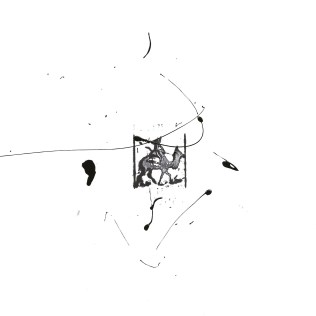 On Louis Schumacher’s second release as Jiang XiaMeng, he aims to “take onkyo and noise from their usual contexts and place them in the mundane world.” This is accomplished via the duality found on both tracks, each composed of extended field recordings and active improvisations using the components described in the album’s title. The contrast achieved is an interesting one. On “真っ白,” impossibly thin feedback loops and the quiet use of objects form unique harmonies with the sounds of people entering and exiting a library, while “真っホワイト” sees much noisier mixer and pedal manipulation placed atop a recording of a busy road at night. These juxtapositions are odd, to be sure, but also fascinating and pretty. There are subtle similarities to be found here: the opening and closing of the metal door on “真っ白” bears resemblance to the mechanical feedback, and the artificial whooshings of “真っホワイト” are not unlike the distant sound of the cars passing by. It’s an unlikely result that gives the album a charm despite its obstinance, and allows even the most unusual and difficult sounds to have their own beauty.
Event: Lustmord at the COSI Planetarium (May 26, 7/9 p.m.)
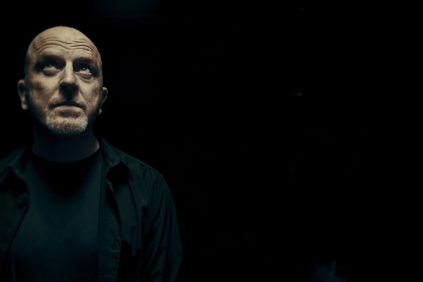 This amazing event is being put on by the Fuse Factory Electronic and Digital Arts Lab. Legendary ambient composer and musician Brian Williams, a.k.a. Lustmord, will be putting on two performances at the planetarium of the Center of Science and Industry, located in downtown Columbus. Lustmord is famous for his trance-inducing ambient music and immersive accompanying visuals, and these shows are sure to be some of his most ambitious and incredible events yet. Tickets can be purchased here for the 7 p.m. show and here for the 9 p.m. show (one ticket will not grant admission to both). This is truly a once-in-a-lifetime experience. (Clicking the image above will redirect to the event’s Facebook page, which has more information)
Review: Dyb – Un punto donde todo se desvanece (self-released, Apr 12)
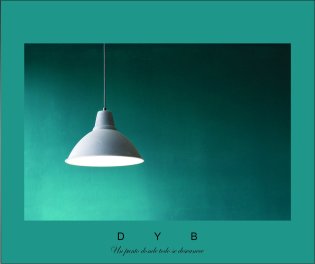 Un punto donde todo se desvanece is an album that toys with beauty, teasing you with moments of gorgeousness amidst tension and darkness before they dissolve and you’re left wanting so much more. While the first two tracks eventually reward patience with majestic climaxes, the third, “El llamado imperceptible,” works magic through tantalization. Its airy choral samples and distant electronic flairs expand and contract with amazing ease, with brief respites in anticipation only occasionally granted throughout its extended length; a structure that somehow makes it even more sublime than the wonderful songs that preceded it. Argentinian musician Dyb displays a tremendous patience and compositional skill on Un punto donde todo se desvanece; this is music that really takes its time, but at nearly an hour in length it doesn’t even feel very long. Nothing feels forced or pushed along faster than it needs to be, but nothing overstays its welcome either. It’s a fantastic release from this promising artist, from whom I would definitely love to hear more in the future.
 Noise Not Music