
 Sunn Trio further explores and refines their unique brand of Arabian-informed raw drone-rock on Fayrus, their second studio album after last year’s self-titled LP. Looking at the liner notes, I can’t help be reminded of the hilariously overstated credits included with Sun City Girls’ Torch of the Mystics, which included, among other things, ‘algebraic percussion,’ ‘ambient and terminally fatal ear poison,’ ‘blood of the moon lute,’ and ‘forward subliminal messages.’ The influence of the Girls on Sunn Trio’s distinct style is undeniable, but as far as I could tell every instrument listed was used on this ceaselessly eclectic record, from gongs and tamburas to shortwave radios and Gameboys. “Shayatin” and “Al-Rijal Al-Khafiya” start things off with a fiery bang, threading hypnotic harmonic minor unison riffs into fluid drumming that seems half rhythmic and half freely improvised. The next two tracks venture into some darker, electronics-heavy soundscapes, which only makes the furious loose grooves of Al-Ghayb even more incendiary. As if Fayrus wasn’t diverse enough already, “Mukhbir” takes us into swinging bebop territory, with saxophone solos and walking bass gradually being drowned out by radio interference and dissonance. At every instant on this album, every performer seems perfectly in sync with and aware of each other, no matter how disparate their playing is, and it’s this unity that keeps the ecstatically overstuffed LP from falling apart at the seams.
Author: Jack Davidson
I like to listen to, read and write about, and play music.
Review: Mary Jane Leach – (f)lute songs (Modern Love, Nov 2)
 (f)lute songs is a collection of pieces composed by artist Mary Jane Leach, almost entirely written for sustained tones played by flutes and voice. Trio for Duo, composed in 1985, features four components, of which only three are present at a given time. The notes, created by alto flutes and voice (I had no idea there were any other sounds other than flutes until I read more about the album; the vocal drones are nearly indiscernable from the others), phase in and out of the stereo mix. Carefully played glissandos create slight dissonance, bringing natural, fluid tension into the cascading strings of pure harmonic tones. The constant movement of the separate parts allows for simultaneous resolution and introduction of new, subtle agitation; the harmonies that arise are beautiful and uneasy, never one without the other. Dowland’s Tears (2011), for nine flutes, explores similar territory, but with more movement; each instrument plays a somber descending melody at differing intervals, again creating fascinating phase effects. Semper Dolens (2018) uncovers light from darkness, with gorgeous chords rising from the melancholy phrases—the higher notes entering at around the three minute mark are breathtaking—and Bruckstück (1989) is possibly the most beautiful piece, letting the listener hear the soft breaths of the performer as they play each note. (f)lute songs is truly wonderful, captivating music, whether you want to read about the techniques used or not.
Review: Komare – Komare (Round Bale Recordings, Nov 1)
 Some of you may have read my review of Mosquitoes’ Drip Water Hollow Out Stone 12″ that came out earlier this year, in which I gushed about its bizarre, broken groove jaunts and unique deconstruction of the rock format. In fact, I still gush about that album to most people I talk to about music; it’s that good. Komare, a newer project that consists of two members of Mosquitoes (I can’t find much about the identities of the members of either band), explores similar territory with an even more detached and alien approach on their self-titled debut. The same unintelligible vocalizations are muttered and groaned over sputtering, half-formed industrial rhythms, with the spidery bass work also returning. The soundscapes built with this sparse palette are cold and intense, and range from the short burst of loud, confrontational dissonance on “Orientation” to long form atmospherics with creeping synth buzz and vocal effects that sound like a crowd of dying robots on “Ice Belt”—and these two tracks are right next to each other! Komare covers a lot of ground, but it always keeps things patient and restrained, with something unfamiliar always lurking in the shadows. It’s a distinct project from Mosquitoes, with entirely different things to offer, but the two are still a bit similar in that they are the only artists that can create this immersive and harrowing atmosphere.
Review: Olan Mill – Variations on the Letter H (Unknown Tone, Oct 31)
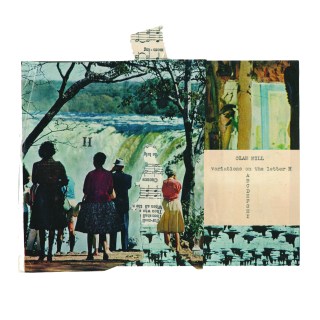 Variations on the Letter H, or most of Olan Mill’s work for that matter, is far from what I would consider “my kind” of ambient music. The project, conceived and led by musician Alex Smalley, deals with the intersections of ambient with neo-classical composition and largely produces airy clouds of reverb with a beautiful and slightly haunting atmosphere. Not really my style, but Variations on the Letter H is apparently one of Olan Mill’s last official releases, so I figured I’d give it a shot. I’m glad I did; Variations subverts any tropes about which I’d usually have reservations, swapping out long and indulgent tracks for short, digestible vignettes. The sonic palette on display here is nothing new or terribly exciting, but you’ll be too caught up in the warm, seraphic beauty to really notice. Processed pipe organ melodies, soft warbles of buried field recordings, and even less identifiable elements are layered to create spacious, shifting soundscapes that drift with brevity and purpose. Smalley continues to work with shorter song durations, a decision that complements his compositions well. Each piece takes its own direction; for example, the largely stagnant “E” brings in gorgeous high-pitched tones, and “G” persistently rises to a peak above the clouds. “I” couldn’t have been a better closer, with its throaty low drones pulling everything back down to earth. Recommended for insomniacs.
Review: Creep Stare – Pain Game (Youth Attack, Oct 31)
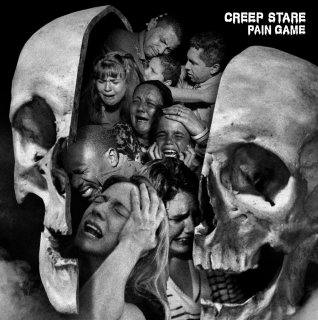 Youth Attack is one of those labels that rarely surprises me, but I wouldn’t want it any other way; the thrash-punk/modern hardcore sound that dominates many of their releases never gets old—or even close to old, for that matter. I can’t even count the number of times I’ve spun Vile Gash’s Nightmare in a Damaged Brain LP from earlier this year, and Cadaver Dog’s Dying Breed is one I’ve been coming back to a lot lately. Creep Stare adds to the 2018 roster with their mini-album Pain Game, presenting ten short tracks full of misanthropic punk fire. Creep Stare’s style is fresh and exciting, but it also harkens back to old-school hardcore in a variety of ways and fills a different niche than the faster and brasher aforementioned releases. Josh Everett’s vocals occupy a perfect middle ground between NY gruffness and harsh, shrill bite, ranting over the galloping drums (played by James Trejo, who is also the sole member of Cadaver Dog) and crunching guitars. There’s something that just clicks about this tried-and-true combination, especially on tracks like “Said and Done” where well-placed crashes synchronize with the vocals, unifying all the elements into a steamroller of sound. Accentuated with a decidedly modern edge, Pain Game will be filling many spare 7-minute stretches for me in the future.
Review: Poppy – Am I a Girl? (Mad Decent, Oct 31)
 On Halloween we were rewarded with a spooky surprise: a new Poppy album. Some of you may be aware of Moriah Rose Pereira’s bizarre online persona and surreal Youtube videos, but it honestly might be better to go into Am I a Girl? without knowing anything about her. The opening quartet of tracks, spearheaded by the saccharine grooves of “In a Minute,” are all first-class electropop songs. Poppy’s cutesy, bubblegum vocals are commanding and infectiously catchy, and coupled with the sleek synthy production the album is off to a irresistibly danceable start. For the most part, the Poppy character isn’t at the forefront of most of the songs, making Am I a Girl? a more universal record than its predecessor Poppy.Computer, but fans looking for Poppy’s satirical bite and uncanny valley-ness will still be satisfied. The two instrumental interludes divide the album roughly into thirds, and segue between dance floors with some pretty enthralling soundscapes. They’re short and I’m not surprised they don’t get as much focus as the main songs, but they’re also an example of how adventurous Am I a Girl? gets; but nothing can prepare for the final trio of songs. The title track sees Poppy singing unexpectedly poignant musings about gender over some of the album’s best production, and gives us an amazing anthem chorus complete with meaty alt metal guitars. “Play Destroy” dials up the metal even more and makes me long for a Poppy/Grimes collaboration. Along with the massive closer “X” there are countless crazy whiplash style changes that are just so much fun. I really want a whole album of this insane metal-pop combination but Am I a Girl? gives me nothing to complain about.
Review: Guttersnipe – My Mother the Vent (Upset the Rhythm, Oct 26)
 Brutal. There is no other word that more accurately describes My Mother the Vent. There are neither brakes nor breaks on this unstoppable train of scalding noise, constructed, mind-bogglingly produced solely by the duo of Uroceras Gigas and Tipula Confusa. The cryptically titled opening tracks—though now that I look through the track list pretty much every track has a bizarre title—”Loaded From the Vector Trap” and “Like My Voice Was Holothurin” pound into submission with jagged freely improvised guitars, punishing drum work, and completely deranged screams and shrieks. As a whole, My Mother the Vent explores the edge of technicality, playing complex rhythms until they collapse and then picking up the pieces. “Stromatolite’s Kiss” is nothing short of exhausting; it wraps rusting metal limbs around the listener and pulls them into its nightmarish landscape of insanity and ruin. And just when you can’t take anymore of the meandering sections, a vicious blast beat enters and destroys everything in its path. I’m being hyperbolic as usual, but this album is so overwhelming that I can’t help it. “Pipa Pipa Portalspawn” descends into an evil groove, the chugging drums and guitar creating a dark, oppressive atmosphere, before we are launched into the ten minute opus “God’s Will to Gain Access.” It’s a fitting end, cramming as much violent excess before everything explodes at the end, leaving only a confusing, even pretty ambient conclusion. This is one of those albums that feels so much longer than it actually is, but in a good way.
Review: Vertonen – Hostage Exchange (No Rent, Oct 18)
“What makes you think I am entitled to my own opinion?”
Hostage Exchange is easily one of the most cryptic releases I’ve encountered this year. It’s yet another instance of a No Rent release introducing me to a great new artist, but somehow I don’t think being familiar with Blake Edwards’ past work as Vertonen would be much help in deciphering the arcane sounds harnessed on this tape. Edwards sculpts janky, unpredictable soundscapes from devices and field recordings, and when I say unpredictable, I mean it; there’s a flash of punishing noise midway through the first side that scared the living daylights out of me (happy Halloween, I guess). What interests me most about this release, however, is how the disparate elements clash and the ways in those juxtapositions change how the listener feels. Recordings of soft footfalls and bird calls that might have been peaceful on their own are unseated by mechanical clicks and buzzes, casting those familiar textures in a less unidentifiable light. The battles between elements are sometimes very physical, especially during part C of the second side when Edwards literally blasts away the sounds of people murmuring and milling around with an unyielding wave of squalling noise. Needless to say, Hostage Exchange gives the listener a lot to think about.
“Damn, what the hell was that??”
Review: Charles Barabé – La Révision (Archive Officielle Publications, Oct 25)
 Ever since I fell in love with Charles Barabé’s 2016 double-tape opus Cicatrices I get tremendously excited whenever I see that he has a new release out. It’s a different kind of anticipation, however, than for most other artists, from whom I usually know some of what to expect; with Barabé, I have absolutely no idea what each album will sound like. Cicatrices II had a much heavier focus on collaging and sampling than the original, this year’s De la fragilité was totally unique in its use of classical music excerpts, and now La Révision is its own beast as well. Culled from sound experiments recorded fifteen years ago, the CD’s two pieces utilize a very focused palette, a far cry from the other aforementioned releases. Each builds into thin, fragile drones, floating through mechanical darkness, electric whirring and crackling, unsettling thumps and rattles, and airy gusts that sound like they were recorded in a giant ventilation shaft. Though the album is, first and foremost, a ‘revision’ (surprising, I know), Barabé’s sampling of his own recordings manifests as fluid, natural shifts in texture and ideas, a fascinating new direction for the seasoned sound artist. I obviously haven’t spent as much time with La Révision as I have with Cicatrices, I can see it becoming my new favorite of Barabé’s.
Review: The All Golden – Harmonograph (Modern Aviation, Oct 24)
 I don’t really consider myself to be a ‘visual person,’ but I can’t deny the fact that album covers heavily influence which music I try out. I realize I probably miss out on some great releases with terrible covers, but hey, I have to whittle down this never-ending barrage of new music somehow. I had no idea what kind of music I would find on Harmonograph when I saved it, but I knew I had to because the artwork (done by Sarah Batchelor) is beyond gorgeous. Thankfully, so are the songs. The multi-instrumentalist Pete Gofton performs here as The All Golden, and uses the tape as a kind of musical sketchbook; each track is a small vignette of various permutations of guitar, electronics, and field recordings. I’m unfamiliar with Gofton’s other music, but he certainly has a great ear for both melody and texture, stuffing just the right amount of each into the songs. It’s difficult to make and develop interesting compositions when the tracks fly by this fast, but each ends up holding its own amidst the flood: “Big Wednesday” braids cloying synth grit with an electronic drum loop, “Sevdah” uses simple rhythms as a springboard for constructing sunny ambience, “Harmonograph” keeps it simple with magnetic, stomping fingerpicked acoustic guitar. I do think that Harmonograph would be much stronger if there was less use of the drum machine, but the rest is well-constructed and pretty as hell. It just takes a little over twenty minutes to listen, so check it out!
 Noise Not Music