
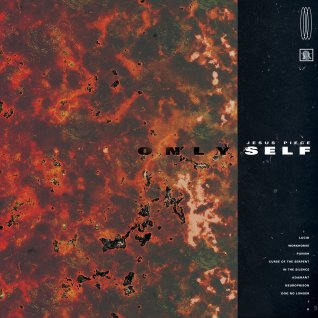
 There are a hell of a lot of metalcore acts out there. Now more than ever, as the genre approaches the end of its third decade of existence, it’s difficult for bands to stand out while remaining somewhat true to the original sound. Philadelphia quintet Jesus Piece’s debut full-length Only Self is definitely one of the most refreshingly creative albums that still pays significant homage to the classic metalcore style. They bring progressive song structures and some pretty entertainingly crusty old school death metal inclinations into the mix, an efficient arsenal of eccentricities that never detract from what we all love about this stuff. Yes, there are plenty of breakdowns, and thankfully they’re equal parts unpredictable and crushing, employing angular riffs and breaths of silence that only emphasize the heaviness. “In the Silence,” one of the record’s longest tracks that ends the A side, concludes with a labyrinthine sequence of off-kilter rhythms and crunching double bass pounds. This one also precludes what is in my opinion the best part of Only Self, the three song stretch from “Adamant” to “Dog No Longer,” the latter showing the strongest OSDM influences. Unfortunately, the final two songs put way too much stock in some weak ambient noodling and halfheartedly ends what could have been a concise and dense record. Still, for a first album it’s pretty damn awesome, and once again it’s so great to see a classic metalcore release in 2018 that has me headbanging this hard.
Category: Reviews
Brief summaries intended to describe and express my enjoyment of albums. My opinions are not the focus: I purely seek to facilitate discovery.
Review: Matthew Revert – Letters to Friends of the Late Darcy O’Meara (Round Bale Recordings, Jul 9)
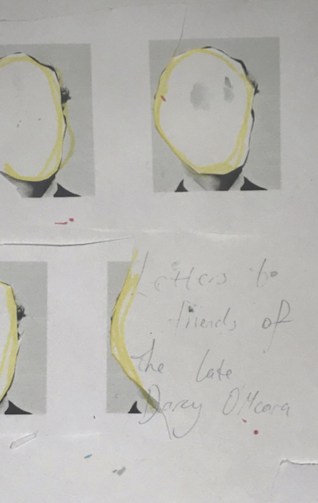 Every once in a while, even within the area of experimental music where styles and sounds are often quite singular, an album comes along that is so absolutely unique that I find it difficult to express my thoughts on it. Letters to Friends of the Late Darcy O’Meara exemplifies that more than any other album of which I can think. It’s without a doubt multi-disciplinary artist Matthew Revert’s most uncompromising and esoteric release, even compared to his already strange and innovative body of work, and it’s also his best. Working with a starkly limited palette of solely low fidelity tape recordings of his own voice and mouth sounds, Revert constructs uncomfortably intimate and charmingly bizarre pieces that completely capture your attention. Despite their sparse, humble origins, the eight tracks are satisfyingly diverse, ranging from the chaotic collage of “Dear Penny” to the unsettling minimal tape-noise soundscapes of the following “Dear Saint Marcus.” While it’s clearly a conceptual album, Revert offers very little explanation as to the meaning behind Letters to Friends…, and the cryptic “letters” themselves that are as much abstract sound poetry as they are intelligible speech don’t help much either. But there is something so profoundly but inexplicably emotional about this music, and you really just have to listen to understand that, because I sure as hell can’t tell you about it myself. “With love, Matthew Revert.”
Review: Buck Young – Proud Trash Sound (No Rent, Jul 24)
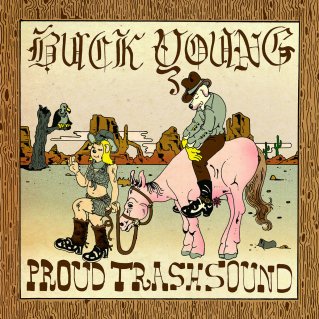
From its opening moments, it’s clear that Proud Trash Sound will probably place among the most unique albums you’ve ever heard. “Trash Sound,” a rough, jagged cocktail of farm animal sounds, primitive guitar melodies, and a sunny beauty that hides under the muck, sets the stage well for the rest of the record. Buck Young masterminds Jason Crumer and Zoe Burke (Sapphogeist) enlist a host of collaborators, including Christian Mirande, Matthew Schuff, and Alan Jones, to craft marvelously messy sonic paintings of a surreal Wild West. I’m going to be honest; going in to my first listen back when the album was first released on cassette, I didn’t expect this bat shit insane formula to accomplish anything beyond novelty appeal. But wow, was I wrong. These chaotic collages of dirty country tunes, obscure recordings, and Crumer’s trademark blasts of cathartic harsh noise initially seem random and slipshod, but further listening reveals a level of care in composition that seems to contradict the source material. This is where the charm of Proud Trash Sound is found; who else could stitch together such disparate elements into songs that are simultaneously hilarious, punishing, thrilling, and arrestingly gorgeous? Who else could follow up an amateurish guitar stomp about pussy pains and fuckboys with one of the most sublime, emotional tributes I’ve heard (rest in peace Mr. Christopher Alan Murdoch)? Buck Young, that’s who, and I sure hope they keep it up.
Proud Trash Sound was initially released as a cassette earlier this year, which has since sold out. You can (and should) purchase the LP version here.
Review: Mordan Jaikel – Open Your Lie (Mascarpone, Aug 10)
 This diminutive but dense cassette by American project Mordan Jaikel is chock full of haphazard, cut and paste fun. Romping through 30 tracks in 27 minutes, Open Your Lie plunders a colorful toy box of sounds full of everything from plasticky synth melodies and zolo-esque prog miniatures to quirky spoken word and processed concrète samples. The segmented, almost schizophrenic vignette format works well for Mordan Jaikel’s music, for as much of its charm comes from the unexpected changes and impermanence as the eccentric collages themselves. From the hilarious speech manipulations of opening piece “Good Morning,” it’s clear that Open Your Lie is unafraid to explore both the playfully surreal and the unsettlingly cryptic; the latter is less present but crops up on oddities like penultimate track “Fire Machine,” in which a heavily affected recording creates a brief but spellbinding dark atmosphere. It’s amazing how these minuscule pieces construct their own little worlds and stories, which are almost immediately torn down and rearranged by the ones after.
Review: R. Schwarz – Wind 4-7 (Audio. Visuals. Atmosphere., Jul 19)
 R. Schwarz’s new tape collects “four more exposures of the universal wonder of wind congealing in a compact cauldron.” While wind, like much of nature, is a powerful but ultimately neutral force, the sounds on Wind 4-7 manifest in a dark, mysterious, even unsettling atmosphere. The pieces move along at a lethargic pace, their abstract structures consisting of both the sound of wind itself and clattering, clinking objects that are set in motion by it. On “4” and “6” especially, these objects, whose identity is unknown but sound to me like an assortment of wind chimes, aerophones, tubes, etc, create hauntingly tactile textures. It’s unclear just how processed these sounds are – at the very least they are sequenced, layered, and mixed with each other – but for the most part the music is quite bare and neutral, which makes its eeriness even more profound. There’s still light outside, but a storm is coming; the clouds begin to smother the sun, a chill descends, and the ever-present wind picks up its pace to whip your hair back from your face and rattle everything around you. Schwarz has done well with the elusive task of harnessing and manipulating such a primordial entity while preserving its energy.
Review: World – World (Dotsmark, Aug 22)
 While I don’t actually have the lovely white CD in my hands, I thought I’d talk a bit about World’s amazing and influential music in celebration of their revamped discography compilation out on Dotsmark today. World was a vicious noise-grind trio from the endlessly fruitful creative hub of Osaka, Japan, who recorded and performed with their unique lineup of dual vocalists Hiroshi Zen and Akira Kawabata and drummer Aono Tadahiko. Restricted to a pair of 7″ EPs, splits with YesMeansYes and C*****e Bastards, and some tracks for a few various artist compilations, World’s output is mainly characterized by relentless stop/start blast beats, squalling feedback and crushing distortion, and agonized wordless shrieks. They fills a special place between the semi-improvised amateur chaos of noisecore or “shitcore” music and the compact, composed songs of grindcore, embodying the best elements of both and giving your bones a good rattle while they’re at it. The Dotsmark release, simply titled World, includes everything previously released on Ormolycka’s 2014 Discography release as well as a 1995 demo and two more series of tracks from V/A comps.
Review: Jeremy Hegge – Six Days in Townsville (self-released, Aug 20)
 Field recorder Jeremy Hegge’s albums are reverent auditory documents of places in nature. Acting as a passive observer, Hegge presents high-fidelity recordings of the harmonies of nature, from cacophonous clusters of animal calls to the soft sounds of moving wind or water. Six Days in Townsville is a collection of eight short pieces collected in and near the eponymous city of Townsville in Queensland, Australia, and explores a wide variety of sounds throughout these areas. As always, Hegge’s recording and mastering is of the highest quality, and the keeping of each element’s original orientation in the stereo range ensures absolute immersion and faithful reconstruction of the space. In addition to his usual interest in the noises made by birds and frogs and the like, Hegge also captures less familiar, more abstract textures, like the syrupy rumbles of “Parched earth, wet” and the low buzz of “Humming dusk, red clouds.” For me, these recordings uncannily portray that tense, electric feeling often present in the warm, dry twilight, like something big is about to happen. Ultimately though, just like physically being in nature, everyone’s relationship with these sounds will be different, and at the very least you can enjoy the vivid sonic environments on a purely superficial level; they’re pretty therapeutic.
Review: | RG | – Blush (A R C H I V E, Aug 13)
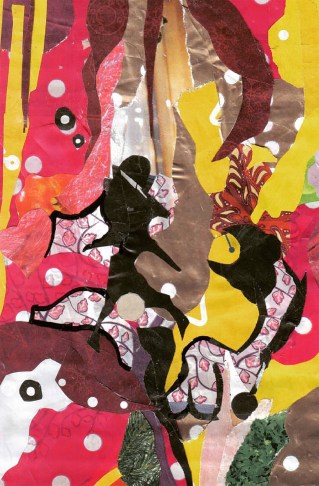 Ambient music serves different purposes for different people. Some fall asleep to it, others use it as background music for reading or studying, etc. For me, it fills many needs, and the mark of a great ambient album in my mind is its versatility. Blush, the new tape by Belgian artist | RG |, conceals a myriad of valuable elements within its unassuming, calm atmosphere. It’s certainly music you can drift away to, and makes sure to stay out of your way if some intense thinking is on the docket, but | RG | has ensured that these soft sounds have substance. There’s a distinct tangibility to many of the reverb-drenched drones, implying a musique concrète methodology, and especially in tracks like “Sink Shots” close attention will reveal very physical constructions beneath the clouds of fuzzy ambiance. This long piece is the tape’s strongest, delving the deepest into the harmonies between the corporeal and treated sounds used. Stretches like the middle section make me wish this was explored more in the rest of the album, but it also shows that | RG | is drawing from a very deep pool of material with admirable restraint. This restraint is what makes Blush a much more universally appreciable album, and allows it to complement both distracted activity and focused listening.
Review: Ariana Grande – Sweetener (Republic, Aug 17)
 I expect a lot from the artists I love, so much so that I am often way too critical of their new creative efforts. And as the lead-up to the release of Ariana Grande’s fourth studio album, Sweetener, began, I went a bit overboard. Despite liking the first single, “No Tears Left to Cry,” a veritable blizzard of complaints would inevitably be uttered whenever Grande was brought up. But I was being ridiculous. Did I think that “The Light Is Coming” was a bad song with bizarre production choices and annoying repetition, and that “God Is a Woman” was overindulgent and had one of the trashiest music videos I’d ever seen? Yes. Was I annoyed that there was to be a song on the new album named after Grande’s latest beau? Yes. Was I completely lying to myself and being melodramatic when I swore to never listen to Sweetener? Absolutely, and I’m glad I was. This record is ambitious, sprawling, and imperfect, but it’s also fantastic. All of my doubts were soothed by the surprisingly well-ordered track list and flow, and I’ve even come around on both of the aforementioned singles. “R.E.M.” and “Sweetener” are new favorites, both instances of the perfect production evolution from the bombastic dance instrumentals of Dangerous Woman to this record’s increased use of electronic music and trap flavors. In my opinion, Sweetener sort of falls apart at the end, with the unneeded “Pete Davidson” and the lengthy closer “Get Well Soon,” but hey, I’ve flip-flopped on basically everything else so who knows how I’ll feel about it in a week. Sweetener is no Dangerous Woman, but I was way too hard on an artist I love and respect when I should have put more faith in her. Thank you Ariana, as always.
Review: Fousek / Hansen / Tellier-Craig – No Way of Knowing (Never Anything, Aug 15)

Sound experimenters Karl Fousek, Devon Hansen, and Robert Tellier-Craig come together in this trio to create lush electronic soundscapes. After releases on Dinzu Artefacts and Spring Break Tapes over the past two years, their new tape on Never Anything, No Way of Knowing, is a short C30 filled with spacious electroacoustic constructions, the two pieces (it’s uncertain whether the music is composed or improvised) floating and swelling through different combinations of textures. It’s difficult to tell who contributed which sounds, but it’s not difficult to discern that these musicians really understand how to play well with each other; each element enters at the perfect time to complement and be complemented by the others already present. I’ve noticed at least three unifying categories of timbres used: the synthetic and mechanical, the airy and ethereal, and the organic and tactile. This latter group of sounds is probably the most unique characteristic of No Way of Knowing, and includes things resembling anything from footsteps in puddles to the rustling of dewy leaves; an obvious (but gorgeous) contrast to the tape’s more artificial facets.
 Noise Not Music