
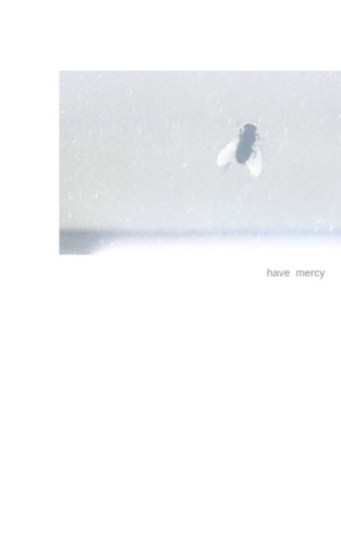
 Though have mercy runs just 17 minutes, its structure is clearly defined and it feels perfectly paced. The new tape from Turin, Italy–based sound artist Edoardo Cammisa (who releases music as Banished Pills) makes use of sounds as fleeting and diminutive as its short duration, finding a delicate beauty in the textures of clattering objects and choice bits of warbly synthesis. The opening trilogy of tracks, “bonds_I-III,” begins with a Small Cruel Party–esque symphony of closely recorded rattle and rustle, with the first piece exploring the entirety of the stereo field while retaining a palpable sense of empty space (it’s this latter quality that engendered my SCP comparison, I think). Things get even sparser with “II,” in which an array of domestic recordings forms a skeletal structure around a looping, sprightly synth melody. These tonal pieces create interesting interplay between themselves and the less conventionally musical elements whose world they occupy—though on “wounds_I,” it’s hard to even tell which is which. have mercy also doesn’t restrict itself to the familiar and the minuscule; “wounds_III” is a cut of cavernous environmental capture, which nonetheless possesses the same sense of tactile action and movement as the previous pieces. The concluding “smoke slowly surrounds her lungs” occupies some mysterious midpoint between tiny and vast, crafting a wide, intricate soundscape from the smallest of ingredients that ends beautifully.
Review: Blessing – Exquisite Tokens of Love (Pink Lemonade & Sludgelord, Mar 1)
 Few things act as a better opener to a brutal sludge-hardcore album while simultaneously tapping into pandemic paranoia than a sample instructing citizens that “the bodies must be carried to the street, and- and burned. They must be burned immediately, soak them with gasoline and burn them.” Razor sharp slices of feedback plague those opening words, and once they finish a couple of snare hits signify that it’s time to be crushed. Exquisite Tokens of Love is the second release by London, Ontario quartet Blessing, and this cassette reissue brings their brand of eviscerating, heavyweight metallic hardcore to a much wider audience. The misanthropic growls and industrial strength blast beats evoke beloved bands like Friendship and Sectioned while retaining a uniquely straightforward punk backbone. The whole thing seems like a battle against feedback; “Potent Brew” begins with with a riff that trades between low and high so fast it’s dizzying, before descending into a ridiculously heavy doom breakdown with infectious dualing vocals. And just like that, the first side is over in the blink of an eye, the three bite-sized slabs of sludge offering little preparation for what’s to come on “Hand in Hand Into a Morose Extinction,” the seven-minute closer that leaves no survivors in its path. Far from the overly repetitive riff-fests that conclude many otherwise excellent powerviolence releases, the track draws its energy from the nightmarish atmosphere that surrounds its lumbering grooves and breakneck blasts, a maelstrom of misery and darkness constantly seeping in. The ending riff is pretty much exactly what I’d imagine being clubbed in the head to death would sound like. If that doesn’t motivate you to listen, I don’t know what will.
Review: Astral Social Club – Abstract Double Concrete (Concrète, Feb 28)
 One of the albums I most heavily associate with my tumultuous, stressful first year at university (I’ve since relocated to a different, more suitable institution) is Astral Social Club’s Happy Horse. Along with some other examples of dense, abstract, sun-drenched psychedelia (Sunroof!’s Found Star Sound, Kemialliset Ystävät’s self-titled LP, Black Dice’s Beaches & Canyons), Happy Horse provided me with a much-needed escape into a beautiful and lush alternate dimension, where oppressive negativity and deep existential paranoia are replaced with joyful, surreal textures and rays of sonic sunlight. The solo electronic project of Neil Campbell (Vibracathedral Orchestra, A Band, Smell & Quim) has been around for a long time, but Abstract Double Concrete is its first solo release since 2014’s Fountain Transmitter Meditations, and in both sound and aesthetic seems to hearken back to earlier releases. “funfun” wastes no time in blasting currents of ecstatic electronic mayhem directly into the vein, its detailed soundscape only becoming more so as harsher modulations are introduced into the mix. “Chunk Abstract” settles into a subdued but persistent techno stomp as saccharine melodic cells create hypnotic headspace, while “Concrete Sag” embodies a more sluggish psychedelic swamp, festooning every inch of the stereo field with watery, organic synth rollicks. While it doesn’t evoke as much raw, unbridled happiness as Happy Horse, Abstract Double Concrete is a superb return to form for Astral Social Club.
Review: polly velvet – stomatology (self-released, Feb 29)
 Music writers have certainly made use of the painful grinding and invasiveness evoked by orthodontic analogies when talking about harsh noise, but newcomer project polly velvet takes it a step further by releasing an entire album based upon such comparisons. stomatology, whose name references the “study of the structure, function and diseases of the oral cavity,” is a brief but brutal assault on the senses, hurling wave after wave of assaulting sound throughout the six short, hyperactive tracks. Harsh noise is one of those musics that’s not always purely limited to aurality; it’s often also physically punishing, viscerally impactful, something that polly velvet tries to maximize with the album’s imagery, track titles, and presentation. Enter through the unwelcoming entryway of a swollen, diseased open mouth and you’re met with the painful, piercing slices of “wisdom grind”; the seething, unstable churns of “hollow teeth”; and the dizzying, broken oscillations of “dr. feinstone.” Whether stomatology is spicing up the waiting room for your semiannual dental checkup or providing a soundtrack for a readthrough of Harry Mathews’ bizarre novel Tlooth, it’s sure to leave you begging for mercy.
“support your local dentist. ** PLAY IT LOUD **”
Review: Coagulant – Rendlesham Transmitter (self-released, Feb 27)
 On Rendlesham Transmitter, UK sound art and research project Coagulant follows up their superb previous release Anamorphoses with another set of deeply immersive abstract soundscapes. The approach to sonic processing they adopt is once again pleasingly aggregate, with spacious room recordings and airflow drones melding with distant voices and clatter to create opaque, mysterious currents of sound—the elements all truly “coagulate” into something new. For me, Coagulant’s music is difficult to elucidate because it is so unavoidably holistic; just like the complex psychological processes it attempts to examine, each piece the project generates unfolds as an inseparable whole, the multitude of ingredients that constitute them always bound within a dense knot of relationships. This quality provides an explanation for why each track is able to draw so much from what is essentially stagnancy (on “DMT Entities” especially, not much changes throughout its nearly 24-minute duration, yet “boring” or “repetitive” are the absolute last words I would use to describe it); the listener spends their time constantly attempting to decipher that tangled web of inextricable relations, trying in vain to isolate each component in this congealed amalgam of auditory uncertainty. As background music, Rendlesham Transmitter is meditative, nocturnal, murky; as focused listening, it’s an impenetrable clump of sound that we’re constantly trying to break open, but all we can really do is perceive it from different angles and futilely try to convince ourselves that we have it all figured out.
Review: R.O.T. – Klein Eiland (morc, Feb 25)
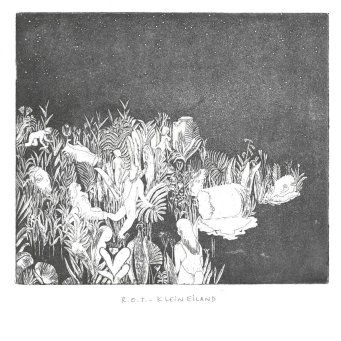 Amazingly, it’s been over a decade since the last full-length release from Belgian improvisational group R.O.T., whose public and internet presence is as elusive and obscure as the music they create. Klein Eiland is an album heavily indebted to location; all ten pieces contained on the CD were recorded in a now-demolished Brussels building of the same name, and the quartet’s abstract textural interactions reverberate through its spacious rooms and halls before disappearing into the dark, spectral void that lurks just beneath our perception. Improvised music and documentation have always been locked in a knotty, even contradictory relationship; purists insist that the identity of an improvisation is hinged inextricably on its taking place in real time, and that recording it creates something entirely distinct. These issues are complicated even further on Klein Eiland—not only was the location where it was recorded demolished, but something entirely new now stands in its place (an apartment complex which is pictured on the back of the CD sleeve). But the skilled sound artists who perform as R.O.T. have somehow managed to evoke that profound reality of impermanence even in this timeless document: the ghostly electronic transmissions, sparse concrete interplay, and distant instruments are somber, elegiac, fleeting, breathtaking in how they fill these mysterious spaces yet dissipate just as quickly. I’m reminded of similarly environment-dependent improvisations like the Battus/Gauguet/La Casa Chantier series or Akio Suzuki and Aki Onda’s KE I TE KI, but Klein Eiland is singularly sublime and harrowing, and evokes something that’s at once material and completely intangible.
Review: Staubitz and Waterhouse – Staubitz and Waterhouse (Gertrude Tapes, Feb 17)
 Mary Staubitz and Russ Waterhouse’s first release as a duo, a lathe cut 7″ on Gertrude Tapes, is pretty much over as soon as it starts, a brief and concise ten minutes of elusive sound. But strangely, our experience of time during each listen is not nearly as cut-and-dry; the two artists manage to elicit a strong feeling of stasis and permanence in these two short pieces, trapping the listener in comfortable yet subtly sinister ennui extracts that defy our typical conceptions, like the unpredictable, unexplainable temporal distortions that occur during a university class or a shift at work. Plagued by heavily amplified rustles, chewing, and an ongoing churn of heavily processed environmental sound, the sonic scenery of “Pickup for Mark” plots itself with fractured verbal exchanges and ringing telephones. Here, we are both invisible observer and conspicuous trespasser, aware that the events taking place are not caused by ours—or even the artists’—presence, yet keenly cognizant of the jagged, imperfect opening through which we have entered this soundscape, the perceptible seams that expose its artificiality. “Exterior Scroll” is even less concrete, as lo-fi recordings of clattering, cascading junk and other objects disrupt the natural hum of the outdoors and the distant sound of human voices. Staubitz and Waterhouse is one of those modest, unassuming releases that doesn’t make a big deal about itself, but the questions we inevitably ask in deciphering the knotty quandaries it presents are anything but inconsequential.
Review: Roger Tellier-Craig – Études (Second Editions, Feb 21)
 Even excluding than his previous membership in seminal post-rock bands Fly Pan Am and Godspeed You! Black Emperor, I was already familiar with Roger Tellier-Craig from his work as a trio with Karl Fousek and Devon Hansen, who together have released several cassettes containing some truly fascinating and innovative electroacoustic improvisation. Each, unsurprisingly, also has their own distinguished catalog of solo work, but regrettably I have not made the effort to dig into any of these. Tellier-Craig’s new full-length CD Études makes a strong case for my need to change that. It’s a 50 minute tour-de-force of mind-blowing computer music, with the French sound artist manipulating a diverse array of heavily processed sound objects into increasingly complex formations. On opening track “Duelle,” the arrangements are frequently interrupted by stretches of silence, yet Tellier-Craig’s arsenal of digitally dissected concrete sounds still coalesce into bombastic cacophonies, especially near the end when there’s a brief hint of crystalline melody hidden amidst the tangles. Silence adopts a much more significant role in the following “Jamais d’un vouloir,” where the composer utilizes pure absence to evoke a Frey-esque suspense. Like Frey, too, the nature of the intermittent intrusions of sound recontextualize the moments when there is no sound present at all; the listener is suspended between processing what they’ve just heard and anticipating what will come next—the fragile, flimsy platform we build beneath our feet to avoid falling into nothingness. Études certainly draws from the acrobatics and artificiality that computer-based electroacoustic music makes possible, but it is never cold nor lifeless. As human listeners, we’re always searching for warmth and emotion even when there is none to be found; there is plenty to be found here.
Études is available for purchase from Forced Exposure in the US, Anost in Europe, and on streaming services.
Review: EARTHFLESH – //- (Nailed Nazarene Industries, Feb 12)
 Though the title of this site doesn’t solely refer to noise music, that genre was the initial step in my personal odyssey into subversive music as a whole, and it’s always nice to hear something that reminds me of the records that first piqued my oh-so-innocent ears (Rocket Shrine, Life in a Peaceful New World, All Live Recording at My Room). In fact, I first thought of this yesterday, when I listened to and reviewed Connive’s debut self-titled cassette, and I suppose the universe saw it fit to deliver a similarly nostalgia-evoking yet nonetheless fresh and excellent noise album with mainly red cover art. EARTHFLESH is a very new project from Switzerland, and since their inception in December 2019 have put out nine digital releases ranging from full-length albums to shorter tracks and remixes. //- is the first to grace a physical format, and though I haven’t heard any of the artist’s prior catalog, it is undoubtedly a worthy choice. Warm roils of analog distortion, sustained feedback shrieks, and other abrasive sonic emissions emerge as EARTHFLESH finds their footing on opening track “113726,” a succinct and well-structured piece that concludes with some hypnotic loop manipulation. Things spread out on the 28-minute “152913,” which eventually settles into a scorching current of textural noise and screeching feedback tones that could honestly go on forever. The following two tracks embark into less familiar territory, with the sub-minute contact mic crescendo of “173653” serving as a brief interlude before “121329” cuts through with a meaty modular synth cell that gradually expands and is wracked by stuttering blasts of distortion. To anyone as young as me who should listen to this or any other noise album and have their world rocked: keep going. This shit will change your life.
Review: Connive – Connive (Reserve Matinee, Feb 18)
 Connive’s self-titled cassette begins with the unmistakable sound of a recording slowed to an extremely low playback rate, a dissective yet messy element that is perhaps in line with the strange low-res artwork on the cover (I can’t even tell what medium was used to create it). But Michael Stumpf’s new project (he has previously released cassettes on Reserve Matinee and other labels as Esper Werm and Faithful) doesn’t waste much time before immersing the listener in what we’re all here for: massive waves of churning harsh noise. The way the dense currents spread and unfurl is very much reminiscent of beloved noise band C.C.C.C., whose celestial, psychedelic maelstroms saturate the entirety of whatever venue in which they’re performing; yet something about the distortion on Connive keeps it more grounded than that—in a good way. This is especially apparent once we get to “Senseless Carnage,” which swaps the full-bodied crunch and squall for a skull-rattling low register rumble that constantly seems like it’s about to shake itself apart. And eventually, that’s exactly what it does: the teeth-grinding oscillations top out with broken peaks that sound like a broken PA’s deafening swan song. The relatively brief “Cheek of Sorrow” isn’t the cathartic mess of screeching feedback and contact mic abuse I was expecting from its being described as a “classic Midwest basement banger,” but it is a nice respite before the eclectic insanity of “Contaminated ‘by the barracks and the sacristy’.” This is a promising debut for Stumpf’s new alias, a concise slab of guerrilla noise that basks as much as it blasts.
 Noise Not Music