
 Though the release as a whole is quite the head-scratcher, the opening moments of Astor’s new tape The Aubergine Dream are, to me, profoundly disconcerting. “Aubergine dream. I love aubergine. I fucking love it,” states the immediately recognizable voice of a text-to-speech program. It’s not the use of text-to-speech itself, but instead that the actual text being transferred to speech is so colloquial and earnest that hearing it spoken in such a flat, synthetic manner is disturbing. In fact, though, most of the elements that make The Aubergine Dream so befuddling arise from this apathetic warping of humanity. The material on the tape was performed in 2017 at Cafe Oto, a London venue known for its ongoing support of experimental arts, but in trying to decipher the expected sonic space that a live performance provides we’re left floundering. The deafening contact mic shuffles and mysterious hum that materialize after the spoken introduction fade away around five minutes into side A, and after an extremely muffled bout of applause—and I wonder if it’s even the same audience that was watching Astor perform that day—we’re left in complete silence for nearly 30 seconds before the entry of some reverently struck piano chords and grimy hiss. Further on in the side the “live” identity of the piece becomes even less concrete as warbly tape manipulations distort what we’re inclined to believe are recordings of the surrounding environment, but at this point I’ve given up trying to align The Aubergine Dream with any preconceived musical templates I’ve stored away in my brain, and as the stuttering, segmented collages of side B unspool, it’s clear that’s the best approach. Unpredictable to say the least, endlessly subversive, fascinatingly strange, and ultimately sublime, Astor’s newest release is one I’ll be returning to many times.
Review: VipCancro – Su Se Stesso (Lisca, Oct 5)
 The fittingly titled “Ex Musica” rises into being with a wonderfully delicate, deliberate touch not at all unexpected in the work of VipCancro, a quartet comprised of sound artists Alberto Picchi, Andrea Borghi, Nicola Quiriconi, and David Lucchesi. Though their music is free by every meaning of the word, liberated from conventional melody and structure through instantaneous sonic interaction, the group’s philosophy doesn’t focus on the inherent impermanence of improvisational performances; instead, they chart progressions and evolutions throughout their work, make an effort to try new approaches, work toward their own musical language. Su Se Stesso, according to them, is where this “new language” has finally been achieved, one that’s “based on the search for personal solutions oriented towards characters and gestures, according to the typical methods of a concrete matrix improvisation. The mixture of electronic and acoustic instruments reflects the attention of the quartet to spaces and sound objects organized through pure instant composition.” Like many analyses of such abstract methodology, it sounds arcane at first, but these observations couldn’t be more apparent in the music itself. Though the two pieces are quite mechanical and metallic in nature, all slithering scrapes and stifled snuffles, they’re undeniably gestural as the descriptions states; each action taken by the performers has a destination in mind, like things are being set in motion rather than entirely manipulated. The quartet’s appreciation for space is also clear, and their ability to construct vivid, immersive, physical sound-worlds like the heaving, sighing cluster of clatter on “Laterale” is astounding.
Review: Emanuele Fais, Giacomo Salis & Paolo Sanna – Earthworms (Aural Tempel, Oct 2)
 As a duo, Earthworms is not Giacomo Salis and Paolo Sanna’s first rodeo. The two abstract percussionists perform and record frequently as Salis/Sanna Percussion Duo, as well as embarking on other ventures with other artists—although, more often than not, they still appear on these releases together. I had the good fortune of being sent some video recordings of the sessions that produced the Humyth tape on Confront last year, and even with the most unconventional combinations of objects, natural ephemera, and actual percussion instruments, Salis and Sanna’s chemistry is palpable (and that’s definitely the case here). But arguably their most successful works are those which involve just one other participant, like 2016’s KIO GE with Jeph Jerman (also on Confront) and now Earthworms with Emanuele Fais. The latter is an artist I don’t know much about, but his unique role in the trio as the sole provider of electronic effects often throws the delicate interplay of the disc into strange new areas, maintaining the quiet, almost subterranean atmosphere (and that’s not just because of the title) but also introducing foreboding, murmuring flows that curl beneath the clatter and subtle glitch warps that, sometimes, shape the proceedings into something quite alien, and, at others, desperately reach for beauty.
Review: Glenn Branca – The Third Ascension (Systems Neutralizers, Oct 4)
 The music world lost a truly great artist last year with the death of contemporary composer Glenn Branca. With a formidable career spanning from 1980 until his death in 2018, Branca’s work explored and stretched the possibilities of rock guitar in a classical context throughout various symphonies and live performances, but he is perhaps best known for his 1981 LP The Ascension. Serving as a meticulously arranged counterpoint to the irreverent, improvised chaos of the no wave movement with which it was closely associated, the landmark recording transposed a slightly expanded standard rock music lineup (four guitars, bass guitar, drum set) into Branca’s peerless ear for texture, dynamic progression, and catharsis. It’s indisputably one of the most influential guitar albums ever released. But unfortunately for listeners who seek more of this singular sound, there’s not a ton of material available; Branca’s 1980 EP Lesson No. 1 is fantastic and serves as a great companion to The Ascension, but apart from that there’s only 2010’s The Ascension: The Sequel in terms of legendary sextet brilliance, which for many (including me) fell flat.
Now, however, the posthumous release of The Third Ascension offers a breathtaking return to form. The six track, 65 minute album documents a 2016 live performance by the Branca Ensemble—is that enough sixes for you?—and recaptures everything with which I fell in love when I first heard its original predecessor. A better opener than “Velvets and Pearls” couldn’t have been picked; it starts things off with an incendiary motorik groove that immediately immerses. Though throughout the rest of the album the guitar interplay becomes more elaborate and intricate, here the players are in wondrous tonal solidarity, evoking the trance-inducing propulsion of “The Spectacular Commodity.” From there, the elements only evolve further: there’s the mesmerizing dissonant jangle of “German Expressionism,” the indescribably powerful climax of “The Smoke,” the anxious tremolo cacophonies of “Lesson No. 4″…. I could go on. I’m not sure if there are any plans for future releases under Branca’s name, but if not, this is a perfect final statement that is sure to both resonate with longtime fans as well as introduce new listeners to the legendary composer’s oeuvre.
Mix: Transmissions
Think of this one like stations on a dying shortwave radio. Static, garbled voices, jumbled beauty.
00:00. CC – “Haunted Sideband” from AM (Crooked Acres, 2017)
02:36. Thought Broadcast – “The Immaterial Eschaton” from Abduction (Chained Library, 2019)
04:40. Jack Taylor – “Somnii” from Somnii (Dinzu Artefacts, 2017)
09:35. Rolf Julius – “Fast Schwarz” from (Halb) Schwarz (Edition RZ, 2001)
11:33. Philippe Petit – “04” from Nyctalopia (Electronic Musik, 2011)
15:34. Joe Panzner – “Less Than a Feeling” from Clearing, Polluted (Copy for Your Records, 2011)
20:24. fringe limb – “victuals” from endling (self-released, 2019)
26:14. [N:Q] – “November” from November Quebec (Esquilo, 2006)
33:01. Andrea Marutti & Fausto Balbo – “Winter” from Detrimental Dialogue (Afe, 2010)
34:24. Surface of the Earth – “Shield” from Interference (Fusetron, 1997)
Review: Andreas Trobollowitsch – Ventorgano (mAtter, Sep 27)
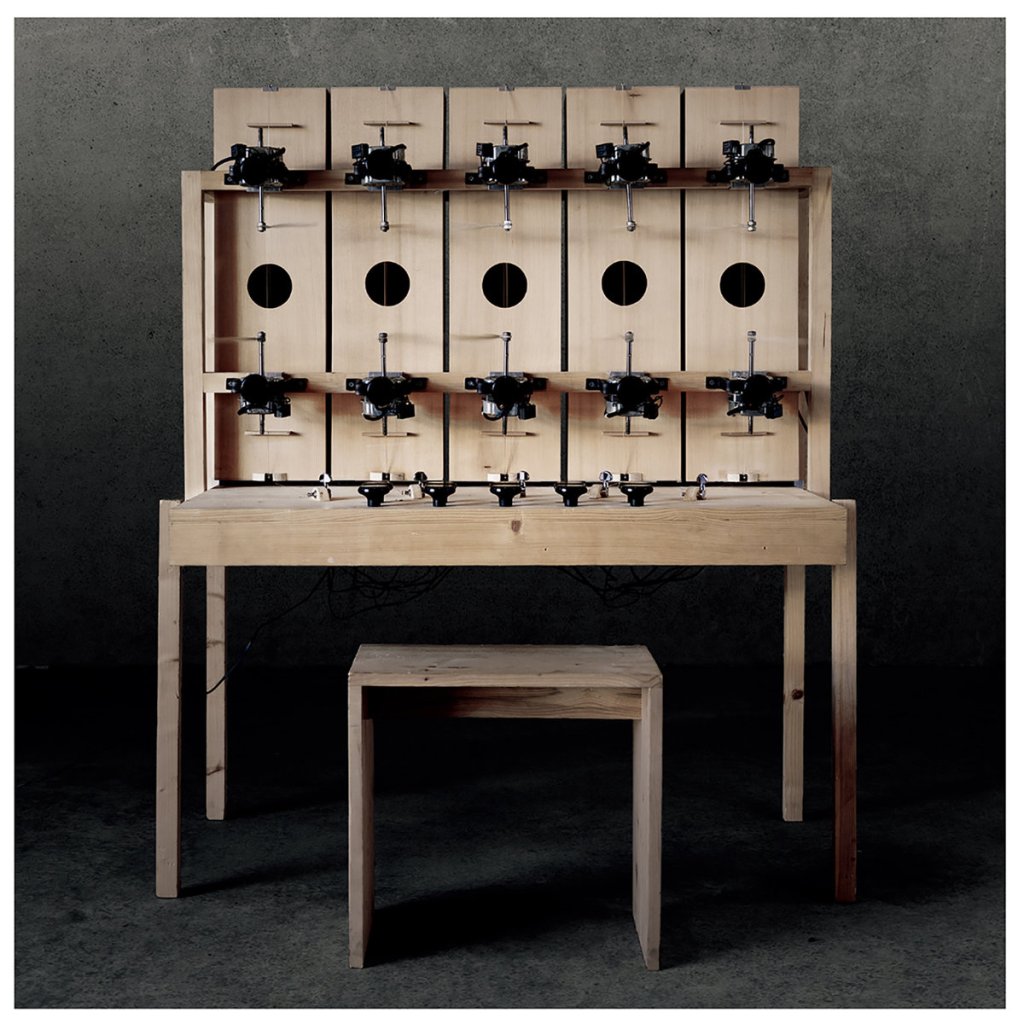 Few works rival the primordial sonic meditations of pioneering, hypnotically minimal drone compositions, such as Eliane Radigue’s monolithic Trilogie de la Mort, Pauline Oliveros’s Accordion and Voice, or Folke Rabe’s What??, whose simple but radiant exhalation I often describe as “the sound of a small leak in the wall of heaven.” For the first few minutes of Ventorgano, the newest release from Austrian composer Andreas Trobollowitsch (following some fascinating installations and 2016’s brilliant Roha), that same feeling of soothing, almost celestial calm is achieved. But the synthesizer Trobollowitsch used to create this piece isn’t designed to keep with such reticence for long; the titular device, built by the artist himself, “consists of guitar strings, wooden resonating bodies and converted fans which use cello-bow hair instead of propellers to set the strings into oscillation. Rotating speed, string tension and attack can be adjusted progressively, allowing the player to control micro rhythmical elements and subtle changes in the overtone spectrum.” Unsurprisingly, the music that unfolds has a very physical presence, slowly increasing in complexity as it expands outward from humble origins. And the sounds of the Ventorgano are not the menacing clanks of an industrial machine. They’re pensive, lush, even comfortingly organic at times, and the otherworldly headspace such a special instrument creates is truly something to behold. Trobollowitsch’s wondrous creations do evoke the work of the aforementioned artists, but the immersive polyrhythms and overtones conjure something even more mystical.
Review: Donoval & Fiala – INTERSTAT (Canigou, Sep 27)
 Though it’s an otherwise pleasant and effervescent opening track to Adam Badí Donoval and Jakub Fiala’s debut collaboration, beneath the surface of “I” lurks a nagging, slightly disconcerting tension, helped along by an out of place tone here, a dissonant guitar note there, etc. Though freely improvised, like the rest of INTERSTAT, this hint of discordance is no accident. It manifests in nearly all of the eight sections of the tape, snaking through the foundational industrial rumble of “II” to the strange, isolating distance present in “III” to the barest semblance of inharmoniousness in the drones of “IV”—and if I haven’t yet proven to you all how well I can count, we arrive at side B with “V”, where the looping synth piddles and new age electronics that had asserted themselves as crucial elements become less integrated. It’s like the unspoken formula developed via the duo’s interactions splits open and calls attention to its own parts, moving that distance I mentioned earlier from the space between listener and music to within the music itself, resulting in some of the album’s most uncanny tracks. On “VI”, the electronica sticks sullenly to the edges, and the effect is dark and spectral, something that’s explored further on the rest of the album. Having been unfamiliar with both Donoval and Fiala until now, INTERSTAT was a wonderful surprise, and is likely to appeal to fans of both straightforward ambient/drone music and more abstract improvisation in equal measure.
Review: Mosquitoes – Vortex Veering Back to Venus (Feeding Tube, Sep 27)
 U.K. avant-rock project Mosquitoes released one of my favorite albums last year with the Drip Water Hollow Out Stone LP, a brief but dense exploration into the radical deconstructions pioneered by seminal no wave bands like DNA and Mars. Comparisons to these predecessors are nearly inevitable when discussing Mosquitoes, but unlike many other instances of revivalist artists in this genre, they don’t aim to emulate or even to incorporate the styles of influential bands, instead focusing on furthering and paving new ground in this ongoing approach of fragmentary, convention-defying rock music. Vortex Veering Back to Venus shares the previous record’s brevity, clocking in at just over 20 minutes across six tracks, but its subversiveness is even more total. The hints of stuffy, oppressive darkness that lurked at the edges of Drip Water Hollow Out Stone now pervade every element of the band’s style, looming over the listener like the shadow of a spreading storm with razor-sharp percussion strikes as its lightning and lumbering, muffled bass as its thunder. The pieces are even less rhythmic than before—the most we get is a plodding bass drum throb, and sometimes not even that—and instead the drums often function as stabbing punctures in the thick atmospheres being woven, crashing through layers of crackling guitar noise and low-frequency hum. Sparser and more abstract still are the vocals, which sputter and shake somewhere quite a ways away from intelligibility. It all comes to a truly majestic climax with closing track “VS,” which is perhaps Mosquitoes’ finest work yet.
Review: Territorial Gobbing – Capitalist Art Is Cartoons Fucking (Opal Tapes, Sep 27)
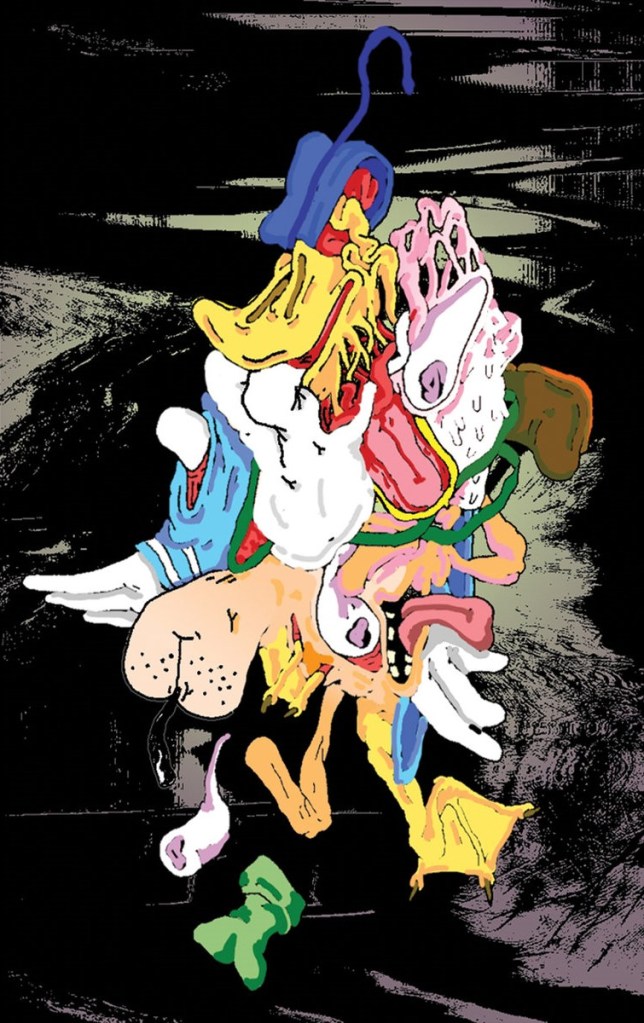 Earlier this year, Leeds-based tape skronk project Territorial Gobbing (also known as Theo Gowans) entered my ears with Stud Mechanism, a brief but formidable odyssey into junk coagulations, mucous-caked a cappella scrabbles, and other aspects of Gowans’ “no expense spent cheap stupid music with tapes, clutter and spit.” Despite this irreverent, no holds barred, almost anti-music approach, there’s always a great deal of masterful technique at work on a Territorial Gobbing tape, especially on Capitalist Art Is Cartoons Fucking, the project’s most recent release. This time, Gowans’ toolkit is largely the same—dizzying, violent tape manipulation; chopped-up radio grabs; gargling, moisture-filled mouth sounds; and clattering object hodgepodges—but the space occupied by the music is much more expansive and ambitious. Introductory remarks of indecipherable deadpan muttering and contact mic clutter are claustrophobic yet atmospheric, and “Tooth Orb” specifically evokes something not dissimilar to the dark, musty basement milieu of Mars beneath its noisy bustle. Things spread out a bit more on “Are Militant Atheists Using Chemtrails to Poison the Angels of Heaven,” with terrifying throat warbles ricocheting off raucous clanking metal and what sounds like a field recording of a public environment. This track is the longest on the tape and therefore has the most time to bring its hulking junkyard monstrosity to fruition, but the shorter pieces accomplish amazing feats with their more limited durations; “Armpit Beer” discombobulates with sudden blasts of fast-forwarded tape, “Spooky Electrics Blog” stitches together a haphazard form from disparate voice samples, and there’s a moment amidst the heavyweight kinetics of “Raw Plastics” that seems to depict a small mouse being brutally murdered. Stuffed full of rust, slime, and trash, Capitalist Art Is Cartoons Fucking is Territorial Gobbing at the top of his game.
Review: Derek Baron & Zoots Houston – A Realistic Morning Prayer (Tsss Tapes, Sep 25)
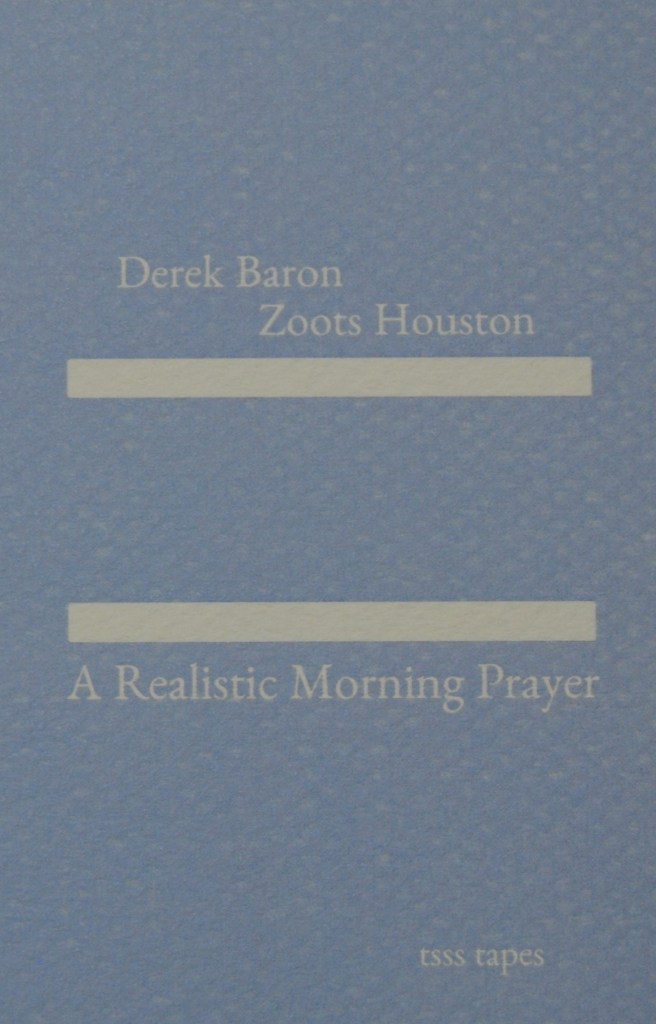 Small scale, object-based improvisations often create the most immersive and intimate sound-worlds, which depending on the approach of the artist(s) can be soothing and peaceful, raucous and overwhelming, or anything in between. Not only do the improvisers control the sounds they produce but also the level of prominence with which they are presented; amplification plays a key role in these delicate performances, and can either isolate the sound objects in question from their surrounding environment or allow for seamless intermingling. With A Realistic Morning Prayer, the first collaboration between sound artists Derek Baron and Zoots Houston, it’s a bit of both. The well-captured minuscule texture selections of resonant metal, miscellaneous percussion, trivial objects, broken gadgets, chimes, and miniature oscillators map out a detailed environment, confined to a small area but given further reach via the movements of the devices in and out of the recording field as well as the creaks and clunks of the performance surface. But as I mentioned, there’s no forced claustrophobia, no artificial extrication from circumambience. We hear passing cars in the distance, gusts of air past the window: a wider universe in which these sonic events occur, not necessarily emphasized but present nonetheless.

