
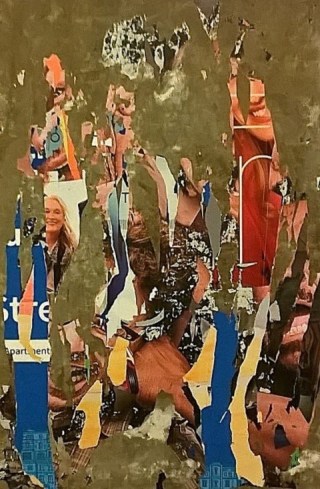
 As members of Reynols and Volcano the Bear, respectively, Alan Courtis and Aaron Moore are no stranger to outsider music. Throughout each musician’s career with those bands, their solo work, and a host of other collaborative endeavors (Dragon or Emperor, Guignol, Mutantea, Textile Orchestra, the list goes on), they’ve examined and worked with countless unusual sound sources, techniques, and performance settings. 2283 is their fifth release from the pair’s ongoing duo project, almost entirely recorded during a brief meeting at Moore’s apartment in New York, and sees the two artists both composing and improvising with toy instruments, primitive electronics, percussion novelties, and their own voices. It’s a bizarre and magnetic amalgam of minimalist free music and occult folk headspace, with each track falling somewhere between either end of that strange spectrum. The A side is quite reserved, the soft clatters, rattles, and rings swathed in a cloak of heavy silence; the space of Moore’s residence is a significant addition to the music, and through its lens the duo’s odd sonic interactions are even more elusive. The following side is more eclectic, with the almost pretty fingerpicked guitar and muttered vocal gravel of “347” and tribal ambience of “296” evoking my favorite Volcano the Bear moments, and though the final two tracks were produced by Courtis using overdubs there’s no drastic shift in presence that reduces or overshadows the impact of what came before.
Review: Posset & Charlie Ulyatt – A Jar Full (Crow Versus Crow, Jun 4)
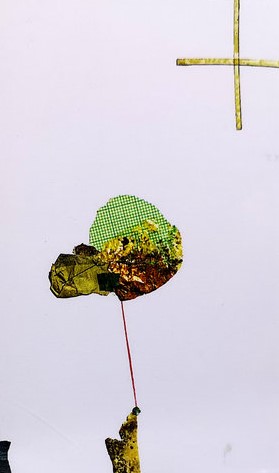 Joe Murray, who performs and releases music as Posset, is one of the most prolific magnetic tape manglers active today. The strangled spoken words, gurgling mouth sounds, and disjointed dictaphone manipulations that pervade his work are more than capable of creating an enrapturing and very distinct atmosphere (see Totally Corporate!, one of my favorite records last year) but don’t seem to be the most versatile sound materials in a live improvised setting. A Jar Full, which sees Murray collaborating with avant-garde cellist and and artist Charlie Ulyatt, pretty much obliterates that assumption. Comprised of tracks made both through long-distance correspondence as well as direct live recording, the tape presents a pairing of instruments that hardly seems effectual… yet the results are astounding. The first side, composed of three tracks created by each musician playing over recordings sent by the other, documents a treasure trove of whimsical, dynamic improvisations, traipsing and trampling through typical duo conventions as Ulyatt’s bow squeals and percussive extended techniques call out, respond, and intermingle with Murray’s fast-paced cut-ups and impatient playback alterations. The untouched silence that squirms between the awe-inspiring conversational moments of “At This Lost Hour” and constricted cries of “High Head” is abandoned on “At the Angel,” the final track, which documents the duo’s first in-person live performance. It’s a restless, scrabbling conclusion to the tape, the audible space of the venue providing a welcome counterpoint to the claustrophobic sterility of the first side.
Review: Shuta Hiraki – Across the Empty Lot (Falt, Jun 9)
 Apathetic, disastrous scourges on the planet though they are, human-made urban sprawls have the ability to produce some truly gorgeous sounds. On Across the Empty Lot, Japanese sound artist Shuta Hiraki documents two occasions of astute, attentive environmental listening, in practice simply capturing construction on a bridge and its surroundings but in actuality immortalizing a sublime instance of natural harmony. The unprocessed presentations that span the two sides of Across the Empty Lot are dominated by a persistent tonal drone that weaves itself through auxiliary intrusions of rustling leaves, chirping birds, distant voices, and the clatter of the construction itself. Similar to Ludwig Berger’s work Cargo, the spatial resonance of industrial processes (in this case, cement mixers) at a distance creates this almost organ-like hum, which provides an unexpected yet undeniable musical backbone for the other elements that appear in the recordings. Though already far from a trivial field recording, the meditative, calming effect of Across the Empty Lot is amplified by Hiraki’s faithful conveyance of such a beautiful sonic event.
Review: Modelbau – A World of Difference (Regional Bears, Jun 7)
 Unlike The Invaders, the other Modelbau tape from this year I’ve heard, there isn’t nearly as much sonic permanence to be found in A World of Difference. Here, the seasoned, prolific musique concrète master works with fleeting rhythms, reverberations, and pulses, constantly projecting new elements into the mysterious worlds he creates. It’s not impatience or indecisiveness that lurks behind these unusual choices, nor do they lead to a lack of cohesion; instead, the effect is an endlessly evolving and shifting sound construction, a jittery, surreal collage of disparate injections that keeps you on your toes. De Waard’s segmented approach manifests as music that is difficult to describe summarily because of how unpredictable and disjointed it ends up being. The two fifteen-minute sides of the tape pulls together auditory items in an episodic fashion, progressing from decaying, low fidelity synth chords and mangled radio extracts to blasts of white noise and moments of textural tactility on the first to stretches of unadulterated field recording, unusually mixed folk music loops, and some truly strange electronica on the second. Like the cover, where aggressively uniform, flat, digital graphics are superimposed upon a distorted photograph, the music on A World of Difference is a disconcerting and inexplicably intriguing hodgepodge of contradictory ingredients.
Review: Arboreal – Deconstruction (Perpetual Abjection, Jun 3)
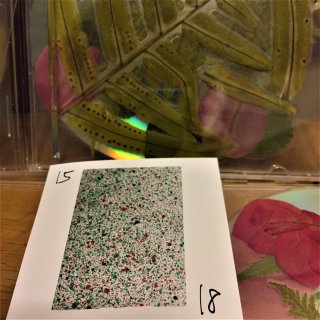 There are a lot of possibilities in composing wall noise in terms of the kinetic identity the artist wishes to bestow upon their creation; some pieces blaze forward with drive and fury; others are stubbornly stagnant, clawing and fighting temporal progression like an anchor along the ocean floor. Still others, like Deconstruction, seem to move independently of a linear direction, instead expanding outward from a defined center. Arboreal (a.k.a. Polwach Beokhaimook) allows his delicate, crackling structures to worm their way through the soil like the plants that initially inspired the work, fanning out from the stalk or trunk which here takes the form of a contained, choked rattling sound. As you spend more time with the single track on Deconstruction, the emanating static seems to trade prominence with this interior point, the former’s more expansive stereo movements drawing attention away from the latter’s obstinate stasis. Also present is a barely perceptible hiss, which could either be just a remnant of the techniques used to create the wall or even a muffled nature recording; I’m not really sure. What is certain, though, is that it is one of several elements that casts this release as a lushly detailed and intimate examination of organic growth, imbuing this relatively simple framework of sounds with the familiar characteristics of life.
Review: Nate Scheible – Indices (Never Anything, May 27)
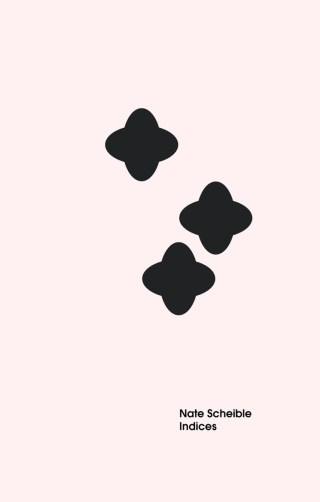 For all of its delicate beauty, Nate Scheible’s brand of ambient music always has undercurrents of tension, hints of uneasiness buried beneath the floating drifts of effects-laden keyboard drones and samples. Indices has none of the vocal elements that were explored on Fairfax, the Washington, D.C. artist’s previous tape release, but no less of the woozy subliminity and emotional resonance. “A01” unfurls with bubbling movements drenched in reverb, soft gossamer waves of sound expanding outward atop a base of dusty tape recordings and crackling artifacts, setting the stage for more reserved sketches of this wonderfully diaphanous atmosphere—which, although I’m no synæsthete, is quite in line with the soft pink that was chosen for the cover design. As each of Scheible’s carefully constructed miniatures progresses, they move past beginnings fraught with uncertainty and strangeness—such as the abstract manipulations that introduce “A03” or the stifled chokes at the start of “B02″—into gorgeous stretches of harmony and tonal resolution like a deep sigh and a flop down on the couch after a long day of work. As you can probably guess, this is the perfect tape for me right now. By the time those rustling branches (or whatever they are) that conclude “B03” fade into existence, I am ready to drift away.
Review: Le geneS – Por Fin, la Marmota Accedió a Mutarse (Plus Timbre, Jun 2)
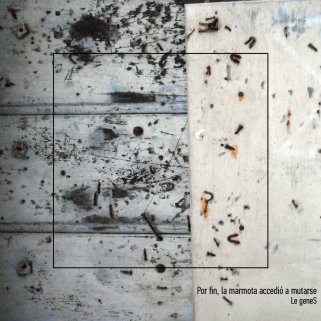 Though Por Fin, la Marmota Accedió a Mutarse was created through the collective trio improvisations of Jose María Pastor, David Ramos, and J.G. Entonado, a combination that already allows for unhindered spontaneity and musical freedom, the album somehow feels even more flexible than simply the freeform conversations of three musicians. “Estrella del Pop” establishes this feeling of limitlessness right away; an industrial-strength drone like the whir of some giant metal fan tears into existence, yet its strength is tempered by unpredictable pauses and a playful coda departure, whose suddenness signifies that no element is sacred. Using a veritable arsenal of modified instruments, custom-built devices, and their own bodies, Le geneS embarks on a tottering stumble through the endless possibilities of the musicians’ sonic chemistry, the results ranging from the whimsical call-and-response flutters that one might expect from a trio affair to the nightmarish vocal experiments of “El Cura de Mi Parroquia Es Ciego” and decaying, ersatz electronics of the nine minute epic “El Lenguaje Estrujado del Embalaje Deshecho.” Eclectic as it is, Por Fin… keeps itself from falling apart with the ever-present drum work of Pastor, who maintains a distinct style while always interacting with the various absurdities thrown his way.
Review: Chaver – Transference (Lower Class Kids, May 24)
 I wouldn’t describe Transference as metallic just because of its chugging thrash-worship grooves and raw, vicious attitude, but also because the instruments themselves actually sound like they’re made of metal, all sharp junkyard edges and scraping rust as these ten concise tracks tear across the landscape. German trio Chaver’s sound draws from a variety of sources and influences, but at its heart are the rolling bass throbs and crash hits that are the backbone of tracks like “Ultimate Abuse”; this album is all about the breakdowns. The way the band builds anticipation for these cathartic blasts of chugging rhythm is varied and unpredictable. “Disinclined,” whose first half is a fast, fiery d-beat gallop, falls after a brief respite into a deliberate, halftime lead-in groove that provides a perfect link to the slower-paced thuds that conclude the track; “A Tool” draws its magnetism from metronomic, almost rap-like vocal delivery; and the headbanging unison hits of “Efficiency” require no further elucidation. Aside from the repose offered by “Feckless,” a small interlude between the album’s two halves, Transference is a nonstop barrage of punishing hardcore, and though the definite highlights are the slamming breakdowns there isn’t a single wasted moment.
Transference was originally released as an LP by Injustice Records earlier this year.
Review: Moon RA – Promenade Magnétique (Czaszka, May 29)
 Promenade Magnétique is true computer music, every bit a “magnetic walk” through the annals of the software plugins and hardware used by Marie e le Rose to create these six short sound pieces. A faithful yet original homage to classic concrète music, Rose’s “field recordings of artificial landscapes” take on abstract physical forms in their impossible movements and synthetic contortions, almost completely isolated from any pure source material used. Each track is chock-full of detailed progression, never really following any sort of predictable linearity but instead exploring the possibilities of this unfettered magnetic landscape in increasingly complex ways. Rose’s manipulations are restless and kinetic, the tension barely contained even in the most reserved moments like the unstable drone that threatens to burst at any moment at the start of “D,” digital clicks and taps and oscillations expanding into shifting weaves of plasticky sonorities. As is common—yet never any less surprising—in even the most removed of electroacoustic compositions, the artificial soundscapes begin to evoke real-life phenomena in the mind of the listener: “A” adopts the tubular configuration of air flowing through a pipe, “C” mimics the bubbling motion of boiling liquid, “2” vibrates like an agitated metal surface. Despite the modest rules Rose gave herself to create this work, Promenade Magnétique is a formidable and far-ranging work of abstract electronic music.
Review: Matthew Atkins & Adam Kinsey – Lowercase (Minimal Resource Manipulation, May 22)
First, I want to thank anyone who sends me physical items for review. It’s already amazing to receive digital copies for consideration, but the fact that my writing warrants people wanting to pay to ship stuff to me is extremely humbling. I greatly appreciate it.
 Lowercase documents a collaboration between British sound artists Matthew Atkins and Adam Kinsey, both of whom are quite active in London’s experimental music and improvisational community. The name of the CD evokes common traits of the titular genre, which often features an emphasis on silence and purposefully sparse composing, but the vivid constructions conjured by Atkins and Kinsey don’t feel restricted by any such constraints. The colorful two thirds of an hour of Lowercase bubble and boil through evolving mixtures of tactile object interplay, fragile granular textures, and field recordings coated in varying amounts of manipulation. The release situates itself in a sound-world that is consistently calming and always a bit familiar, but the two artists never neglect to push this envelope of comfort closer and closer to the breaking point, bending and twisting and stretching the elements they introduce into increasingly elusive configurations. The ever-present balance of the tangible and the detachedly synthetic, the distorted tape groans that conclude part one, the immersive but almost uncomfortably intimate stereo space… it all materializes into an abstract musical language that never quite lays all its cards on the table.
 Noise Not Music