
 On this self-titled debut tape from Ontario duo (ph)authers, tension is built and released with masterful ears. They craft delicate but substantial pieces from field recordings, synth and guitar ambiance, even the occasional bowing of string instruments, and the dynamic movement this palette creates is breathtaking. The tape is barely twenty-five minutes long, but at its end I felt contentment and closure rather than dissatisfaction at its short duration. This is largely due to the careful dynamic structure previously mentioned; (ph)authers have managed to cultivate an incredibly natural gait within their music, both tracks ambling along at a comfortable but deliberate pace, ebbing and flowing and rising and sinking in the way only great ambient music can. With this stuff it’s sometimes easy to fall into the trap of predictability, but thankfully that hasn’t happened here. (ph)authers forego constant crescendos and cheesy climaxes in favor of organic drifts and more reserved catharsis, a perfect example of the latter being the soft recording of rainfall that emerges at the end of “Beneath the Tide;” certainly much more effective and impacting than any cliches I could think of. (ph)authers is a debut release that displays the thoughtfulness and skill of a much longer-running project, so needless to say I am excited for what the duo comes up with next.
Author: Jack Davidson
I like to listen to, read and write about, and play music.
Review: Charles Barabé – De la fragilité (Astral Spirits, Jul 27)
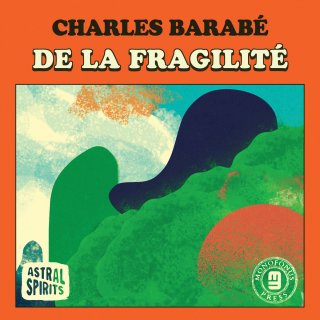 When Charles Barabé reached out to Austin, TX label Astral Spirits about releasing something for them, he described the recordings that would become De la fragilité as “something like a new turn in my work… and it’s quite different from what I release in the past…” Unsurprisingly, Barabé is quite correct in his assessment of his own art, and De la fragilité is quite a departure from the MIDI electronics of Les dernières confessions and even the lively collage work found on both Cicatrices releases. Instead, it seems to be more informed by contemporary classical, both by the abstract sonorities of serialism and the synthetic contortions of early musique concrète, but as always the overall style is unique to Barabé. The six movements make use of a wide range of sounds, with Mouvement III delving into manipulated choral passages and Mouvement V mixing low rumbles with sparse string plucks, but everything is unified by the consistent piano chords that provide both tension and resolution throughout the album. As someone who wasn’t a huge fan of either of the aforementioned previous Barabé releases, De la fragilité is the first instance of me truly connecting with his music, and I am excited to see where he goes next.
Review: Andrew Fogarty & David Lacey – The Wig (Fort Evil Fruit, Jul 20)
 The mind-numbing ennui of a corporate office workplace is reshaped and manipulated to yield unexpected beauty on Andrew Fogarty and David Lacey’s new collaborative tape The Wig. Mostly composed of recordings collected via “ingenious subversion” on company time, the two artists stitch together the mundane and dubious sounds of copiers, printers, shuffling boxes, and others I can’t place, using synthetic tones and crackles as needle and thread. While the unremarkable origin of the recordings is, in my opinion, crucial to the final product’s strange appeal, each sound is merely an ingredient, used on equal footing with the others to create unpredictable texture collages. It’s this coexistence of method that makes Fogarty and Lacey’s approach interesting, not really neatly fitting into either the principles of musique concrète or the area of field recording exploration. But, of course, uniqueness is never almost never a bad thing, and I’d say that the inscrutability of The Wig is what will bring many back for repeated listens, as we try to unravel these mysterious sounds.
Review: Marlowe – Marlowe (Mello Music Group, Jul 13)
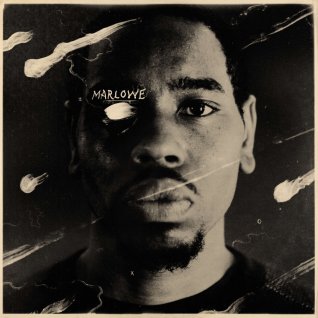 The most beloved, enduring producer/rapper hip-hop duos are the ones whose members bring out the best in each other. With their debut self-titled record as Marlowe, Solemn Brigham and L’Orange have joined the greatest of these, and I couldn’t imagine a better pairing for both of these artists. Despite the difference in experience – L’Orange has been actively producing for over seven years, and this is the first full-length release on which Brigham has appeared – both work together to create something greater than either could have accomplished on their own. From the very beginning, Marlowe is playful and theatrical, but in an abstract way; Brigham’s messages are heavily veiled in his cryptic, cascading bars, and the occasional crackle-marred sample interjections don’t further illuminate anything. But I prefer it this way. There are few things I dislike more in hip-hop than annoying transparency, and I love the fact that I have to actively try to figure this record out. I recognize that not everyone shares this opinion, and the fact that Marlowe is just as strange in style means it’s probably not for everyone – but those who will like it will really like it. Brigham’s droning, monotone delivery is perfect atop L’Orange’s dynamic and driving beats, with both always pushing each song along at a meditative pace. I found myself bobbing my head similarly to when I listen to Neu! or Boredoms, and I’m grateful that I’ve finally found a hip-hop record with this sort of rhythmically hypnotic effect. The skits are short, entertaining, nondisruptive; the pacing perfect; the ending conclusive and satisfying despite my never really knowing what was going on. I really can’t say enough good things.
Review: Vytear – Kingtrips EP1.5 (Occult Research, Jul 7)
 In what is presumably a release halfway between EPs 1 and 2 of Vytear’s series on Occult Research, the producer (aka Jason Begin) far surpasses the limits of last year’s Kingtrips EP1 and delivers an ambitious C60 of twisted techno and concrète contortions. While the “EP” seems to be loosely organized into tracks, its two thirty minute halves aren’t split up in any way, mirroring the music’s meandering and free-form nature. The rhythmic beat music of EP1 is still often present, but it’s even more effective and appreciable amidst the tumbling, whirling collages of synthetic sound. My favorite instance of this is midway through side B, when a hypnotic, bouncing groove is built up after a long period of aimless noises, and after it worms its way into your head it morphs into a new, even weirder rhythm, which in turn begins to collapse back into chaos. These changes are dizzying but not in any way sudden or unwelcome; Begin displays a masterful control of every sound he makes, and despite EP1.5′s less-than-concise structure everything feels well planned out, maintaining a sense of direction even during the most stagnant sections.
Review: Ona Snop – Geezer (Rip Roaring Shit Storm, Aug 24)
 I’ve been itching to write about this album nonstop since the band sent it to me, and I’m even more excited for people to hear it. Geezer is the first LP by the U. K. fastcore band Ona Snop, and it’s everything a debut release should be: succinct, heavy, exhilarating, and bat shit insane. Across eighteen tracks in nearly twenty minutes, these lovable manics tear through a maelstrom of schizophrenic hardcore, switching on a dime from sludgy head-banging breakdowns to dizzyingly fast thrash-punk blasts to catchy hard rock guitar licks and back again. When it’s over you just wonder how the hell they fit all of it in. For those worried by Geezer‘s eclecticism, have no fear; it’s pulled off tremendously well and avoids being annoying in favor of straight-up hilarity. I can’t help but burst out laughing after opening track “In Pieces,” when what sounds like the beginning of a completely new section ends abruptly after less than five seconds, and am then immediately silenced by the light-speed assault of “Total Both,” which kicks in immediately afterward. The pacing is perfect, and the two longest tracks (both around three minutes) are well-placed at the middle and end, offering a break from the blender without sacrificing any energy. I feel like I’m not fully communicating how much I love this record, but luckily it’s so short that you have no excuse not to listen to it!
The digital album is out now on Ona Snop’s Bandcamp. The CD will be released later this month on No Bread!, with LPs shipping in August via Lixiviat, Rip Roaring Shit Storm, and Here and Now.
Review: KBD – Idyll (self-released, Jul 5)
 Getting to see Ohio-based improvisational collective KBD last week was a treat. Though performances and recordings most often consist of Michael Kimaid’s drums and electronics and Gabriel Beam’s modular synthesizer, that night they were joined by Ryan Dohm on trumpet and electronics. KBD takes a do-it-yourself, less formal approach to the spacious, sometimes noisy electroacoustic improvisation style pioneered by groups like AMM, Morphogenesis, and Gruppo d’Improvvisazione Nuova Consonanza, with some pieces even approaching the former’s ideas of “meta-music.” Idyll, a tour c40 that features Kimaid and Beam, presents fluid instrumental conversations between the experienced collaborators and, like many other albums, demonstrates the power and possibilities of the drum and synth combo. Beam takes the lead most times, his patching resulting in percussive oscillations and almost gunfire-like chatter, and the versatile synthesizer provides a sustained atmosphere with dynamic textural interjections. Kimaid’s playing is more subtle but no less rich, with the softly tapped drums and droning loops flitting between foreground and background. I couldn’t help but smile at the voices heard near the end of side B; whether from an actual radio or not I’m heavily reminded of Keith Rowe (whose biography was featured in the background of a picture showing these very tapes).
Review: Validine Chronus – Transdermal (self-released, Apr 20)
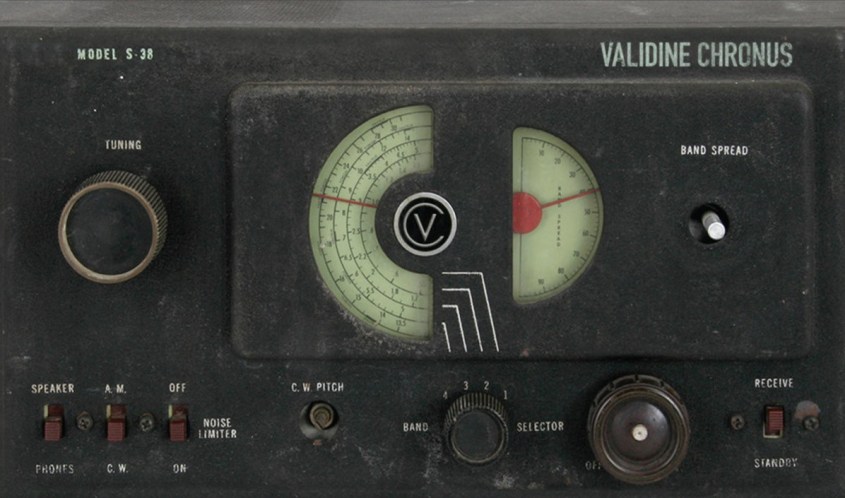 It’s been a while since this tape actually came out, and there’s not really any excuse for me waiting this long to write about it other than I just recently was able to really dig in. I bought it after hearing (and enjoying) the twentieth anniversary reissue/remaster of the first Validine Chronus album, Ultia. The long-running solo project of composer Eric Bertrand incorporates a plethora of experiments and styles in each release, and Transdermal is no exception. These pieces unfold in a controlled manner, especially in relation to their haphazard construction from “samples, field recordings, and partially finished tracks,” each one exploring a particular sonic pairing or progression. The longer compositions on side A, as well as the nearly ten-minute “Digital E. coli” later on, are patient drones, with the former built on sustained tones that are surrounded by curling, washing strands of mechanical sound, while the latter slowly descends into beautiful, distorted chaos like a dying machine. It took me a while to come around on the rhythmic elements on “Tiny Hands” and “Atomic Clock,” but once I did I realized that they advance in equally interesting ways, with the structure provided by the percussion collapsing as each track becomes more and more hectic. Transdermal is a long album but doesn’t feel like it, and with so much ground covered across the nine pieces it’ll be one I’ll return to many times.
Review: Foresteppe – Mæta (Eilean, Jul 7)
 I first came across Foresteppe, the alias of Siberian musician Egor Klochikhin, through his collaborative EP with you c, Seven Sleepers. The hypnotic atmosphere created by his reel-to-reel tape loops drew me in instantly, and led me to discover other great releases on the short-lived label ШАΛАШ, including Foresteppe’s other album with Bisamråtta and Nikita Bondarev’s epic three tape set Untitled. Mæta is Klochikhin’s newest release, and sees him finally reaching the full potential of his unique musical toolkit without assistance from collaborators. He’s come a long way since No Time to Hurry; here, the loops are the driving force on the tracks, providing a woozily beautiful basis for added layers of metallophone, bells, synth, and strings. Each section of the fifty-eight minute album is lush in such a delicate way, the pieces floating along at a reserved pace, with new elements naturally fading in and out and introducing just enough variation to remain engaging. Mæta is only as substantial as you want it to be; it’s just as well-suited for background music for reading or studying as it is for focused, active listening. It’s quite the achievement to make such a quiet ambient album so enthralling; the stylistic honing Klochikhin has been performing since he began making music has paid off in the best way. I can’t wait to fall asleep to this tonight and then wake up to it tomorrow.
Review: SEF III – Selling SEF III (Ehse, Jun 1)
 Concept albums, story albums, sound operas, whatever the hell you want to call them; they’re hard to get right, and even harder to really get right. Especially when the story you’re telling is about a mortal struggle between a guy named Phil and his computer, and the accompanying music consists of surreal electronic compositions. But no one is better equipped for this task than the trio of Max Eilbacher, Duncan Moore, and Alex Moskos, who are now known under the same name as the artificial antagonist: SEF III. Selling SEF III is a much more cohesive and complete offering than their last release on Ehse, and manages to pull off both the ambitious narrative and the bizarre sonic elements. “Introductory Remarks From the Musicians,” temporarily absent of any spoken word, instead presents exactly what its title would imply: a demonstration of the breadth of sound the trio can conjure up, raising fluid mechanical chunks that immediately overwhelm. “The Machine’s Theme” introduces the villain through an ominous sung mantra, and from then on the listener is sucked into the quirky sci-fi adventures of Phil and SEF III, in which both humor and unease are always present in equal measure. “Three Counts and You’re Damned at a Subaltern Party,” the penultimate and longest track on the record, ends the story with what I’d interpret to be the victory of SEF III, with metallic electronics swirling and leading into a reprise of the theme from the beginning, which is so much more disquieting this time around. Selling SEF III neither takes itself too seriously nor ever gets unappealing silly, and is certainly one of the most unique and rewarding things I’ve heard this year.
 Noise Not Music