
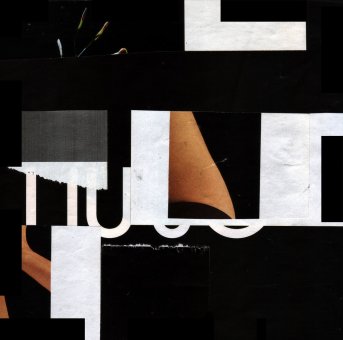
 The young Italian sound artist Renato Grieco displays a tremendous amount of range across his relatively small discography, his virtuosic dissections sometimes evoking warm, comfortable domesticity (Queste cose non avvennero mai ma sono sempre / Rlecchinesque) and other times fashioning jagged juxtapositions, surreal sludge, and atmospheres with compelling ambiguity (Double Goocher Shop, Granchio Pinocchio). This new release, for which Grieco is joined by countryman Francesco Tignola (who frequently releases music as Elisha Morningstar, a project with which I definitely need to better familiarize myself), mostly belongs to the latter camp. The four tracks that comprise Hibernacula are full of layered, detailed, intricate music, but also probably isn’t the best thing to get stoned to; opening track “Two” is a a dense, restless mass of paranoia, a lushly arranged array of rustles, thumps, knocks-on-doors from all directions, ringing bells—but it never boils over into full-blown insanity, instead sticking to the corners and shadows, fleeing from the light. Though Glistening Examples head Jason Lescalleet’s only contribution to Hibernacula was his reliably superb mastering work, I hear a lot of his influence here, especially near the end of “One,” a moment where pitched-down vocals and electronic drones make for some rare, fleeting beauty. This short album slithers back into its hole after less than half an hour, but many repeat listens are necessary to decipher it all.
Category: Reviews
Brief summaries intended to describe and express my enjoyment of albums. My opinions are not the focus: I purely seek to facilitate discovery.
Review: Seth Cooke – Selected Works for No-Input Field Recorder (Every Contact Leaves a Trace, Apr 29)
 The UK-based Seth Cooke is easily one of my favorite sound artists working in the new millennium. Such high praise is not based purely on my opinion of his work itself (which is often the case), but rather what it means, what questions it implores me to ask, what it says about this “music” thing to which I devote so much of my time. These factors are more important than ever in the case of Selected Works for No-Input Field Recorder, Cooke’s newest release that acts as a sequel of sorts to previous 3″ documents such as Four No-Input Field Recordings and Sightseer. Selected Works actually collects four distinct 3″-length projects, some of which were intended for individual release while others were made specifically for the set. If you’ve never heard what exactly Cooke means when he talks about “no-input field recordings,” this is an excellent place to start; unlike Sightseer, the magnifying glass is focused entirely on the inner workings of the popular Zoom H4n recorder. It’s never revealed how exactly the sounds are captured—whether it’s some electromagnetic detection apparatus, post-recording digital manipulation, some combination of the two, or something else entirely—but somehow this is the least of our concerns. Cooke states that An Agoraphobe was created as a direct follow-up to Sightseer; “rather than contrasting the inside/outside of the recorder it just contrasts different approaches to inside.” The emphasis is placed not on the unusual approach Cooke takes, nor even the strange sonic results it generates, but instead on the phenomenon of listening to something we’re not supposed to hear, accessing some dimension of transparency that perhaps doesn’t need to be accessed. We hear stagnant static hums, blasts of electronic dead-air, digital pings and pulses, but what exactly is it? The sound of an inactive device? A recorder recording nothing? The totality of Cooke’s masterful ambiguity is realized with the packaging of Selected Works: a “2GB micro SD card encased in a 4cm x 4cm x 4cm silicone moulded black concrete cube, painted with Stuart Semple’s Black 2.0. The micro SD is highly unlikely to work and cannot be recovered without destroying the cube.” Because how on Earth else would this be delivered in a physical format?
Everything and/or nothing. At once a singular and engaging electronic odyssey, a considered conceptual piece, and a satirization of the music industry’s over-reliance on physical objects. At once a useless, broken storage card of boring sonic interference, half a paperweight, and concrete dust all over your desk. Why not both?
Review: Sial – Tari Pemusnah Kuasa (La Vida Es Un Mus, May 1)
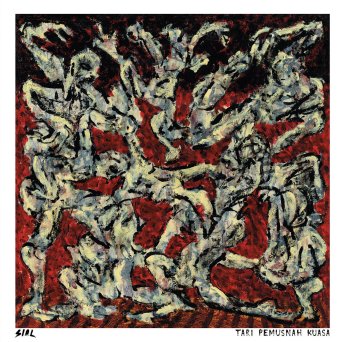 Singapore quartet Sial returns to La Vida Es Un Mus for the third time following their 2017 self-titled LP and 2018’s Binasa 7″ to deliver Tari Pemusnah Kuasa, whose title translates to something in the vein of “the revolt dance” or “dance of the power crusher.” Though all of the lyrics are in Malay, it’s one of those albums that is unmistakably political even if the lyrics aren’t intelligible; every deceptively simple power chord riff, drum gallop, and razor-sharp scream drips with anger and indignation. True to Sial’s distinctive style, these eight songs aren’t dizzyingly fast or technical. They instead aim for more of a hypnotic effect a la Raspberry Bulbs, mid-tempo plods drenched in jagged-edged noise with plenty of memorable headbang climaxes and tension release that don’t sacrifice either vitriol or volume. This is best seen in songs like the title track, on which the passionate, delay-fragmented vocal eruptions and excellent production by the one and only Will Killingsworth transform a rudimentary two-note riff into one of the LP’s most infectious moments. Sial are four rusting hinges on a Pandora’s box filled with noise, anger, violence, and pure punk armageddon; the lid constantly strains against them, the annihilatory contents spilling through the cracks and threatening to escape completely while the band stands fast with masterful restraint.
Review: Free Magic Show – Polymorphous (Czaszka, Apr 30)
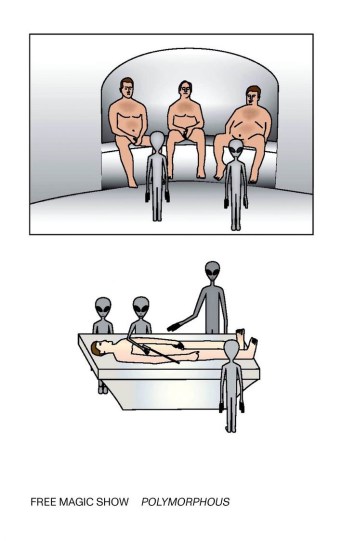 Polymorphous is not an easy tape to describe. To my knowledge, this is the first release by Free Magic Show, the duo of Edinburgh sound artists Joe Coghill and Michał Fundowicz, and introduces a singular, indefinable style conjured with computer, tape, and radio. Pairing well with the unsettling cover art, many of the pieces are a bit (or more than a bit) uncomfortable, humid, sweaty, claustrophobic. Incessant loops jitter into unsteady rhythmic pulses that throb with urgency at some times, lethargy at others; heavily processed sound effects and radio grabs materialize like extradimensional transmissions; tactile thumps and shifts evoke dark industrial underbellies and alien technology. According to the artists, the work they have produced is an “improvised magic show with sounds effects,” a quite, erm, loose description that makes the sounds on Polymorphous even more compellingly cryptic. “house music” is one of two significantly longer tracks on the tape and a masterpiece of enrapturing ambiguity; percussive digital reverb-bombs are launched from the magicians’ table into the massive, empty room to which they perform, their impacts sending shockwaves throughout the space as the lonely sound of slowed-down singing and other melancholy manipulations play out on center stage. I suppose Polymorphous is a “magic show” in the truest form, in that it delights in pure surprise and spectacle—regardless of how utterly bizarre those may end up being.
Review: Áine O’Dwyer – Daedalus Airs (self-released, Apr 27)
 2018’s superb and affecting Green Ways with partner Graham Lambkin marked a significant creative shift in the work of Irish sound artist Áine O’Dwyer. Though prior releases saw her testing the limits of organ drones and other instruments within lush environments, successive projects reveal an unmistakable interest in public spaces, audience participation, and humanism. Early this year, O’Dwyer revealed she was gathering material for something new; she “engaged in street talk all day yesterday in Bristol suburbia” in preparation for live performances in April, which presumably had to be canceled. But we were still graced with something new: Daedalus Airs documents nine excerpts from an “audio visual performance installation” located at an art studio in Athens, Greece. Listeners who witnessed any of the performances by Lambkin and O’Dwyer (whether in person or via Green Ways) will find familiarity in the way the proceedings are captured; the generous recording field places the artist and her audience on equal footing. “Live Air,” the segment that concludes part one of the release, is especially exemplary of this; the space feels strictly defined and yet still distorted as the distant organ lament is marred by the creak and squeak of moving hinges. Things get even more intense in “Ella Capella,” in which a closely recorded and rather startling gush of water immediately invades, and during the rest we’re left to imagine what’s going on as O’Dwyer honks horns, rolls giant metal machinery, and whimsically vocalizes, all atop a persistent keyboard tone. One certainly misses out on a great deal of the true experience of an installation by not being physically present, but there’s more than enough “physical presence” in this wonderful recording for it to be pretty close. Plus, a dog’s barking once again plays a simultaneously grating and meaningful role. What’s not to love?
Review: Koniec Pola – trop (Devoted Art Propaganda, Apr 27)
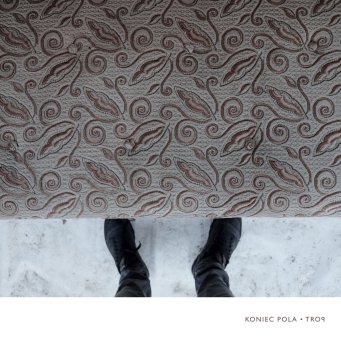 If, like me, you randomly stumbled across trop on Bandcamp, you would probably (again, like me) assume it sounds quite different from how it actually does. Subversive style tags like “electroacoustic,” “field recording,” “performance,” and “poetry” occupy the bottom of the page, and Polish quintet Koniec Pola’s bio simply states “Explore the sounds from the field.” One wouldn’t be misguided in hypothesizing that the material on this album barely resembles conventional music, but the truth is that Koniec Pola merely finds inspiration in abstract approaches, the many experimental elements that either manifest within or simply influence their music providing foundations for their powerful, unruly avant-rock compositions. Yes, trop is for the most part a rock album, complete with a full drum set, vocals, and some very creative guitar work, each track uniquely evolving from formless atmospherics to noisy, muscular climaxes (with the exception of “Czwarty,” which pretty much serves as an interlude despite being a great track in its own right). These are easily the mini-LP’s best moments, when all five band members emerge from the shadows to rouse a unified racket that owes as much to theatrical European neo- and dark folk as it does to art-damaged rock bands like Faust or Oxbow. The finest example of this can be found on lengthy closer “Szósty,” on which scratchy violin stutters over a loose, lumbering bass/drum groove until all hell breaks loose.
Review: Andrew Paine – Kledon (self-released, Apr 26)
 Despite its largely dark and unsettling atmosphere, listening to Andrew Paine’s new release Kledon sort of feels like putting on a new jacket that already feels like you’ve worn it your whole life. The Glasgow sound artist’s choice palette of abstract vocalizations, shortwave radio, whistle, and what sounds like minimal digital processing often reminds me of music I already cherish dearly: Mosquitoes, Double Goocher Shop, Michael Barthel. These aren’t detrimental similarities or lapses in originality; it’s more like Paine is asking the same questions, ruminating on the same oddities as those other artists. Or perhaps he isn’t at all, and the end results happen to bear resemblance. Either way, it’s only one of the reasons why I feel so drawn to Kledon, even at its modest sub-twenty-minute run time. Robert Moss provides the release’s fitting epigraph: “Be alert, as you go about your world, for the first sounds that come out of the silence or out of the shapeless noise of a city street.” This release seems to consist of those sounds that emerge from the silence in which we so humbly stumble around, unwitting witnesses to the thoughtless utterances and reactionary gestures of a detached consciousness scrambling for a physical foothold in our world. Under, atop, and amidst a sparse smattering of shifty electronic transmissions, Paine’s vocal contortions gradually gain some semblance of intelligibility until they finally begin to resemble actual words and sentences—a futile accomplishment, as part II promptly comes to an end right afterward. What casts the shadows into which Kledon invites us? Will we ever know? Will we ever escape?
Review: NEF – Intervalles (INSUB, Apr 23)
 The credits for Intervalles read like an all-star list of masters of the minimal and miniscule: Pascal Battus and Bertrand Gauguet, who have previously collaborated for the Chantier series with Éric La Casa, contribute “rotating surfaces” and alto saxophone, respectively; the mastering was handled by prolific sound artist engineer Giuseppe Ielasi; and the mixing and design for the ekopack CD was done by reductionist improviser and classical performer d’incise. The only name I don’t recognize is that of snare drum player Rodolphe Loubatière, who joins Battus and Gauguet to comprise NEF, but that is sure to change after hearing his brilliant work on this album. INSUB’s short description for Intervalles captures its essence well when it states that the trio’s performance is an “-almost- pure” abstraction of their chosen instruments. While all are vastly different devices, they converge in a unified harmony of spectral whir and hum extracted with masterful use of extended techniques, yet there are many times when it is clear which element is which—the metallic silhouettes of even Gauguet’s most elusive exhalations are often apparent, and Loubatière’s snare drum will sound familiar to anyone who’s ever messed around with a snare strainer (or listened to a Seijiro Murayama album)—but there are also many times where the music is a gloriously lush and ambiguous mess of indefinable sonorities. Like so many other examples of my most treasured documents of electroacoustic improvisation (Aut Disce Aut Discede, Cardtape Drafts, Is Music Invisible?) Intervalles is both micro- and macroscopic, completely immersing one in a detailed sound-world that is somehow at once tactile and dimensionless.
This album is also great because I swear my shitty coffee maker makes an appearance in “Acte VII.”
Review: Light Wa/orship – Equine (Noise Pelican, Apr 24)
 I’m not sure what I was expecting upon my first listen of Light Wa/orship. Perhaps something more in line with the only other Noise Pelican release I’ve heard (the oft-mentioned Anaconda), raucous improvisational interplay and abrasive abuse. I certainly didn’t anticipate that a guitar album would so perfectly hit the spot this morning; I’d already turned off another album because I felt it had too much guitar for what it was. But this recent release by Denver-based guitarist Kevin Michael Richards (who releases music under the alias Equine) has no concern for meeting or even defying anyone’s expectations. It simply is what it is: a superbly paced, well-textured piece of solo improvisation. Richards immediately cements our attention with the initial segment of part I, a patient, spacious feedback study that simultaneously builds contentment and anticipation. Soon, however, more begins to work its way in. Richards’s idioms are not the abstract squawks of extended technique reliance or even the dissonant phrasing of noise-generation; instead he mainly relies upon the conventional, crafting polymorphous drones of oscillating loops and pentatonic cells. These enrapturing structures create an utterly hypnotic and time-distorting effect as Richards manipulates and adds to his arsenal of shifting layers. This only makes the moments where the noodling gives way to blazing hot psychedelia even more impactful and cathartic. Come for the brilliance of the title, stay for the brilliance of the music.
Review: Astro + Jero Route 66 – Live @ Suizokukan Okubo (Pauf Recordings, Apr 20)
 I first came across Jerónimo Jiménez’s project Jero Route 66 thanks to a previous release on his own imprint, Pauf Recordings Ltd. Live from Devil’s Den is a strange, reticent performance, in which Jiménez’s fragile digital synthesis is paired with the ever-elusive clatter of the beloved trio Shots. Pauf’s next JR66 release again utilizes Shots member Daniel Dimaggio’s mastering services, but this document of a live set in Tokyo’s Suizokukan Okubo bar is a very different beast than Devil’s Den, more bombastic and boisterous in every way. This is unsurprising; the CD immortalizes the meeting of Jiménez and legendary noise duo Astro, now composed of two eardrum-blasting stalwarts both with the instantly recognizable surname Hasegawa. The quite spacious recording does appropriate justice to the awesome room-filling qualities of the Hasegawas’ roaring electronics, while piercing circuit errors and whirring glitches from Jiménez keep things grounded in an appropriately abstract way; Hiroshi’s searing transmissions are halted long before they can soar to the heights achieved on transcendent releases like Love & Noise, instead ballooning within a palpably confined space, filling it with a chaos of distortion, feedback, and other electronic mayhem. This is stuff you can get completely lost in.
 Noise Not Music