
 Yes, this album literally just came out today, but I’m so excited about it that I’m already writing a review. Midnight Colours is the newest tape by ambient/drone musician and composer Rafael Anton Irisarri, one of two officially announced for 2018 so far (Sirimiri will be released by Umor Rex on March 16). It elicited one of the most positive initial reactions of anything I’ve listened to so far this year, which was surprising considering I was not a fan of last year’s The Shameless Years. From the first seconds of leading track “The Clock” it is breathtakingly beautiful, as ethereal drones and warm vinyl-esque crackles pervade the lush soundscapes. Despite the consistent prettiness, Midnight Colours does not suffer from the mindless simplicity of “laptop ambient.” Instead, it is well constructed, detailed, and possesses a unique identity among music that is so often plagued by homogeneity; the same music, coincidentally, that is making 2018 a great year so far.
Review: Asher White – Transfigure Eighteen (self-released, Feb 2)
 Transfigure Eighteen is an album of beautiful angst. Asher White‘s lyrics are troubling and cryptic and everything in between, their raw vulnerability matched by her frail, androgynous vocals, which often take center stage. The instrumental arrangements are wispy and fragile, every element within the pleasingly messy stitching possessing its own unique texture. It’s an album that’s difficult to read. It all seems so melancholy, with the brushed drums and weakly plucked guitars and ghostly voices; but it’s also gorgeous, even hopeful. From the organic climax of “Seasons Change” to the soft head-bobbing groove of “Reasons I Freaked Out in My Room” to the wrenching catharsis of “Nudes,” Transfigure Eighteen resides in a middle ground between many emotions, and it is wondrous to behold. Maybe the record is White’s declaration of optimism amidst hardship, or something else entirely, but for now I’m happy to be uncertain. One thing’s for sure, though: this is an astonishingly realized work from a young artist, and all but assures that the rest of her career will shine brightly.
Review: Fossil Aerosol Mining Project – August 53rd (Helen Scarsdale Agency, Feb 23)
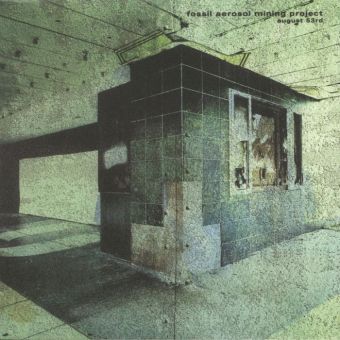 With origins dating as far back to the mid-80’s, Fossil Aerosol Mining Project seems to be a name I should have heard much earlier than now. Though the group was on hiatus for most of the 90’s, they have been working and releasing recordings since 2004, mainly utilizing found sounds, field recordings, and signal processing to create imaginative soundscapes. August 53rd is their most recent record, a seven track LP that represents one of the most detailed sonic constructions I’ve heard this year. The stuffy, lethargic atmosphere projects a pronounced solitude, the wistful tape loops and airy sound bits fleshing out a hauntingly beautiful environment that never stops closing in. Every element used is so enigmatic; no one sound is immediately identifiable or obvious, but everything seems to fall into place perfectly. The photograph featured on the cover could not have done a better job of representing the music contained within.
Review: Thomas Tilly – Codex Amphibia (Glistening Examples, Feb 22)
 On Codex Amphibia, Thomas Tilly lets the field recordings take the reins. Collected in Guiana in late 2016 as part of a field research project with the French National Center for Scientific Research, the mostly unprocessed selections paint vivid pictures of a lush natural environment. Leaves rustle, water bubbles, and the ribbits of the titular amphibians are just a few of the sonic elements that comprise the organically dense collages, and the masterful production ensures that everything is heard clearly. The digital version comes with a few photos that I assume were taken during the recording process, and it’s a testament to the album’s clarity that they’re almost exactly like what I was picturing in my mind while I was listening. It’s one of the most intensely immersive albums I’ve ever heard, with Tilly’s subtle additions in the form of sine waves and quiet drones keep anything from seeming too stagnant. Codex Amphibia is a truly awe-inspiring work, one that I’m sure will reveal more layers as time goes on.
Review: Erik Levander – Couesnon (Katuktu Collective, Jan 26)
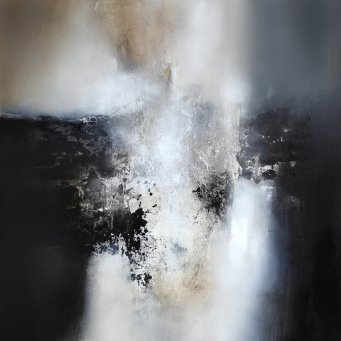 I bought Couesnon in a three tape bundle from Katuktu Collective’s Bandcamp for $12, which is probably among the best decisions I’ve ever made (free domestic shipping too! Only three left, get them while you can). Haven’t gotten a chance to listen to the other two tapes yet, but Couesnon honestly made the purchase worth it all on its own. Ambient musician Erik Levander creates achingly beautiful, noisy soundscapes that expand and contract effortlessly. Textural and melodic elements exist in perfect harmony, as equal a balance as the abrasive elements have with the gorgeous drones and ethereal ambiance. There’s more than enough diversity across the five tracks to warrant multiple listens, which I have definitely been taking to heart; I can’t seem to get enough of it.
Review: Vanessa Rossetto – Fashion Tape (No Rent Records, Feb 6)
 Despite the apparent transparency and directness of spoken word samples, music that makes use of them is usually anything but. It is often true that the combination of a multitude of snippets – that on their own would hardly be significant – results in creations that are cryptic, mysterious, and even disorienting. I hope I’m getting my point across, but if not, you need not look farther than Vanessa Rossetto’s Fashion Tape for an example. In contrast to last year’s Rocinante, an hour long piece completely absent of field recordings, the new tape largely consists of a wide variety of collected vocal samples; anywhere from whispered numerical calculations to the description of a certain color. The resulting diversity makes Fashion Tape‘s collages as colorful and fascinating as its bold cover art. When coupled with Rossetto’s well-tuned sense of dynamics, as well as an almost playful atmosphere, it makes the album something really unique. I feel like I will have to listen many more times to make sense of it all, so it’s a good thing that the package No Rent has put together is one of the best-looking tapes I’ve ever bought.
Review: Manja Ristić – Fairy & The River Teeth (Sonospace, Jan 31)
 Fairy & The River Teeth is Madrid label Sonospace‘s sixth release this year. It joins a multitude of other projects in various areas of electroacoustics, field recording, phonography, and soundscaping. Probably the most notable example of these is the nearly four-hour, multi-artist collection Soundmaps for the Dreamer II, which I will reviewing as well (once I finish listening to it, of course). But despite the wide variety of sounds and even instruments Ristić uses, Fairy & The River Teeth is an incredibly intimate album. It quickly sucks you into an unfamiliar world, one that I’m still not really sure is comforting or frightening. Many of the recordings, i.e. a teakettle squealing, a pencil scratching on paper, or the twittering of birds, seem to magnify everyday noises to the point where you become completely immersed. In this way, the record exerts a lot of control over the listener, but not in a malignant way. For example, on the title track, I found myself so lost in the collages of sound that I was almost moved to tears when hints of conventional melody began to break through; not because of the beauty of the melodies themselves, but because it actually felt like these notes were coming from within me – a very profound experience to be sure. What I’m getting at is that Fairy & The River Teeth is amazingly unique, and ultimately you’ll have to listen for yourself to determine its true nature (which is a course of action I highly recommend).
Review: Make a Change… Kill Yourself – IV (Cursed Records, Jan 15)
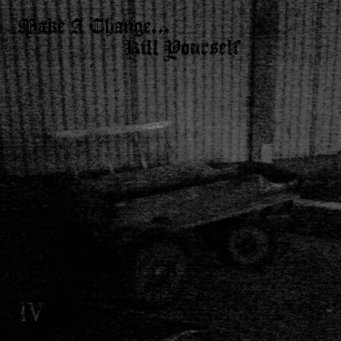 It’s not exactly a revolutionary idea that longer songs are better suited to certain contexts. An 8-minute long grindcore track would, in most cases, be exhausting and overextended, while a 30-second drone piece would probably feel stunted and unfulfilling. While long songs are not out of place in atmospheric black metal, when a band releases an album consisting only of two side-long tracks it’s usually pretty hit or miss whether or not their duration will be justified. And Make a Change… Kill Yourself’s new tape, IV, is definitely a “hit.” The movement and progression of both songs feel natural and organic, yet just composed enough to not come across as aimless. As the (in my opinion, overly melodramatic) band name would suggest, the atmosphere created on IV is depressive and dark. The guitar tones are simultaneously airy and claustrophobic, and the tortured vocals, despite being mostly unintelligible, communicate anger, hatred, and sadness. Surprisingly, these long form tracks are mostly carried by the drums, whose subtle changes retain interest without drawing too much attention to themselves. As you can probably tell, I went into my first listen of IV not really expecting to like it. But the band overcomes any pigeonholing as a meandering, whiny depressive suicidal black metal act, and reaches impressive heights.
Review: Junko Hiroshige & Pandu – A Collaboration (Gerpfast Kolektif, Feb 8)
In an effort to boost the relevance of my blog and give me more writing material (only one of those reasons is true, I’ll let you guess which), I’ve decided to start reviewing recently released albums. If you have any suggestions for records I should review, please comment on posts or send me an email!
 The aptly titled A Collaboration is a dual effort by vocalist Junko Hiroshige of legendary noise band Hijokaidan and Pandu of the more recent project Bergegas Mati. Having loved 2004’s Pinknoise, a collaboration between Junko and noisician/improviser Mattin, I was excited to find this album had a similar format: Junko’s shrill, yipping vocals set against waves of piercing noise. Despite consisting only of a 21-minute track, it’s easily the best harsh noise release I’ve encountered this year, and possibly one of the best I’ve ever heard. Pandu’s contributions are dense and infernal, with chunks of distortion and ear-splitting frequencies roiling and shifting like a demented sonic river. Surprisingly, the piece is anything but static; the dynamics are actually very pronounced, making the track seem even shorter than it actually is – a good thing in this case, because once I’m finished I just want to listen again. It’s always refreshing to hear really great stuff in this genre, especially when it offers the pairing of a personal favorite and a new face.
Thoughts: Jürg Frey’s Weites Land, Tiefe Zeit: Räume 1-8, or, The Difficulties of Listening to Lowercase Music on a College Campus
 In contrast to many traditional figures of classical music, Swiss composer Jürg Frey is not exactly known for loudness or grandiosity. And while many works by well-known composers aren’t exactly short, Frey’s pieces often dwarf them in scope – take, for example, last year’s archival release of L’âme est sans retenue I by Erstwhile Records; this composition stretches past the six hour mark. Weites Land, Tiefe Zeit: Räume 1-8 is shorter, but by no means brief. Originally created to accompany installations by the late artist Mauser from 2001 to 2002 (Olewnick), the album was released on 8xCD by b-boim in 2010. It consists of eight segments, each titled simply “Raum” plus the disc number, that were produced through heavily processed field recordings gathered by Frey himself. The processing results in the original sound sources becoming mostly unintelligible, instead blurring into ethereal, layered drones. If you haven’t heard the album, at this point it probably sounds like a pretty typical ambient construction. However, as is Frey’s tradition, the music is so quiet it is almost imperceptible at normal volume.
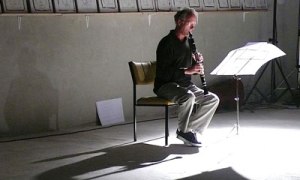 This use of low volume and occasionally complete silence to emphasize sound is a cornerstone of the philosophy of the Wandelweiser Group, of which Frey is a key member. The compositions created by Antoine Beuger, Radu Malfatti, Michael Pisaro, and others are often categorized as “lowercase,” a moniker that references their scaled down palette. Though I am no expert in many of these artists’ work, what I have heard has been both fascinating and gorgeous. However, the quiet and sparse nature of these recordings necessitates a very quiet listening environment, something not easily found on a bustling college campus. So Weites Land… has been, for lack of a better phrase, my “guinea pig album” for prospective listening environments, as I investigate various libraries and secluded areas around town to find the optimal space. And today I think I’ve found it; I was able to listen to “Raum 3” in the geology library’s almost complete silence, a favorable setting that allowed me to truly appreciate the subtle beauty that Frey has constructed. Music at such a quiet volume level requires a lot of focus, which causes a significantly increased perception of even the most minuscule dynamics and elements. In the future, if no one who works here objects to me spending hours upon hours at a time just sitting with headphones on, I’ll be able to experience a lot of cool stuff.

