
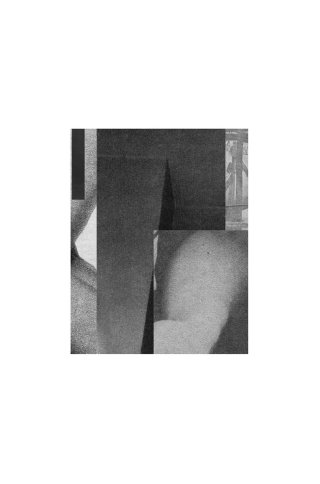
 Little is known—or even can be known—about the obscure Belgian project Ivory Trade, whose modest discography is allegedly concluded by this latest release on A R C H I V E. The familiar elements are still at play on Atlas, a “grief settlement in familiar surroundings”: the muffled, fuzzy, marred bits of woozy keyboard ambience and field recordings are as sullenly detached yet beautiful as ever, trapped in languid enclosures of tape hiss and distortion. Most of Ivory Trade’s releases feature covers that frame a simple design with a pronounced white border, a visual representation of the profound claustrophobia evoked by the presence of the music. But it’s not always an unpleasant sense of compression or imprisonment; the more sublime tracks often seem to begin to drift beyond their bounds, faint beams of warm light slowly breaking through a shell of shadow. Atlas, though all in all a quite minimal affair, runs the emotional gamut, touching on murky uncertainty with the title track, bewilderment and queasiness with “Feinting Around the Furniture Like Dog Handlers,” and soothing comfort on “Crystal Dogs”… and that’s all within the first ten minutes of the tape. As it progresses, the music begins to reveal more and more pieces of humanity, and by the end Atlas presents a wonderful summary of Ivory Trade’s work.
Category: Reviews
Brief summaries intended to describe and express my enjoyment of albums. My opinions are not the focus: I purely seek to facilitate discovery.
Review: Harae Nagoshi – 120-1380 (self-released, Jul 1)
 Translating concrète music to a live environment is difficult, but even more difficult is the task of creating a means for fluid improvisation. Geniuses like Jérôme Noetinger or Jason Lescalleet make it look easy, coaxing the most abstract textures from unconventional sources like their tape machines are extensions of their bodies. And even if a piece is entirely improvised, on a recording it may end up sounding very composed. What I’m trying to say that it is not an easy thing to make this sort of music come across as naturally conjured as, say, a solo improvisation using guitar or saxophone. On 120-1380, enigmatic Japanese sound artist Harae Nagoshi’s latest independent tape release, delicate crinkles, clicks, and cycles flow into existence with palpable spontaneity, framed with well-placed silence—especially in the piece’s sublime beginning—and manual manipulations that reveal the presence of an active participant. Nagoshi’s typical palette of diminutive, tactile timbres is presented in a new light, and near the halfway point of the track the sounds are embroiled in a fragile but undeniably kinetic state of unrest that feels much more unpredictable and immediate than the artist’s previous releases.
This review is based on the digital version.
Review: Yellow Eyes – Rare Field Ceiling (Gilead Media, Jun 28)
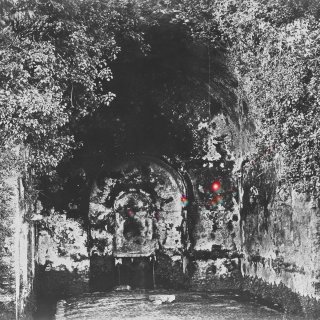 I still remember the first time I heard Sick With Bloom, Yellow Eyes’ 2015 atmospheric masterpiece. With lo-fi grit, a palpable love for nature that isn’t at all forced or cheesy, and constant, unbridled passion, it’s a crowning achievement of the stateside black metal scene. 2017’s Immersion Trench Reverie was a bit of a new direction for the band that I admittedly didn’t enjoy as much, the New York quartet experimenting with psychedelic elements and a new vocal direction, but the emotion and reverence is still there in spades. But even though it just came out, I’m inclined to say that Rare Field Ceiling might exceed the amazing heights of both of these great albums. The record shows the band soaring with a newfound freedom: every evocative, climbing tremolo riff, every hypnotic double bass pulse, every desperate shriek flows forth with spellbinding fervor, an undammed river of nocturnal beauty. I can barely even express how perfect the production is. The album is mixed so well but also shrouded in a slightly muffling, blanketing warmth that imbues the music with a consuming, meditative atmosphere, like it’s blasting from the yawning mouth of a forgotten cave. From the cathartic guitar ascensions of “No Dust” to the angular rhythmic interplay of the title track to the sublime, reserved closer “Maritime Flare,” Rare Field Ceiling is nothing short of magnificent, an enduring triumph.
Review: Sweet Dreams – Insane (Sputo, Jun 27)
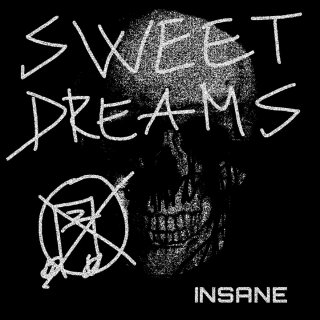 The term “noisecore” is a case-in-point for the futility of genre specificity. Sometimes it refers to the harsh, spastic, often comedic blast miniatures of bands like The Gerogerigegege or Nikudorei, other times I’ve seen it applied to more structured noisegrind releases, and people even try to tack it on to records with a raucous, abrasive brand of hardcore punk… not exactly a well-defined moniker. But what the hell else am I supposed to call something like Insane, a razor-sharp release that (allegedly) blazes through 22 tracks in less than six minutes, all distorted explosions of electronic blast beats, fractured shrieks, and waves of screeching, chunky noise. Like some of my favorite albums in this musical grey area—Sissy Spacek, Unyoga, The Hermeneutics of Fear of God, etc.—Insane uses the warped, blurred grind segments as elements in a twisted collage, constructing a nightmarish sound environment that draws its formidable presence from the unnerving blends of speeds, palettes, and genres. Despite the release having 22 tracks, it’s essentially a single Instruments Disorder-esque maelstrom full of noise in every form. If I had to argue, this is what “noisecore” should really be.
Review: Taiwan Housing Project – Sub-Language Trustees (ever/never, Jun 28)
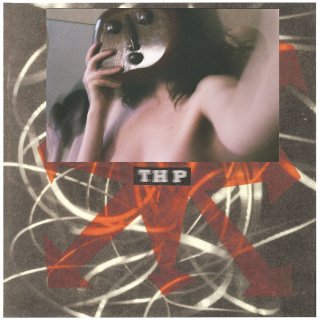 Taiwan Housing Project’s (hereafter THP) incendiary follow-up to 2017’s Veblen Death Mask is more intense, abrasive, and overwhelming than its predecessor in virtually every way. Sub-Language Trustees moves beyond the angular post-punk slithers but retains the raucous garage rock energy, losing a lot of its sanity in the process (a change for which I couldn’t be more grateful). It’s more in the vein of “Luminous Oblong Blur” from Veblen Death Mask, further exploring the stumbling, deconstructed rhythmic structures and grating, Pop Group-esque sax skronk. Kilynn Lunsford’s vocals are as mesmerizing and disconcerting as ever, and the renewed power granted to them by THP’s new stylistic formula is no better exhibited than on opening track “Charitable Fiend,” a nearly five-minute inferno of jagged noise rock carnage. How the band manages to loosen the ties of their music to this extent yet still bring it back together for infectious, propulsive moments like the coda of “Universal Size” is beyond me, but Sub-Language Trustees is so amazing because it makes very little sense. It’s dark, menacing, and completely disjointed at some points, head-bobbingly catchy at others, and the whole thing ends up as one of the most entertaining cases of musical whiplash you’ll hear this year.
Review: Connor C. Ellis – Improvisations with Various Objects, Gestures, and Weather Conditions (self-released, Jun 28)
 Improvisations with Various Objects, Gestures, and Weather Conditions is a wonderful title for sound artist Connor C. Ellis’s newest release, not only because of its inclusion of the Oxford comma or even because of how straightforwardly descriptive it is; the album’s humble heading, track names, and cover art are a nondescript argument for the power of unconventional sound sourcing. Yes, each track is just what its title states, an improvisation using the provided materials, but Ellis touches on truly breathtaking subliminity with his minimal approach, an enrapturing quality only enhanced by the album’s modesty. This direct relationship goes even further when the sounds that the listener hears are made more mysterious by their clearly elucidated source material. This is especially the case with “(water, gravity),” where a tactile soundscape materializes from percussive clicks that, to me, sound much more like a crackling campfire than falling water. Improvisations is one of those special works where singular simplicity is imbued with beauty and emotion via the ears and gestures of a creative artist.
Review: Jugendwerkhof – Dienstmord (Low Life High Volume, Jun 25)
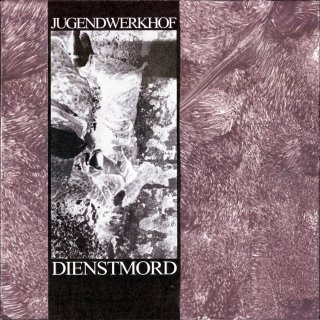 Dienstmord, Berlin duo Jugendwerkhof’s follow-up to their 2018 debut album Blutstätte, is the second installment in their (hopefully) ongoing series of crushing noise releases. There’s not a lot of information available regarding what exactly the artists use to create their music, but it’s all so loud and abrasive that deciphering the origins of each layer isn’t exactly crucial. Swirls of screeching feedback, crashing junk, vocals distorted beyond recognition, and god knows what else are the assaulting elements that make up the three tracks, each an unrelenting 11-minute industrial nightmare. The first part wraps its crushing tendrils around you like an ersatz animatronic anaconda, all overlapping waves of squall and racket crashing in one after the other. The second takes a bit more time to get going, starting things off with a minimal drone and largely unaffected metal clatter before escalating into a flood of cracking electronics that bleeds into the painful discord of part three. A simple summary doesn’t really do Dienstmord justice, though; like most great harsh noise records it’s all about the viscerality of the experience, and there’s no shortage of that here.
Review: Left.Bank – Zentrum Statisch (KOI8-R, Jun 23)
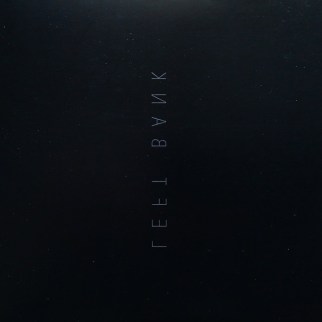 Many things about Zentrum Statisch led me to believe it would be a work produced using pure data processing: the flat, minimal cover design, the seemingly random sequences of letters and numbers found throughout the album page, the bizarre URL for Left.Bank’s website (lllbnk.x-xx—x.info/)… But the unnamed artist’s “free-form computer-based improvisations” are not at all entirely detached from reality. Spastic, unpredictable, and kinetic, the four tracks do harness many a mangled glitch cluster or grating, error message-esque blast, yet organics play a significant role as well. “reqnee,” despite its disorienting, artificial first moments, soon introduces what sounds like a processed field recording of cricket-filled night air, squashed between the much less familiar curls of pulsating electronics. As the album progresses, it becomes even more difficult to distinguish between sound sources, and Left.Bank’s sonic repertoire approaches that fascinating dimension where heavily manipulated sounds begin to mimic the very reality from which the original material was yanked. Restless digital tendrils evoke watery slaps and squashes, buzzing electrical dins muffle distorted animal-like roars… it all just makes this wonderful album that much more immersive.
Review: Owen Davis – Interference (Lurker Bias, Jun 21)
 My dishwasher currently has a strange ailment: it doesn’t seem to be malfunctioning in any way other than it now produces a mid-range tonal hum. Despite this sound being completely unintentional, it still introduces an undeniable hint of foreboding into my home, and blends well with the ominous washes of grating electronics and virtuosic percussion improvisations conjured by Owen Davis on Interference. I begin my writing with this unusual observation because of how important the relationship between concrete physicality and detached injections is to Davis’s newest release; as Nick Meryhew writes regarding the “Slime Fence” suite, “the boundary between drums and electronics becomes profoundly blurred; the assemblage seems to briefly coalesce.” Purely based off opening track “Crinkly,” where a seething electric cacophony is disrupted by the entry of a furious snare roll in the right channel, one might think that Interference is a People Pleaser-esque collage of free drumming and unruly electronics, but Davis is more concerned with treading and mapping the no-man’s land in between the two elements, switching their places on “Slime Fence II” or even simulating one with the other on “Insistent.” I hesitate to compare this well-crafted work to my sub-par home appliance, but it does tap into the same uneasiness that arises when defined sonic roles are disrupted, when the line that separates two distinct sound sources becomes “profoundly blurred.”
Review: Fissures – Morphosis (self-released, Jun 21)
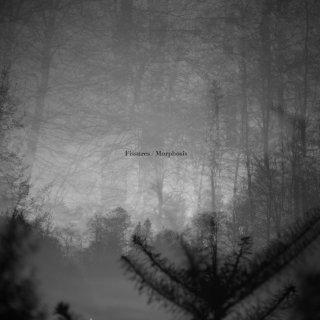 Belgian sound artist Ludovic Medery (who often uses the alias Fissures) has had a very impressive year so far in terms of output. Right at the beginning of 2019 he released Rituels (reviewed here), a spectacular half-hour piece drawing largely from swampy, aquatic sound sources. In March the ambitious Les Voix du Matin was presented, a series of improvised and concrète miniatures that soundtracked voice samples. After Benvenuti in April, which I have yet to here, we have the arrival of Morphosis, perhaps Medery’s most developed release so far this year. Comprised of 11 untitled tracks, most of which are under five minutes, the anatomy of Morphosis is one of scrabbling objects and mechanical electronic manipulations juxtaposed against more organic environmental recordings. Fittingly, the album is preoccupied with changes of state, and it’s often the case that the synthetic elements slowly start to sound more natural, and vice versa. This is especially apparent on the ninth track, where closely recorded thuds and muffled clatters initially sound bizarrely out of place in the presence of rustling leaves and birdsong; but as the piece progresses, the nature sounds begin to dissociate into something much more spectral, and the claustrophobic electroacoustics ends up resembling the soothing sounds of bending, creaking tree trunks. To listen to Morphosis is to venture into a sound-world where the dichotomy of natural and artificial is hardly as defined as you might expect.

