
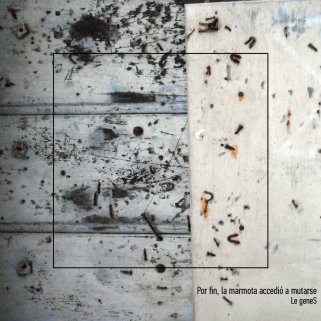
 Though Por Fin, la Marmota Accedió a Mutarse was created through the collective trio improvisations of Jose María Pastor, David Ramos, and J.G. Entonado, a combination that already allows for unhindered spontaneity and musical freedom, the album somehow feels even more flexible than simply the freeform conversations of three musicians. “Estrella del Pop” establishes this feeling of limitlessness right away; an industrial-strength drone like the whir of some giant metal fan tears into existence, yet its strength is tempered by unpredictable pauses and a playful coda departure, whose suddenness signifies that no element is sacred. Using a veritable arsenal of modified instruments, custom-built devices, and their own bodies, Le geneS embarks on a tottering stumble through the endless possibilities of the musicians’ sonic chemistry, the results ranging from the whimsical call-and-response flutters that one might expect from a trio affair to the nightmarish vocal experiments of “El Cura de Mi Parroquia Es Ciego” and decaying, ersatz electronics of the nine minute epic “El Lenguaje Estrujado del Embalaje Deshecho.” Eclectic as it is, Por Fin… keeps itself from falling apart with the ever-present drum work of Pastor, who maintains a distinct style while always interacting with the various absurdities thrown his way.
Category: Reviews
Brief summaries intended to describe and express my enjoyment of albums. My opinions are not the focus: I purely seek to facilitate discovery.
Review: Chaver – Transference (Lower Class Kids, May 24)
 I wouldn’t describe Transference as metallic just because of its chugging thrash-worship grooves and raw, vicious attitude, but also because the instruments themselves actually sound like they’re made of metal, all sharp junkyard edges and scraping rust as these ten concise tracks tear across the landscape. German trio Chaver’s sound draws from a variety of sources and influences, but at its heart are the rolling bass throbs and crash hits that are the backbone of tracks like “Ultimate Abuse”; this album is all about the breakdowns. The way the band builds anticipation for these cathartic blasts of chugging rhythm is varied and unpredictable. “Disinclined,” whose first half is a fast, fiery d-beat gallop, falls after a brief respite into a deliberate, halftime lead-in groove that provides a perfect link to the slower-paced thuds that conclude the track; “A Tool” draws its magnetism from metronomic, almost rap-like vocal delivery; and the headbanging unison hits of “Efficiency” require no further elucidation. Aside from the repose offered by “Feckless,” a small interlude between the album’s two halves, Transference is a nonstop barrage of punishing hardcore, and though the definite highlights are the slamming breakdowns there isn’t a single wasted moment.
Transference was originally released as an LP by Injustice Records earlier this year.
Review: Moon RA – Promenade Magnétique (Czaszka, May 29)
 Promenade Magnétique is true computer music, every bit a “magnetic walk” through the annals of the software plugins and hardware used by Marie e le Rose to create these six short sound pieces. A faithful yet original homage to classic concrète music, Rose’s “field recordings of artificial landscapes” take on abstract physical forms in their impossible movements and synthetic contortions, almost completely isolated from any pure source material used. Each track is chock-full of detailed progression, never really following any sort of predictable linearity but instead exploring the possibilities of this unfettered magnetic landscape in increasingly complex ways. Rose’s manipulations are restless and kinetic, the tension barely contained even in the most reserved moments like the unstable drone that threatens to burst at any moment at the start of “D,” digital clicks and taps and oscillations expanding into shifting weaves of plasticky sonorities. As is common—yet never any less surprising—in even the most removed of electroacoustic compositions, the artificial soundscapes begin to evoke real-life phenomena in the mind of the listener: “A” adopts the tubular configuration of air flowing through a pipe, “C” mimics the bubbling motion of boiling liquid, “2” vibrates like an agitated metal surface. Despite the modest rules Rose gave herself to create this work, Promenade Magnétique is a formidable and far-ranging work of abstract electronic music.
Review: Matthew Atkins & Adam Kinsey – Lowercase (Minimal Resource Manipulation, May 22)
First, I want to thank anyone who sends me physical items for review. It’s already amazing to receive digital copies for consideration, but the fact that my writing warrants people wanting to pay to ship stuff to me is extremely humbling. I greatly appreciate it.
 Lowercase documents a collaboration between British sound artists Matthew Atkins and Adam Kinsey, both of whom are quite active in London’s experimental music and improvisational community. The name of the CD evokes common traits of the titular genre, which often features an emphasis on silence and purposefully sparse composing, but the vivid constructions conjured by Atkins and Kinsey don’t feel restricted by any such constraints. The colorful two thirds of an hour of Lowercase bubble and boil through evolving mixtures of tactile object interplay, fragile granular textures, and field recordings coated in varying amounts of manipulation. The release situates itself in a sound-world that is consistently calming and always a bit familiar, but the two artists never neglect to push this envelope of comfort closer and closer to the breaking point, bending and twisting and stretching the elements they introduce into increasingly elusive configurations. The ever-present balance of the tangible and the detachedly synthetic, the distorted tape groans that conclude part one, the immersive but almost uncomfortably intimate stereo space… it all materializes into an abstract musical language that never quite lays all its cards on the table.
Review: Private Anarchy – Central Planning (Round Bale Recordings, May 31)
 Lately, it’s rare that I get to listen to something the exact day it comes out (starting up full-time work again is kicking my privileged ass). It’s even rarer that I sit down to review something on its release date. As you can see, such an occurrence would necessitate a very special case—which is exactly what Private Anarchy’s new album Central Planning is. Private Anarchy is the moniker Clay Kolbinger uses for his one-man art punk project, which began with a small run of self-titled tapes—also on Round Bale—back in 2015, and provides an outlet for the idiosyncratic artist’s penchant for sardonic, rambling lyrics that reach new levels of deadpan and off-kilter instrumentals that are somehow tense and taut while also never seeming to be perfectly in sync. Kolbinger’s various endeavors all worm their way into my dearest musical preferences at varying locations, with Termite Acropolis providing some of my favorite wobbly DIY tape music, Maths Balance Volumes staking out a space in my most beloved outsider experimenters, and Davenport always transmitting the most beautiful of deconstructed folk music; Private Anarchy is no different, and on Central Planning even more so than the debut tape the music becomes truly enrapturing. The new record feels more developed and fully-formed, but still sounds appealingly scuzzy and stitched together, and there’s a bit more optimism to the oddball imagery and bone-dry sarcasm that Kolbinger mutters over his stumbling post-punk contraptions. This isn’t to say it’s any more accessible, however… even the shortest songs like “H.A.” and “The Catalog of Fire” explore bizarre textural worlds through their disorienting guitar interplay, and “Accumulation,” essentially an abstract tape piece whose only rhythmic consistency comes from the looping guitar strums, is PA’s strangest track yet. Private Anarchy’s ability to keep you constantly both bobbing and scratching your head is unmatched.
Review: Impermanence – Purgatory Flows (Perpetual Abjection, May 27)
 Despite Bangkok artist Visarute Virojanawat’s solo moniker being Impermanence, the walls he crafts are often quite tangible and even enduring, leaving behind fragments and disturbances in their formidable wake. By this I mean you can feel the forward motion of his stagnant sonic creations (paradoxical, I know), and especially on Purgatory Flows there’s a sense of weight, of gravity, of presence, that evokes the possibility of a lasting impact. “Underflow” is reserved and meditative, but also imbued with plenty of physicality, molded with grumbling crackles and a restless, kinetic clatter that provides much of the aforementioned illusion of motion. As the track progresses, this latter element almost seems to grow more prominent, its volatile textural monopolizing the sound space. This is a good lead-in to “Overflow,” which blasts into existence with a brash yet spacially contained roil of crunching noise. The track shares its predecessor’s sense of movement, but the two differ in their posture: where “Underflow” was quiet and reticent yet concealed a physical force, “Overflow” hides its insubstantiality behind a heavy curtain of distortion.
Review: Manja Ristić – The Black Isle (Flag Day Recordings, May 24)
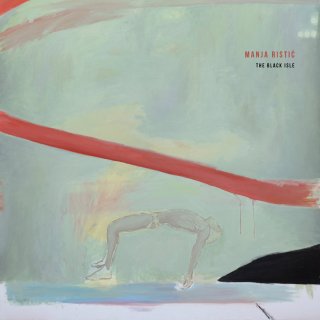 Artists working in the areas of field recording and electroacoustic composition will often describe certain actions taken to produce their music as “interventions,” a somewhat abstract term whose definition is not always easy to uncover. In Manja Ristić’s work, however, her interventions are at the forefront of the sounds at play, and I love it so much because the relationship between observer and environment is always given due representation (not an easy task, in my opinion). The Black Isle cements itself in physical locations, but the auxiliary sonic additions never cease to influence or directly interact with them; Ristić’s careful violin scrapes introduce tension to bubbling hydrophone recordings and whimsical birdsong, heavy footsteps crunch leaves, quiet orchestral samples unseat the natural atmosphere and cast eerie, spectral shadows over the proceedings. There’s even moments in “Black Forest” where what I think is the click of a camera shutter occasionally crops up, providing even more of the strong, established human presence that is often shied away from in this sort of thing. The Black Isle, true to its ominous title, is some of the darkest material I’ve heard from Ristić, her focus on the aforementioned duality of observation and action casting everything into an uneasy, uncanny realm of whispers and rustles and uncertainty.
Review: Pourbon – Pourbon (Mevzu, May 23)
 Pourbon’s self-titled debut release hovers around the oppressive, nocturnal gloom of their guitar tones, which, unlike many chaotic hardcore bands, are muffled and sludgy rather than crunching and jagged. Opening track “Entreé” delivers pretty much the exact opposite of the promise its title implies, because the solitary guitar meanderings leave you starving and raving for more by the end. Thankfully, Pourbon delivers, and the remainder of the album embarks into the punishing combination of pounding, low-end heavy drums; vocals that jump between disconcerting growls, anger-filled screams, and desperate spoken interludes; and, as mentioned previously, the pervasive darkness that seeps from every strike of the guitar strings. There’s plenty of thudding rhythms and high-pitched screeches, but Pourbon doesn’t shy away from adopting a more eclectic palette, and many of the driving blast beat sections are accompanied by tremolo guitar and howled vocals and approach something not at all far from black metal. Clocking in at around twenty minutes, the first proclamation from Pourbon provides a satisfying range of hardcore chaos, from the suffocating brilliance of the “Regular Sheikh” trilogy to the filthy groove of “Lector System Failure.”
Review: Jo – Bumblebee (self-released, May 11)
 The story behind Jo’s debut album Bumblebee is one that’s been experienced, in infinitely varied iterations and circumstances, by any practicer of phonography, found-sound composition, or concrète music. The artist traveled to Iceland and captured countless recordings to be examined later, a process they describe as “discovering [their] own musical terrain.” Bumblebee is a brief but dense exploration into the adapting, processing, and combining of recorded sounds into something completely new, the eclectic array of snippets and vignettes assembled with the help of Jo’s unique, indiscriminate ear for natural melody. The provision of the identities of the elements used is helpful, because although there’s very little effects or alterations used on each, the abstract, sculptural manner in which they are put together clouds the original sources. Consistent with the principles of musique concrète, composition is the final step in Jo’s process, which results in musical products that distance themselves from any individual sound; but the inclusion of these clear identifications of their sonic repertoire establishes an interesting connection between listening and assemblage, emphasizing the importance of each auditory event among the others with which they share space. Jo’s songs often approach something otherworldly and alien in their abstractness, venturing into almost synthetic sounding restless pulses on “Wayfare the Broondocks” or disarming marriages of electronic and natural noises on “I Have Done”; but occasionally the only thing removing the final result from its source is the musicality that is coaxed from the most unlikely of materials, such as the cascading scales played on a bridge pillar in “Gewgaw.”
Review: Stephen Cornford – Constant Linear Velocity (Consumer Waste, April)
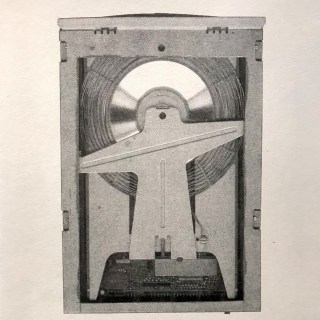 This is another release that took me a while to both get my hands on and fully process (pun intended). Constant Linear Velocity is a recording of British sound artist Stephen Cornford’s ambitious installation of the same name, which has since been lost in transit. In line with the defiance of waste permanence that is central to Consumer Waste’s philosophy as a label, the sculpture consisted of hundreds of repurposed computer shells and DVD drives, constantly being rearranged into new iterations for each presentation. At play in the work’s sonic profile are the distinctive hums, clicks, buzzes, crackles, and glitches of an intimate digital landscape, the sounds of the mechanisms once hidden behind the functions they were designed to perform now fully deconstructed and brought to the forefront. In the booklet included with the CD, Danae Stefanou identifies Constant Linear Velocity as a formidable entity, both in its physical and auditory forms: “Its sounds denoted another, more fragile and transient layer of presence. This assemblage of disused equipment emitted a complex and unsettling pulsation: long stretches of stillness interrupted by moments of increasingly erratic density. CD trays sticking out and quietly retreating; like exhausted mechanical tongues, in anticipation of an ever-suspended finish line.” On their own, the sounds of the installation are fascinating and immersive; when thought of in relation to their tangible source, they become a hulking testament to the endless mountains of electronic waste that we are producing every day, a forgotten byproduct of humanity that is anything but silent.

