
 Oakland DIY duo Breeze truly put the “no” in “no wave.” Their irreverent brand of anything-goes improvisation isn’t entirely indebted to the archetypal no wave sound, but more often than not Jackson Blumgart and Max Nordile find themselves falling into the lumbering, not-quite-in-time grooves, nonsense vocalizations, and razor-sharp guitar skronk that we all know and love. I first encountered the band through their short digital-only release The Guilty Baby, which luckily was not that long ago so I didn’t have too much time to wait for new music. Of the two releases with which Breeze graced us on November 26th, Toad Crossing is definitely noisier and harsher, frequently delving into straight-up terrifying territory as the two friends summon unholy frenzies of punishing synth noise, piercing saxophone wails, ear-splitting feedback, and completely unintelligible ranting and raving. This 26-minute release is greatly helped by its high volume and substantial dynamic range, both of which imbue the music with a sense of dangerous instantaneity. Hulking cacophonies of rusted metal and studio detritus threaten to collapse at any moment, and any brief respite from the madness is unceremoniously pulled away on the most fleeting of whims.
Category: Reviews
Brief summaries intended to describe and express my enjoyment of albums. My opinions are not the focus: I purely seek to facilitate discovery.
Review: Deathbird/Budman – Fruits from Saturn (Cadmus Tape, Nov 22)
 It’s not uncommon for bands who have crafted a unique or eclectic style, or even labels that cultivate a singular aesthetic, to carve out a “personal genre” for themselves (R.I.P. David Markson) with some crazy name. Some personal favorites of mine are “vapor punk,” “fog electronics,” and “shitgaze.” Self-classification, however, is notoriously unreliable, and many of these artists’ music ends up failing to meet the expectations that such creative titles evoke. I thought for sure this would be the case with the “death Appalachia” that allegedly graces Fruits from Saturn, the new collaborative tape from Deathbird Stories and Vadim Budman; there’s no way anything could sound that cool. As you can probably guess, I was dead wrong. The pairing of these two musicians spans the quite large expanse of ocean that separates the U.K. from Canada, a geographic scope that is somehow matched by the formidable racket the duo conjures. “Gone to Croatoan,” perhaps fittingly named for the word found carved into a tree after the mysterious disappearance of the island colony of Roanoke, is among the tape’s shortest tracks, but doesn’t waste any time whipping up a howling storm of distorted guitar gunk. Whether Deathbird and Budman are getting right to the point on “Gone to Croatoan” and “Moons of Gomrath” or constructing massive sprawls of harrowing, dissonant atmospherics on “The Word for World is Forest” and “Tindalos,” their ability to swirl various sound sources into gargantuan drones that rival the apocalyptic meditations of Daughter of Darkness is pretty astounding. The length may intimidate some of you, but personally I hadn’t even looked to see how long Fruits from Saturn actually was until about two-thirds of the way through and was baffled to see how quickly the time passed. I assure you, listening to this hefty slab of true “death Appalachia” will be eighty minutes well spent.
Review: Chow Mwng – Dis-Ordnance (Recordiau Dukes, Nov 18)
 Most questions along the lines of “what’s the best ______ ever?” are pretty damn difficult to answer. But when someone asks me who I think is the best guitarist of all time, my response is an absolute no-brainer: Derek Bailey. No other practitioner of that classic instrument has seamlessly combined sublimity, technical skill, and uncompromising originality with such aplomb in a staggering variety of contexts. Across enrapturing solo performances (Aida, Standards), unconventional experiments (String Theory, Music and Dance), mind-blowing collaborations (live album with Han Bennink, Mirakle with Jamaaladeen Tacuma and Calvin Weston), and even more conventional ventures like Arcana’s Arc of the Testimony, Bailey created an impossibly idiomatic musical language, the impact and legacy of which reverberate long past the musician’s death in 2005. On Dis-Ordnance, Welsh artist Ash Cooke (also known as Chow Mwng) pays homage to every avant-garde guitarist’s hero with a style he calls “Gwrth-gitâr,” which translates to “anti-guitar” in Cooke’s native language. For Cooke, “Gwrth-gitâr is free playing in the sense that anything goes. It does not explicitly reject standard Western tuning, melody or harmony, but it does reject the need for such things. It seeks to explore new ways of using a traditional and universally familiar object to paint an alternative view of the world. It is unrehearsed and leaves as much to chance as it does to the ability of the operator. It has no interest in being reproducible.” In the case of Dis-Ordnance, Cooke seeks to paint more than just an alternative view of the world; he grounds the five elusive improvisations that comprise the album in specific locations around the mountains of North Wales, using found objects to coax unfamiliar timbres from his acoustic guitar and fragments of more traditional playing to retain an element of conventional harmony amidst the abstract explorations. The recordings are focused on the assaulting sounds of the guitar, but snatches of the surrounding environment often sneak in, and can be viewed as either auxiliary elements of the improvisations or as their sources of inspiration. Dis-Ordnance is simultaneously familiar and alien, personal and primordial, intimate and grandiose—a series of paradoxes made possible by the all-encompassing ideology of Gwrth-gitâr.
Review: Sugar Pills Bone – Lumb (Orb Tapes, Nov 18)
 Looking at the credited musicians for Lumb (Boney Dog Davis and Sleepy Sugar Thompkins) and the absurd list of instruments, which includes anything from “possum fiddle” and “git’r” to “tall tales” and “crunch and twinge,” it’s just as hard to discern what’s actually real as it is in the music itself. Do any parts of those aliases come from the artists’ real names? Is there really audible use of a “hobo sack” in any of these recordings (because yes, it’s entirely possible, if a hobo sack is what I think it is)? Where exactly do the “gravy samples” stop and the actual musicianship—a term used quite loosely here—begin? But the answer I, and you, should give to these questions is who cares? The newest tape from the enigmatic Sugar Pills Bone project is about as intellectual an affair as you make it to be, but by the time you come across the… gratuitous “Without Me” sample on “Greasy Piece E” I’d venture that you won’t want to lean too heavily into some astute critical analysis. Like Proud Trash Sound, an album with which Lumb shares some notable qualities, the primary goal here is fun, and it’s not hard to have it as you submerge yourself in these jittery junk piles of frantic bluegrass blasphemy, startling noise blasts, disorienting tape-sample tendrils, hilariously recognizable snatches of pop songs and who the hell knows what else. I implore you not to just take my word for the astonishing heights of absurdity this thing reaches; at the very least just listen to “Cain’t Deny My Wormhole, Buckaroo.” It’s always great when you enjoy music because it cracks you up—something that’s very hard to pull off. If I end up grabbing this tape it’ll go with Horse Cock Phepner in the “Jack just needs a good laugh” pile.
Review: Berthelot – Miniatures Héliotropiques (self-released, Nov 18)
 Here on Noise Not Music I spend a great deal of time chronicling the presence and development of musique concrète techniques in contemporary experimental music, and I’d be lying if I said I didn’t largely prefer these modern usages to the work of more classically influenced early pioneers such as Luc Ferrari, François Bayle, and Pierre Schaeffer (who himself coined the term and practice of “musique concrète”). But something that I must admit is frequently lost in the rugged DIY experimentalism of newer artists is the sense of theatricality and often filmic narrative that’s so powerfully evoked through the use of orchestral samples, speech snippets, and other fragments of more conventional art filtered through magnetic tape manipulation. However, there are also countless composers and musicians out there who pay homage to that distinct era and the specific milieus the music occupied, from the digestible throwback sound of Fletcher Pratt’s Rituals for Magnetic Tape Vol. 1 to the warbly nostalgia and pseudo-classical movements of sound-smiths like kNN (Renato Grieco) and Marc Baron. Berthelot is not a name I’ve heard before, but his newest album Miniatures Héliotropiques certainly cements its place in this esoteric canon. The digital-only release collects 22 individual miniature pieces in a vignette style that reminds me of Pierre Henry’s pioneering 1967 LP Variations pour une Porte et un Soupir, though that album’s minimal palette of creaking doors and clattering clutter (its title does translate to “Variations for a Door and a Sigh,” after all) can’t hold a candle to the wide variety of sound sources and lush interweaves Berthelot utilizes here. It was the opening track, “Contracture de prolégomènes,” that first turned my mind to classic concrète, with its reverb-saturated kinetics and symphony snatches, but Berthelot makes good on his promise that each piece “tells its own story” and ventures into some very unique—and, occasionally, recognizably modern—territory. There’s head-bobbing rhythmic electronica on “La marche à suivre était trop haute,” synthesized cacophony on “Brume organique” and “Bricoles de ville,” and pulsing alien transmissions on “Ribambelle de mouches.” The density of this album is a bit overwhelming, and it’s definitely going to take me a while to really decipher the strange energies that manifest in each diminutive composition.
Review: Naga – Void Cult Rising (Spikerot, Nov 15)
 Though black and doom metal both can greatly benefit from compositions that are quite freeform in nature—swirling, repetitive storms of smothering darkness (see Yodh, Antelux)—they can also, like most musical styles, be bolstered by some excellent, concise songwriting. I don’t use “concise” here in the way I typically do to refer to the lengthy atmospheric excursions spread across Naga’s third studio album Void Cult Rising. These are not condensed microcosms of horror and violence; the six tracks take up plenty of space with their massive, elephantine grooves, building anticipation both within the riffs themselves by alternating low and high chords and over the course of the song via some excellent dynamic control. I call them “concise,” however, because nothing feels longer than it needs to be. The grimly titled opener “Only a God Can’t Save Us” is in the upper percentile of tracks in terms of length but comes across as an expertly paced tone-setter, and the full breadth of Naga’s structural prowess is demonstrated on “Melete” where a plodding jam falls into quiet repose before culminating in a spectacularly crushing climax. Though the lumbering, deliberate pace is maintained throughout, even when desperate blast beats claw their way through the murk, an abundance of rhythmic variation and frequent appearance of psychedelic elements make Void Cult Rising a gripping and engaging entry in the 2019 metal canon.
Review: Elettronica Ultras – Opposta Fazione (Ominous Recordings, Nov 15)
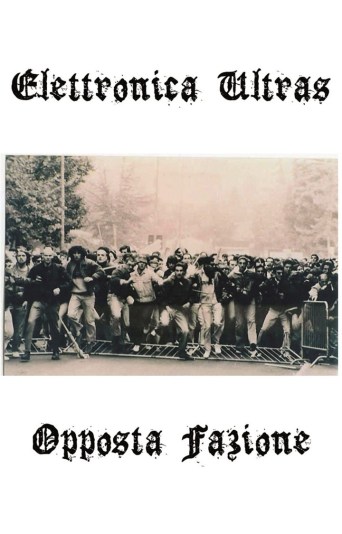 Of all the strange music I cover on this site, people I know both in person and online seem to be the most intrigued, or occasionally baffled, by my interest in wall noise. Why this is the case is obvious: they are confused and perturbed by the idea of music that is intended to not only be harsh (in the traditional sense at least) but also largely the same throughout its duration. I default to an explanation I’ve probably brought up a dozen times here, where I compare a wall track to an abstract visual art piece that never physically changes yet nonetheless yields greater depth and emotional resonance the longer it is looked at. But there’s another dimension to wall noise that this analogy doesn’t accommodate: though there’s nothing preventing listeners from prematurely ending their observance of a particular track, but there is certainly significance in the fact that the artist chooses a specific time frame for the consumption of their creation. Thus, the duration of a wall is as much an quality to be considered as what it actually sounds like.
A release as visceral as Elettronica Ultras’ Opposta Fazione doesn’t necessarily require such a pedantic preamble, but the acknowledgment of the importance of length allows me to articulate part of the reason I enjoy this tape so much: it’s short. The new artist, whose only other release (that I can find) is last April’s Oltre Tutto e Tutti CDr, presents two slabs of raucous, smoldering harsh noise across the C13, and true to such brevity the sound is intense and punishing. Restricting these incendiary blasts of crunch and crackle to six and a half minutes each not only makes them digestible but also imbues the music itself with a powerful immediacy, a quality that makes Opposta Fazione stand out from other harsh releases that place more emphasis on the extended reverie that such deafening stagnancy can induce.
Review: Red Wine and Sugar – Lake / Wildflower (Thalamos, Nov 15)

When it comes to speech-related elements in music, it’s almost easier, or at least less daunting to work with the nonsense ranting, abstract utterance, and rhythmic repetition of sound poetry or text-sound rather than straightforward spoken word. As listeners we’re trained to resist transparency; nothing grates at the ear more than painfully unsubtle lyrics or any other elements that are too direct to be at all effective. Mark Groves’ murky mutterings that comprise much of his contributions to Red Wine and Sugar (which also features sound artist Samaan Fieck) are lucid and intelligible, but it’s less about what he’s saying than the things his words evoke, the way they sound within the soundscapes the duo craft, the deliberate pacing and placement of certain statements. Lake / Wildflower doesn’t even reach 20 minutes but its presence is one of spindly, spidery sprawl, sketching out strange and surreal environments through the use of woozy electronics, sparse recordings, and the pregnant spaces between Groves’ ramblings. The atmosphere that seeps into both pieces is dark and uncertain, but it doesn’t draw from the moth-eaten scuzz of Lindus or the hiss-filled suspense of Letters to Friends of the Late Darcy O’Meara, instead occupying a space much more cold and synthetic. The subversive proceedings aren’t without warmth, however; it just requires a bit of digging to find it. I’d suggest starting your search amidst the ringing negative space near the halfway point of “Lake” or the tactile ennui that rustles itself into existence once “Wildflower” begins—both instances are moments that seem grey and sterile at first, but focus on them long enough and small slivers of light shine through.
“Should I have just kept my mouth shut? The ambiguity is… distressing.”
Review: Daphne X – To Be Brave (Sono Space, Nov 11)
 Barcelona-based sound artist Daphne Xanthopoulou finds beauty not only in the mundane sounds of our everyday lives, footsteps and chimes and ringing telephones captured with wildly varying fidelity, but also in the intense, noisy glitch-scapes she coaxes from extensive processing of those recordings, presenting two dimensions of reality simultaneously—though moments on To Be Brave that feel like “reality” are quite sparse. Unlike September’s Jaguar 100%, the heavily altered auditory acrobatics of Xanthopoulou’s text-sound ranting is at least not perceptible on this new release, and instead the buzzing digital abstractions are woven throughout ennui-vignettes, the two often coexisting as on “New Moon” where the alien pulses of the former lurk beneath the meditative object percussion of the latter or on the blasting opener “Warm Milk” for which the opposite is the case. This coexistence occurs with differing amounts of unease, often undergoing a drastic change within a single track, as is the case with both of the aforementioned tracks; “Warm Milk” evolves from harsh to hypnotic, “New Moon” from soothing to sinister (the wet smacking noises used near the end really could be some heavily processed mouth sounds, I honestly have no idea). The stretch of cryptically numbered miniatures in the second half of the album, preceded by the equally diminutive title track, embark into deeply physical sound-object arrangements that further blur the divide between the thumps and bumps of reality and the electrical storm hanging above. I’d be lying if I said To Be Brave wasn’t intense, but it’s so concise and well put-together that the more discordant elements are digestible. Even if it doesn’t sound like your thing, you should try it; this is a very special and exciting new album.
Review: Medhane – Own Pace (self-released, Nov 12)
 Own Pace is not only New York MC Medhane Olushola’s first LP since 2017’s Poorboy, the only album (so far) from his collaborative project Medslaus with producer Slauson Malone; it’s his first full-length solo release, following on the heels of the self-released EPs DO FOR SELF (2017) and Ba Suba, Ak Jamm (2018). Like many of his fellow NYC undergrounders—MIKE, Pink Siifu, Standing on the Corner, Adé Hakim, Mavi—Olushola proves his miraculous ability to deliver a universally accessible hip-hop album that utilizes the wordless ad-libs, adventurous sampling techniques, and lushly nostalgic atmosphere that make this developing style so unique. Own Pace is clearly a very special project for Olushola; he “went thru the most” while making it, a level of personal involvement that seeps from every emotion-soaked second. The young rapper’s lyricism is at a new height here, especially on “Stranger,” which like “The Mint” on Some Rap Songs is made one of the album’s strongest tracks by a great feature from Navy Blue (as well as impressive production from the mysterious AFB). Over shuffling percussion slivers and a smooth melodic sample Olushula admits “faith been a stranger to me / it ain’t strange when I bleed / wasn’t able to see / the other side where it’s greener / over the fence that’s between us / hope is what I need but the sun don’t shine every day,” a simple yet evocative series of lines whose carefully constructed inner rhyme schemes make them nothing short of magnetic. Unsurprisingly, it’s not the only moment of introspection on Own Pace, an album that as a whole is heavily steeped in solitude, memory, and internal conflict, but it’s one of many examples of how Olushula conveys even the barest confessions with remarkable charisma.

